Our readers keep the lights on and my smoothie glass nicely filled. As an Amazon Associate, I earn from qualifying purchases.
Foam board is a notoriously tricky surface—too much solvent in the wrong glue melts it into a craterscape before you can blink, while weak formulas let your project sag apart within hours. Choosing an adhesive that penetrates the board without dissolving it is the single make-or-break decision for builders, modelers, and DIY installers.
I’m Mohammad Maruf — the founder and writer behind WellFizz. After analyzing hundreds of adhesive spec sheets and real-world user reports across foam types from EPS to EPP to DEPRON, I’ve zeroed in on the formulas that deliver a safe, permanent hold without chemical burns or de-lamination.
This guide breaks down the five highest-performing options available now, giving you the exact criteria to match an adhesive to your specific foam project. Use this to find the best adhesive for foam board whether you are working on RC planes, home insulation, crafts, or sign mounting.
How To Choose The Best Adhesive For Foam Board
Foam is not wood or plastic—it has an internal cell structure that solvents can collapse instantly. The wrong adhesive leaves pits, melted channels, or brittle joints that snap under light load. Here are the three core factors to weigh before you buy.
Foam Safety Index
Check the label for “foam safe” or “polystyrene safe.” Solvent-heavy formulas (toluene, acetone, xylene) eat through EPS and XPS foam like acid. Water-based, cyanoacrylate with low-solvent carriers, and contact adhesives designed for foam pass the test hands-down. Every product on this list passes this check.
Open Time vs. Tack Strength
Open time is the window you have to align materials before the adhesive sets. Spray contact adhesives often offer 10 to 60 minutes, which is ideal for large panels because you can reposition with confidence. Instant-bond formulas (like foam-safe CA glue) grab in seconds—perfect for small repairs but unforgiving for big sheets.
Application Method
Spray cans cover large surface area quickly and lay down an even film without pooling. Bottled precision glues (squeeze or dropper) are better for seams, edges, and attaching small parts like control horns on RC aircraft. Match the format to your project scale: spray for laminating, bottle for detailing.
Quick Comparison
On smaller screens, swipe sideways to see the full table.
| Model | Category | Best For | Key Spec | Amazon |
|---|---|---|---|---|
| Gorilla Ultimate Spray Adhesive | Spray Contact | Multi-material panels & crafts | 12.2 oz, Low VOC | Amazon |
| Beacon Foam-Tac | Bottle Contact | RC plane building & repair | 2 oz, UV blockers | Amazon |
| Scotch Spray Mount | Repositionable Spray | Posters & presentation boards | 10.25 oz, VOC <30% | Amazon |
| Bob Smith Industries Super-Gold | Foam Safe CA | Miniatures & diorama details | 1 oz, 5‑15 sec cure | Amazon |
| 3M Hi-Strength 94 ET | Heavy-Duty Spray | Large insulation & lamination | 19.75 oz, 60 min open time | Amazon |
In‑Depth Reviews
1. Gorilla Ultimate Spray Adhesive
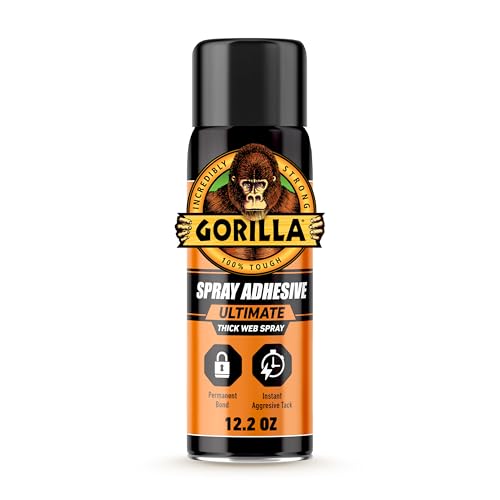
This spray contact adhesive strikes the best balance between strength and versatility among the entire list. The formula resists heat and moisture, so indoor projects like upholstered foam panels and outdoor foam signage both hold tight without softening or delaminating in weather shifts.
The adjustable nozzle lets you switch between a narrow and wide web pattern, giving you fine control over coverage area. Users consistently report an “aggressive tack” that bonds instantly on contact, which is ideal for foam-to-fabric and foam-to-laminate laminations where slipping during setup ruins the alignment.
The 12.2‑ounce can is a mid-size sweet spot—enough for several large mat boards or a couple of upholstery cushions without wasting unused propellant. A few reviewers noted the spray covers a wide arc even on the low setting, so mask off surrounding surfaces if you need pinpoint accuracy.
Why it’s great
- Three spray patterns offer precise control for different board sizes
- Permanent bond resists moisture and temperature swings
- Low VOC formula meets strict indoor air quality standards
Good to know
- Spray pattern is wide even on low—use masking for detail work
- Repositioning is nearly impossible after initial contact
2. Beacon Foam-Tac
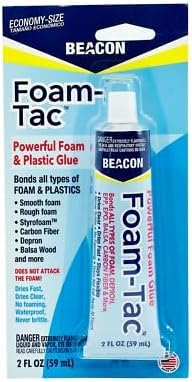
Foam-Tac is the go-to glue for RC aircraft builders who need a bond that can flex during flight stresses without snapping. It works across EPP, EPO, and DEPRON foams, plus balsa wood and carbon fiber, making it uniquely suitable for hybrid airframe repairs where one part is foam and the other is wood.
UV blockers are a serious value-add if your build sits in a workshop window or flies under direct sun—untreated glues yellow and embrittle within a season. The adhesion promoter chemically keys into the foam surface, which explains why users say it “saves” cracked coolers and beat-up foam fuselages that other glues could not penetrate.
The 2‑ounce bottle is compact, but the glue is extremely thick, almost like a gel. Some users find the stringy consistency messy without a fine tip applicator. A short repositioning window (about two minutes) gives you just enough time to adjust before the contact bond locks in permanently.
Why it’s great
- Flexible bond withstands vibration and impact loads
- UV blockers prevent yellowing and brittleness in sunlight
- Works on multiple foam subtypes plus wood and carbon fiber
Good to know
- Extremely thick—messy to apply without a dedicated nozzle
- Full cure takes 24 hours for maximum strength
3. Scotch Spray Mount

When the project demands zero errors in alignment, this repositionable spray from 3M lets you lift and reset foam board prints or posters without tearing the surface. Unlike a permanent contact bond, the adhesive stays tacky enough to peel apart and re-seat even after several minutes of drying time.
The formula is explicitly designed for graphic arts—layouts, presentations, stencil work, and appliqués. Crafters report that it holds thin foam-core lettering and shapes firmly during sewing machine feeding without gumming up the needle. The non-wrinkling property is particularly critical for large foam-backed art prints where bubbles ruin the finish.
On the down side, the hold is not permanent or weather-resistant. If your foam board sign will be exposed to outdoor humidity or frequent handling, a stronger contact adhesive like the Gorilla spray is a safer bet. The 10.25‑ounce can is a good single-project size for home and office use.
Why it’s great
- Lets you peel and re-seat foam board without damage
- Won’t wrinkle paper or thin foam facings
- Clean, low-mess application for indoor crafting
Good to know
- Not designed for high-strength or outdoor bonding
- Hold strength may loosen over time on heavier boards
4. Bob Smith Industries Super-Gold
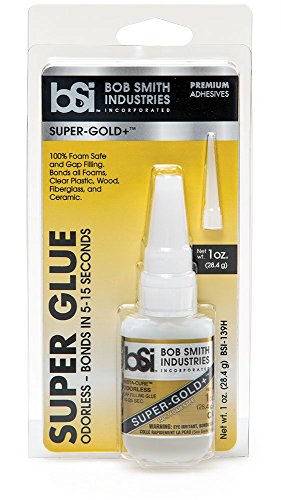
For precision work like D&D terrain tiles and architectural model details, this foam-safe cyanoacrylate is peerless. The 100% odorless formula means you can bond small foam parts in an enclosed workshop without triggering headaches or eye irritation—a subtle but important advantage for long-crafting sessions.
Cure time is 5 to 15 seconds, so joints stiffen nearly instantly. That speed is a superpower for attaching small bracing to foam board or securing delicate cosmetic pieces, but it leaves no room for repositioning. The included extender tip lets you place single drops exactly where needed, preventing excess glue from pooling and melting foam channels.
The 1‑ounce bottle is small, but a drop goes a long way. Diorama builders have reported that one bottle still has usable glue after several months of intermittent use.
Why it’s great
- Odorless formula—safe for indoor work without ventilation stress
- Foam-safe chemistry does not craze EPS or XPS surfaces
- Gap-filling viscosity bridges small misalignments
Good to know
- Cures in seconds—no time for repositioning
- Not suitable for large-area lamination
5. 3M Hi-Strength 94 ET
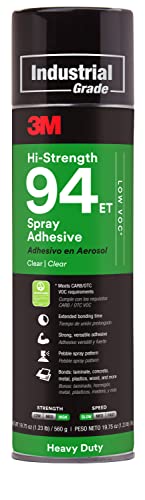
When you are laminating 4×8 sheets of foam board insulation to plywood or metal, open time is everything. This 3M spray gives up to 60 minutes of bonding window, so you can coat both substrates, position the panel, and fine-tune the alignment without the adhesive locking prematurely at the corner.
The GREENGUARD certification means VOCs are low enough for use in occupied indoor spaces—important for basement insulation work where you cannot ventilate to the outdoors. Industrial users say the spray pattern is consistent, wetting both the foam and the metal substrate evenly without dry spots that cause the board to peel over time.
The 19.75‑ounce can is the largest in this lineup, designed for high-coverage commercial or large residential projects. One can covers roughly 80 to 100 square feet in a single even coat. The aggressive tack requires a knuckle test before mating surfaces—touch the adhesive film with your finger; if it strings but does not stay wet, the bond is ready.
Why it’s great
- Extremely long open time (60 minutes) for large panel alignment
- GREENGUARD certified and Low VOC for indoor use
- Bonds foam to metal and wood with industrial strength
Good to know
- Strong solvent smell requires ventilation during application
- Fully wetted bond requires a 30-minute wait before mating
FAQ
Can I use hot glue on foam board instead of spray adhesive?
How do I prevent the foam from melting when using cyanoacrylate?
What open time should I look for when laminating large foam panels?
Final Thoughts: The Verdict
For most users, the best adhesive for foam board winner is the Gorilla Ultimate Spray Adhesive because it combines adjustable spray coverage, moisture resistance, and low-VOC safety in a single can that works across fabric, wood, metal, and foam. If you build and repair RC aircraft where flexibility and UV stability matter, grab the Beacon Foam-Tac. And for large-scale insulation or foam-to-metal lamination, nothing beats the long open time and certified indoor safety of the 3M Hi-Strength 94 ET.

Mo Maruf
I created WellFizz to bridge the gap between vague wellness advice and actionable solutions. My mission is simple: to decode the research and give you practical tools you can actually use.
Beyond the data, I am a passionate traveler. I believe that stepping away from the screen to explore new environments is essential for mental clarity and physical vitality.