Our readers keep the lights on and my smoothie glass nicely filled. As an Amazon Associate, I earn from qualifying purchases.
Your ears are not calibrated. The subjective “loud” you feel during a neighbor’s party, a workshop tool, or a classroom full of kids might be 75 dB or it might be 95 dB—a difference that separates a quiet annoyance from a workplace hearing hazard. A decibel meter settles that argument with a number, letting you turn anxious perception into objective data.
I’m Mohammad Maruf — the founder and writer behind WellFizz. I’ve spent hundreds of hours digging into audio metering hardware, dissecting frequency weighting curves, condenser mic designs, and firmware quirks to map exactly which sound level meters deliver reliable, repeatable readings for the real-world buyer.
Whether you are documenting a noise complaint, monitoring a woodshop, or balancing a home theater, the right tool changes how you hear your environment. This guide evaluates seven models side by side to find the best decibel meter for your specific situation.
How To Choose The Best Decibel Meter
Not every sound level meter fits every task. A unit you leave plugged in a classroom needs different features than one you carry to measure a motorcycle exhaust. Focus on a few core specs to avoid wasting money on the wrong tool.
Weighting: A vs. C
A-weighting rolls off low-frequency noise to mimic the human ear’s sensitivity, making it the standard for environmental complaints, office noise, and anything under about 55 dB. C-weighting flattens the low end for industrial machinery, loud music, and engine noise. A meter that offers both lets you match the weighting to your actual source.
Response Time: FAST vs. SLOW
FAST mode (0.125-second time constant) catches sudden peaks like a door slam or a gunshot. SLOW mode (1-second constant) averages out fluctuations for steady-state noise such as a running AC unit or a hum from a server room. If you plan to document intermittent loud events, FAST responsiveness is critical.
Portability vs. Fixed Installation
A handheld meter with a carrying case and battery power lets you walk around a property or job site. Wall-mounted units with large LCDs and continuous AC power make sense for quiet zones like libraries or home offices where you want a constant visual reference. Decide where the meter will live most of the time before you choose a form factor.
Quick Comparison
On smaller screens, swipe sideways to see the full table.
| Model | Category | Best For | Key Spec | Amazon |
|---|---|---|---|---|
| ennoLogic eS528L | Premium | Long-term recording & analysis | 30-130 dBA, ±1.5 dB, Type 2, data logging | Amazon |
| DURFICST SL720C | Mid-Range | Home, office & neighbor complaints | 30-130 dB, ±1.5 dB, A/C weight, dB/SONE | Amazon |
| SQECH SL720C | Mid-Range | General environmental & industrial noise | 30-130 dB, ±1.5 dB, condenser mic, metal shell | Amazon |
| LSENLTY L6101 | Mid-Range | Plug-in wall monitor with temp & humidity | 30-130 dBA, ±1.5 dBA, 3-in-1 sensor | Amazon |
| Tadeto TE017 | Mid-Range | Portable with 5-range adjust & tripod mount | 30-130 dB, ±1.5 dB, 5 measurement ranges | Amazon |
| SNDWAY SW-525A | Premium | Wall-mount with large LCD & alarm | 30-130 dB, ±1.5 dB, 9.6-inch display | Amazon |
| TestHelper SW-525A | Premium | Large red LCD wall-mount for shop or office | 30-130 dB, large red LCD, USB-C powered | Amazon |
In‑Depth Reviews
1. ennoLogic eS528L

The ennoLogic eS528L is the only meter in this roundup that combines Type 2 accuracy with a proper data logging engine. Its measurement window spans 30 to 130 dBA at ±1.5 dB, and the ability to record noise levels over hours or days makes it the definitive tool for documenting recurring noise complaints or workplace safety compliance. Both A and C weighting are available alongside FAST and SLOW response, and the large backlit LCD includes an analog bar graph for quick visual reference.
Build quality is a step above budget handhelds. The unit ships with a 9V battery, USB cable, and software CD (Windows-only, though the recording feature requires it). A tripod mount is built in, and the inclusion of DC and AC analog outputs adds flexibility for integration with other monitoring systems. Users who need to present logged data to property managers or HR departments will find the exportable graph view essential.
The main drawback is software dependency. Several users report USB connection issues that make the recording feature unreliable, though the company has resolved many of those cases with patches. Without the software functioning, the hardware is still an excellent handheld meter. The 10-year warranty provides a strong safety net for a premium investment.
Why it’s great
- Type 2 accuracy for documented evidence
- Long-duration data logging for complaints
- Analog outputs and tripod mount
Good to know
- Recording software can be finicky on some PCs
- Windows-only software limits Mac users
2. DURFICST SL720C

The DURFICST SL720C packs a surprising amount of versatility into a mid-range handheld. Its 30 to 130 dB range with ±1.5 dB accuracy is standard, but the addition of a color LCD screen with a bar graph makes reading levels at a glance much easier than a monochrome display. The meter supports both A and C weighting, FAST and SLOW response modes, and two measurement units—dB for intensity and SONE for perceived loudness in acoustic applications.
Build details show thoughtful touches. A condenser microphone protected by a metal shell and a windbreak ball help outdoor readings stay stable. The included cloth carrying case and three AAA batteries mean it is ready out of the box. Reviewers consistently praise the intuitive interface and the backlight that works well in dim conditions. Several users confirmed accuracy against their other SPL meters, lending credibility for noise complaint documentation.
No meter at this level is without a compromise. The battery cover requires a screwdriver to open, and the base lacks a stable stand for vertical placement. The auto-off function, while helpful for battery life, can interrupt long monitoring sessions. For home, office, and neighbor-dispute use, this is a well-rounded performer.
Why it’s great
- Color display with clear bar graph
- SONE unit for loudness perception
- Windbreak ball for outdoor use
Good to know
- Battery cover needs a screwdriver
- No stable stand for vertical use
3. SQECH SL720C

The SQECH SL720C runs on the same core platform as the DURFICST but differentiates itself with a green-accented design and a condenser microphone housed in a protective metal shell. The measurement spec is identical: 30 to 130 dB with ±1.5 dB accuracy, A and C weighting, FAST and SLOW response, and dB/SONE unit switching. The three-color analog bar on the screen shifts to indicate safe, moderate, and loud zones automatically.
Portability is a strong suit. The meter weighs 242 grams and comes with a windbreak ball, screwdriver, and cloth bag. Users in the field—measuring motorcycle exhausts or workshop tools—appreciate the immediate responsiveness of the FAST mode. The metal microphone housing adds drop protection that the all-plastic competitors lack, making this a more rugged choice for job site carry.
Design flaws are minor but real. The battery cover requires the included screwdriver to open, and the base is too small to stand the unit upright without tipping. Several reviewers wished for a stand-up base for hands-free operation. If you plan to set the meter on a table for continuous readings, a separate tripod or a DIY solution may be necessary.
Why it’s great
- Metal-shielded condenser mic for durability
- Color screen with zone-based bar graph
- Lightweight and portable with carry bag
Good to know
- Unstable when standing vertically
- Screwdriver needed for battery access
4. LSENLTY L6101
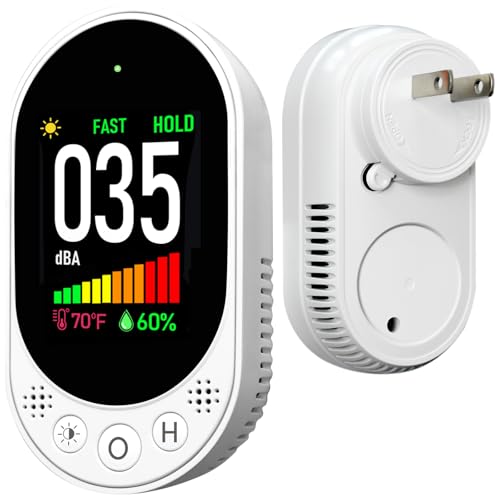
The LSENLTY L6101 breaks the battery-dependent mold by plugging directly into a standard US wall outlet. This set-and-forget design eliminates battery swapping and makes it ideal for permanent placement in a classroom, library, or home office. The 2.1-inch color screen displays noise in dBA alongside temperature and humidity, giving a three-dimensional view of room conditions. The 30 to 130 dBA range with ±1.5 dBA accuracy covers typical indoor situations.
Three brightness levels for the screen and a color-coded visualization help you assess noise at a glance from across the room. The meter records and remembers the maximum and minimum noise levels over the previous 24 hours—a simple but effective log for tracking daily patterns. Users confirm that readings align closely with phone app estimates, and the inclusion of temperature and humidity monitoring adds utility beyond pure sound measurement.
The main compromise is mobility. Plug-in design means the unit stays where you install it, and the cord is relatively short. A few reviewers noted a slight lag in reading updates and a tendency to show 50+ dBA even in silent rooms, which could be a baseline offset rather than a fault. For a dedicated wall monitor that covers sound and climate data in one device, this is a smart choice.
Why it’s great
- No batteries required—permanent plug-in
- Records 24-hour max/min noise history
- Adds temperature and humidity monitoring
Good to know
- Short power cord limits placement
- Minor lag in real-time reading updates
5. Tadeto TE017

The Tadeto TE017 stands out for its five manually selectable measurement ranges, a feature uncommon in mid-range handheld meters. Instead of a single 30 to 130 dB sweep, you can narrow the range to focus precision on quieter or louder environments. The ±1.5 dB accuracy holds across all ranges, and the meter offers A and C weighting, FAST and SLOW response, and a backlit LCD display with both digital numbers and an animated analog bar.
Ergonomics are well-considered. The body fits one-handed operation with separate dedicated buttons for each function—range, weighting, response time, min/max, and hold. A removable foam windscreen and a standard tripod mount add versatility for semi-permanent setups. The included cloth zipper bag with a strap and manual pocket keeps everything organized for fieldwork. Reviewers confirm its accuracy for noise complaints and production testing, with several noting the calibration adjustment as a bonus.
The auto-off timer saves battery but can be annoying during longer sessions—there is no disable option. The display is large and readable, but the monochrome LCD lacks the color coding of newer competitors. For users who want granular range control and tripod-ready stability, the Tadeto delivers a lot of hardware for the investment.
Why it’s great
- Five selectable measurement ranges for precision
- Tripod mount for stable monitoring
- Calibration adjustment possible
Good to know
- Auto-off cannot be disabled
- Monochrome screen, no color coding
6. SNDWAY SW-525A
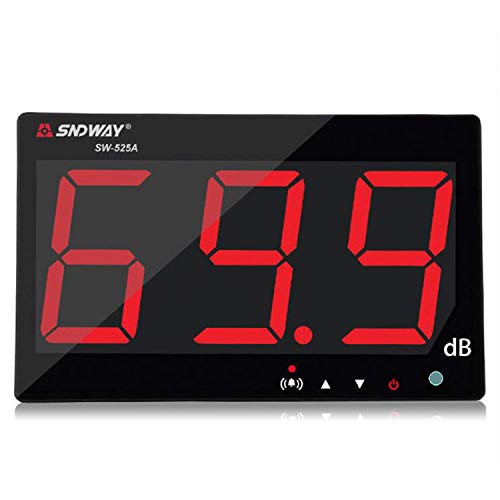
The SNDWAY SW-525A is a wall-mounted noise monitor designed for visibility at distance. Its 9.6-inch LCD display with backlight shows readings from 30 to 130 dB with ±1.5 dB accuracy, and the frequency response stretches from 31.5 Hz to 8.5 kHz. The unit is powered by a Micro USB connection (5V 1A, not included) and includes an alarm function with a red light that you can set to trip at a chosen decibel threshold—useful for keeping a workshop or classroom in check.
Setup is straightforward. Plug in the power and the meter auto-starts. Short press the power button to shut down, long press to enable auto-start when power is reapplied. The alarm setting is adjustable via the front keys, and the threshold is saved on exit. Reviewers have used it successfully for music room volume monitoring, hearing protection in woodshops, and even alerting kids to quiet down during work calls.
Calibration inconsistency is the biggest risk. One reviewer measured a 15 dB offset in a quiet room, and the unit lacks a user-facing calibration control. The USB cable placement on the bottom can make the meter sit unevenly on a desk, and the short cable limits wall placement. For buyers who can verify accuracy out of the box, the massive display and alarm make it a strong fixed-location tool.
Why it’s great
- Very large, readable display from across a room
- Adjustable audible/visual alarm
- Auto-start on power input
Good to know
- Some units arrive with calibration offset
- No stand for desk use; wall-mount only
7. TestHelper SW-525A
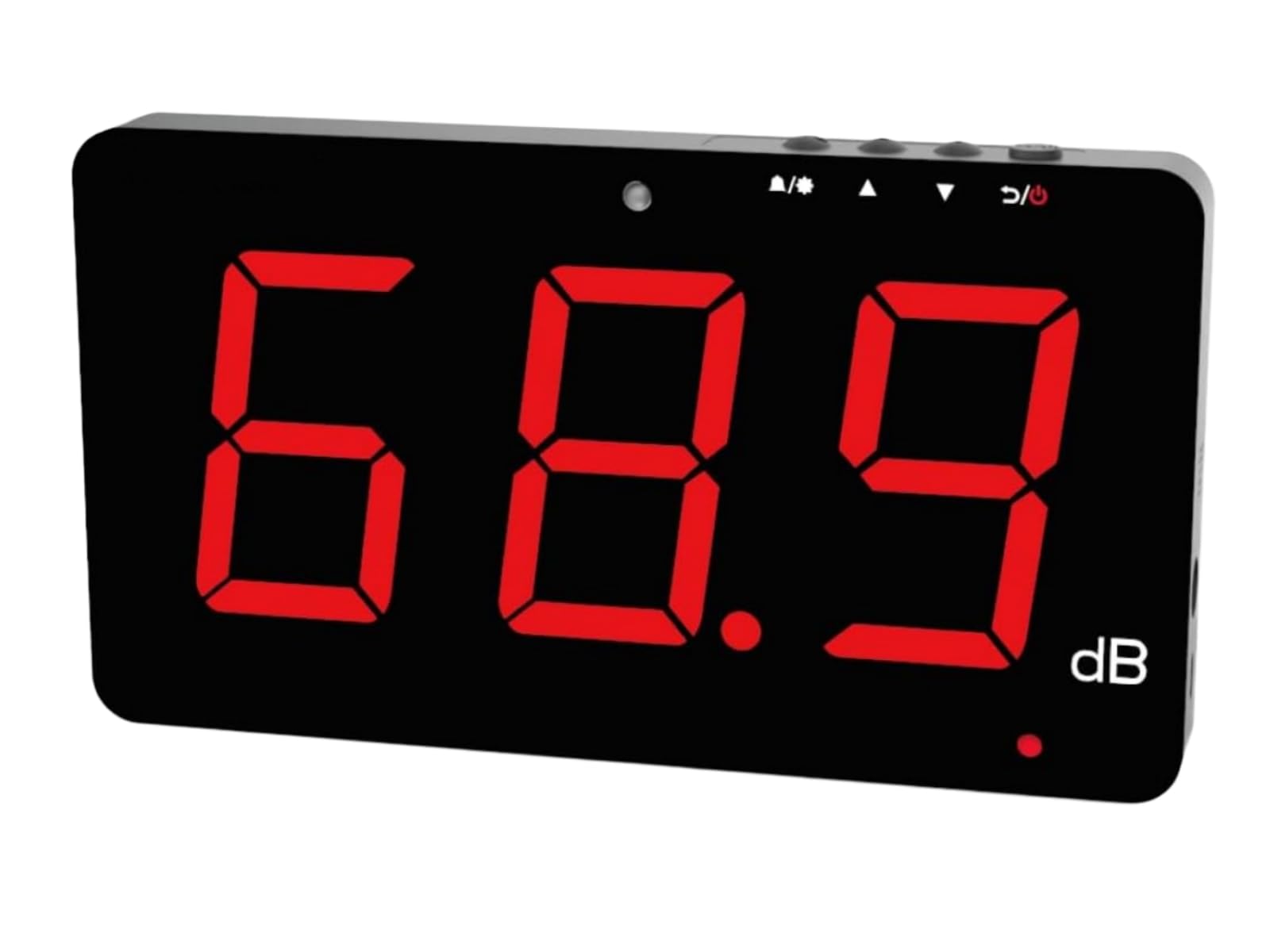
The TestHelper SW-525A shares the same large LCD wall-mount concept as the SNDWAY but adds a vivid red backlit display that stands out even in bright daylight. The measurement range covers 30 to 130 dB, and the response time is fast enough to catch sudden volume spikes—updating roughly every second. The unit is powered via USB-C (cord included, adapter not), making it easy to power from any standard USB wall plug or even a laptop.
User feedback highlights its role in hearing protection. Woodshop owners and retired broadcasters alike praise the immediate visual feedback that lets you adjust gear or enforce quiet zones without second-guessing. The alarm version adds an external alert that can be wired to a remote indicator, though the standard model suffices for most personal spaces. Several reviews confirm that the readings are accurate when cross-checked against other meters at loud levels.
The lack of a stand is limiting. This meter is designed to be wall-mounted, and the USB-C cable exits from the side of the unit. Without a vertical surface, it cannot sit upright on a desk. The cable is also on the shorter side, so a USB extension may be needed for convenient placement. If you need a dedicated, always-on monitor that you can read from across a room, this is a strong contender.
Why it’s great
- Red backlit display is highly readable at distance
- Fast response time for loud spikes
- USB-C power, no batteries needed
Good to know
- Wall-mount only—no desktop stand
- Short USB-C cable included
FAQ
Can I use a decibel meter app instead of a dedicated hardware meter?
How do I document a noisy neighbor complaint with a decibel meter?
What does ±1.5 dB accuracy mean in practice?
Should I choose a wall-mounted or a handheld decibel meter?
Final Thoughts: The Verdict
For most users, the best decibel meter winner is the ennoLogic eS528L because its Type 2 accuracy and data logging capability turn subjective loudness into documented evidence for noise complaints or workplace safety. If you want a portable, color-screen handheld that is ready to use out of the box, grab the DURFICST SL720C. And for a permanent wall-mounted monitor with a huge display and alarm that keeps a classroom or shop in check, nothing beats the TestHelper SW-525A.

Mo Maruf
I created WellFizz to bridge the gap between vague wellness advice and actionable solutions. My mission is simple: to decode the research and give you practical tools you can actually use.
Beyond the data, I am a passionate traveler. I believe that stepping away from the screen to explore new environments is essential for mental clarity and physical vitality.