Our readers keep the lights on and my smoothie glass nicely filled. As an Amazon Associate, I earn from qualifying purchases.
The brittle edge geometry that makes Japanese knives legendary for precision also makes them uniquely vulnerable on the wrong cutting surface. Standard bamboo or glass boards can chip a fine 15-degree edge in a single hard chop, turning a premium blade into a dull liability.
I’m Mohammad Maruf — the founder and writer behind WellFizz. I’ve analyzed the hardness scale, grain structure, and maintenance protocols of dozens of board materials to determine which surfaces actually protect a Japanese knife’s delicate edge without sacrificing usability.
Whether you prefer the traditional aroma of hinoki, the self-healing density of end-grain maple, or the vibration-damping consistency of hi-soft synthetic, this guide isolates the real performance metrics behind each option. Here you will find the definitive best cutting board for japanese knives based on edge retention tests, material science, and real user wear patterns.
How To Choose The Best Cutting Board For Japanese Knives
Japanese knife edges are forged at a harder Rockwell rating (typically 60-65 HRC) than Western blades, which means they hold a razor edge longer but chip more easily on impact with a hard surface. The ideal board material sits soft enough to cushion the edge without being so soft that it sheds plastic or wood fibers into your food. The interplay between material hardness, grain orientation, and board thickness determines whether your knife stays sharp for weeks or dulls after a single meal prep session.
Material Matters: Wood Grain vs. Synthetic
End-grain wood boards, where the wood fibers run vertically, allow the knife edge to slip between fibers rather than cutting across them. This “self-healing” property creates significantly less blade friction and leaves minimal surface marks. Edge-grain boards, where fibers run parallel to the surface, are harder on edges and show cuts more readily. High-density polyethylene (LDPE) boards like the Yoshihiro Hi Soft offer a different advantage: uniform softness across the entire surface with zero risk of warping, though some users report visible scoring over time.
Thickness and Weight for Stability
A board that slides, rocks, or bounces during a cut is dangerous and inefficient. Thicker boards—1.5 inches and above—provide the mass needed to stay planted on the counter without rubber feet alone. Lightweight hinoki boards under one inch thick work well for quick vegetable prep but may shift during heavier chopping. Consider your counter surface, the size of your prep area, and whether you prefer to wash and dry a board that can be moved easily versus one that stays put permanently.
Moisture Resistance and Maintenance Reality
Japanese knives demand a board that resists moisture absorption to prevent bacterial growth and warping. Wood boards require regular mineral oil application—typically once a month for the first year, then less frequently once the wood reaches saturation. Hinoki and cypress are naturally water-resistant due to their high oil content, while maple and walnut need more diligent care. Hi-soft synthetic boards require no oiling at all and can be placed in the dishwasher, making them the lowest-maintenance option for cooks who prioritize convenience.
Quick Comparison
On smaller screens, swipe sideways to see the full table.
| Model | Category | Best For | Key Spec | Amazon |
|---|---|---|---|---|
| Yoshihiro Hi Soft | Synthetic | Maximum edge protection, easy cleaning | 0.8″ thick LDPE | Amazon |
| Bevel & Bond Maple End-Grain | End-Grain Wood | Premium self-healing surface, professional use | 1.75″ thick maple | Amazon |
| BABILONIA Black Walnut | End-Grain Wood | Large prep area with serving versatility | 1.7″ thick walnut | Amazon |
| Cozifa Black Walnut | End-Grain Wood | Extra-large surface, heavy-duty chopping | 2″ thick walnut | Amazon |
| Dalstrong Teak | End-Grain Wood | Teak durability with steel handles for serving | 1.9″ thick teak | Amazon |
| KAI Sekimoroku Cypress | Soft Wood | Traditional Japanese feel, lightweight | 0.8″ thick cypress | Amazon |
| YAMASAN Kyoto Uji Hinoki | Soft Wood | Entry-level hinoki, gentle on edges | 0.59″ thick cypress | Amazon |
In‑Depth Reviews
1. Yoshihiro Hi Soft High Performance Synthetic Board

The Yoshihiro Hi Soft is engineered around a single principle: the cutting surface should be the softest thing your blade ever touches. Made from high-density LDPE, this board is noticeably softer than any wood option, which translates to dramatically reduced edge wear over time. At 0.8 inches thick, it lacks the heft of end-grain boards but keeps your knife sharp longer than virtually any other material on the market.
Home cooks and professional chefs alike report needing fewer sharpening sessions when using this synthetic surface. The beige color hides staining well, and the non-porous construction prevents odor absorption from garlic, fish, or onions. The board is dishwasher-safe, which eliminates the maintenance burden entirely—no oiling, no seasoning, no worry about moisture damage.
The trade-off is surface scoring. Harder knives, especially those with thin edges, will leave visible cut marks over time, and some users note minor plastic residue during initial use. The board also feels less premium than a thick walnut slab. For anyone who prioritizes edge longevity above all else, this is the definitive choice.
Why it’s great
- Maximizes edge retention—less frequent sharpening needed
- Dishwasher-safe and completely odor resistant
- Stays firmly planted on smooth counters without slipping
Good to know
- Visible scoring and cut marks accumulate on the surface
- Thinner profile means less stability during heavy chopping
- Not a serving-worthy surface for guest presentation
2. Bevel & Bond Maple End-Grain Board
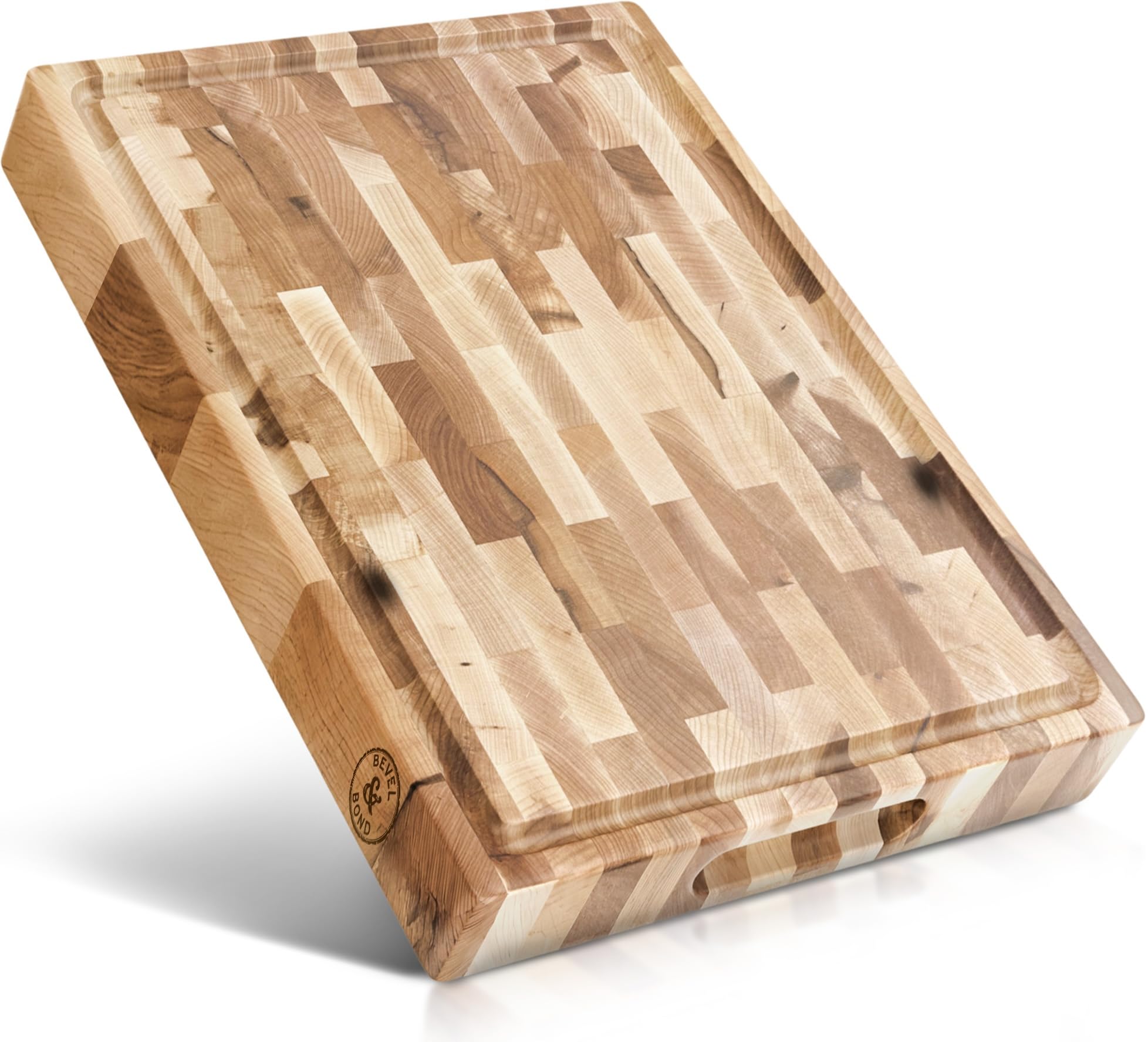
At a full 1.75 inches thick, this board delivers the mass necessary to stay absolutely still during any cutting task. The end-grain construction allows the vertical wood fibers to part and close around your knife edge, which minimizes surface marks and keeps the board looking new far longer than edge-grain alternatives.
User reviews consistently praise the board’s ability to resist odor and staining compared to other wood options, thanks to maple’s tight grain structure. The deep juice groove captures liquid from tomatoes, melons, or roasted meat without overflowing, and the non-slip feet add an extra layer of stability. Every board arrives pre-conditioned with food-safe mineral oil and ships in a premium gift box.
The 5-year warranty and free Board Balm conditioner upon registration underscore the brand’s confidence in long-term durability. At just over 10 pounds, this board is not portable—it is designed to live on your counter. Regular monthly oiling is required to prevent the wood from drying out, but the payoff is a cutting surface that improves with age and never needs replacing.
Why it’s great
- Self-healing end-grain construction preserves knife edges
- Extra-thick 1.75″ profile provides unmatched stability
- 5-year warranty with complimentary board balm included
Good to know
- Requires regular mineral oiling to prevent cracking
- Heavy enough that moving it for cleaning is a chore
- Maple grain is lighter in color and shows stains more than walnut
3. BABILONIA Black Walnut End-Grain Board
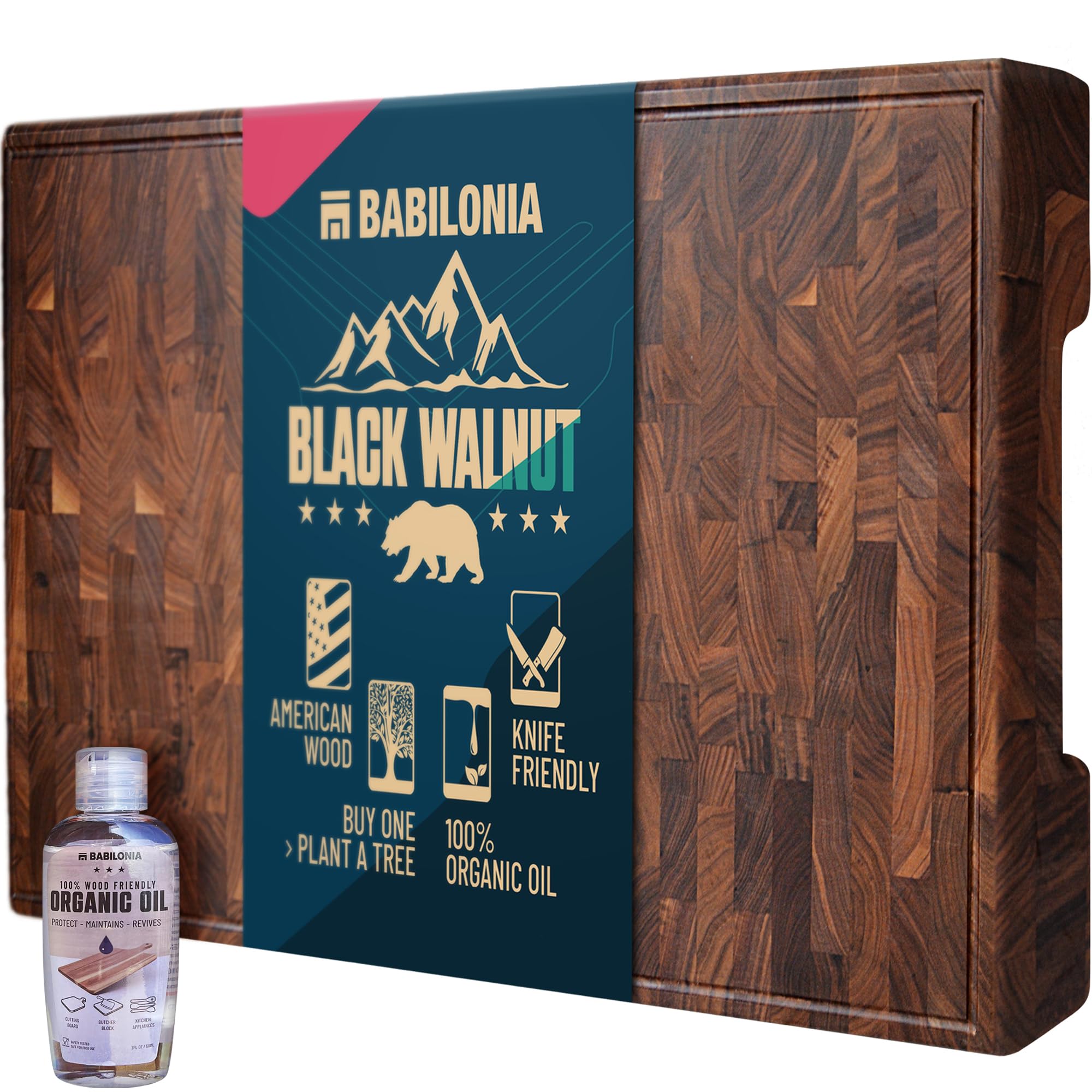
The BABILONIA Black Walnut board combines a generous 19.7-by-12.2-inch surface with an end-grain construction that is both knife-friendly and visually striking. The 1.7-inch thickness gives it the heft of a premium butcher block, while the walnut’s rich brown hue hides stains far better than lighter maple boards. A built-in juice groove and a hidden plate slot add functional touches that simplify transferring chopped ingredients directly to a pan.
Multiple users note the board’s versatility as a serving tray for charcuterie and cheese, making it a dual-purpose investment rather than a purely utilitarian tool. The board arrives pre-seasoned and includes a bottle of organic mineral oil, so it is ready for immediate use. The natural walnut grain creates a unique pattern on every board, giving each unit a one-of-a-kind look.
Some reports mention the board splitting after extended use, though the responsive customer service issued replacements promptly. The manufacturer recommends hand washing and monthly oiling. For cooks who want a large, attractive surface that transitions from prep to table without sacrificing edge protection, this board delivers strong value.
Why it’s great
- Extra-large prep area suitable for batch cooking and serving
- Hidden plate slot and juice groove improve workflow efficiency
- Pre-seasoned with mineral oil, ready to use immediately
Good to know
- Some units experienced cracking after initial months of use
- Heavy at nearly 9 pounds, not ideal for storage
- Walnut requires diligent oiling to maintain moisture balance
4. Cozifa Black Walnut End-Grain Board
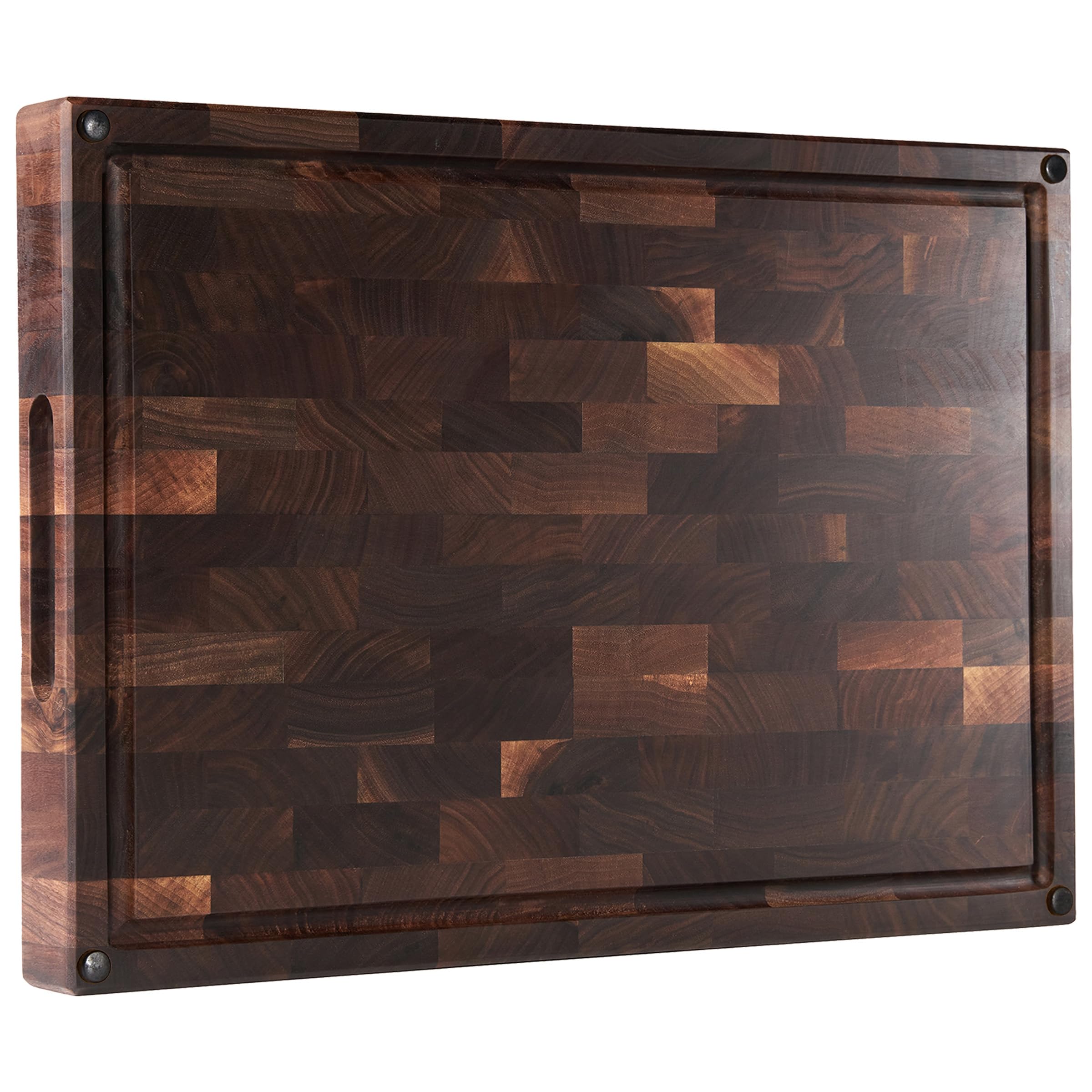
At 20 inches long, 15 inches wide, and a massive 2 inches thick, the Cozifa Black Walnut board offers the largest pure prep surface in this lineup. The end-grain construction is finished with linseed oil, beeswax, and carnauba wax for a smooth, food-safe surface that protects knife edges while resisting moisture penetration. The deep juice groove is positioned close to the edge, maximizing usable cutting area without sacrificing liquid containment.
Users describe this board as a permanent counter fixture—its 12-pound weight ensures it will not slide, shift, or bounce during any cutting task. The walnut’s dark color hides minor stains effectively, and the built-in handles on both sides make it easier to move despite the considerable mass. The back side is flat and reversible, functioning as a serving board for breads or cheeses.
Initial quality reports are overwhelmingly positive, though isolated incidents of bowing and cracking have been noted over longer timeframes. The 1-year replacement warranty covers manufacturing defects, but consistent oiling with a food-safe conditioner remains essential for longevity. For chefs who need a board that can handle heavy chopping without moving, this is the most substantial option available.
Why it’s great
- Largest surface area in the review at 20″ x 15″
- 2-inch thickness provides extreme stability and weight
- Finishing wax blend offers smooth surface feel out of the box
Good to know
- Very heavy—difficult to lift and store away
- Reported warping in some units over extended use
- No pre-applied mineral oil; requires immediate conditioning
5. Dalstrong Lionswood End-Grain Teak Board

Teak is naturally denser and more oil-rich than walnut or maple, which gives the Dalstrong Lionswood board exceptional resistance to water, warping, and discoloration. The end-grain checkered pattern creates a slip-resistant surface that absorbs impact effectively, ensuring that Japanese knife edges experience minimal friction during use. At 1.9 inches thick, this board sits solidly on the counter without any bounce or rock.
Two built-in stainless steel handles turn the board into a practical serving platter for roasted meats or large cheese boards, and a curved half-moon cutout on one side allows for direct transfer of chopped ingredients into a bowl or pan. The tight teak grain does not absorb odors easily, and users praise the vivid natural pattern that emerges after conditioning the wood with mineral oil.
Quality control has been a concern in some units—cracking reports exist, though the manufacturer has replaced damaged boards promptly. The board ships shrink-wrapped and may require seasoning before first use. For cooks who want a moisture-resistant, edge-friendly surface that doubles as elegant serveware, teak offers a compelling alternative.
Why it’s great
- Teak’s natural oils resist moisture and warping better than other hardwoods
- Integrated steel handles and cutout for easy ingredient transfer
- End-grain construction keeps knife edges sharp for longer
Good to know
- Some boards arrived cracked or required replacement
- Heavy and wide, takes up significant counter space
- Initial shrink-wrap packaging may prevent proper seasoning
6. KAI Sekimoroku Cypress Board
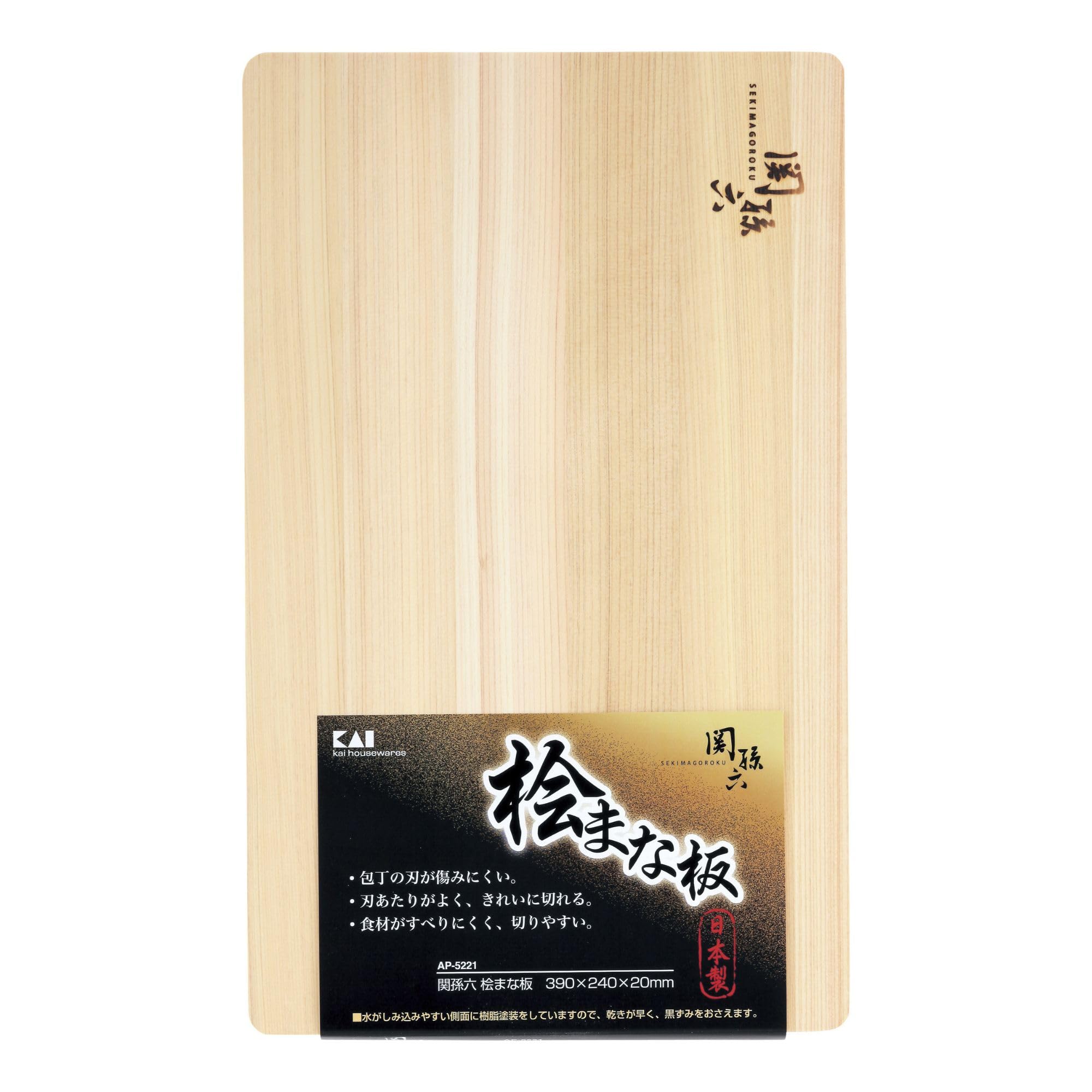
The KAI Sekimoroku board brings the traditional Japanese approach to a wider audience with its 0.8-inch thick cypress construction and a resin-coated edge that prevents moisture absorption along the sides. Cypress, like hinoki, has a soft Janka rating that makes it exceptionally gentle on knife edges, and the wood releases a mild, pleasant aroma reminiscent of a Japanese bathhouse. The board includes a clever built-in kickstand for upright drying and storage.
Multiple user reviews highlight the almost therapeutic sensory experience of cutting on this board—the soft sound of the blade meeting the wood, the clean fall of chopped ingredients, and the absence of that hard, jarring impact that comes from denser surfaces. At 2.8 pounds, it remains light enough to wash and store easily, making it suitable for kitchens where counter space is limited.
The board’s relatively small size and lack of a juice groove limit its use for large projects or wet ingredients. It is best suited for vegetables, fruits, and light prep rather than heavy chopping. The wood will show cut marks over time, which is normal for this material. Regular oiling with mineral oil helps prevent the cypress from drying and splitting.
Why it’s great
- Soft cypress wood is exceptionally gentle on Japanese knife edges
- Built-in kickstand allows proper airflow drying
- Pleasant natural aroma and traditional aesthetic
Good to know
- Small surface area limits meal prep capacity
- No juice groove for liquid-heavy cutting tasks
- Will show cut marks and requires regular oiling
7. YAMASAN Kyoto Uji Hinoki Board

The YAMASAN Kyoto Uji board is the most accessible entry point into hinoki wood for Japanese knife owners. At just 0.59 inches thick and 1.2 pounds, this board is unmistakably lightweight—easy to wash, quick to dry, and simple to store. The hinoki wood is naturally soft, which means it absorbs blade impact without transferring stress to the knife edge, making it ideal for everyday slicing and dicing with high-hardness Japanese steel.
Users consistently mention the pleasant citrus-like hinoki aroma that gradually fades after washing, with no flavor transfer to food. The smooth, finished surface is gentle on knife edges, and several reviewers specifically note that it allows rock-cutting motions that rigid synthetic boards restrict. For home cooks who want the traditional Japanese cutting experience without committing to a heavy, expensive slab, this board delivers the core benefit of edge protection at a low barrier to entry.
The board’s thin profile means it will not stay planted during aggressive chopping—it slides on smooth counters without a damp towel underneath. It also requires frequent oiling to prevent warping, and the narrow width of 8.66 inches limits multitasking space. Long-term durability depends entirely on proper care, but for the price, it offers genuine hinoki performance in a no-frills package.
Why it’s great
- Authentic hinoki wood is extremely soft on knife edges
- Ultra-lightweight design simplifies washing and storage
- Pleasant natural aroma and no flavor transfer to food
Good to know
- Thin 0.59″ profile slides on smooth countertops
- Narrow cutting surface limits multi-ingredient prep
- Requires diligent oiling to avoid warping and splitting
FAQ
Can I use a bamboo cutting board with Japanese knives?
How often should I oil my hinoki or maple board?
Is a hi-soft synthetic board safe for high-end Japanese knives?
What size cutting board do I need for a Japanese chef’s knife?
Final Thoughts: The Verdict
For most users, the best cutting board for japanese knives winner is the Bevel & Bond Maple End-Grain Board because it combines professional-grade self-healing end-grain construction with a 5-year warranty and a dense maple surface that stays stable under heavy use while respecting your blade geometry. If you want maximum edge retention with zero maintenance, grab the Yoshihiro Hi Soft. And for the traditional hinoki sensory experience at an entry-level price, nothing beats the YAMASAN Kyoto Uji.

Mo Maruf
I created WellFizz to bridge the gap between vague wellness advice and actionable solutions. My mission is simple: to decode the research and give you practical tools you can actually use.
Beyond the data, I am a passionate traveler. I believe that stepping away from the screen to explore new environments is essential for mental clarity and physical vitality.