Our readers keep the lights on and my smoothie glass nicely filled. As an Amazon Associate, I earn from qualifying purchases.
The difference between a frustrating prep session and a truly fluid, professional one often comes down to a single surface. A thin, warped board that slides across the counter, dulls your expensive blades, or harbors bacteria in deep knife scars will undermine everything you do. A proper board transforms chopping, slicing, and carving from a chore into a quiet, efficient rhythm.
I’m Mohammad Maruf — the founder and writer behind WellFizz. I’ve spent hundreds of hours analyzing material science, construction techniques, and real-world user feedback to separate marketing claims from genuine performance in kitchen tools.
The market is flooded with options, but selecting the wrong material or size can damage your blades and create food-safety risks. This guide dissects every spec, grain type, and maintenance requirement so you can find the best cutting board for chefs that fits your workflow and your knife collection.
How To Choose The Best Cutting Board For Chefs
Selecting a professional-grade board means weighing material, construction, size, and maintenance against your specific cooking volume and knife care standards. The wrong choice leads to dulled blades, counter slipping, and premature replacement.
Material: Wood vs. Plastic vs. Composite
Wood boards, particularly end-grain acacia or rubberwood, are the gold standard for knife longevity because the grain absorbs blade impact instead of blunting it. Plastic boards (HDPP) are non-porous, NSF-rated for commercial sanitation, and dishwasher-safe, but they will dull knives faster over time. Bamboo is harder than most woods and can be surprisingly tough on blades, though it offers excellent water resistance and a lower price point.
Grain Construction: End-Grain vs. Edge-Grain
End-grain boards (the wood fibers run vertically) are significantly more forgiving on knives, showing less visible wear and creating a self-healing surface. Edge-grain boards (fibers run horizontally) are more affordable and still durable, but they will retain deeper cut marks and can dull knives slightly quicker. For a chef’s daily use, end-grain construction justifies the higher investment.
Thickness, Weight, and Stability
A board under 1.5 inches thick may warp over time or shift under heavy chopping. Boards weighing 10 pounds or more offer inherent stability, while heavier commercial-grade options (13-18 pounds) stay planted without needing rubber feet. Thicker boards also provide deeper juice grooves and more material for repeated sanding if the surface becomes worn.
Quick Comparison
On smaller screens, swipe sideways to see the full table.
| Model | Category | Best For | Key Spec | Amazon |
|---|---|---|---|---|
| GAOMON 24×18 Acacia | Wood (Acacia) | All-purpose oversized prep & stovetop cover | 24″ x 18″ x 1.1″ thick | Amazon |
| FANICHI XL Acacia | Wood (Acacia) | Thick end-grain feel & dual-sided cheese/meat prep | 20″ x 15″ x 1.5″ thick | Amazon |
| Socisen 3-Piece Bamboo | Bamboo | Multi-size set for task separation & budget | 17″ x 12″ (largest) x 2.8″ thick | Amazon |
| Thirteen Chefs 30×18 HDPP | Plastic (HDPP) | NSF commercial sanitation & heavy-duty meat prep | 30″ x 18″ x 0.75″ thick | Amazon |
| Winco WCB-1824 Rubberwood | Wood (Rubber) | Massive commercial-grade durability & stability | 24″ x 18″ x 1.75″ thick | Amazon |
In‑Depth Reviews
1. GAOMON 24 x 18 In Acacia Cutting Board

This GAOMON board delivers an exceptional balance of surface area, weight, and wood quality at a price that undercuts many competitors. The 24×18 inch acacia slab is thick enough at 1.1 inches to stay stable during heavy chopping, yet light enough (9 pounds) to move between the counter and stovetop with recessed handholds. The built-in juice groove effectively captures runoff from carving meat, preventing countertop mess.
The acacia wood grain is naturally water-resistant and attractive, though the surface will show cut marks quickly because acacia is a softer hardwood that prioritizes knife protection over scratch resistance. Users report it functions beautifully as a stovetop cover, noodle board, and serving tray, making it a three-in-one tool for kitchens with limited counter space.
The reversible design lets you use one side for meat and the other for vegetables, reducing cross-contamination risk. Cleaning requires warm water only — no dishwasher — and periodic mineral oil treatment keeps the wood from drying out. For a mid-range price, this board offers the most versatile footprint and genuine professional utility.
Why it’s great
- Oversized 24×18 surface fits across gas stovetop
- Juice groove prevents liquid runoff during carving
- Lightweight for its size with ergonomic handholds
Good to know
- Soft acacia scratches quickly under heavy knife use
- Not dishwasher safe; hand wash only
2. FANICHI XL Acacia Wood Cutting Board
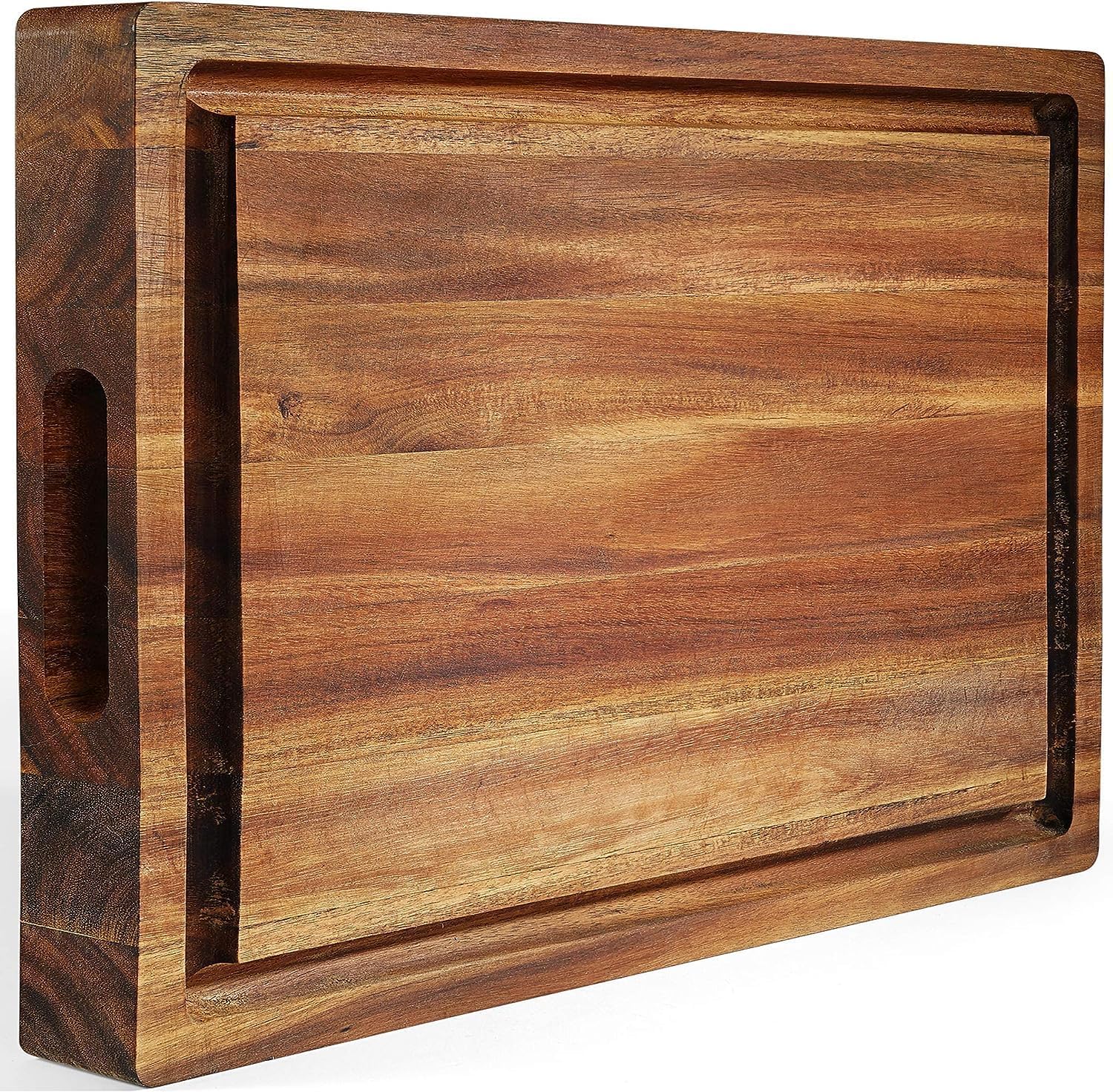
What sets this FANICHI board apart is its 1.5-inch thickness, which provides a butcher-block heft rarely found at this price. The added mass (8.6 pounds) absorbs cleaver blows without transferring shock to the counter, and the end-grain-like feel of the acacia fibers is noticeably gentler on Japanese-style blades. The front side features a deep juice groove around the perimeter, while the reverse side includes a dedicated long holder for catching bread and cheese crumbs.
Owners consistently praise the board’s pre-oiled finish, which arrives ready for immediate use. Reapplying mineral oil after several washes restores the water-repellent barrier, and users report no visible warping even after months of daily chopping. The natural color variation between boards means each piece has a unique grain pattern, adding a handcrafted aesthetic to the kitchen.
The inner side handles are flush with the board edge, making grabbing easy without interfering with flat storage. Some users note the board can slide on smooth countertops without a damp towel underneath, and the weight makes it awkward for small sinks. Still, for chefs who prioritize knife preservation and a solid cutting feel, this is a standout option.
Why it’s great
- 1.5-inch thick acacia absorbs impact and resists warping
- Two-sided design with juice groove and cracker holder
- Pre-oiled finish and beautiful natural grain pattern
Good to know
- Heavy at nearly 9 pounds; may be bulky to wash
- Can slide on smooth counters without a towel underneath
3. Socisen 3-Piece Bamboo Cutting Board Set

This three-piece Socisen set offers exceptional versatility by delivering three distinct board sizes for task-dedicated prep. The largest board (17×12 inches) handles primary chopping and carving, while the two smaller boards suit vegetables, cheese, or quick slicing. Each board features non-slip rubber feet that grip the counter firmly, a critical safety feature for heavy chopping sessions.
The bamboo construction uses a 5-layer splicing technique that resists cracking and warping, though bamboo is notably harder than acacia or rubberwood. This hardness means the surface is less forgiving on blade edges over long-term use, but it also makes the boards highly resistant to deep cut marks and staining. Users report that even beets did not leave lasting color after washing.
The set comes with rounded edges for comfortable handling and side handles on each board for easy transport. Bamboo requires hand washing and periodic mineral oil treatment, but the dense grain stays smooth even after months of use. If you want to separate raw meat, produce, and bread without buying individual boards, this set delivers excellent organization.
Why it’s great
- Three sizes for dedicated meat, veg, and bread prep
- Non-slip rubber feet ensure stability
- 5-layer bamboo resists warping and stains
Good to know
- Hard bamboo surface may dull knives faster than softer woods
- Hand wash only; not dishwasher safe
4. Thirteen Chefs 30 x 18 Plastic Cutting Board
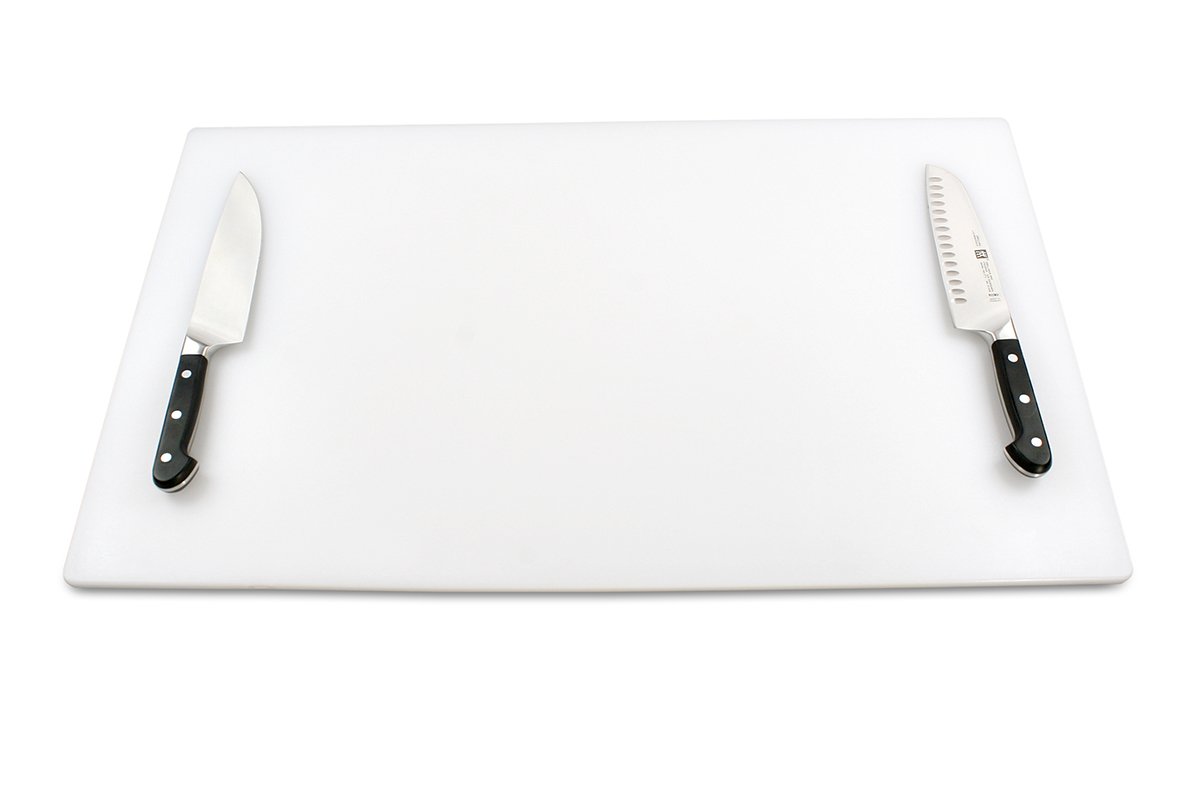
For chefs who need a board that can withstand commercial sanitation, this Thirteen Chefs board is a game-changer. Made from high-density polypropylene (HDPP), it carries NSF certification for use in restaurant kitchens and can handle 200°F commercial dishwashers. The 30×18 inch surface is enormous, designed for processing large quantities of meat, fish, or produce in one pass.
The 3/4-inch thickness and 13-pound weight make it stable and non-porous, resisting stains, odors, and bacterial growth better than wood. The bright white surface improves visibility when dicing dark ingredients, and the textured finish prevents food from sliding. However, the polypropylene surface is harder on knife edges than wood, so frequent honing will be necessary to maintain blade sharpness.
A major consideration is size — this board will not fit in a standard home sink or dishwasher, requiring spray-down cleaning in place or a commercial wash station. Users warn that the 30-inch length may overwhelm small kitchens. But for high-volume prep, game processing, or any scenario requiring rigorous sanitation, this board delivers unmatched durability.
Why it’s great
- NSF certified for commercial kitchen sanitation standards
- Non-porous HDPP resists stains, odors, and bacteria
- Dishwasher safe up to 200°F for easy cleaning
Good to know
- 30×18 size too large for most home sinks and dishwashers
- Poly surface dulls knives faster than wood
5. Winco WCB-1824 Rubberwood Cutting Board

The Winco WCB-1824 is an absolute workhorse of a cutting board, built from dense rubberwood at a formidable 1.75-inch thickness. Weighing nearly 18 pounds, it sits on the counter with zero shifting — no rubber feet needed. The rubberwood material is harder than acacia but softer than bamboo, making it a strong middle ground for blade protection while still resisting deep gouges from heavy cleaver work.
At 24×18 inches, it provides ample real estate for rolling dough, processing large cuts of meat, or serving as a heat-safe platform for hot appliances in small kitchens. Users consistently report that the board withstands heavy hacking without splitting, warping, or developing visible surface damage after months of use. The light tan color shows cut marks but also makes food debris easy to spot during cleaning.
The board arrives with a natural finish that benefits from immediate oiling to enhance its water resistance. Some units have arrived with minor corner damage during shipping due to the board’s weight and size, so inspecting upon arrival is recommended. For chefs who want a no-compromise surface that stays planted and can handle extreme daily abuse, this is the final answer.
Why it’s great
- 1.75-inch thick rubberwood absorbs heavy cleaver blows
- Nearly 18 pounds of weight ensures zero sliding
- Large 24×18 surface ideal for dough and large meat prep
Good to know
- Extremely heavy at 18 pounds; not portable
- Minor corner damage possible during shipping
FAQ
How often should I oil a wooden chef’s cutting board?
Is bamboo or acacia better for protecting expensive chef knives?
Final Thoughts: The Verdict
For most users, the cutting board for chefs winner is the GAOMON Acacia Board because it offers the most versatile size, a protective wood surface, and great value without the premium price. If you want a thicker, butcher-block feel with dual-sided functionality, grab the FANICHI XL Acacia Board. And for commercial-grade sanitation and massive prep capacity, nothing beats the Thirteen Chefs HDPP Board.

Mo Maruf
I created WellFizz to bridge the gap between vague wellness advice and actionable solutions. My mission is simple: to decode the research and give you practical tools you can actually use.
Beyond the data, I am a passionate traveler. I believe that stepping away from the screen to explore new environments is essential for mental clarity and physical vitality.