Our readers keep the lights on and my smoothie glass nicely filled. As an Amazon Associate, I earn from qualifying purchases.
That dull chef’s knife you keep avoiding? It’s not just slowing down your prep work—it’s actually more dangerous than a sharp one. Dull blades require extra force, and that extra force is what leads to slips and cuts. An electric knife sharpener fixes this by restoring a factory-level edge in under a minute, with zero guesswork and no manual stone technique required.
I’m Mohammad Maruf — the founder and writer behind WellFizz. I’ve spent countless hours researching the abrasive materials, motor power, and angle precision that define how well a home sharpener can actually perform.
After sorting through dozens of models and analyzing real owner feedback, I’ve narrowed down the options that deliver reliable, repeatable results. This is your complete guide to finding the best electric knife sharpener for your kitchen routine.
How To Choose The Best Electric Knife Sharpener
Every electric sharpener looks similar on a shelf, but the internal differences determine whether you get a polished razor edge or a rough burr that fades after a week. Focus on these three areas to avoid wasting money on a unit that chews up your blades.
Abrasive Material: Diamond vs. Sapphirite vs. Carbide
The abrasive material is the actual cutting surface that contacts your blade. Diamond abrasives offer the hardest and longest-lasting grit, making them the gold standard for both speed and consistency. Sapphirite wheels, used by Presto, are an ultra-hard ceramic alternative that performs well on standard steel. Tungsten carbide systems rely on replaceable blades and are common in manual pull-through units. For electric sharpeners, diamond or Sapphirite deliver the most consistent results without wearing out quickly.
Stage Count: What 2-Stage and 3-Stage Really Mean
A 2-stage sharpener uses a coarse wheel to grind a new edge and a fine wheel to hone it. A 3-stage system adds a polishing or stropping step between the coarse and fine stages, which removes the microscopic burr left by grinding and produces a smoother, sharper final edge. For most home cooks handling weekly maintenance, a 2-stage unit works fine. For heavy use or restoring badly neglected knives, a 3-stage system yields a noticeably better finish.
Angle Guide: Fixed vs. Flexible
Fixed angle guides lock the blade at a specific degree (usually 20 degrees) and are ideal for beginners who want consistent results without measuring or guessing. Flexible spring-loaded guides, like those found on Chef’sChoice models, automatically adjust to the blade’s curvature and grind a longer, arch-shaped edge. Fixed guides are simpler; flexible guides produce a more uniform edge across the full length of the blade, especially on curved chef’s knives.
Quick Comparison
On smaller screens, swipe sideways to see the full table.
| Model | Category | Best For | Key Spec | Amazon |
|---|---|---|---|---|
| Chef’sChoice 15XV | Premium | Serious home chefs | 3-Stage, 15-degree edge | Amazon |
| Chef’sChoice UltraHone | Premium | Straight & serrated blades | 2-Stage, 20-degree edge | Amazon |
| VIDOME 3-Stage | Premium | Ceramic & metal knives | 15-degree, diamond abrasives | Amazon |
| Grihot VN3 | Mid-Range | Serrated & pocket knives | Tungsten carbide, manual | Amazon |
| dskiley 3-Stage | Mid-Range | Beginner home cooks | 100% diamond, 20-degree | Amazon |
| Anylot 3-Stage | Mid-Range | Budget-conscious users | Diamond wheels, magnetic tray | Amazon |
| Presto 08800 | Budget | Entry-level, light use | 2-Stage, Sapphirite wheels | Amazon |
In‑Depth Reviews
1. Chef’sChoice 15XV Professional

The Chef’sChoice 15XV is the benchmark for electric sharpeners that serious home cooks trust. Its brushed metal upper housing adds weight and stability, reducing vibration during sharpening. The 3-stage EdgeSelect system uses 100-percent diamond abrasives in the first two stages to grind and hone, then a flexible stropping stage polishes the edge to a mirror finish.
What sets this model apart is the Trizor XV technology, which converts a standard 20-degree factory edge into a finer 15-degree edge. The result is a blade that cuts with noticeably less resistance. The flexible spring guides automatically adjust to the blade’s curve, producing a longer edge profile than fixed-angle sharpeners. First-time sharpening takes about a minute, and touch-ups are done in roughly ten seconds per blade.
Owners report that this unit restores badly neglected knives in a few passes and holds up well under heavy weekly use across a dozen or more blades. The motor is robust enough to handle frequent sessions without overheating, and the angled blade guides keep even full-tang chef’s knives stable during the pull-through.
Why it’s great
- Metal housing dampens vibration and adds durability.
- 3-stage diamond system creates a polished 15-degree edge.
- Flexible guides adapt to curved blades for uniform sharpening.
Good to know
- Removes more material than manual stones; use sparingly.
- Premium price point may exceed casual users’ budget.
2. Chef’sChoice UltraHone 0312000

The UltraHone is the simpler, more affordable sibling in the Chef’sChoice lineup, and it focuses on delivering better-than-factory sharpness for both straight-edge and serrated knives. It uses a 2-stage system with 100-percent diamond abrasives: Stage 1 grinds the primary edge, and Stage 2 uses advanced micron-size diamonds to refine and polish the blade.
This unit maintains the traditional 20-degree angle that fits most Western-style knives, including German steel brands like Wusthof and Henckels. The precision angle guides are fixed, so there is no learning curve—just pull the blade through each slot with light pressure. At just 16 ounces, it is the lightest model in this guide, making it easy to store in a drawer or hang on a magnetic strip.
Customer feedback consistently highlights how well it handles serrated bread knives and fishing fillet knives, which many sharpeners struggle with. The diamond wheels are aggressive enough to repair lightly nicked edges but fine enough to leave a smooth cutting surface. For anyone who owns a mix of straight and serrated blades and wants a single solution, this is the most versatile pick.
Why it’s great
- Diamond abrasives handle both straight and serrated blades effectively.
- Compact, lightweight design fits in small kitchens.
- Fixed 20-degree guides are foolproof for beginners.
Good to know
- 2-stage system lacks a dedicated polishing step.
- Plastic housing feels less durable than metal models.
3. VIDOME Professional 3-Stage
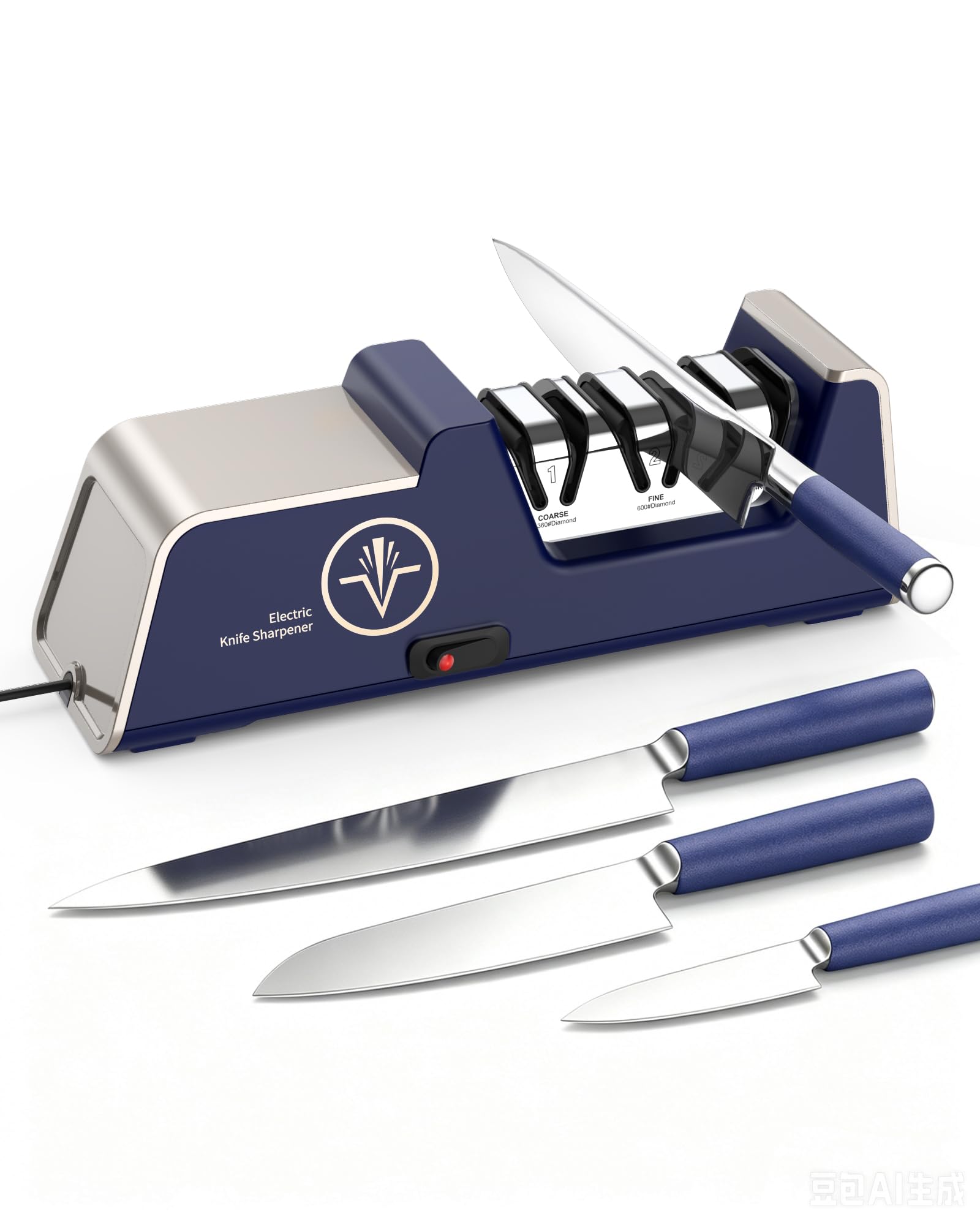
The VIDOME sharpener stands out because it explicitly supports ceramic knives, a feature most electric sharpeners avoid. Its 3-stage system uses 100-percent diamond abrasives in the first two stages to sharpen and hone, while the third stage uses stropping disks to polish the blade. The diamond material is hard enough to cut through ceramic without chipping the edge.
The unit applies a 15-degree edge angle, which is finer than the standard 20 degrees. This creates noticeably sharper cutting performance on vegetables and boneless proteins, but it also means the edge may wear faster on very hard steels. The elastic constant-force design uses spring-loaded guides that keep consistent pressure across the blade, reducing the risk of uneven grinding.
Owners have successfully restored both German steel chef’s knives and white ceramic blades in under a minute. The motor runs at a reasonable noise level, and the magnetic debris collector captures shavings for easy cleanup. The champagne gold finish adds a premium look, though the compact footprint still fits comfortably on most countertops.
Why it’s great
- Works on ceramic knives without causing edge chipping.
- 3-stage diamond system leaves a polished, burr-free finish.
- Spring-loaded guides provide even contact across the blade.
Good to know
- Slot placement requires pulling knives from one side only.
- 15-degree edge may need more frequent touch-ups on hard steel.
4. Grihot VN3 Sailboat
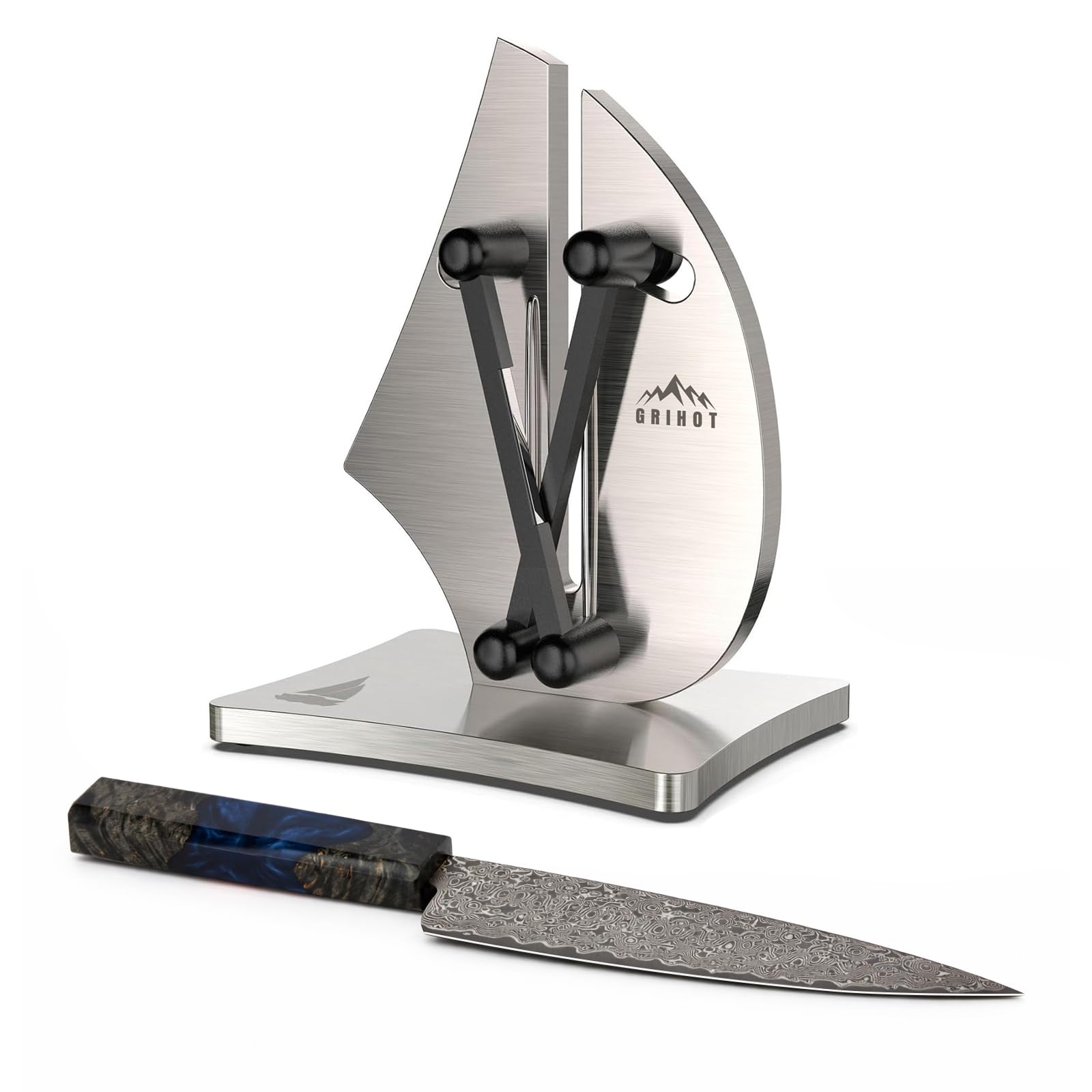
The Grihot VN3 is not an electric sharpener—it is a manual 3-action system built with Himalayan tungsten carbide blades and a solid 304 stainless steel housing. Its sailboat-shaped body is heavy at nearly 2 pounds, which keeps it planted on the counter during use. The two independent spring arms automatically adjust the sharpening angle to match the blade’s existing edge.
The 3-action system covers repair, restoration, and standard sharpening across three different slots. The coarse slot handles heavily dulled or nicked blades, the medium slot restores the edge, and the fine slot hones to a sharp finish. It also includes a dedicated slot for serrated knives, which is rare in manual sharpeners. Replacement carbide blades are included, extending the unit’s lifespan significantly.
This model bridges the gap between electric convenience and the control of a stone. It removes metal efficiently, so technique matters—pulling too fast or at the wrong angle can leave marks. Owners who take the time to practice report razor-sharp results on both German and Japanese steel, with the serrated slot handling bread knives and steak knives without catching.
Why it’s great
- Stainless steel and carbide construction is near-indestructible.
- Dedicated serrated slot handles bread and steak knives.
- Replaceable carbide blades extend the useful life of the unit.
Good to know
- Manual operation requires consistent pull speed and pressure.
- Heavier than most electric models, less portable.
5. dskiley 3-Stage Electric
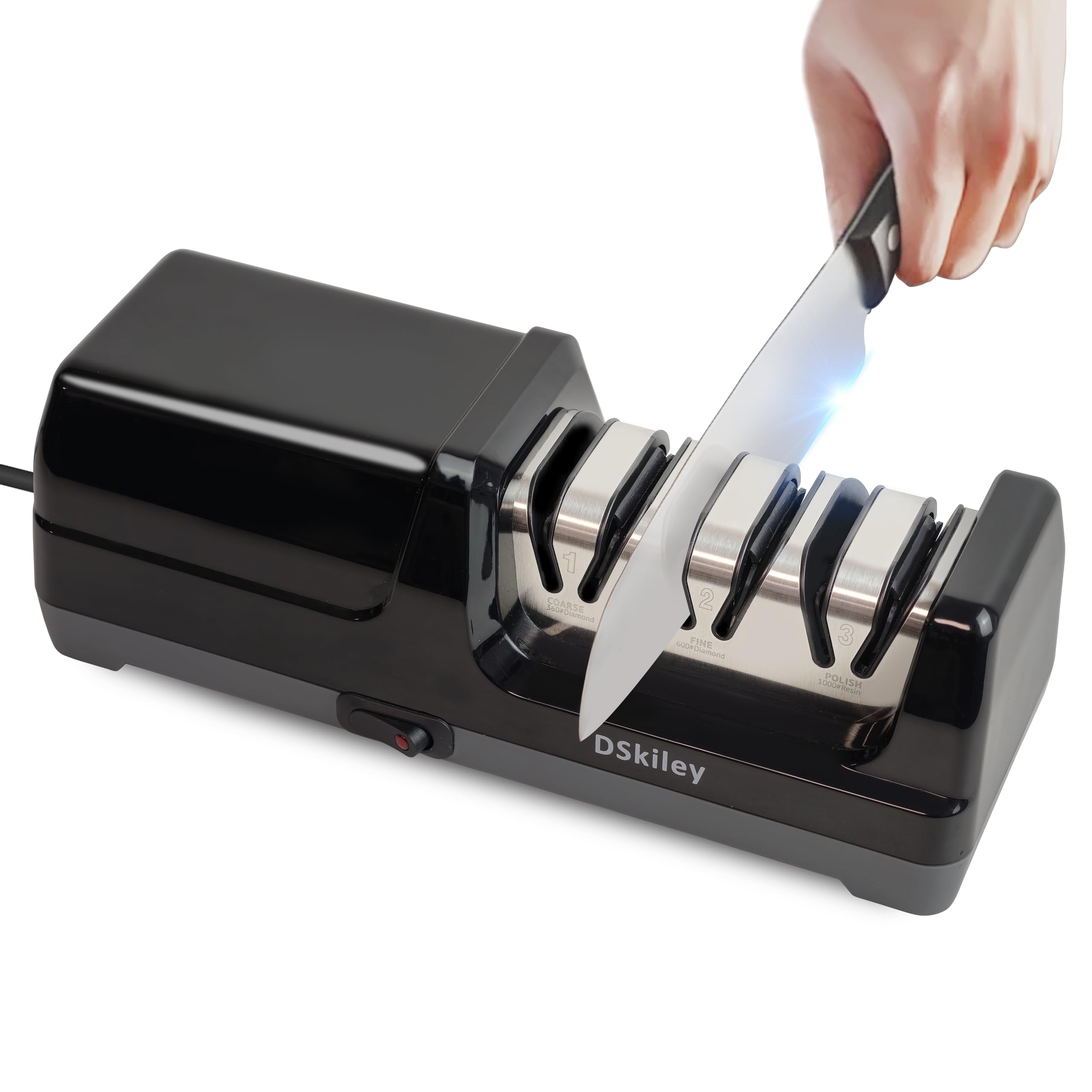
This dskiley model delivers a full 3-stage diamond sharpening system at a mid-range price that undercuts many competitors. It uses a fixed 20-degree angle guide, which is forgiving enough for Western-style kitchen knives and safe for beginners who worry about over-grinding. The three slots handle repair, sharpening, and polishing in a single pull-through sequence.
The motor is stable and quiet during operation, and the built-in magnetic collector catches most metal shavings for quick cleanup. The unit measures 12 inches long and 4.9 inches wide, giving it a stable base that resists sliding during use. It also comes in gift-ready packaging, making it a practical choice for anyone who wants to upgrade a family member’s kitchen tools.
Owner feedback highlights how quickly it restores old, neglected knives—several reviewers noted that knives they had given up on cut through meat and vegetables like new after just one session. The 3-stage process produces a visibly polished edge without the rough burr that some 2-stage sharpeners leave behind. The only common complaint involves knives with oversized handles that prevent the full blade from engaging with the slots.
Why it’s great
- 3-stage diamond system at a very competitive price point.
- Fixed 20-degree guide is beginner-friendly and safe.
- Magnetic tray keeps metal debris contained during sharpening.
Good to know
- Knives with bulky handles may not fit fully into the slots.
- Plastic body feels less premium than metal-housed units.
6. Anylot 3-Stage Electric
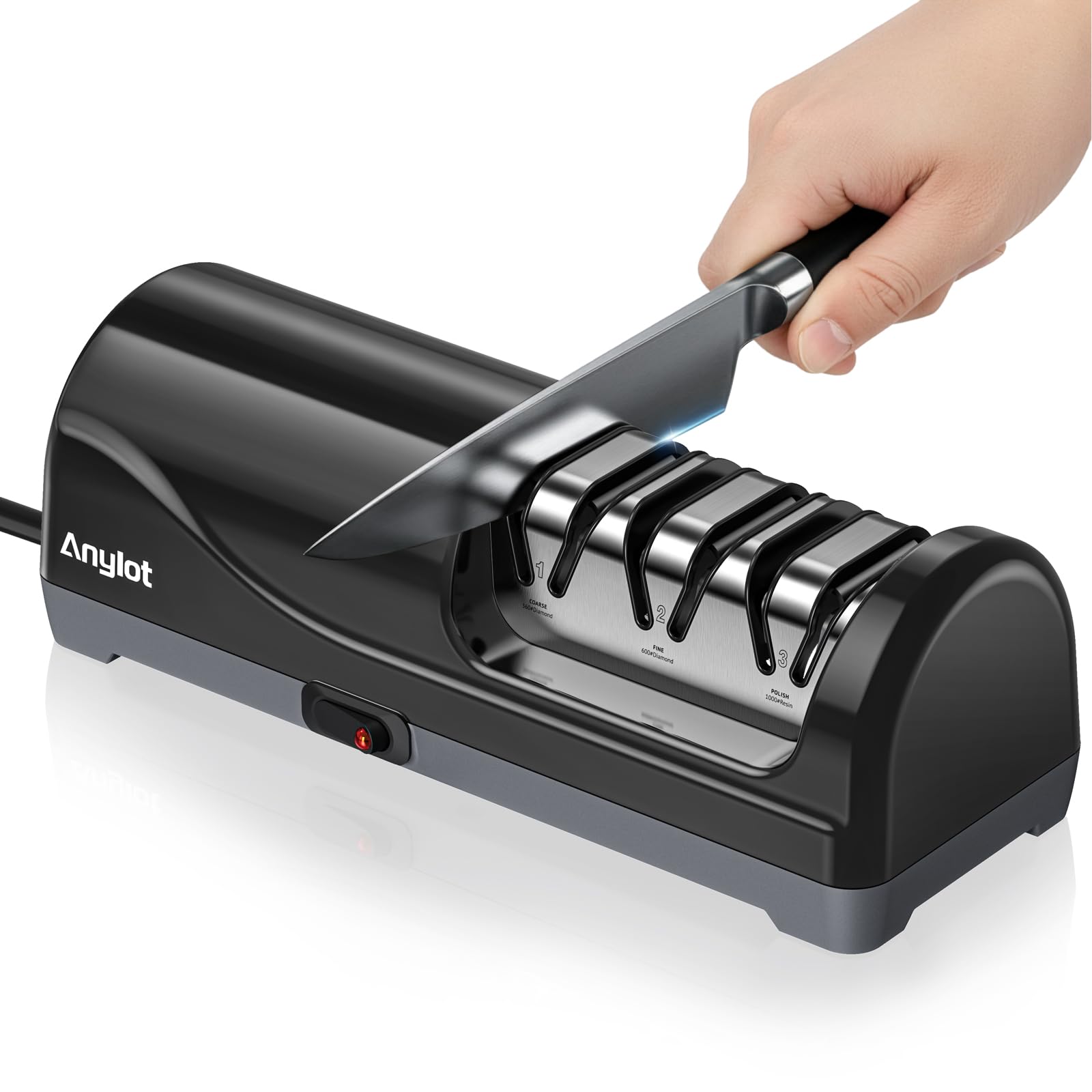
The Anylot 3-Stage sharpener brings 100-percent diamond abrasives into the budget-friendly tier without sacrificing the core features that matter. It uses a preset 20-degree angle guide that follows chef-recommended standards, so there is no need to guess the angle or risk uneven sharpening. The three-stage process repairs damaged edges, sharpens dull blades, and polishes the final surface.
The motor delivers smooth, consistent power without noticeable slowdown during multiple passes. A built-in magnetic debris collector gathers metal shavings as you sharpen, reducing the mess that usually follows a sharpening session. The anti-slip base keeps the unit firmly in place, even when pulling through wider chef’s knives that generate more lateral force.
Users report that it brings old knife sets back to life in a matter of minutes, and several note that it is especially helpful for people with arthritis or limited hand strength who struggle with manual sharpeners. The compact dimensions fit well in small kitchens, and the black finish hides fingerprints and smudges. The 12-month replacement policy adds peace of mind for first-time electric sharpener buyers.
Why it’s great
- Diamond wheels at a price that rivals basic carbide sharpeners.
- Magnetic tray and anti-slip base keep the workspace clean.
- Simple pull-through design is safe for beginners and seniors.
Good to know
- Some users report the actual angle is closer to 15 degrees than the listed 20.
- Edge retention may be slightly lower than premium diamond systems.
7. Presto 08800 EverSharp

The Presto 08800 is the most affordable electric sharpener in this lineup, but it earns its place through reliable performance and a proven 2-stage system. It uses Sapphirite sharpening wheels—an ultra-hard ceramic material found in professional sharpening shops—to grind a precise angle in Stage 1 and then fine-hone and polish in Stage 2. The precision blade guides lock the knife at the correct angle automatically, eliminating any guesswork.
Weighing just 3 pounds and measuring under 10 inches long, this unit is light enough to store in a drawer or move between counter and cabinet. The suction-cup feet help keep it anchored during use, though some users note they work best on smooth, non-textured surfaces. The motor runs quietly compared to many budget sharpeners, and the two wheels produce a consistent 20-degree edge suitable for most kitchen knives.
Real owners report that it sharpens even very dull, neglected knives to usable sharpness in 1 to 2 minutes, often in just three to four passes through the fine wheel. The coarse wheel handles nicked edges without stalling, but users recommend a honing rod afterward to remove the slight burr left by the fine wheel. For anyone who needs a no-frills, entry-level solution that gets the job done, the Presto 08800 is a proven choice.
Why it’s great
- Sapphirite wheels match professional shop durability.
- Lightweight and compact for easy storage.
- Two-stage system sharpens dull knives in under two minutes.
Good to know
- Short power cord limits placement options.
- Fine wheel can leave a burr that requires a separate honing rod.
FAQ
Can an electric sharpener damage my good kitchen knives?
What is the difference between a 15-degree and 20-degree edge?
Will these sharpeners work on serrated bread knives?
Final Thoughts: The Verdict
For most users, the best electric knife sharpener winner is the Chef’sChoice 15XV because its 3-stage diamond system, metal housing, and flexible spring guides produce a professional 15-degree edge that outperforms any other home unit. If you want a model that handles both straight and serrated blades at a lower price, grab the Chef’sChoice UltraHone. And for a budget-friendly entry point that still uses professional-grade Sapphirite wheels, nothing beats the Presto 08800.

Mo Maruf
I created WellFizz to bridge the gap between vague wellness advice and actionable solutions. My mission is simple: to decode the research and give you practical tools you can actually use.
Beyond the data, I am a passionate traveler. I believe that stepping away from the screen to explore new environments is essential for mental clarity and physical vitality.