Our readers keep the lights on and my smoothie glass nicely filled. As an Amazon Associate, I earn from qualifying purchases.
The sight of deep knife scars on a plastic board hiding bacteria is enough to make any home cook switch to wood. But the real worry isn’t just hygiene — it’s the hidden glues and finishes that can leach into your food. A truly non-toxic cutting board must start with a solid, untreated surface from the ground up.
I’m Mohammad Maruf — the founder and writer behind WellFizz. I’ve spent hundreds of hours analyzing wood grain types, glue-free construction methods, and food-safe finish certifications to separate marketing fluff from genuine kitchen safety.
After sorting through dozens of boards across bamboo, acacia, teak, and maple, I’ve narrowed the field to the seven that actually deliver on their clean promise. This guide to the best cutting boards non toxic breaks down exactly what makes each one a safe and lasting choice for your kitchen.
How To Choose The Best Cutting Boards Non Toxic
The biggest mistake buyers make is assuming any piece of wood is automatically safe. Many commercial boards use formaldehyde-based adhesives to bond layers together, especially in budget bamboo options. A true non-toxic board either uses a single solid piece of wood or a glue-free lamination process that avoids any chemical binders altogether. Always check for explicit claims about the construction method and the finish used.
Wood Type and Grain Orientation
Hardwoods like maple and teak offer natural density that resists knife scarring and bacterial penetration. Edge-grain construction provides the best balance of durability and knife-friendliness, while end-grain butcher block surfaces are gentler on blades but require more oil maintenance. Bamboo is technically a grass, not a wood — it’s hard and eco-friendly, but it can be tough on knives if not properly sanded. Acacia falls between bamboo and maple in hardness, offering a rich grain pattern and good moisture resistance without the premium price tag of teak.
Finish and Surface Treatment
A non-toxic board must be finished with food-safe mineral oil or a beeswax blend. Avoid any board that advertises a “lacquer” or “varnish” coating — those are not safe for direct food contact. The best boards arrive pre-seasoned or include a bottle of organic oil so you can maintain the surface yourself. Re-oiling every few weeks keeps the wood sealed against moisture, prevents the board from drying out and cracking, and maintains a naturally antimicrobial surface that plastic boards cannot replicate.
Construction and Joint Method
Look for single-piece boards or those assembled with a glue-free, tongue-and-groove, or compression method. Multi-piece boards that are glued together need to specify the adhesive type — ideally a food-safe, formaldehyde-free glue. If the product page does not mention the joint method, assume it uses standard wood glue that may contain urea-formaldehyde. Greener Chef’s glue-free surface technology is a standout example of engineering around this problem entirely.
Quick Comparison
On smaller screens, swipe sideways to see the full table.
| Model | Category | Best For | Key Spec | Amazon |
|---|---|---|---|---|
| Greener Chef Luxury Bamboo Set | Bamboo Set | Glue-free safety | 0.63″ thickness, 3-piece set | Amazon |
| EDELHAUS Acacia Set | Acacia Set | Dual-sided prep & serving | 16″ x 13″ x 3.5″ board size | Amazon |
| BABILONIA Acacia Board | Single Board | Thick 1.6″ stability with slide plate | 1.6″ thickness, edge-grain | Amazon |
| Ziruma FSC Acacia Set | Acacia Set | FSC-certified sustainability | 0.8″ thickness, 3-pack | Amazon |
| Socisen 5-Layer Bamboo Set | Bamboo Set | Non-slip heavy-duty build | 2.8″ total thickness, 5-layer | Amazon |
| Socisen Teak Wood Set | Teak Set | Moisture-resistant premium wood | 17″ x 12″ x 2.4″ board, 3-pack | Amazon |
| WoodForChef Maple Board | Single Maple | Hard maple edge-grain durability | 16″ x 12″ x 1.5″ edge-grain | Amazon |
In‑Depth Reviews
1. Greener Chef Luxury Bamboo Cutting Board Set of 3
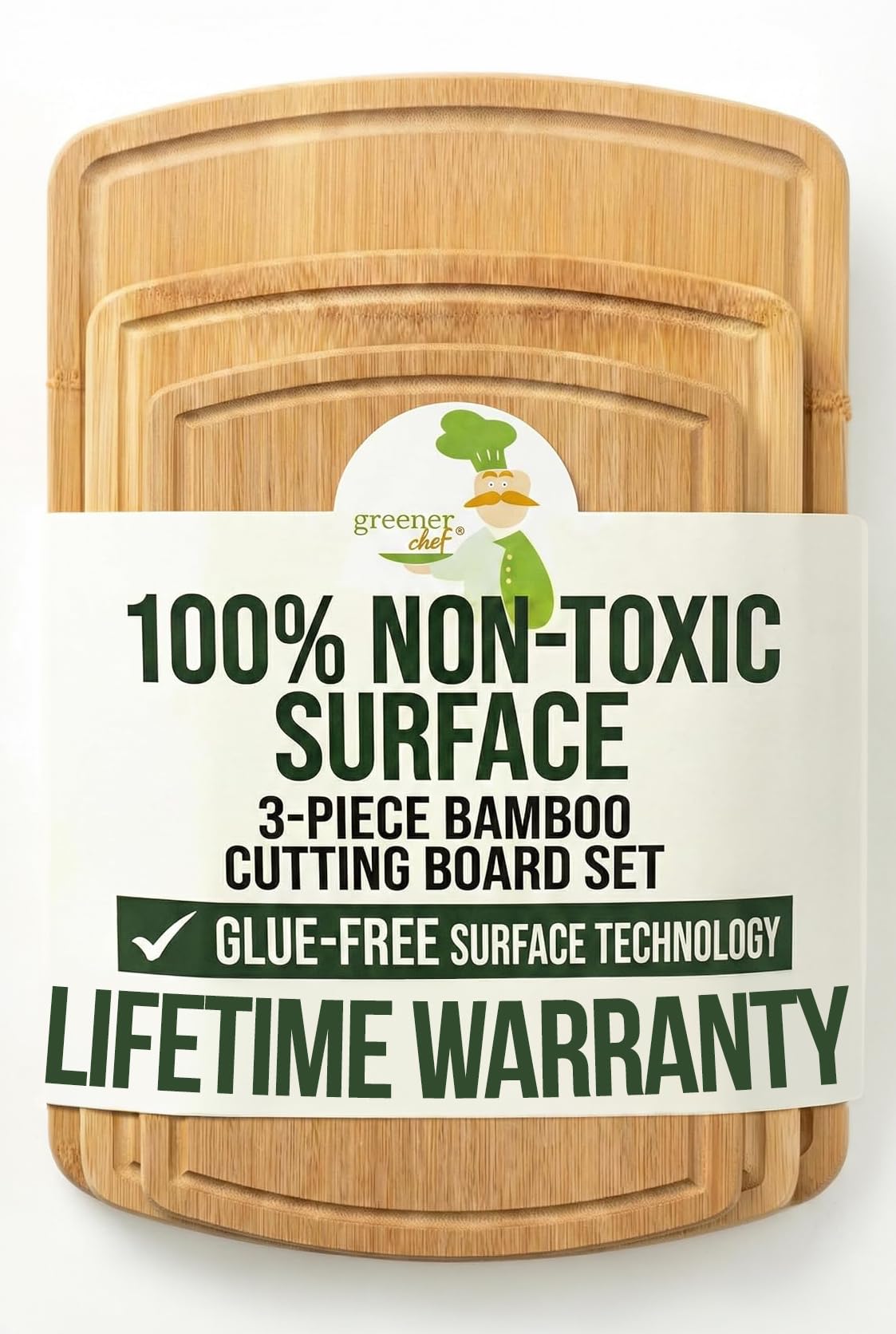
The Greener Chef set solves the single biggest concern with bamboo boards — hidden glue. Their patent-pending glue-free surface technology eliminates all glue and formaldehyde from the cutting surfaces, making this one of the safest bamboo options available. The boards measure 18×12.5, 15×11, and 12×9 inches, which is about 50% larger than most competing sets, giving you real room for meal prep without needing a separate butcher block.
At just 0.63 inches thick, these boards are noticeably lighter than thick-end grain blocks, which makes them easy to lift, wash, and store. The bamboo is dense with a smooth, knife-friendly surface that resists staining — even after cutting beets. Each board has a built-in juice groove to catch runoff from meats and fruits, and the boards are reversible for additional use. Users report no warping after daily hand-washing when following the recommended care routine of occasional mineral oil application.
The set comes with a lifetime replacement guarantee from a USA-based brand, which adds real peace of mind. The boards arrive pre-seasoned and ready to use out of the box, with a pleasant natural bamboo scent that fades after the first wash. For anyone wanting a non-toxic board set without the heavy weight of a traditional butcher block, this is the most practical choice.
Why it’s great
- Genuine glue-free construction eliminates formaldehyde risk
- 50% larger surface area than typical bamboo sets
- Lightweight at 0.63″ thick; easy to handle and store
- Industry-best lifetime replacement guarantee
Good to know
- Bamboo is harder on knife edges than maple or teak
- Requires occasional re-oiling to maintain luster
- Not dishwasher safe — hand wash only
2. EDELHAUS Acacia Wood Cutting Board Set of 3
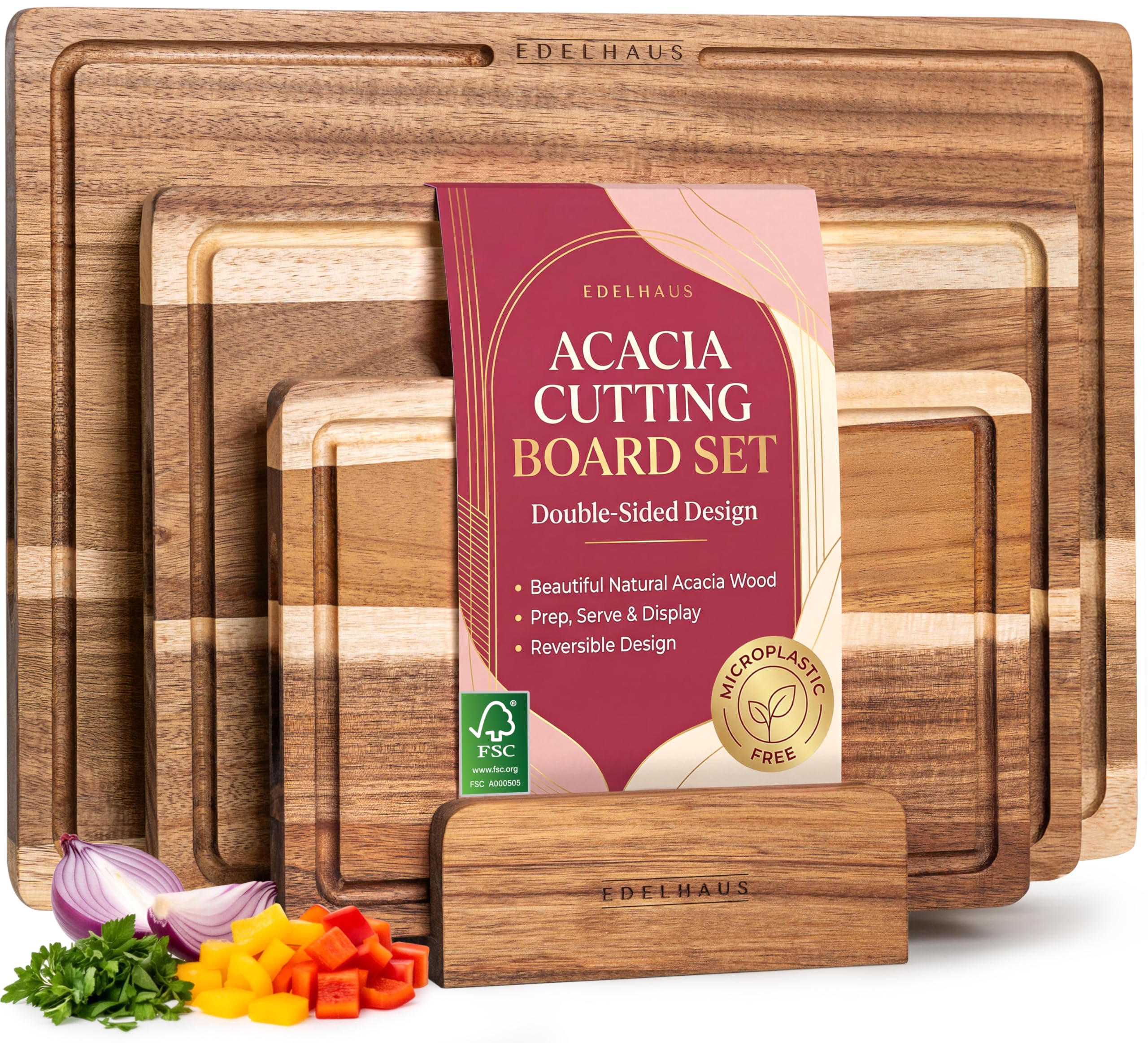
The EDELHAUS acacia set stands out for its dual-sided design — one side is a flat cutting surface for food prep, while the reverse has dedicated serving compartments for cheese, charcuterie, or appetizers. This eliminates the need for a separate serving board and makes the transition from kitchen to table seamless. Acacia wood is naturally antimicrobial and denser than bamboo, providing a good balance of durability and knife friendliness.
The set includes three boards measuring 15.7×11.8, 13×9.5, and 10.2×7 inches, covering everything from large meat prep to small vegetable chopping. Each board has a deep juice groove around the cutting side to catch liquids, and the included storage stand keeps the boards upright for air circulation and quick drying. Users note that the boards are thick and sturdy with a nice weight — they do not slide around on the counter during use.
One practical detail is the mild initial wood scent that fades after a few washes. The boards require hand-washing and immediate drying to maintain the wood integrity. The multi-purpose serving compartments make these a strong choice for home cooks who also entertain regularly. The set comes with a stand that looks attractive enough to leave on the counter as a kitchen accessory.
Why it’s great
- Double-sided design with cutting and serving sides
- Deep juice grooves catch liquids effectively
- Includes storage stand for organized drying
- Thick acacia wood resists cracking and warping
Good to know
- Must be dried immediately after washing to prevent moisture damage
- Initial wood smell requires a few washes to dissipate
- Serving compartments limit reverse side to non-cutting use
3. BABILONIA Acacia Wood Cutting Board 15.7 x 10.2 Inch
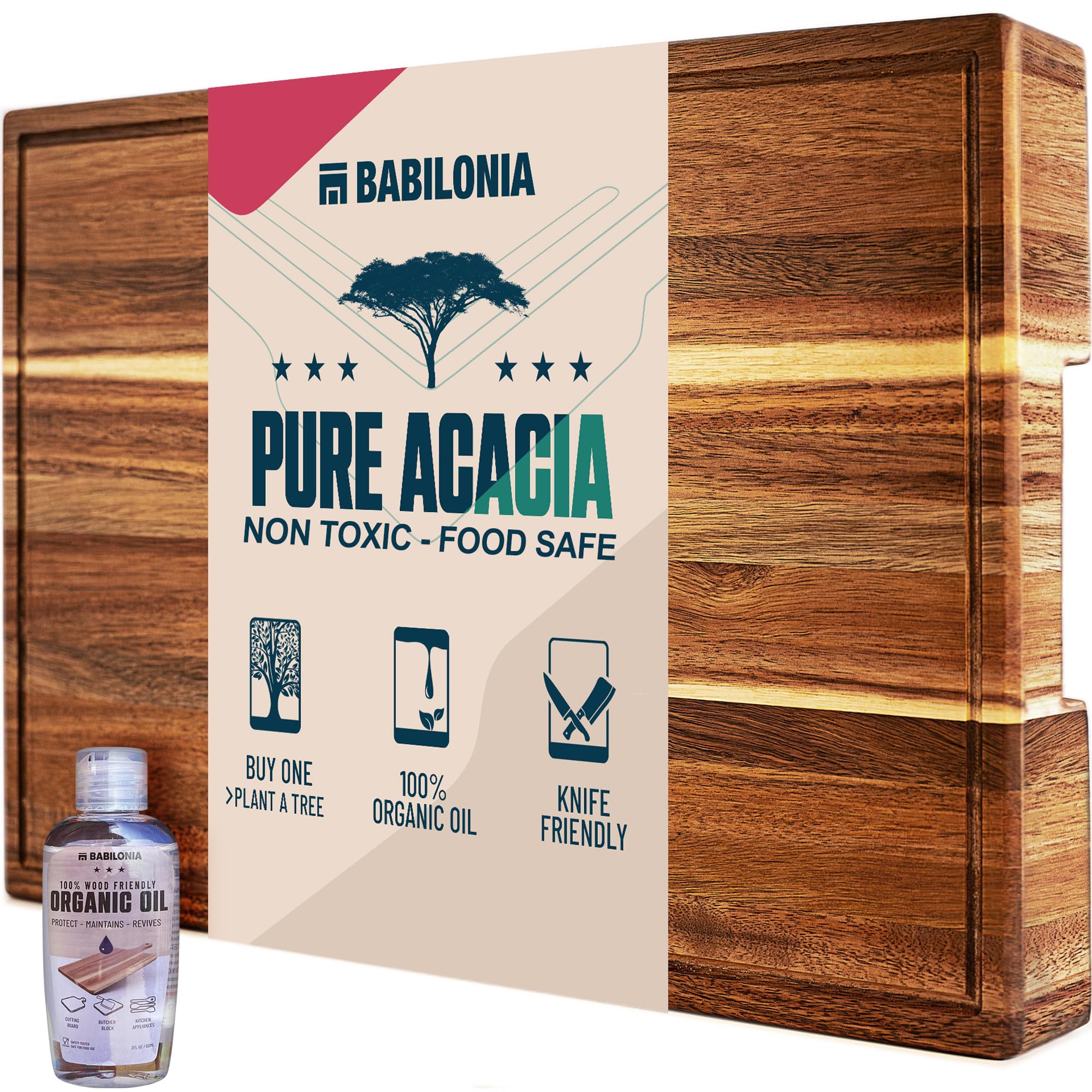
The BABILONIA board uses a 1.6-inch thick edge-grain acacia construction that gives it substantial weight and stability. Unlike thinner boards that flex or slide, this board sits solidly on the counter and absorbs knife impact without transferring energy to the blade. The edge-grain orientation makes it gentler on knives than bamboo or face-grain acacia, and the thickness allows for future sanding to refresh the surface after years of use.
The standout feature is the included sliding plate that fits into a notch at the board’s edge. This lets you chop vegetables and slide them directly into a pot or bowl without lifting the board — a small ergonomic win that makes cooking feel smoother. The board also has a hidden handle on one side for easy transport, and the reverse side is flat for use as a serving tray. The set comes with a bottle of organic oil and a small plate, so you can start seasoning immediately out of the box.
Users who use the board 5-6 times per week report that it holds up well with just one re-oiling after the initial seasoning. The wood has a rich, warm color that deepens with oiling, and the natural grain pattern makes it attractive enough to leave on the counter full-time. This is a single-board solution for those who want a thick, stable cutting surface with a genuinely useful slide-plate convenience.
Why it’s great
- 1.6″ edge-grain acacia provides excellent stability and knife-friendliness
- Innovative slide plate allows direct transfer of chopped food to pots
- Comes pre-seasoned with organic oil included for maintenance
- Hidden handle and reversible design for serving
Good to know
- Single board only — no smaller secondary board included
- Requires hand-washing and occasional re-oiling
- Slide plate is an additional piece that can be misplaced
4. Ziruma FSC Acacia Wood Cutting Board Set
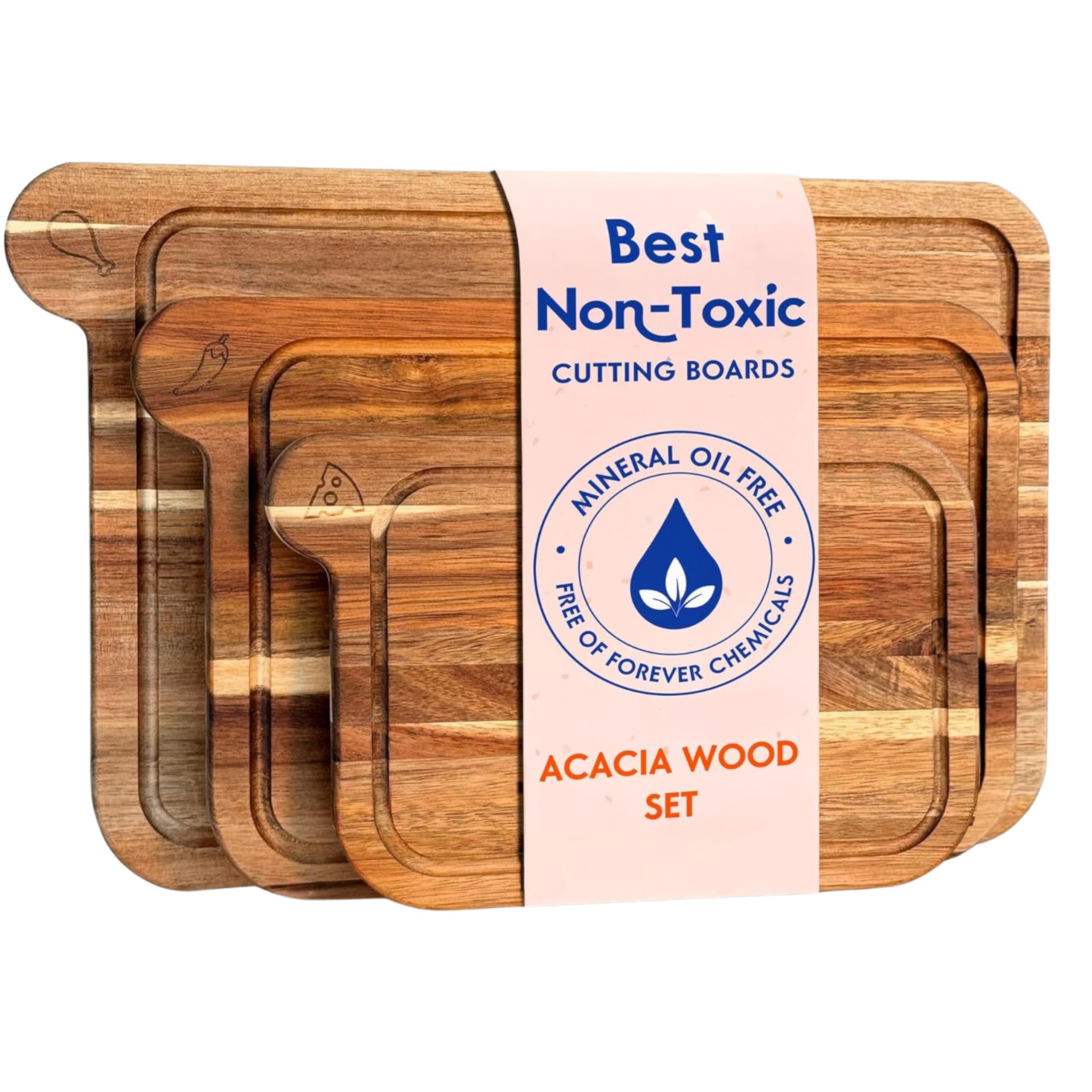
The Ziruma set is built from FSC-certified acacia wood, which means each board comes from responsibly managed forests with verified ethical sourcing. The 0.8-inch thickness is slightly heavier than thin bamboo boards but still manageable for daily handling. Each board has a deep juice groove and etched icons on the surface that designate which board is best for meat, vegetables, and dairy — a practical system to prevent cross-contamination if you follow strict food prep separation.
The acacia grain is rich and varied, with dark brown streaks that give the boards a premium look suitable for serving charcuterie or cheese at the table. The wood is dense and low-porosity, which means it naturally resists absorbing odors and bacteria compared to softer woods. Users who switched from plastic boards report a noticeable improvement in both the feel of the cut and the lack of lingering smells after washing.
A minor drawback reported by some users is that the etched icons and juice grooves can trap food particles, requiring more thorough scrubbing than a flat board. The boards do not have hanging holes, and they arrived with a mineral oil finish rather than the beeswax described in the listing. Despite these small quirks, the set offers strong value for its FSC certification and solid acacia construction, especially for eco-conscious buyers.
Why it’s great
- FSC-certified acacia from responsibly managed forests
- Etched icons help separate meat, veggies, and dairy prep
- Dense, low-porosity wood resists odors and bacteria
- Rich natural grain suitable for serving use
Good to know
- Etched grooves and icons require thorough cleaning to avoid food trapping
- No hanging holes for wall storage
- Arrived oiled — not beeswax finished as advertised
5. Socisen 5-Layer Heavy Duty Bamboo Cutting Board Set of 3

The Socisen set is built with a 5-layer bamboo splicing technique that makes the boards roughly twice as thick as standard bamboo cutting boards. The total thickness is 2.8 inches per board, giving them the heft of a small butcher block without the weight of solid end-grain wood. Each board has non-slip rubber feet on the bottom that grip the counter securely during heavy chopping and carving, and the rounded edges provide a comfortable grip for carrying.
All three boards are hand-sanded and finished with food-grade mineral oil, making them ready to use out of the box. The surface is ultra-smooth with no burrs or splinters, and the dense bamboo is gentle enough to avoid rapid knife dulling — a common complaint with cheaper bamboo boards. The set includes a large 17×12-inch board for meat and larger prep tasks, along with medium and small boards for vegetables and fruit.
Users appreciate the easy-carry handles on each board and the included storage stand that keeps the set organized. The juice groove is deep enough to manage runoff from steaks and roasts, though one user noted it can overflow when resting medium-rare cuts with significant juices. The natural bamboo color and grain pattern make this set visually appealing enough for countertop display. For those who want the non-toxic benefits of bamboo with the stability of a heavy-duty board, this is a strong contender.
Why it’s great
- 5-layer construction provides exceptional thickness and durability
- Non-slip rubber feet keep the board stable during heavy use
- Hand-sanded with food-grade mineral oil finish
- Includes storage stand and easy-carry handles
Good to know
- Juice groove can overflow with very juicy meats
- Bamboo surface is harder than maple or teak on knife edges
- Requires occasional re-oiling to prevent drying
6. Socisen Teak Wood Cutting Board Set of 3
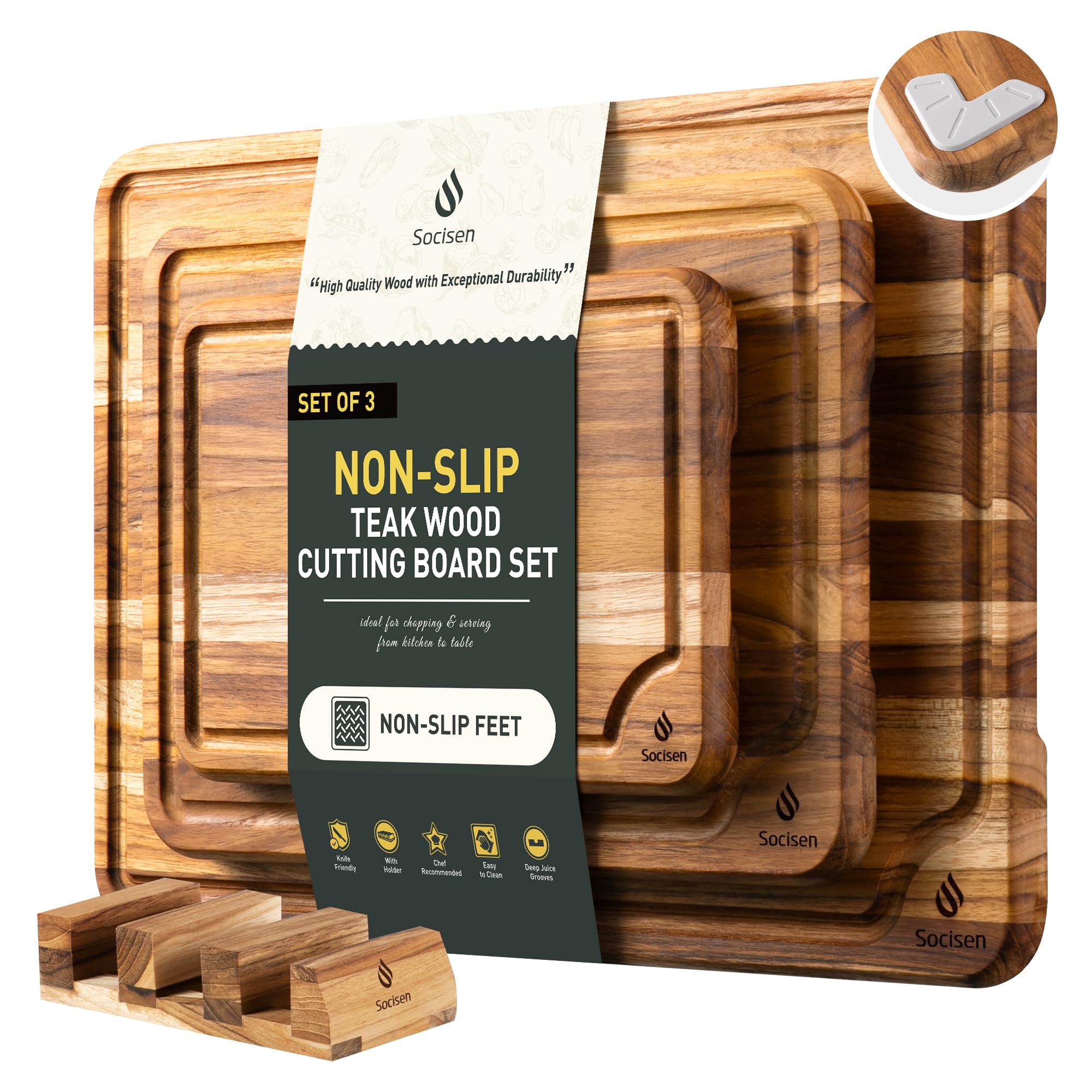
Teak wood is naturally resistant to moisture, making it one of the best materials for a long-lasting cutting board. The Socisen teak set uses FSC-certified teak with a non-slip base and rounded edges, and the set includes three boards in 17×12, 13×10, and 10×7-inch sizes. Teak’s natural oil content means it does not absorb water as readily as maple or bamboo, and it resists mold growth even in humid kitchen environments.
The boards have a beautiful straight grain pattern that looks elegant on the counter, and the surface provides a smooth glide when cutting. Users report that the teak is gentler on knives than bamboo, and the hidden handles make it easy to lift and carry each board. The juice groove is well-positioned to catch runoff, and the non-slip rubber feet prevent the boards from moving during carving. The included storage stand keeps the boards upright for air drying.
One user noted that the teak boards produce a slightly louder chopping sound compared to maple, but this is a minor trade-off for the superior moisture resistance. The boards require hand-washing and occasional oiling, but the natural durability of teak means they need less frequent maintenance than softer woods. The set also comes with a storage stand that keeps the boards organized and allows for proper air circulation. For those who cook in humid environments or want a wood that naturally repels moisture, teak is the answer.
Why it’s great
- Teak’s natural oil content resists moisture and mold
- Non-slip rubber feet keep boards stable during use
- Includes three practical sizes with hidden handles
- FSC-certified from responsibly managed forests
Good to know
- Chopping sound is slightly louder than maple boards
- Requires hand-washing and occasional oiling
- Teak is a premium wood with a higher price point
7. WoodForChef Medium Maple Cutting Board 16x12x1.5

Maple is the gold standard for butcher blocks because of its tight grain structure that resists knife scars and bacterial penetration. The WoodForChef board uses edge-grain construction from responsibly sourced North American hardwood, and it is FSC Certified. The 16x12x1.5-inch size is large enough for carving a roast or prepping a full meal, but still manageable to lift and store. The reversible design means both sides are usable — one side has a deep juice groove, and the flat side works for tasks that need a clean, uninterrupted surface.
The board arrives pre-seasoned with a mineral oil and beeswax blend, making it ready for immediate use. Users note that the hard maple surface is noticeably durable — even after months of daily use, knife marks are minimal and the board maintains a flat, warp-free surface. The weight of the board (8 pounds) keeps it planted on the counter without needing non-slip feet, and the surface provides a satisfying feel when chopping that softer woods cannot match.
One important note: some users received the board in an “uncoated” state and needed to apply multiple coats of oil before first use. The manufacturer recommends oiling before initial use, and the wood responds well to a good seasoning. The lack of a storage stand is a minor drawback, but the board’s size and quality make it a long-lasting investment. For those who want the most durable, knife-friendly surface available, maple edge-grain is the benchmark, and this board delivers on that promise.
Why it’s great
- Hard maple edge-grain is the most durable and knife-friendly wood
- FSC-certified from responsibly sourced North American hardwood
- Deep juice groove on one side; flat surface on the reverse
- Pre-seasoned with food-safe mineral oil and beeswax
Good to know
- Heavier than bamboo or acacia at 8 pounds
- May require additional oiling before first use depending on batch
- No included storage stand
FAQ
How do I know if a cutting board is truly non-toxic?
Is bamboo a good material for a non-toxic cutting board?
How often should I oil a non-toxic wood cutting board?
Final Thoughts: The Verdict
For most users, the best cutting boards non toxic winner is the Greener Chef Luxury Bamboo Set because it eliminates formaldehyde risk entirely with its glue-free surface technology while offering the largest usable surface area in a lightweight, well-priced set. If you want the dual functionality of prep and serving, grab the EDELHAUS Acacia Set. And for those who need the absolute durability and knife-friendliness of a hard maple butcher block, the WoodForChef Maple Board is the long-term investment that will outlast all others.

Mo Maruf
I created WellFizz to bridge the gap between vague wellness advice and actionable solutions. My mission is simple: to decode the research and give you practical tools you can actually use.
Beyond the data, I am a passionate traveler. I believe that stepping away from the screen to explore new environments is essential for mental clarity and physical vitality.