Our readers keep the lights on and my smoothie glass nicely filled. As an Amazon Associate, I earn from qualifying purchases.
The water coming out of your tap looks clear, but the invisible load of dissolved solids — minerals, salts, metals — tells a different story. A digital drinking water tester puts a number to that story, revealing the total dissolved solids (TDS) in parts per million. That single number can confirm whether your expensive reverse osmosis filter is actually working, or whether your supposedly pure bottled water is just fancy tap water.
I’m Mohammad Maruf — the founder and writer behind WellFizz. This guide is the result of cross-referencing hundreds of verified customer experiences with the technical specifications that actually define accuracy in this narrow category, from probe material and measurement range to automatic temperature compensation.
Whether you are monitoring a home RO system, checking aquarium conditions, or verifying the output of a water distiller, knowing the right specs separates a useful tool from a frustrating guess. That is why I built this guide to the best digital drinking water tester around the features that matter most for real-world use.
How To Choose The Best Digital Drinking Water Tester
Not all TDS meters are built the same. The cheap pen-style testers and the more robust units differ in probe quality, measurement range, and temperature compensation. Understanding these differences will save you the frustration of inconsistent readings and premature failure.
Probe material and build quality
The probe is the only part of the tester that touches the water. Titanium alloy probes resist corrosion far better than standard stainless steel. If you plan to test water across a range of temperatures or leave the meter in storage for long periods between uses, a titanium probe will hold its accuracy longer.
Automatic temperature compensation (ATC)
Readings from water at 40°F versus 80°F can differ significantly without compensation. ATC adjusts the measurement based on water temperature so you get the same TDS reading from cold tap water and room-temperature bottled water. Meters without ATC are less reliable for consistent monitoring.
Measurement range and resolution
Most home meters offer a 0–9990 ppm range. The resolution matters more at the low end — 1 ppm increments for readings below 999 ppm allow you to detect subtle changes that indicate a filter is starting to fail. Units that jump in 10 ppm increments below 1000 ppm are less sensitive.
Quick Comparison
On smaller screens, swipe sideways to see the full table.
| Model | Category | Best For | Key Spec | Amazon |
|---|---|---|---|---|
| HoneForest TDS Meter | 3-in-1 Meter | Home RO system monitoring | Titanium alloy probe | Amazon |
| iSpring TDS2 | 2-Button Tester | Hard water ppm testing | Backlit LCD display | Amazon |
| INKBIRD 3-in-1 TDS Meter | Backlit Meter | Low-light reading conditions | ATC stainless steel probe | Amazon |
| HM Digital TDS-EZ | Economy Tester | Quick before/after comparisons | 1000-hour battery life | Amazon |
| HM Digital TDS-3 | Commercial Grade | Hydroponics nutrient tracking | ±2% readout accuracy | Amazon |
In‑Depth Reviews
1. HoneForest TDS Meter

The HoneForest meter uses a titanium alloy probe paired with an intelligent chip to deliver stable readings across the full 0–9990 ppm range. Unlike standard stainless steel probes that can corrode over time, the titanium alloy resists degradation, making this meter a long-term companion for homeowners testing tap, filtered, and RO water. The backlit LCD and auto-lock function simplify use in dim cabinets or basements where you might keep your water filtration system.
Users consistently report accurate results that match their expectations — tap water around 98 ppm, distilled water at 0 ppm, and filtered water in the 80s. The meter also measures electrical conductivity (EC) and temperature in both Fahrenheit and Celsius, giving you three metrics from a single dip. The included leather carrying case protects the probe tip between uses, a thoughtful detail that cheaper meters omit entirely.
The auto-shutoff triggers after two minutes of inactivity, which conserves the coin-cell battery well. While the meter does not include batteries out of the box, the LR44 cells are widely available and inexpensive. For a mid-range investment, this unit delivers the most balanced feature set: titanium durability, backlit readability, and three measurement functions in a compact form factor.
Why it’s great
- Titanium alloy probe offers superior corrosion resistance
- Backlit LCD with auto-lock simplifies recording readings
- Includes protective leather carrying case
Good to know
- Batteries not included
- Plastic body feels lightweight
2. iSpring TDS2

The iSpring TDS2 is purpose-built for testing hard water contaminated with arsenic, lead, aluminum, and other metals commonly found in municipal supplies. Its two-button interface keeps operation simple — one button powers the unit on, the other holds the reading so you can remove the meter from the water before jotting down the measurement. The backlit LCD is crisp, though some users note the digits could be clearer at certain angles.
Customer reports show this meter accurately distinguishes between unfiltered tap water at 750 ppm and RO-filtered water at 50 ppm, confirming that the RO membrane is performing correctly. iSpring backs the unit with a 30-day money-back guarantee and lifetime customer support from their Atlanta office, a level of after-sales service rare at this price point. The automatic shut-off conserves battery life, and the included case prevents the probe cap from going missing.
One limitation: the TDS2 is a basic TDS meter only. It does not measure EC or temperature, so if you need those extra data points, you will need to look elsewhere. Several long-term users report the unit still working accurately after eight years, which speaks to the build quality and the reliability of the internal microprocessor.
Why it’s great
- Lifetime technical support from US-based team
- Hold function simplifies recording readings
- Proven eight-year durability in customer reviews
Good to know
- No EC or temperature measurement
- Not waterproof — submerge only 2 inches
3. INKBIRD 3-in-1 TDS Meter
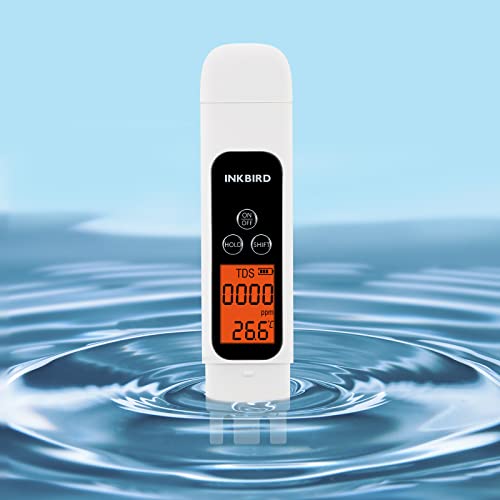
The INKBIRD 3-in-1 TDS meter stands out for its automatic temperature compensation (ATC) using a food-grade stainless steel probe. ATC ensures that readings remain accurate whether you are testing ice-cold well water or warm tap water, a feature that matters if you track water quality across different seasons. The meter measures TDS from 0 to 4995 ppm and EC from 0 to 9990 µs/cm, with a temperature display that one reviewer confirmed matched a Fluke digital multimeter at 25°C.
The backlit LCD is notably bright, making it easy to read in dark utility closets or during nighttime aquarium checks. Unlike many competitors that use coin-cell batteries, this unit runs on two standard AAA batteries, which are easier to find and replace. Users who have owned the meter for four years report it remains reliable, especially when stored without batteries between uses.
The main drawbacks are ergonomic. The probe cap requires significant force to remove, which may be difficult for users with arthritis or limited hand strength. The battery cap also lacks a locking mechanism — one reviewer accidentally opened it and lost the batteries. Despite these quibbles, the INKBIRD delivers professional-grade ATC accuracy at an accessible price point.
Why it’s great
- Automatic temperature compensation for consistent readings
- Runs on replaceable AAA batteries
- Bright backlit display for low-light use
Good to know
- Tight probe cap difficult for some users
- Battery cap prone to accidental opening
4. HM Digital TDS-EZ

The HM Digital TDS-EZ is the entry-level workhorse of the category. Its translucent purple housing is durable enough to survive drops, and the large LCD is easy to read without a backlight. The measurement range covers 0 to 9990 ppm with 1 ppm resolution below 999 ppm, giving you the granularity needed to detect small changes in water quality. A TDS chart sticker on the back explains what the numbers mean, which is helpful for first-time users.
Battery life is a standout specification here — roughly 1000 hours of continuous use from two included LR44 button cells. The auto-off function kicks in after ten minutes of inactivity, so the batteries will last months or even years under normal household use. The hold function locks readings for convenient recording, and the meter can be recalibrated with a mini-screwdriver if you purchase a calibration solution.
The TDS-EZ lacks automatic temperature compensation, which means readings can shift slightly with water temperature. For simple before-and-after comparisons — tap versus filtered — this is rarely an issue, as one reviewer noted only a 2 ppm difference compared to pricier units. If you need absolute accuracy across varying temperatures, a meter with ATC is a better fit, but for most home monitoring tasks, the TDS-EZ gets the job done reliably.
Why it’s great
- Exceptional 1000-hour battery life
- Recalibration possible with screwdriver
- Includes TDS chart sticker for reference
Good to know
- No automatic temperature compensation
- Readings can shift with water temperature
5. HM Digital TDS-3

The HM Digital TDS-3 is positioned as a commercial-grade instrument, and the specifications back that claim. With ±2% readout accuracy and 1 ppm resolution in the 0–999 ppm range, this meter is precise enough for hydroponic nutrient tracking, aquarium salinity checks, and professional water testing. The advanced microprocessor technology provides stable readings even when testing multiple water sources in quick succession.
The meter includes a carrying case with a belt clip, making it easy to carry around a facility or greenhouse. The hold function works reliably, and the auto-off timer saves battery power after ten minutes. One reviewer replaced a defective iSpring meter with the TDS-3 and reported superior build quality and identical accuracy test results. The built-in digital thermometer adds temperature information without requiring a separate device.
Battery life is rated at only three hours of use, which is considerably shorter than the TDS-EZ. This makes the TDS-3 better suited for occasional professional use rather than daily household monitoring. The unit is also not waterproof, so care is needed when testing to avoid submerging the electronics beyond the probe tip. For commercial environments where accuracy matters more than battery longevity, the TDS-3 earns its reputation.
Why it’s great
- High ±2% readout accuracy
- Includes carrying case with belt clip
- Built-in digital thermometer
Good to know
- Battery life is only 3 hours
- Not waterproof
FAQ
What is a safe TDS level for drinking water?
Can a TDS meter test for harmful bacteria or lead?
Why do my readings vary when I test the same water twice?
Final Thoughts: The Verdict
For most users, the best digital drinking water tester winner is the HoneForest TDS Meter because its titanium alloy probe, backlit LCD, and three-function measurement deliver reliable accuracy at a reasonable investment. If you want premium build quality and lifetime customer support, grab the iSpring TDS2. And for entry-level budget buyers who just need a quick before-and-after comparison, nothing beats the HM Digital TDS-EZ.

Mo Maruf
I created WellFizz to bridge the gap between vague wellness advice and actionable solutions. My mission is simple: to decode the research and give you practical tools you can actually use.
Beyond the data, I am a passionate traveler. I believe that stepping away from the screen to explore new environments is essential for mental clarity and physical vitality.