Our readers keep the lights on and my smoothie glass nicely filled. As an Amazon Associate, I earn from qualifying purchases.
The right ergonomic seat uses targeted lumbar curves, adjustable seat depth, and breathable mesh to keep your skeleton aligned from morning coffee to final email. This isn’t about padding; it’s about support that moves with you minute by minute.
I’m Mohammad Maruf — the founder and writer behind WellFizz. I’ve spent hundreds of hours cross-referencing foam densities, gas-lift certifications, and real-user durability reports to separate chairs that truly support all-day sitting from those that only look like they do.
Whether you’re coding, writing, or managing remote teams, your chair determines how your body feels at 5 p.m. This guide cuts through the noise to help you find the absolute best desk chair for sitting all day that fits your height, weight, and work habits without the guesswork.
How To Choose The Best Desk Chair For Sitting All Day
An all-day chair must solve three problems: spine support, pressure distribution, and temperature management. If any one of these fails, your body will rebel within hours. Focus on these specific specs to avoid that outcome.
Adjustable Lumbar and Seat Depth
A fixed lumbar bump can’t align with every spine. Look for vertical and depth adjustment so the support pad actually fills your lower back curve. Equally critical is a sliding seat pan — without it, tall users lose thigh support and short users feel edge pressure on the backs of their knees.
Mesh vs High-Density Foam
Mesh seats breathe, reducing sweat buildup during long sessions, but they require a firm frame to avoid sagging. High-density foam (55D or higher) offers plush initial comfort but can trap heat. The best all-day chairs use a mesh back for cooling and either a foam or tight-weave mesh seat that resists permanent compression.
Armrest and Headrest Adjustability
Fixed armrests force your shoulders to hunch or spread. 3D or 4D armrests let you match desk height and typing angle, reducing neck and upper-back strain. A headrest is optional but helpful if you recline during calls — it must tilt and slide to avoid pushing your head forward.
Quick Comparison
On smaller screens, swipe sideways to see the full table.
| Model | Category | Best For | Key Spec | Amazon |
|---|---|---|---|---|
| Steelcase Leap | Premium | Spine-mimicking support | 3D LiveBack + Natural Glide System | Amazon |
| Herman Miller Aeron Size C | Premium | PostureFit sacral support | Adjustable PostureFit SL lumbar | Amazon |
| Hbada X7 Smart | Premium | Auto lumbar tracking + massage | Gravity-sensing lumbar + 8D massage | Amazon |
| FLEXISPOT ErgoX-PRO | Mid-Range | Full adjustability + footrest | 5D lumbar + 7D armrests + 551lbs cap | Amazon |
| WorkPro Quantum 9000 | Mid-Range | Durable mesh for 8-10hr shifts | Ratchet back height + seat depth | Amazon |
| Branch Ergonomic Chair | Mid-Range | Petite users and clean styling | 8 adjustment points + aluminum frame | Amazon |
| ProtoArc EC200 | Mid-Range | Budget value with seat depth adjust | 1.97″ sliding seat + 55D foam | Amazon |
| ELABEST Ergonomic Mesh | Budget | Shoulder-friendly bionic-curve back | Golden Triangle shoulder support | Amazon |
| MOLENTS Ergonomic Chair | Budget | Full mesh build with responsive service | Premium high-elastic full mesh | Amazon |
In‑Depth Reviews
1. Steelcase Leap Office Chair

The Leap’s 3D LiveBack technology flexes with your spine as you shift from typing to reclining, so the lumbar curve never loses contact. A lower-back firmness dial lets you dial in tension without moving to a different chair, and the Natural Glide System slides the seat forward as the back tilts — preventing the shirt-riding problem that ruins posture in cheaper chairs.
Seven adjustment points cover seat depth, arm height, width, pivot, and recline tension, making this a true fit for bodies from 5’4″ to 6’2″. The upholstered foam cushion uses a waterfall front edge to reduce thigh pressure, though some users find the padding firmer than memory-foam alternatives. All controls are labeled and reachable while seated.
BIFMA-certified with a 12-year warranty, the Leap is the bench-stool standard for corporate facilities. It arrives fully assembled — no tools required — saving the 20-minute build that mid-range chairs demand. The primary trade-off is fabric over mesh: if you run hot, the Breathable mesh from competitors may cool better.
Why it’s great
- Dynamic LiveBack matches natural spine movement
- Natural Glide System keeps torso-to-desk distance constant
- 12-year warranty with fast parts shipping
- Lower back firmness dial for fine-tuning
Good to know
- Upholstered seat may feel warm compared to full mesh
- Premium price point requires serious investment
- Some users note initial break-in period of 1-2 weeks
2. Herman Miller Aeron Ergonomic Chair – Size C

The Aeron’s PostureFit SL system uses two independent sacral pads that flex individually to cradle the base of your spine — a design that actively corrects anterior pelvic tilt, the root cause of many lower-back complaints. Size C supports users up to roughly 250 lbs and 6’3″, with a seat width of 20 inches and depth of 18.5 inches.
The Pellicle mesh seat eliminates foam entirely, so heat and pressure never accumulate. Three tilt limiter positions plus separate tension control let you lock upright or rock freely. The seat angle can tilt two degrees forward, shifting weight onto the feet — a subtle adjustment that eases tailbone pressure for long sitting sessions.
Arms adjust in height, width, depth, and pivot range. The graphite frame uses recycled materials, and the 12-year warranty reflects commercial-grade confidence. Be aware that Size A, B, and C exist — buying the wrong size can negate all ergonomic benefits. Fully assembled out of the box.
Why it’s great
- PostureFit SL pads target sacral and lumbar independently
- Pellicle mesh breathes actively, no foam breakdown
- Seat angle adjustment relieves tailbone pressure
- 12-year warranty, available in three sizes
Good to know
- Requires 1-2 week break-in for firm support feel
- No headrest included (third-party available)
- Critical to verify Size B vs C for your height/weight
3. Hbada X7 Smart Ergonomic Chair
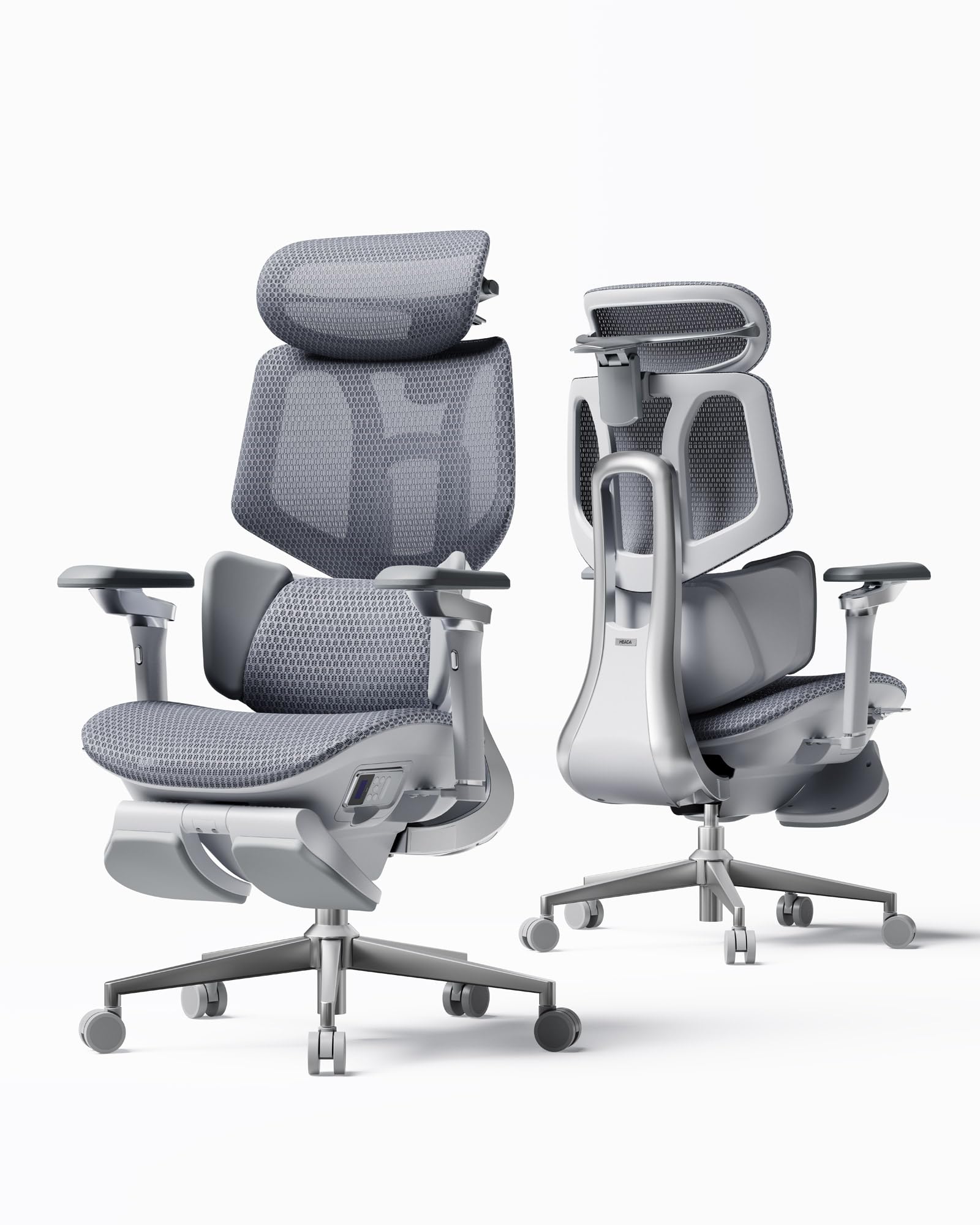
The X7 integrates a gravity-sensing lumbar base that auto-adjusts support intensity as you lean forward or recline — a step beyond manual ratchets. The 8D massage rollers add three-level heating up to 50°C, targeting tight erectors during long coding sessions. A dual-fan system in the mesh seat pushes three airflow speeds (Silent, Balanced, Turbo) for active cooling.
Armrests rotate 360° on two axes and extend 110 mm, syncing with the 140° recline so your arms stay supported whether typing upright or napping in tilt-lock. The 4D headrest rotates 70°, slides 55 mm, and flips 70° to match various monitor heights. Every adjustment is tool-free.
The aircraft-grade aluminum frame and nylon five-star base support up to 330 lbs. Assembly requires attaching only the gas cylinder and headrest — main body arrives pre-assembled. Tall users over 6′ may find the standard cylinder height limits optimal leg extension; a replacement cylinder is available through support.
Why it’s great
- Gravity-sensing auto lumbar adapts in real time
- Integrated dual-fan cooling prevents heat buildup
- 8D massage with heating for muscle relief
- Pre-assembled main body, quick setup
Good to know
- Standard cylinder height may limit tall user ergonomics
- Massage/heating features require power connection
- Premium cost reflects smart hardware integration
4. FLEXISPOT ErgoX-PRO Ergonomic Office Chair
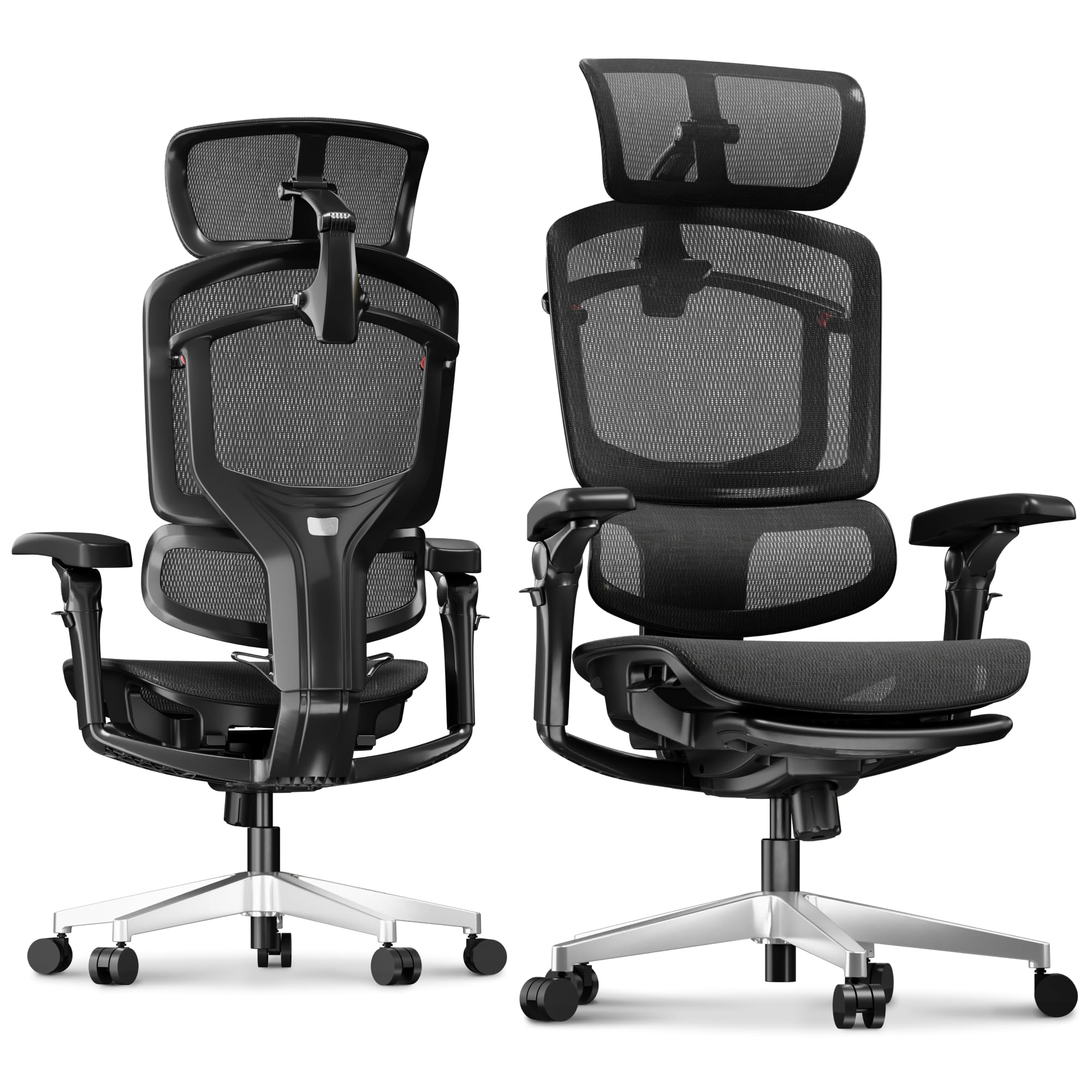
The ErgoX-PRO packs a 5D lumbar support that extends in height, depth, angle, and pressure — letting you target the exact spot where your back arches when you slouch. The 7D linkage armrests mirror your shoulder movement through typing, scrolling, and reclining, reducing static muscle load. The 4D headrest doubles as a backrest for compact setups.
AeroWeave 5.0 mesh seat balances open airflow with enough tension to avoid bottoming out at the maximum 551-lb capacity. The 12-level fine-tuned backrest uses spring cushioning for natural recline, and the 3-position tilt base locks at 90° (focus), 115° (reading), or 135° (rest). An optional footrest clips under the seat for leg elevation during breaks.
Reinforced nylon and fiberglass frame with a lightweight aluminum base and Class 4 gas lift. Assembly time averages 30 minutes with labeled parts. The 3D armrests pivot and slide, though some users report limited front-to-back travel for very wide desks.
Why it’s great
- 5D lumbar targets exact back curve location
- 7D armrests track shoulder movement dynamically
- 551-lb weight capacity with reinforced frame
- Optional footrest adds break-time relaxation
Good to know
- Armrest front-to-back travel may feel limited
- Headrest requires adjustment for very tall users
- Mesh seat tension is stiff during first week
5. WorkPro Quantum 9000 Series Ergonomic Chair

The Quantum 9000 uses a ratchet system for back-height adjustment — uncommon in this price tier — letting you match the lumbar curve to your exact torso length. The mesh seat and back promote constant airflow, and the waterfall seat edge minimizes pressure behind the knees. Weight capacity is rated to 275 lbs with a nylon base and smooth dual-wheel casters.
Seat depth slides incrementally for proportional thigh support, and the tilt mechanism locks in multiple positions with adjustable tension. Armrests adjust in height, width, and pivot angle. The 37.5- to 43.75-inch overall height range fits standard and mid-height desks.
Many users report functional longevity beyond six years with only cosmetic wear to armrest padding. Assembly requires 8 bolts and takes roughly 15 minutes. The limited lifetime warranty from WorkPro provides reliable parts support, though the chair ships with plastic accents rather than full metal.
Why it’s great
- Ratchet back adjustment for exact torso support
- Mesh seat and back breathe for all-day coolness
- 6+ year durability reported by long-term users
- Limited lifetime warranty covers major components
Good to know
- Plastic accents rather than full metal frame
- Armrest padding shows wear after 4-5 years
- Front knee pad requires breaking in (1-3 weeks)
6. Branch Ergonomic Chair
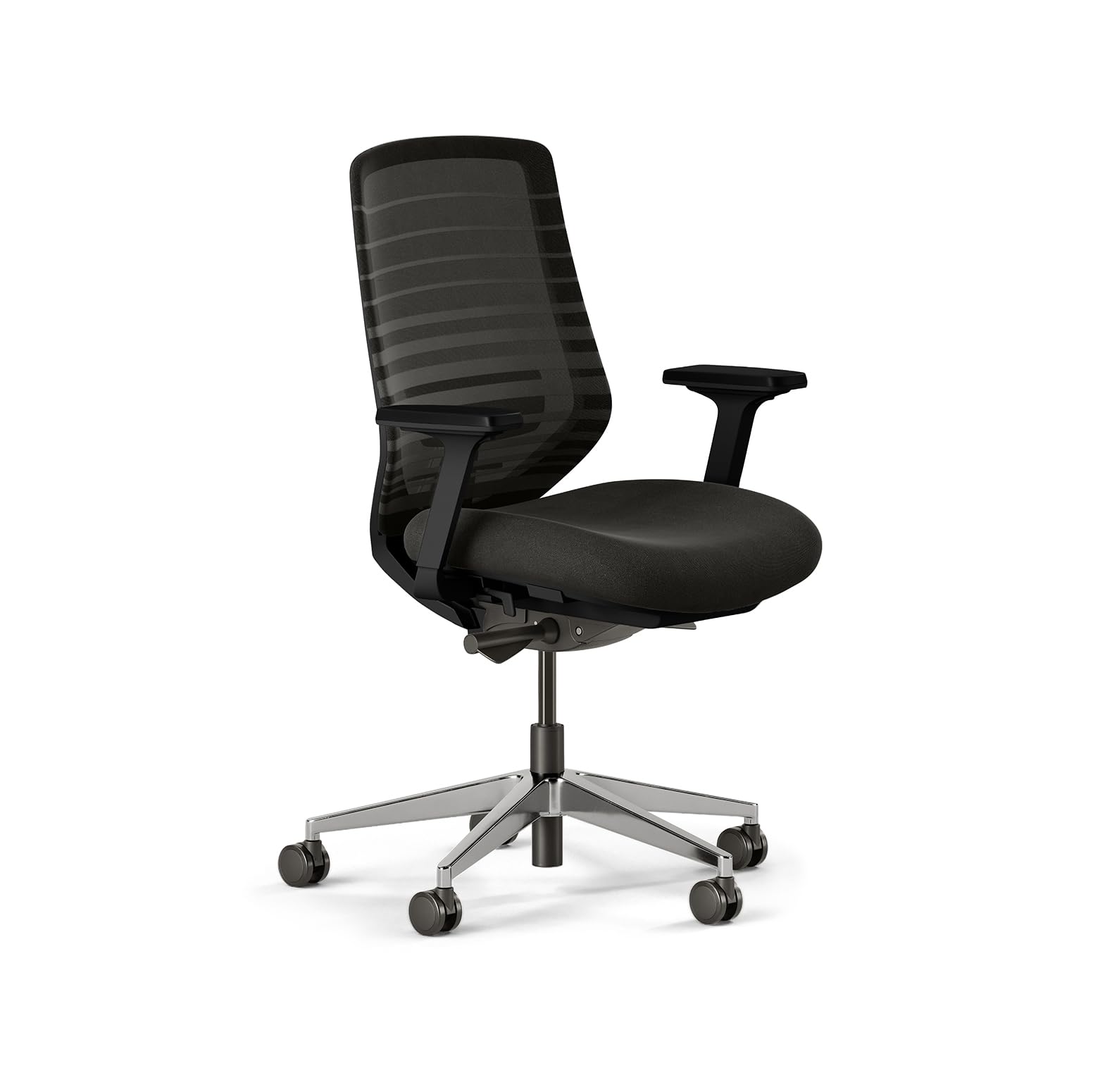
The Branch chair delivers eight adjustment points — including seat height, seat depth, lumbar position, arm height, arm width, recline tension, recline lock, and tilt limiter — in a minimalist shell that doesn’t shout “office gadget.” The breathable mesh back keeps air moving, while the foam seat cushion offers a balanced feel that’s neither marshmallow-soft nor board-hard.
The aluminum frame keeps total weight at 27 lbs — light enough to push around on carpet without wrestling. Smooth-rolling dual casters glide across hardwood and low-pile carpet. The 27 x 29 x 42 inch footprint fits smaller home-office nooks without dominating the room.
Users as short as 5’0″ report the adjustable seat depth corrects the “knee bend overhang” problem. The lumbar support is mild compared to dedicated gel pads — some owners add a separate lumbar cushion. Assembly involves five bolts and takes under 10 minutes with clear instructions.
Why it’s great
- 8-point adjustability including seat depth
- Lightweight aluminum frame weighs only 27 lbs
- Works well for petite users down to 5’0″
- Clean aesthetic suits modern home offices
Good to know
- Lumbar support is mild for severe back pain
- No seat tilt function (forward or rear angle)
- Armrests may slide forward unintentionally
7. ProtoArc EC200 Ergonomic Office Chair
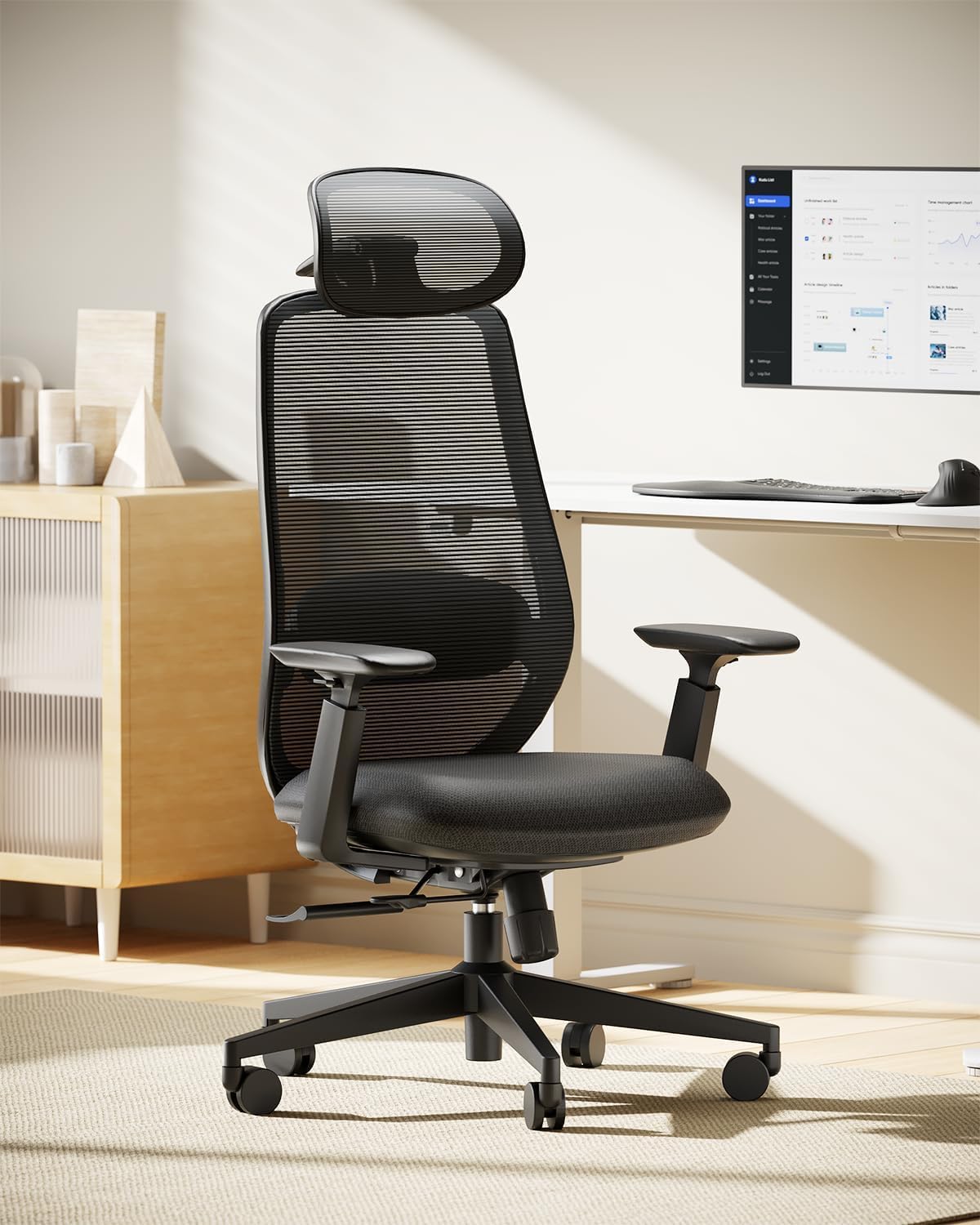
The EC200 brings seat depth adjustment to a price point where it’s rarely offered. The 1.97-inch sliding seat pan with instant lock responds to leg length, eliminating the dangling knee sensation for shorter users and the thigh pinch for taller ones. The 55D high-density foam seat resists the sag that soft cushions develop within months.
Three-point ergonomic support targets head, back, and lumbar independently. The lumbar pad adjusts 2.36 inches vertically and 0.8 inches in depth, filling the gap that fixed-lumbar chairs miss. The 3D headrest moves up/down, in/out, and pivots 75° plus rotates 35° — cradling the cervical spine without pushing the head forward.
Four recline stages (90° work, 105° read, 120° calls, 130° relax) with tilt tension knob allow dynamic posture switching. BIFMA X5.1 and TÜV-tested Class 4 gas lift ensure safety for users up to 220 lbs. Assembly is rated at 20 minutes with a visual guide. The mesh back stays ventilated, though the foam seat retains some heat compared to full-mesh alternatives.
Why it’s great
- Rare seat depth slider in this price tier
- 55D high-density foam resists long-term sag
- 3D headrest with 75° pivot for neck alignment
- TÜV-tested Class 4 gas lift for safety
Good to know
- Foam seat may trap heat more than mesh seats
- Best fit range is 5’4″ to 6’0″ / under 220 lbs
- Armrests are 2D (height + pivot only)
8. ELABEST Ergonomic Mesh Office Chair

The ELABEST uses a “Golden Triangle” shoulder structure — a wider upper back frame that distributes load across the trapezius rather than concentrating it on the lower spine. The bionic-curve backrest mimics the natural S-curve of the spine, and the adjustable lumbar pad moves vertically to match your belt line.
3D armrests adjust in height, width, and rotation angle, helping typists keep elbows at 90° without flaring. The synchro-tilt mechanism offers three lockable positions with adjustable tension, so the seat and back move together during recline. The full-mesh seat eliminates foam heat sink and promotes circulation through the waterfall edge.
BIFMA 5.1 certified with a heavy-duty nylon base and smooth casters. The recommended user range is 5’5″ to 5’10” and under 200 lbs. Some users find the armrests too wide for narrow frames — customer service offers rotating replacements to narrow the span. Assembly takes about 30 minutes with clear instructions.
Why it’s great
- Golden Triangle shoulder support reduces upper back fatigue
- Full-mesh seat stays cool and prevents pressure points
- Synchro-tilt with 3 lockable recline positions
- BIFMA 5.1 certified for commercial durability
Good to know
- Armrests may be too wide for narrow shoulder frames
- Best fit under 5’10” / 200 lbs
- No headrest option included
9. MOLENTS Ergonomic Office Chair

The MOLENTS chair wraps a full mesh back and cushion in a shaped sponge frame that offers firmer support than budget foam alternatives. The lumbar support adjusts both up/down and forward/back, letting you dial in the exact depth of lower-back pressure. The 3D armrests allow height, width, and rotation changes for basic typing support.
Three recline positions range from 90° upright to 120° relaxed, with a tilt tension knob to control resistance. The 18.9-inch seat depth accommodates users from 5’4″ to about 6’0″, and the breathable mesh prevents the dampness that full-foam seats generate during extended use. Assembly takes roughly 15 minutes with labeled parts and illustrated instructions.
Customer service is unusually proactive for this price tier — the MOLENTS team follows up post-purchase to confirm satisfaction and offers free replacement parts (including a foam seat cover) if needed. The shaped sponge seat retains its contour better than cheap polyurethane, though very tall users may wish for a longer seat pan.
Why it’s great
- Full mesh back and cushion for breathability
- Bidirectional lumbar adjustment (height + depth)
- Proactive customer service with free replacement parts
- Under-15-minute assembly with labeled hardware
Good to know
- Shaped sponge seat may feel firm initially
- Armrests lack forward-back slide adjustment
- Seat depth may be short for users over 6’0″
FAQ
Why does my lower back still hurt after buying an ergonomic chair?
Is a mesh seat or foam seat better for 8+ hour sitting?
Do I actually need a headrest for all-day sitting?
Final Thoughts: The Verdict
For most users, the best desk chair for sitting all day winner is the Steelcase Leap because its 3D LiveBack and Natural Glide System keep your spine aligned through every posture shift without manual re-adjustment. If you want active cooling and automated lumbar tracking, grab the Hbada X7. And for a proven mesh icon with sacral-specific support, nothing beats the Herman Miller Aeron.

Mo Maruf
I created WellFizz to bridge the gap between vague wellness advice and actionable solutions. My mission is simple: to decode the research and give you practical tools you can actually use.
Beyond the data, I am a passionate traveler. I believe that stepping away from the screen to explore new environments is essential for mental clarity and physical vitality.