Our readers keep the lights on and my smoothie glass nicely filled. As an Amazon Associate, I earn from qualifying purchases.
EVA foam is the backbone of cosplay armor, RC plane wings, gym mats, and custom props — but its closed-cell surface repels many common glues, leaving you with joints that peel apart days later. Finding an adhesive that chemically bites into the foam without dissolving it is the difference between a project that shatters under stress and one that flexes with every movement.
I’m Mohammad Maruf — the founder and writer behind WellFizz. I dig into the chemistry, bond strength, and real-world application data on adhesives to find which formulas actually hold up on EVA foam substrates like EPP, EPO, and DEPRON.
This guide breaks down contact cements, foam-safe CAs, and specialized formulas so you can confidently choose the best adhesive for eva foam for your next build or repair.
How To Choose The Best Adhesive For EVA Foam
EVA foam is a closed-cell material, meaning its surface offers very little for a glue to grip mechanically. The right adhesive either chemically welds the surface or uses a contact-cement mechanism that bonds as the solvent flashes off. The wrong choice — especially a standard cyanoacrylate without foam-safe modifiers — can literally melt the foam into a sticky mess.
Formula Compatibility
Not all glues are created equal when it comes to foam. You need a formula explicitly labeled as foam-safe. Look for neoprene-based contact adhesives or cyanoacrylates with a foam-safe designation. Standard super glues release heat as they cure, which can deform or dissolve EVA foam. A foam-safe CA controls that exothermic reaction to prevent surface damage.
Bond Flexibility
EVA foam is inherently flexible — a rigid bond will crack under bending stress. Contact cements like those from Beacon or Gorilla create a rubber-tough joint that moves with the foam. For CA glues, the bond strength matters far less than the peel resistance. A flexible bond absorbs impacts; a brittle one fails at the glue line.
Application and Cure Time
Spray adhesives offer wide coverage for large panels, while bottle-style liquid adhesives provide pinpoint control for small joints. Contact cements require you to coat both surfaces, let the solvent dry, then press them together for an instant grab. Foam-safe CAs cure in seconds but demand perfect alignment on the first try. Consider your project scale and your tolerance for repositioning before choosing your weapon.
Quick Comparison
On smaller screens, swipe sideways to see the full table.
| Model | Category | Best For | Key Spec | Amazon |
|---|---|---|---|---|
| Beacon Foam-Tac | Contact Cement | RC foam planes & EPP builds | Includes UV blockers, 24 hr full cure | Amazon |
| Bob Smith Industries BSI-139H | Foam-Safe CA | Model terrain & gap filling | Odorless, bonds in 5-15 seconds | Amazon |
| Gorilla Ultimate Spray Adhesive | Spray Contact | Large panel lamination & upholstery | Adjustable nozzle, 2 min cure | Amazon |
| RH Adhesives S-18 | Neoprene Cement | Rubber-to-metal & marine repairs | 24 hr full cure, water resistant | Amazon |
| Great Planes Pro Foam Safe CA | Thin CA Glue | Tight-fitting foam joint wicking | Water-thin viscosity, 5 min cure | Amazon |
In‑Depth Reviews
1. Beacon Foam-Tac Powerful Glue
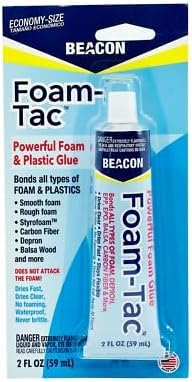
Beacon Foam-Tac is purpose-built for EVA and expanded polyolefin foams like EPP, EPO, and DEPRON. Its contact-cement mechanism requires coating both surfaces and letting the solvent flash off, after which the bond grabs with a tenacious hold that remains flexible enough to survive wing flex on RC planes. The inclusion of UV blockers means this bond won’t yellow or embrittle even when the build lives in direct sunlight.
The glue dispenses as a thick, snot-like string that can be messy on first use, but that viscosity translates into excellent gap-filling ability on uneven foam cuts. Users consistently report that a properly applied Foam-Tac joint outlasts the foam itself. The 2-ounce bottle stretches surprisingly far because a thin, even coat is all that’s needed.
For builders who need a bond that can reposition for a few minutes before locking, Foam-Tac provides that window — unlike CA glues which grab instantly. The 24-hour full cure seems long, but the bond reaches handling strength in about an hour. This is the go-to for serious foam craftspeople who want one adhesive that works on almost every expanded plastic.
Why it’s great
- UV-resistant formula prevents sun damage and yellowing
- Flexible bond that moves with EVA foam without cracking
- Allows a few minutes of repositioning time before locking
Good to know
- Thick, stringy consistency takes practice to apply cleanly
- Bottle does not include a nozzle, so consider decanting
2. Bob Smith Industries BSI-139H Super-Gold
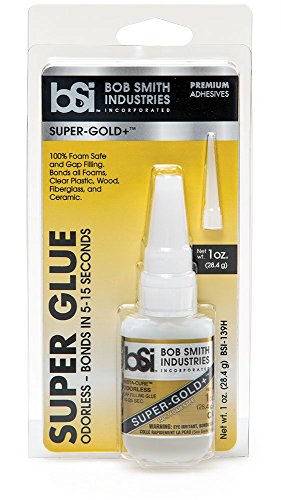
Bob Smith Industries Super-Gold is the industry standard for foam-safe super glues, and for good reason. It is the first truly odorless cyanoacrylate on the market, which eliminates the fumes that often fog up canopy glass on RC planes or irritate hobbyists working indoors. The bond triggers in 5 to 15 seconds, making it ideal for quick repairs and small assemblies where clamping is impractical.
This glue excels in gap-filling scenarios because its slightly thicker viscosity than water-thin CAs allows it to bridge small voids between foam pieces without running everywhere. D&D terrain crafters and diorama builders swear by it for attaching foam bricks and stonework. The 1-ounce bottle lasts through many builds, but the extender tip is essential for reaching tight spots without flooding the joint.
One caution — because it bonds so fast, you must hold parts in perfect alignment from the start. There is no repositioning window. Customers note it bonds materials as tricky as silicone, which speaks to its aggressive chemistry. Store it capped and cool, as heat accelerates curing inside the bottle.
Why it’s great
- Odorless formula allows indoor use without ventilation headaches
- Foam-safe chemistry won’t melt or craze EVA foam
- Gap-filling viscosity bridges uneven foam joints cleanly
Good to know
- Bonds in seconds with zero repositioning window
- Premium tier pricing compared to standard super glues
3. Gorilla Ultimate Spray Adhesive
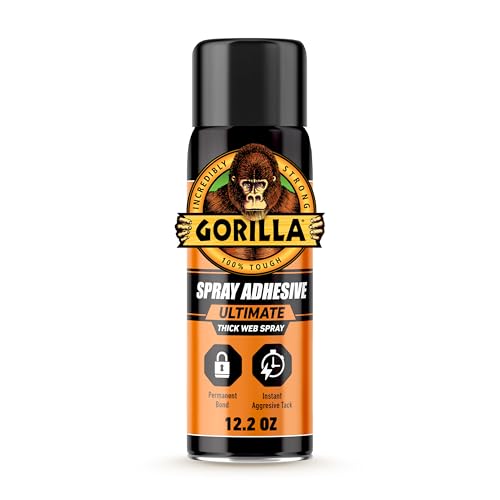
Gorilla’s spray format is the natural choice when you need to bond large EVA foam surfaces — think laminating foam sheets for gym mats, upholstery panels, or costume wings. The adjustable nozzle lets you choose between a narrow stream and a wide web pattern, so you can tailor coverage to your part size. The tack is instant and aggressive, eliminating the need for long clamping sessions.
This contact adhesive resists heat and moisture once cured, which matters if your foam project will live in a garage, a car interior, or an outdoor display. The Low VOC formula meets California CARB requirements, making it relatively safer for indoor use compared to older solvent sprays. Full cure takes just 2 minutes — among the fastest of any glue in this guide.
The trade-off is control: the spray covers a broad area, and you cannot easily adjust overspray once it lands. Users with small projects find the wide pattern wasteful. Also, the bond is permanent from the moment the two surfaces touch — there is zero sliding room. Plan your alignment carefully before pressing foam together.
Why it’s great
- Fast 2-minute cure for rapid project assembly
- Adjustable nozzle provides control over spray pattern width
- Resists heat and moisture for durable outdoor use
Good to know
- Wide spray pattern can be wasteful on small foam parts
- Bond is permanent with zero repositioning ability
4. RH Adhesives S-18 All-Purpose Adhesive
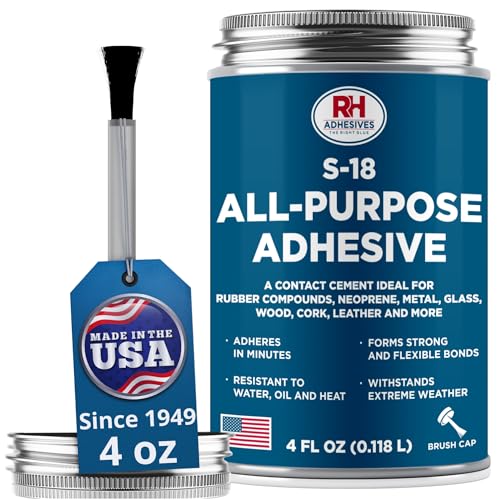
RH Adhesives S-18 is a classic neoprene contact cement that has been made in the United States since 1949 — a legacy that speaks to its reliability on tricky substrates like rubber, metal, and EVA foam. The formula creates a strong film with excellent peel strength and oil resistance, making it a favorite for marine and automotive applications where foam meets metal or hard plastic.
This glue requires a more deliberate process: thorough surface prep including sanding and degreasing, then application to both surfaces. The solvent must dry to the touch before clamping. The 24-hour full cure is the longest on this list, but the resulting bond is truly tenacious and waterproof. Users report it holds neoprene and EVA foam together even under constant mechanical stress.
The biggest downside is the solvent smell — this is a strong industrial adhesive that demands a well-ventilated workspace. The 4-ounce can is small, so larger projects will need multiple units. Also, some users found the bond degrades in sustained outdoor weather, so treat this as an indoor or sheltered-use solution.
Why it’s great
- Excellent peel strength for bonding EVA foam to metal and plastic
- Water-resistant film survives marine and damp environments
- Proven formula with decades of real-world use
Good to know
- Strong solvent odor requires extensive ventilation
- 24-hour cure time is the longest in this lineup
5. Great Planes Pro Foam Safe CA Thin Glue

The Great Planes Pro Foam Safe CA is the thinnest adhesive in this roundup — a water-like liquid that wicks into tight-fitting foam joints by capillary action. If you are repairing a hairline crack in an RC wing or assembling foam where parts mate perfectly, this glue penetrates deeper than any contact cement can. The odorless, non-fuming formula makes it tolerable for indoor bench work.
This glue bonds in 15 to 30 seconds, but the water-thin viscosity means you must use the extra-long applicator tip to control placement. Too much glue floods the surface and dissolves paint or decals before drying back clear. The 20-gram bottle is small — intentionally — because thin CA has a finite shelf life once opened.
Where this glue struggles is on rough or uneven foam surfaces — the thin liquid runs into low spots instead of bridging gaps. It also bonds so fast that you need tape or a clamp to hold joints in alignment for the first minute. For precision work with tight tolerances, the Great Planes CA is unmatched. For sloppy or gap-filled joints, reach for a thicker formula.
Why it’s great
- Water-thin viscosity wicks into tight foam cracks for deep bonding
- Odorless and non-fuming for comfortable indoor use
- Extra-long tip reaches into recessed joints easily
Good to know
- Thin formula runs and can dissolve paint if not wiped immediately
- Full cure takes several minutes, requiring tape to hold joint
FAQ
Can I use standard super glue on EVA foam?
How do I prepare EVA foam for gluing?
Why does my foam glue smell so strong?
Final Thoughts: The Verdict
For most users, the best adhesive for eva foam winner is the Beacon Foam-Tac because it delivers a flexible, UV-resistant bond that works across multiple foam types and allows a few minutes of repositioning. If you need an instant, odorless bond for small assemblies, grab the Bob Smith Industries BSI-139H. And for large panel laminations where speed matters, nothing beats the Gorilla Ultimate Spray Adhesive.

Mo Maruf
I created WellFizz to bridge the gap between vague wellness advice and actionable solutions. My mission is simple: to decode the research and give you practical tools you can actually use.
Beyond the data, I am a passionate traveler. I believe that stepping away from the screen to explore new environments is essential for mental clarity and physical vitality.