Our readers keep the lights on and my smoothie glass nicely filled. As an Amazon Associate, I earn from qualifying purchases.
A dull blade isn’t just frustrating—it’s dangerous. It requires more force to cut, increasing the risk of slips that can lead to serious injury. Whether you’re a home cook tired of struggling through a tomato or an outdoor enthusiast whose axe is blunter than a butter knife, the solution lies in choosing the right sharpening tool, not just any gadget off a shelf.
I’m Mohammad Maruf — the founder and writer behind WellFizz. My research process involves dissecting grit compositions, stone materials, and build quality to separate real edge-maintenance tools from gimmicks that do more harm than good.
After analyzing five top contenders based on material composition, grit versatility, and real-world user reports, this guide cuts through the noise to reveal the best blade sharpener suited for different skills and uses.
How To Choose The Best Blade Sharpener
Selecting a sharpener requires evaluating the blade material, the sharpener’s abrasive type, and your own comfort with manual honing. The wrong choice can chip a high-hardness Japanese knife or take forever on a tough stainless steel cleaver.
Abrasive Material: Diamond, Silicon Carbide, or Corundum
Diamond plates are the fastest cutters and excel on very hard steels (powder metallurgy, high vanadium). Silicon carbide stones like the Norton Crystolon are aggressive and self-sharpening, ideal for quick material removal on softer steels and tools. Corundum (aluminum oxide) stones, such as the Norton oil stone and Work Sharp whetstone, offer a balanced, durable surface that wears slowly and produces a refined edge over time.
Grit Rating and Progression
Coarse grits (100-400) repair chips and set a new bevel. Medium grits (600-1000) refine the edge. Fine/honing grits (3000-6000) polish the edge to razor sharpness. A dual-sided stone with a coarse and fine side is the most practical all-in-one solution, allowing you to restore and refine without switching tools.
Stone Size and Stability
A longer stone (8-12 inches) allows full, continuous strokes without repositioning the blade—critical for maintaining a consistent angle. Heavier stones stay put on the counter and absorb vibration better, enhancing control. Look for non-slip bases or rubber mats that prevent dangerous sliding during use.
Quick Comparison
On smaller screens, swipe sideways to see the full table.
| Model | Category | Best For | Key Spec | Amazon |
|---|---|---|---|---|
| Work Sharp Benchtop Whetstone | Premium Water Stone | Precision kitchen-edge repair | 1000/6000 grit, 9.5″L | Amazon |
| Norton Knife Sharpener Combination Oil Stone | Premium Oil Stone | Heavy re-profiling & tool edges | 100/280 grit, 8″L | Amazon |
| YCAMMIN Double-sided Diamond Stone | Diamond Plate | Ultra-hard steel & fast cutting | 400/1000 grit, 7″L | Amazon |
| Winco Fine/Grain Knife Sharpening Stone | Bench Stone | Long-stroke bench sharpening | Medium/Fine grit, 12″L | Amazon |
| Norton Crystolon Utility File Stone | Field Stone | Outdoor & yard tool touch-ups | 100 grit, 14″L with handle | Amazon |
In‑Depth Reviews
1. Work Sharp Benchtop Whetstone Knife Sharpener

The Work Sharp Whetstone is the most complete sharpening system for home cooks who want a foolproof path to razor edges. It pairs a premium quality 1000 grit side for bevel-setting with a 6000 grit side for mirror-polished honing, all built on a corundum water stone that cuts efficiently without excessive wear. The included 15° and 17° magnetic angle guides lock onto the blade spine, eliminating the guesswork that ruins edges on freehand stones.
Its water control base doubles as storage and keeps the mess contained, a practical upgrade over traditional whetstones that require a separate soaking tub. Users report that even beginners can achieve paper-slicing sharpness on German stainless and carbon steel knives after just a five-minute soak. The anti-skid mat further stabilizes the stone, preventing dangerous slips during long sharpening sessions.
While the plastic base feels less premium than the stone itself, the system’s repeatability and the brand’s four-generation American engineering reputation justify its mid-range investment. This is the most confidence-inspiring tool for anyone moving from pull-through sharpeners to manual stones.
Why it’s great
- Two-sided grit progression (1000/6000) covers repair and finish
- Magnetic angle guides eliminate edge-angle guessing
- Water control base reduces cleanup time
Good to know
- Plastic base feels less substantial than the stone itself
- Corundum stone wears slower than diamond, requires more soaking
2. Norton Knife Sharpener Combination Grit Oil Stone

The Norton Combination Oil Stone is an underappreciated classic for woodworkers and hunters who need to reshape damaged edges quickly. Its 100 grit side aggressively reprofiles chipped blades and dull hatchets, while the 280 grit side refines that edge before moving to a finer finishing stone. The corundum abrasive is tougher than waterstones and does not require soaking—just a few drops of oil or WD-40 keep it cutting cleanly.
Users consistently praise its durability on high-carbon steels and its consistent grit structure that outperforms diamond stones over long sessions. The 8-by-2-inch size is compact enough for a tool bench yet large enough for full-length strokes on most blades. Experienced sharpeners note that the fine side is more of a medium finish, so it pairs best with a 1000 or 3000 grit stone for final polishing.
This stone excels at material removal without loading up, a common frustration with softer natural stones. It is best suited for the sharpener who already has a finishing routine and needs a workhorse stone for the heavy lifting.
Why it’s great
- 100 grit side reshapes chips and re-profiling quickly
- No soaking required; works with oil or WD-40
- Very durable corundum composition resists dishing
Good to know
- Fine side is still relatively coarse (280 grit) for finishing
- Requires lubricant to prevent metal loading on surface
3. YCAMMIN Double-sided Diamond Sharpening Stone

The YCAMMIN diamond plate brings ultra-fast material removal to the budget-friendly tier, effectively sharpening seven dull knives to shaving-sharp status in about 30 minutes each. Its honeycomb surface pattern is designed to trap grinding dust, preventing clogging that slows down traditional stones. The 400 grit side excels at setting a fresh bevel on nicked edges, while the 1000 grit side refines the edge to paper-slicing sharpness.
Because diamond is harder than any steel, this stone stays flat indefinitely—unlike waterstones that dish over time. It works dry or with water, and its compact 7-inch length makes it portable for outdoor kits. However, the lightweight plastic base tends to slide on smooth counters, and the honeycomb pattern can catch the tips of smaller paring knives if you are not careful.
This is the best entry point for users who want the speed of diamond without the premium price tag, provided they are comfortable learning freehand angle control.
Why it’s great
- Diamond surface cuts hardened steel extremely fast
- Honeycomb design prevents dust loading during use
- Compact size fits easily into a camping or tool kit
Good to know
- Lightweight base slides without a damp cloth underneath
- Honeycomb pattern can snag on very small blade tips
4. Winco Fine/Grain Knife Sharpening Stone
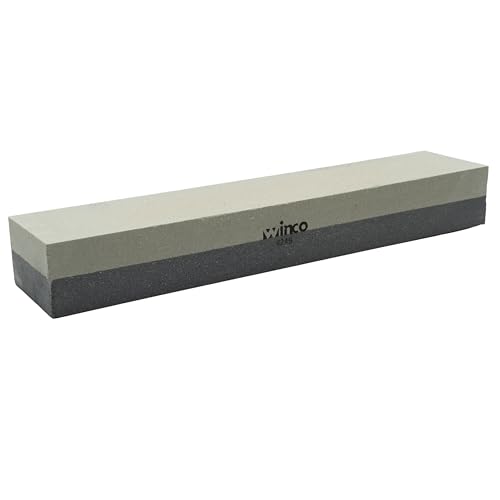
The Winco bench stone stands out for its massive 12-inch length, which allows full, uninterrupted strokes from bolster to tip on chef’s knives. This eliminates the rocking motion required on shorter stones, leading to more consistent edge geometry. It is made from top-grade carbonized silicon (silicon carbide) with a medium and fine grit surface, making it aggressive enough for yard tools yet controlled enough for kitchen knives.
Users who own Wusthof and Henckels German stainless knives report that this stone restores factory-sharp edges after just a few passes, especially when used wet with a rag to prevent sliding. The 1.5-inch thickness gives it substantial weight, keeping it planted on the counter. However, the fine side is still fairly coarse by finishing standards—many users recommend following up with a 1000+ grit stone or a leather strop for a truly keen edge.
This is a no-nonsense stone that prioritizes surface area and durability over grit refinement, ideal for those who sharpen large blades regularly.
Why it’s great
- 12-inch length delivers full blade strokes
- Heavy 2-pound build reduces counter movement
- Very affordable for the amount of sharpening surface
Good to know
- Fine side is too coarse for final edge polishing
- Not suitable for high-hardness Japanese knives
5. Norton Crystolon Utility File Sharpening Stone with Handle
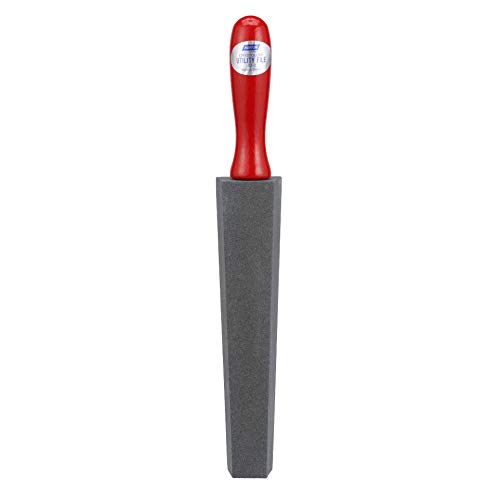
The Norton Crystolon file stone is purpose-built for field sharpening, not kitchen display. Its 14-inch overall length and attached wooden handle keep your fingers safely away from the edge while you work on axes, lawn mower blades, shovels, and scythes. The 100 grit coarse silicon carbide abrasive removes material aggressively, making short work of nicks and dull edges on tough tool steels.
Unlike flat bench stones, this design lets you apply significant pressure without risking injury, and its self-sharpening silicon carbide surface exposes fresh grit as it wears. Users note that it is excellent for the initial heavy grinding stage but is far too coarse for any knife finish work. It is best used as the first step in a multi-stone progression for large blades, or as the sole sharpener for garden tools where a rough edge is acceptable.
If your primary need is maintaining outdoor equipment rather than kitchen knives, this is the most efficient and safest tool in the roundup.
Why it’s great
- Handle keeps fingers away from sharp edges
- Coarse 100 grit removes nicks very quickly
- Self-sharpens during use, extending stone life
Good to know
- Only one grit; no fine side for finishing
- Stone life has reportedly decreased compared to older batches
FAQ
Can I use an oil stone on Japanese high-carbon steel knives?
How do I clean a diamond sharpening stone after heavy use?
Why does my stone load up with metal shavings and stop cutting?
Final Thoughts: The Verdict
For most users, the blade sharpener winner is the Work Sharp Benchtop Whetstone because its dual-grit water stone paired with magnetic angle guides removes the guesswork, delivering consistent razor edges right out of the box. If you need heavy re-profiling for axes and chisels, grab the Norton Combination Oil Stone. And for a fast-cutting, portable solution for outdoor kits, nothing beats the YCAMMIN Diamond Stone.

Mo Maruf
I created WellFizz to bridge the gap between vague wellness advice and actionable solutions. My mission is simple: to decode the research and give you practical tools you can actually use.
Beyond the data, I am a passionate traveler. I believe that stepping away from the screen to explore new environments is essential for mental clarity and physical vitality.