Our readers keep the lights on and my smoothie glass nicely filled. As an Amazon Associate, I earn from qualifying purchases.
Choosing a pair of powered monitors or bookshelf speakers involves more than just wattage ratings. The real distinction between a good-sounding active speaker and a great one lies in the crossover design, driver material, and amplification architecture — details that determine whether you hear a flat, honest mix or a flattering coloration of your music.
I’m Mohammad Maruf — the founder and writer behind WellFizz. I’ve spent hundreds of hours cross-referencing frequency response curves, amplifier topologies, and real user feedback across dozens of active speaker models to build this detailed comparison.
Whether you are building a desktop audio workstation or upgrading your living room listening setup, this guide to finding the best active speakers will help you match the right amplifier topology and driver configuration to your specific space and budget.
How To Choose The Best Active Speakers
Active speakers contain built-in amplification tailored specifically to their drivers, which means the amplifier’s damping factor and the crossover point are pre-optimized. The buyer’s job shifts from matching an amp to a passive speaker to evaluating the entire integrated system.
Driver Materials and Their Sonic Signature
Woven carbon fiber cones, like those used in the Micca PB42X, deliver fast transient attack with controlled breakup, making them ideal for near-field listening where vocal clarity matters. Aluminum diaphragms, found on many Edifier and ADAM Audio models, are stiffer and produce lower distortion at higher output levels but can sound clinical if the crossover is not properly voiced. Planar magnetic tweeters, used on the Edifier S2000MKIII, combine the speed of a ribbon with higher power handling, reducing ear fatigue during long sessions.
Amplifier Topology and Power Delivery
Class-D amplifiers dominate the mid-range and premium active speaker market because they run cool and achieve over 80% efficiency. However, the quality of the output filter and the power supply design determines whether the amplifier sounds thin or delivers controlled low-end punch. Listeners should look for RMS power ratings measured continuously, not peak figures, especially when planning to drive the speakers at moderate near-field levels in a medium-sized room.
Input Flexibility and Room Integration
Balanced TRS or XLR inputs are critical for studio monitoring applications because they reject electromagnetic interference over longer cable runs. For desktop and living room use, a combination of RCA and Bluetooth with aptX HD provides wired fidelity with the convenience of wireless streaming. Boundary EQ switches, available on monitors like the JBL 306P MkII, correct for low-frequency buildup when speakers are placed near walls, saving the user from needing external DSP or acoustic treatment.
Quick Comparison
On smaller screens, swipe sideways to see the full table.
| Model | Category | Best For | Key Spec | Amazon |
|---|---|---|---|---|
| ADAM Audio D3V | Desktop Monitor | Production & critical listening | 45 Hz low-end via passive radiators | Amazon |
| Edifier S2000MKIII | Audiophile Bookshelf | Hi-fi music listening | 130W tri-amped; planar tweeter | Amazon |
| JBL 306P MkII | Studio Monitor | Mixing & mastering | 6.5″ woofer; Boundary EQ | Amazon |
| JBL 305P MkII | Studio Monitor | Entry-level mixing | 5″ woofer; Image Control Waveguide | Amazon |
| Polk Audio ES20 | Surround Bookshelf | Home theater & music | Power Port; 6.5″ woofer | Amazon |
| Pioneer DJ DM-40D | DJ Monitor | DJ practice & production | 2-way sound mode DSP | Amazon |
| Edifier MR3 | Studio Bookshelf | Versatile desktop audio | 52Hz–40kHz; Balanced TRS | Amazon |
| Audio-Technica AT-SP3X | Compact Bookshelf | Turntable & Bluetooth use | Multi-point Bluetooth; Bass Boost | Amazon |
| Micca PB42X | Budget Powered | Desktop & near-field | Woven carbon fiber woofer | Amazon |
In‑Depth Reviews
1. ADAM Audio D3V Active Desktop Monitoring System
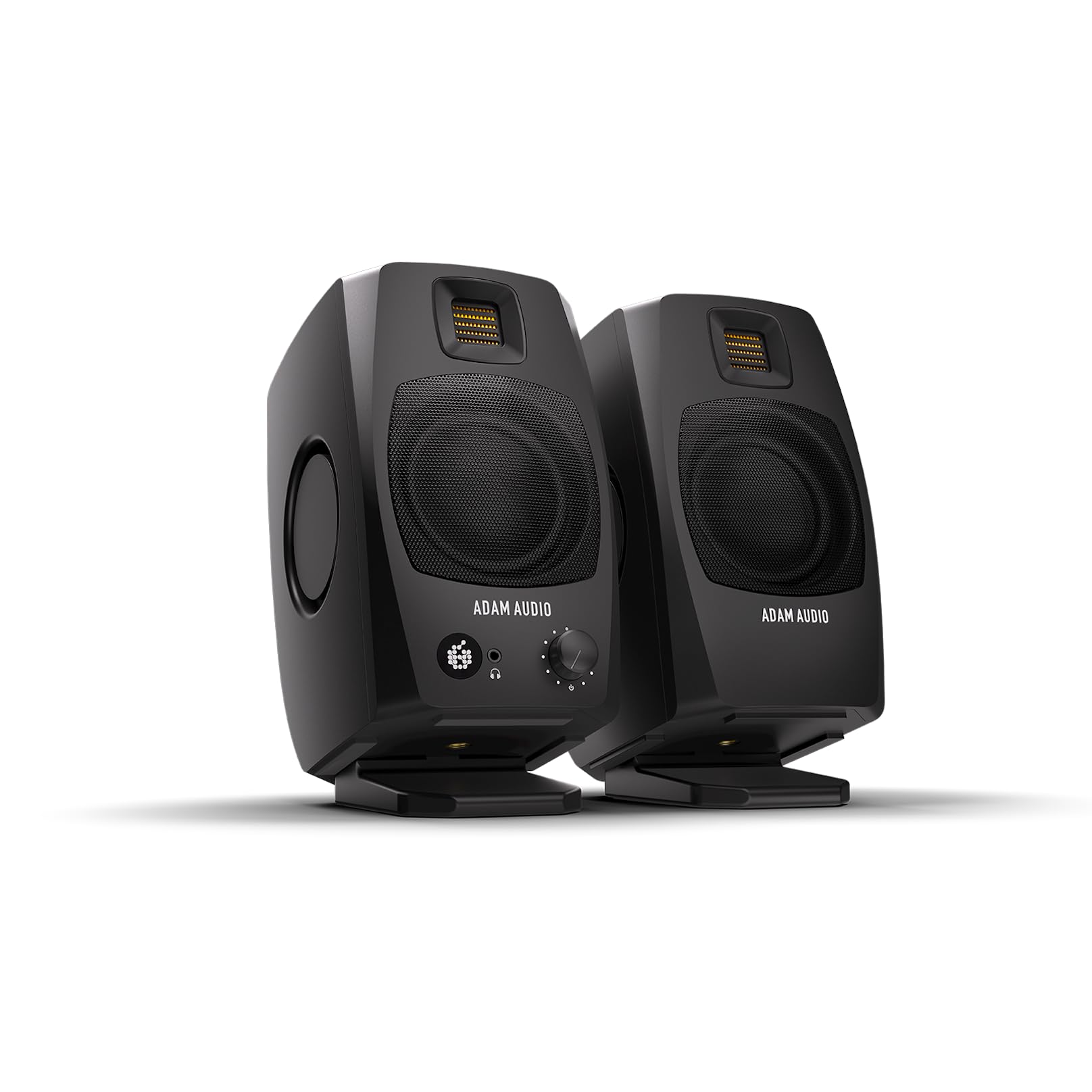
The D3V represents a focused engineering effort from ADAM Audio to shrink their studio pedigree into a compact, fully active desktop footprint. Each satellite houses a 1.5-inch D-ART Desktop Accelerated Ribbon Tweeter — a handcrafted transducer that moves air faster than a conventional dome, delivering the same transient fidelity found in their larger S-series studio monitors. The low-end is produced by a 3.5-inch aluminum woofer reinforced by dual 3.5-inch passive radiators on the cabinet sides, pushing the -3 dB point down to 45 Hz without any port noise or chuffing.
Connectivity centers on a built-in USB-C input that handles up to 24-bit/96 kHz audio from a computer or tablet, plus a balanced 1/4-inch TRS input per speaker for analog sources. DSP-controlled switches on the backplate allow the user to adjust for boundary gain and high-frequency shelving, compensating for desk placement without external gear. The enclosure houses an 80-watt amplifier per speaker — 30W for the tweeter and 50W for the woofer — ensuring enough headroom for near-field mixing at realistic levels without clipping.
User reports consistently highlight the D3V’s ability to reveal fine detail in the upper frequency band, such as reverb tails and sibilance articulation, while the passive radiators produce bass that feels significantly more robust than the cabinet dimensions suggest. A recent firmware update resolved the initial auto-standby issue, allowing users to disable sleep mode for extended sessions. The included 15-degree angled metal stands align the tweeter axis with the listener’s ears at a typical desk distance, optimizing stereo imaging.
Why it’s great
- Ribbon tweeter eliminates listening fatigue during long mixing sessions.
- Passive radiators deliver usable bass extension down to 45 Hz in a compact footprint.
- USB-C direct input simplifies desktop setups without an external audio interface.
Good to know
- Proprietary interconnect cable between satellites limits replacement options.
- Requires on-axis listening for optimal high-frequency detail retrieval.
- USB input operates at 16-bit resolution; a quality DAC improves midrange performance.
2. Edifier S2000MKIII Coaxial Bookshelf Speakers
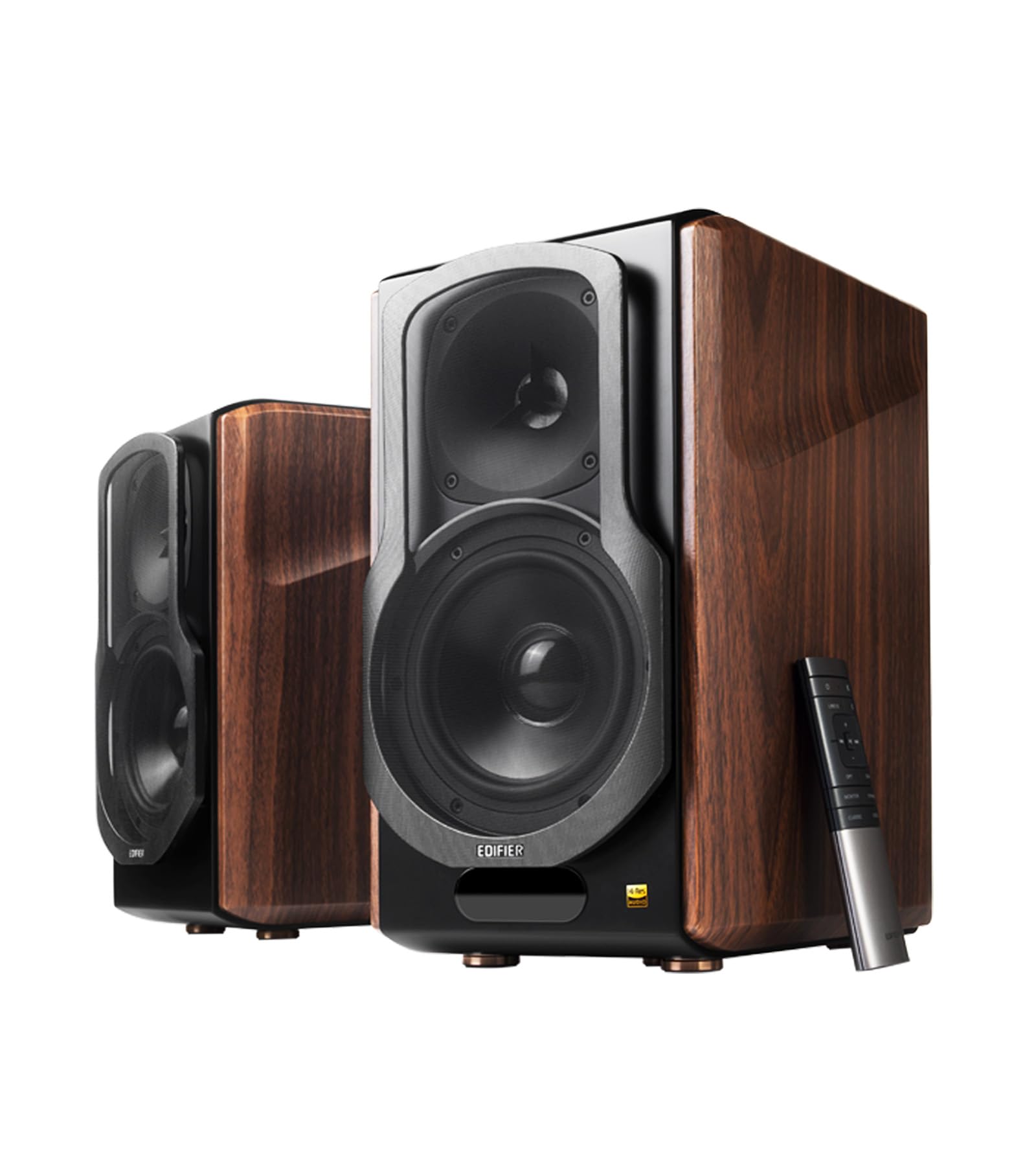
The S2000MKIII is built around a planar diaphragm tweeter paired with a 5.5-inch aluminum diaphragm woofer, each driver receiving its own dedicated amplifier channel in a tri-amped configuration delivering 130 watts total RMS power. The planar tweeter uses a thin, large-diaphragm membrane that oscillates uniformly, producing low distortion and broad horizontal dispersion compared to a conventional dome. This design allows the upper frequencies to fill a wider listening window, reducing the need for precise head positioning during casual listening.
Input options cover nearly every consumer scenario: dual RCA line-in, optical, coaxial, and Bluetooth 5.0 with aptX HD decoding for lossless wireless streaming up to 24-bit. A bundled remote control provides access to volume, input selection, and four DSP presets — Monitor, Dynamic, Vocal, and Classic — each tailoring the frequency response for different content types. The cabinet is constructed from medium-density fiberboard with a real wood veneer finish, contributing to a mass-loaded enclosure that resists panel resonance at high output levels.
Real-world listening reports describe the S2000MKIII as producing deep, chest-thumping bass that can fill a 600-square-foot room without requiring a separate subwoofer. The vocal and classic presets offer a flatter response suitable for acoustic music and dialogue, while the dynamic mode adds low-end weight for electronic and hip-hop genres. Placement requires at least six inches of clearance from the rear wall to prevent bass bloom, and the speakers benefit from being toed in toward the listening position at roughly five feet of separation for optimal imaging.
Why it’s great
- Tri-amped architecture eliminates intermodulation distortion between drivers.
- Planar tweeter provides wide horizontal dispersion and low high-frequency distortion.
- Multiple digital inputs accommodate TV, CD transport, and game console connections simultaneously.
Good to know
- Heavy 40-pound cabinet weight limits placement flexibility on standard shelving.
- Remote control symbols are difficult to read in low-light conditions.
- Soundstage width lags behind competitors at the same price tier.
3. JBL 306P MkII Studio Monitoring Speakers (Pair)

The JBL 306P MkII is a two-way studio monitor built around a 6.5-inch woofer and a 1-inch soft-dome tweeter, each powered by a separate 41-watt Class-D amplifier. The larger woofer cone moves more air than the 5-inch version in the 305P, producing noticeably deeper bass extension and higher maximum SPL without distortion. Patented Image Control Waveguide geometry shapes the tweeter’s dispersion pattern to create a wide sweet spot, which allows the engineer to move laterally across the console while retaining consistent tonal balance.
The rear panel features balanced XLR and 1/4-inch TRS inputs, plus two rotary switches: one for HF Trim that adjusts high-frequency shelving from +2 dB to -2 dB in 1-dB steps, and one for Boundary EQ that compensates for low-frequency buildup when the monitors are placed on a desk or near a wall. The MDF cabinet is internally braced and front-ported, allowing the monitors to be positioned closer to boundaries without the chuffing noise associated with rear-port designs. Rack-mountable options are available for custom studio integration.
Users moving from 5-inch monitors to the 306P MkII describe a noticeable improvement in low-mid fullness and bass weight, making it easier to evaluate kick drum punch and bass guitar articulation in a mix. The Boundary EQ switch is particularly useful for home studio environments where acoustic treatment is limited, restoring a neutral low-frequency balance without requiring DSP. The monitors lack Bluetooth or digital inputs, which is consistent with their professional studio focus but requires the user to interface through an audio interface or mixer.
Why it’s great
- 6.5-inch woofer delivers deeper bass extension for full-range monitoring.
- Boundary EQ corrects low-frequency response when placed near walls.
- Front-ported design reduces boundary interaction issues compared to rear ports.
Good to know
- Bulky cabinet size may be excessive for small desktop setups.
- No wireless connectivity; requires an external audio interface for input.
- High-frequency shelving switch is best left neutral until the room acoustics are assessed.
4. JBL 305P MkII 5-Inch Powered Studio Reference Monitors

The 305P MkII is the compact sibling of the 306P, pairing a 5-inch woofer with a 1-inch soft-dome tweeter driven by dual 41-watt Class-D amplifiers. The patented Image Control Waveguide extends the sweet spot width, enabling multiple listeners to share the same monitoring position without hearing significant off-axis coloration. The Slip Stream port on the front baffle reduces turbulence at high output levels, preserving low-frequency clarity when the monitors are driven near their limits.
Input options are limited to balanced XLR and 1/4-inch TRS connectors, which is appropriate for studio environments where interference rejection is critical. The rear panel includes a HF Trim switch with -2 dB, 0 dB, and +2 dB positions, allowing minor adjustments for room brightness, and a volume control on the front baffle for quick level matching. The MDF cabinet measures roughly 12 inches tall, making the 305P MkII suitable for desktop placement on foam isolation pads without overpowering the visual workspace.
User feedback consistently describes the 305P MkII as delivering a flat, uncolored frequency response that reveals mix issues without flattering them. Compared to similarly priced monitors, the 305P MkII offers superior midrange clarity and low-end definition, though it lacks the deep sub-bass extension of the 306P. The advertised 100-hour reliability test means each unit undergoes a burn-in procedure before shipping, reducing the likelihood of early driver failure or amplifier noise.
Why it’s great
- Neutral, uncolored response suitable for critical mixing decisions.
- Image Control Waveguide provides a wide sweet spot for collaborative listening.
- Front Slip Stream port reduces turbulence and preserves bass clarity.
Good to know
- Limited bass extension requires a subwoofer for full-range monitoring.
- Lacks wireless connectivity; balanced cables are required for operation.
- Some users report audible hiss at idle, which is typical for this amplifier class.
5. Polk Audio Signature Elite ES20 Bookshelf Speakers (Pair)

The ES20 is a passive bookshelf speaker rather than a fully active monitor, but it is frequently paired with stereo amplifiers or AV receivers to function as powered speakers in home theater and music systems. The cabinet houses a 6.5-inch dynamic balance woofer and a 1-inch terylene dome tweeter, with Polk’s patented Power Port flaring the rear port opening to reduce turbulence and increase bass output by roughly 3 dB compared to a conventional port. This port geometry allows the ES20 to produce deeper, cleaner low-end from a relatively compact enclosure.
The crossover network uses Mylar and polyester film capacitors with low dielectric absorption, which improves signal transparency in the critical crossover region between 2 kHz and 3 kHz where the human ear is most sensitive. Sensitivity is rated at 88 dB, which means the ES20 can produce satisfying volume levels from moderate amplifier power, making them compatible with entry-level receivers. The cabinet is available in a walnut vinyl finish with a modern tapered profile, and the magnetic grille attaches without visible hardware.
User reviews frequently note that the ES20 sounds significantly larger than its dimensions suggest, with a warm, full-bodied presentation that works well for both movies and music. The bass extension, while not reaching subwoofer territory, is sufficient for many listeners to skip a subwoofer entirely, especially in mixed-use living rooms. However, the cabinet depth of nearly 12 inches can create placement challenges on shallow shelves or near modern thin-panel televisions.
Why it’s great
- Power Port technology reduces port noise and increases low-end output by 3 dB.
- High sensitivity (88 dB) allows adequate output from moderate amplifier power.
- Timbre-matched with the Signature Elite series for seamless surround upgrades.
Good to know
- Deep cabinet profile may not fit shallow bookshelves or wall-mounted TV stands.
- Requires an external amplifier or AV receiver for power and input switching.
- Vinyl wood veneer appearance may not satisfy buyers seeking real wood finishes.
6. Pioneer DJ DM-40D 4-Inch Desktop Monitor System

The DM-40D is a 4-inch two-way active monitor system designed specifically for DJ practice and production, with a Class-D amplifier that provides 96 kHz sampling DSP for clean signal processing. A 2-way sound mode switch toggles between DJ and Production DSP presets, the former applying a slight low-end bump and punch to match the club-like response DJs expect, while the latter flattens the curve for more accurate mix decisions. The DECO convex diffuser on the front baffle widens high-frequency dispersion, allowing the user to stand or move without losing detail in the top octave.
Input terminals include RCA and mini-jack, and a front-panel headphone socket with independent volume control allows silent practice without unplugging the monitors. The 4-inch woofer is time-aligned with the tweeter to ensure coherent transient response at crossover frequencies, reducing phase shift that can smear stereo imaging. Maximum power output is sufficient to fill a bedroom or small practice room at moderate levels without audible distortion.
Users report that the DM-40D produces punchy bass and clear highs that suit electronic music and vocal-heavy mixing alike, though the DJ preset may sound fatiguing for long production sessions due to the elevated upper highs. The Production mode provides a more neutral reference, but the upper-mid dip around 2 kHz remains noticeable on material with prominent guitars or brass. The Bluetooth connectivity, while not present in the original 40D, is included in this revision and operates reliably at distances up to 30 feet.
Why it’s great
- Selectable DJ and Production DSP modes adapt the monitor to different workflows.
- DECO diffuser widens high-frequency dispersion for off-axis listening.
- Front-panel headphone jack enables silent practice without cable swaps.
Good to know
- DJ preset can cause listening fatigue during long production sessions.
- Upper-mid dip (around 2 kHz) may mask detail in guitar and brass.
- Limited connectivity lacks balanced inputs for professional interface pairing.
7. Edifier MR3 Powered Studio Monitor Speakers

Edifier’s MR3 are compact 3.5-inch two-way monitors certified for Hi-Res Audio playback with a rated frequency response extending from 52 Hz to 40 kHz. The 3.5-inch mid-low driver and 1-inch tweeter are powered by an amplifier delivering 18 watts RMS per channel, which is modest in absolute terms but sufficient for near-field desktop listening at moderate levels. The cabinet is constructed from MDF to reduce resonance, and the front baffle features a low-profile design that fits unobtrusively into most desk configurations.
Connectivity is the MR3’s strongest feature, offering balanced TRS inputs, RCA, AUX, and Bluetooth 5.4 with multi-point pairing that allows two devices to be connected simultaneously. A front-panel headphone output mutes the speakers automatically, and the included Edifier ConneX app provides a five-band EQ and access to Music, Monitor, and Custom listening modes. The 92.5 dB peak SPL rating means the MR3 can produce clean output levels that compete with larger monitors despite the smaller woofer diameter.
User feedback consistently praises the MR3 for their clean, neutral sound signature with zero audible hiss at idle, a notable achievement for this amplifier class. The Bluetooth 5.4 connection is stable and supports the latest codecs, while the balanced TRS input allows direct connection to pro audio interfaces without adapters. The main limitation of the small woofer is evident in bass extension below 60 Hz, where the roll-off becomes steep, making these monitors unsuitable for bass-heavy monitoring without a subwoofer.
Why it’s great
- Balanced TRS input enables clean pro-audio interface connection.
- Bluetooth 5.4 with multi-point pairing allows seamless device switching.
- Zero audible hiss at idle for quiet near-field listening environments.
Good to know
- Bass roll-off below 60 Hz requires a subwoofer for full-range monitoring.
- Volume control is not fully accessible from the Bluetooth source device.
- 18 watts per channel may struggle in rooms larger than 200 square feet.
8. Audio-Technica AT-SP3X Bookshelf Speakers

Audio-Technica’s AT-SP3X are compact active bookshelf speakers with a 3-inch full-range driver in each cabinet, tuned to produce what the company describes as impressive full-range sound from a small footprint. The amplified design eliminates the need for a separate receiver, requiring only a power outlet and a source device connected via Bluetooth or the dual RCA input. A bass boost switch on the rear panel adds low-frequency emphasis when listening to bass-light source material, which helps compensate for the physical limitation of a 3-inch driver.
Bluetooth connectivity includes multi-point pairing, allowing the speakers to maintain connections with two devices simultaneously — a useful feature for switching between a desktop computer and a smartphone without manual re-pairing. The included AC adapter ships with three international plug types, making the AT-SP3X travel-friendly for users who move between regions. The front volume dial and power button with LED indicator provide basic tactile control, and the overall plastic enclosure weighs only a few pounds per speaker, making placement and repositioning effortless.
Owner impressions often emphasize how loud and clear the AT-SP3X sound for their size, with particular praise for their ability to pair with Audio-Technica turntables for a cohesive vinyl listening setup. The bass boost adds noticeable weight to kick drums and basslines without causing distortion at moderate volumes, though the speakers roll off sharply below 80 Hz. The multi-point Bluetooth works reliably within a 30-foot line-of-sight range, and the automatic input switching between Bluetooth and RCA functions seamlessly during mixed usage.
Why it’s great
- Multi-point Bluetooth allows seamless switching between computer and phone.
- Bass boost switch adds low-end weight for small driver compensation.
- Included international plug adapters suit mobile or international users.
Good to know
- 3-inch driver limits bass extension; low-end roll-off begins around 80 Hz.
- Plastic enclosure may resonate at high volumes compared to MDF cabinets.
- Lacks balanced inputs; RCA and Bluetooth only for source connectivity.
9. Micca PB42X Powered Bookshelf Speakers

The Micca PB42X uses a 4-inch balanced woven carbon fiber woofer paired with a 0.75-inch silk dome tweeter in a ported MDF enclosure. The carbon fiber cone is stiffer than paper or polypropylene, which improves transient response and reduces breakup distortion in the upper bass and lower midrange. The built-in Class-D amplifier delivers 15 watts RMS per channel, a modest figure that is nonetheless clean and sufficient for near-field desktop listening at moderate volumes in rooms up to 200 square feet.
The rear panel provides RCA input with a gold-plated connector and a push-type binding post for speaker wire to the passive speaker. The front baffle uses a magnetic grille held by four embedded magnets, allowing easy removal for cleaning or cosmetic change. The crossover is optimized for an open, balanced sound signature with a gradual low-frequency roll-off starting around 80 Hz, which keeps the midrange clear and articulate while sacrificing deep sub-bass impact.
User reviews consistently emphasize the PB42X’s vocal clarity and natural midrange, describing it as outperforming speakers at twice the price in terms of imaging and detail retrieval. The silk dome tweeter produces a smooth treble that avoids the harshness typical of budget metal-dome tweeters, though some listeners note a brief burn-in period of roughly an hour before the highs settle. The lack of a subwoofer output means adding a dedicated subwoofer requires an external splitter or a source with dual outputs, which is a clear limitation for buyers who want to extend low-end response.
Why it’s great
- Woven carbon fiber woofer delivers fast transient attack and low breakup distortion.
- Silk dome tweeter provides smooth, non-fatiguing high-frequency reproduction.
- Exceptional vocal clarity and midrange detail for the price tier.
Good to know
- No subwoofer output requires external splitter for subwoofer integration.
- 15 watts per channel limits maximum output in larger rooms.
- Bass roll-off begins around 80 Hz; subwoofer recommended for bass-heavy content.
FAQ
What is the difference between active and passive speakers?
How much power do I need for active speakers in a small room?
Should I choose a ported or sealed enclosure for active speakers?
Final Thoughts: The Verdict
For most users, the best active speakers winner is the ADAM Audio D3V because it combines a true ribbon tweeter with passive radiator bass extension and USB-C direct input in a compact desktop package. If you want deep, chest-thumping bass without a subwoofer, grab the Edifier S2000MKIII. And for budget-conscious near-field listening with exceptional vocal clarity, nothing beats the Micca PB42X.

Mo Maruf
I created WellFizz to bridge the gap between vague wellness advice and actionable solutions. My mission is simple: to decode the research and give you practical tools you can actually use.
Beyond the data, I am a passionate traveler. I believe that stepping away from the screen to explore new environments is essential for mental clarity and physical vitality.