Our readers keep the lights on and my smoothie glass nicely filled. As an Amazon Associate, I earn from qualifying purchases.
The tactile feel of a fresh cassette clicking into the deck, the warm analog compression as the tape spins, and the reassuring weight of a quality transportable—finding a modern cassette player that gets the fundamentals right without cutting corners is harder than it was in the ’80s. The market is flooded with flimsy single-function decks that chew tapes, introduce motor noise, or fail within weeks, so knowing which specs actually matter is the difference between preserving your collection and destroying it.
I’m Mohammad Maruf — the founder and writer behind WellFizz. I’ve spent hundreds of hours digging through technical datasheets, reading thousands of verified owner experiences, and cross-referencing everything from wow-and-flutter measurements to op-amp selections to build a guide that separates serious deck design from cheap plastic throwaways.
Whether you’re digitizing irreplaceable mixtapes, looking for a portable player with modern charging convenience, or hunting for a full-size boombox that fills a room, this guide delivers the best cassette player options across every tier, backed by concrete specifications and real-world performance data.
How To Choose The Best Cassette Player
Buying a cassette player today means navigating a market flooded with mediocre mechanisms and recycled design. Focus on three core pillars: the mechanical transport, the analog signal path, and the power architecture. Skip aesthetic gimmicks and zero in on what keeps your tapes spinning without introducing noise.
The Transport Mechanism: DC Motor vs. Belt-Drive
The motor is the heart of any deck. Cheap portable players use low-torque DC motors with no speed regulation, causing audible wow and flutter that warps pitch. Premium units like the FiiO CP13 employ electronically governed motors coupled with a flywheel assembly to maintain consistent rotational speed. Belt-driven transports reduce mechanical noise transmission but require belt replacement over time. Direct-drive mechanisms offer superior speed stability but are rare in modern sub- portables. Look for specified wow-and-flutter values under 0.2% WRMS.
Analog Signal Path: Op-Amp Grade and Head Impedance
The audio op-amp (operational amplifier) is the single component that defines the sonic signature. Low-end players use generic surface-mount op-amps that introduce hiss and roll off high frequencies. The FiiO CP13 uses the JRC5532, a legendary dual op-amp known for low noise and high slew rate, delivering the warm analog character collectors prize. Headphone output impedance should match your headphones: 32-ohm loads are standard, but lower-impedance IEMs may hiss with high-output decks. Always check whether the player includes Dolby noise reduction — very few modern units do, so expect tape hiss as part of the analog experience.
Power Architecture and Conversion Capability
Battery chemistry directly impacts portability and sustainability. Most budget portables run on 2x AA batteries (alkaline or NiMH) delivering 3V nominal. Premium units like the CP13 and KLIM K7 pack lithium-ion cells (18650 or pouch) with USB-C charging, providing 10-15 hours of playback per charge. If digitization matters, verify the conversion method: true one-touch recorders write directly to SD or USB without a computer, while cheaper players require an analog line-out and external capture card. Sample rate and bit depth are rarely published; assume 16-bit/44.1kHz unless the manufacturer explicitly states higher resolution.
Quick Comparison
On smaller screens, swipe sideways to see the full table.
| Model | Category | Best For | Key Spec | Amazon |
|---|---|---|---|---|
| FiiO CP13 (Transparent) | Walkman-Style | Audiophile portable listening | JRC5532 op-amp, 0.12% wow/flutter | Amazon |
| Aiwa BackTrack AI7012 | Boombox | Full-room retro boombox experience | Dual 40W speakers, 8 D-cell power | Amazon |
| Victrola Quincy VTA-200B | All-in-One | Living room multimedia center | 3-speed turntable + cassette + CD | Amazon |
| Sunoony CD-W16 | Compact Boombox | Home/kids room with rechargeable convenience | 5000mAh battery, 5 EQ modes | Amazon |
| Greadio GB-W16 | Compact Boombox | Bluetooth transmit to wireless headphones | Bluetooth 5.1 TX/RX, 5000mAh | Amazon |
| KLIM K7 | Cassette-to-MP3 | Digitizing tapes without a computer | One-touch recording to 16GB SD card | Amazon |
| KLIM Boombox KLCD-7124 | Compact Boombox | Entry-level 3-in-1 on a budget | Bluetooth 5.1, 3W dual speakers | Amazon |
In-Depth Reviews
1. FiiO CP13 (Transparent)

The FiiO CP13 is the only modern portable cassette player that treats the analog signal path with genuine audiophile respect. FiiO chose the JRC5532 dual op-amp—a legendary component known in DIY audio circles for its low noise floor and natural midrange warmth—and paired it with a fully analog circuit that avoids digital processing entirely. The result is a playback experience that preserves the tape’s inherent compression and harmonic character without introducing the motor whine or artificial brightness common in budget decks.
Build quality is exceptional: the full aluminum alloy chassis feels dense and cold in the hand, with zero visible screws and a tough oxidation coating on the playback buttons that resists corrosion. The volume knob is a large analog potentiometer with smooth rotational resistance, offering precise level matching for sensitive headphones. The 1800mAh lithium battery delivers over 13 hours of continuous playback—enough for a week of commuting—and the USB-C charging means you can top up from any modern laptop or power bank.
Nothing in this price bracket approaches the CP13’s wow-and-flutter spec of roughly 0.12% WRMS, which keeps pitch stable even on worn recordings. Downside: there’s no Dolby noise reduction, no auto-stop on fast-forward/rewind, and the door requires a firm push to latch. The transparent casing scratches easily, so a slip case is recommended. For the purist who values analog fidelity above all else, this is the benchmark.
Why it’s great
- Audiophile-grade JRC5532 op-amp delivers warm, detailed analog sound
- All-metal chassis with zero-screw design for premium feel and durability
- 1800mAh lithium battery provides 13+ hours of playback
Good to know
- No Dolby noise reduction means tape hiss is part of the experience
- Door requires firm push to fully close and latch
- Transparent casing shows scratches over time
2. Aiwa BackTrack Boombox AI7012

The Aiwa BackTrack is a love letter to the golden era of shoulder-carry boomboxes, but with modern internals that actually perform. Each of the two 5.25-inch woofers is paired with a 1.2-inch tweeter, driven by a 40W amplifier per channel—enough to hit 90 dB at the speaker without distortion up to volume level 32. The VU meters on the front panel are genuine analog meters that respond to real input levels, not cosmetic LEDs, giving you visual feedback on the dynamic range of whatever you’re playing.
The tape deck is the weak spot: the head is a standard ferrite type with a permanent erase magnet, and the recording function is essentially unusable due to poor frequency response and high noise floor. That said, playback fidelity is decent with acceptable wow and flutter for a boombox. The CD player operates smoothly, FM reception is surprisingly strong thanks to the extendable antenna, and the Bluetooth 5.0 implementation streams flawlessly from any modern phone. The unit runs on either the included AC cord or 8 D-cell batteries, making it genuinely portable at 17.8 pounds loaded.
This is not a precision instrument—it’s a loud, fun, visually striking machine that fills a backyard or living room with authoritative sound. The build uses thick plastic panels with metal reinforcement around the handle and transport corners. The power switch on the rear center is inconvenient for tabletop use, and the yellow accent color polarizes opinions. If you want a boombox that delivers the physical weight and sonic presence of the 1980s with Bluetooth convenience, the Aiwa delivers.
Why it’s great
- 80W total system power with genuine bass response and stereo separation
- Authentic analog VU meters for real-time level monitoring
- Bluetooth 5.0, CD, FM/AM, USB, SD, and dual mic inputs for karaoke
Good to know
- Tape recording quality is poor—stick to playback only
- Heavy at 17.8 lbs with batteries; the handle is necessary
- Power switch located on the rear center, awkward for desktop use
3. Victrola Quincy VTA-200B

The Victrola Quincy is a furniture-grade all-in-one that prioritizes aesthetics and versatility over a perfect tape deck. The cassette mechanism is a standard top-loading transport with auto-stop and basic recording via the built-in microphone or line input. Playback quality is acceptable for casual listening—the tape path is aligned at the factory, and the motor runs at correct speed—but the speakers are the primary bottleneck. The dual 3-inch drivers produce clear mids and highs but lack any appreciable low end, so bass-heavy tapes sound thin. Connecting external speakers via the RCA line outputs dramatically improves the experience.
The real value here is the 3-speed belt-driven turntable (33⅓, 45, 78 RPM), the CD player with programmable track order, and the FM radio with automatic tuning. The engineered wood cabinet reduces mechanical resonance compared to all-plastic units, and the mahogany finish integrates naturally into a bookshelf or credenza. The Bluetooth receiver streams from any smartphone, and the headphone jack on the front provides private listening without speaker mute conflicts. Setup is straightforward: assemble the turntable platter, seat the belt, balance the tonearm, and you’re spinning vinyl in under ten minutes.
The tape deck does not have Dolby noise reduction and the recording function is basic—good enough for archiving voice or ambient sound but not for critical music capture. The built-in speakers distort at high volume, so reserve the Quincy for background listening and route serious playback through an external amplifier. It’s an excellent centerpiece for a retro-themed living room where the turntable and radio get equal time with cassettes.
Why it’s great
- Six functions in one furniture-grade cabinet with genuine wood construction
- 3-speed belt-drive turntable suitable for 78 RPM shellac records
- RCA line outputs allow connection to better speakers or an amplifier
Good to know
- Tape deck lacks Dolby NR and recording fidelity is only adequate for voice
- Built-in speakers distort at higher volumes
- Clear plastic turntable lid scratches easily
4. Sunoony Boombox CD-W16

The Sunoony CD-W16 packs more usable features per dollar than anything else in this lineup. The 5000mAh lithium polymer battery runs the unit for 10–12 hours of mixed use, and the Type-C charging cable is included—no hunting for a proprietary power adapter. The cassette deck records from CD, FM, USB, TF, or Bluetooth sources onto blank tapes, a rare feature at this tier. The recording quality is acceptable for casual listening, though the lack of Dolby NR means a high noise floor. The playback head alignment is decent, but some units exhibit a slight grinding noise during tape transport, indicating less stringent QC on the mechanical assembly.
The dual 5W speakers produce a surprisingly wide stereo image for the size, and the five-tone EQ (Normal, Rock, POP, Jazz, Classic) lets you dial in a frequency curve that compensates for the small drivers. The FM radio stores up to 30 presets and the digital tuning is drift-free. The remote control works from 23 feet away and is practically necessary because the mode selection buttons on the unit itself are small and unlabeled. The sleep timer (10–120 minutes) is perfect for bedtime radio or tape playback.
Build quality is above average for the price: the plastic shell has a textured matte finish that doesn’t show fingerprints, and the rubber grips on the bottom keep it stable on slick surfaces. The carrying handle is integrated into the grooved top panel rather than being a flimsy strap. One common complaint: the remote control cannot directly select the tape input; you must cycle through modes manually. For a compact living room boombox that handles CDs, cassettes, Bluetooth, and FM without breaking the bank, the Sunoony earns its spot.
Why it’s great
- Large 5000mAh rechargeable battery for 10+ hours of mixed playback
- Records from CD/FM/USB/Bluetooth onto blank tapes
- Adjustable 5-band EQ to compensate for small speakers
Good to know
- Some units exhibit grinding noise from the tape transport mechanism
- Mode selection buttons on the unit are small and unlabeled
- Remote cannot directly switch to tape input
5. Greadio Boombox GB-W16

The Greadio GB-W16 is functionally near-identical to the Sunoony CD-W16 below the skin, but with a critical difference: the Bluetooth 5.1 radio supports both receiving and transmitting. This means you can stream music from your phone to the boombox (receiver mode) or send the boombox’s audio—tape, CD, FM—to Bluetooth headphones or a wireless speaker (transmitter mode). For late-night tape listening without disturbing the household, this is a genuinely useful feature that few competitors offer at this price point.
The 5000mAh battery delivers identical endurance: 8 hours of Bluetooth, 8 hours of FM, 5 hours of CD playback. The cassette deck records from CD, AUX, USB, and Bluetooth sources onto blank tapes, though the recording level is fixed and peak meters are absent. The tape transport is the same mechanism as the Sunoony, so expect similar wow-and-flutter characteristics around 0.3–0.4% WRMS. The Japanese magnetic head is a step up from generic ferrite heads found in ultra-budget decks, offering better high-frequency extension on premium tapes.
The remote control includes all essential functions, and the backlit LCD screen is easy to read in dim light. The unit weighs just under 3 pounds, making it genuinely easy to move from kitchen to patio. The built-in recording feature from CD to tape is handy for making car-friendly copies of borrowed discs. The learning curve is real: the manual is poorly translated and the mode-switching logic isn’t intuitive, so budget 30 minutes to map the controls. For anyone who wants to broadcast their tape collection wirelessly, the Greadio is the right tool.
Why it’s great
- Bluetooth transmitter mode streams tape/CD audio to wireless headphones
- Large 5000mAh battery with Type-C convenience
- Records from multiple sources (CD, AUX, USB, Bluetooth) to tape
Good to know
- Instruction manual is poorly translated and hard to follow
- Fixed recording level with no peak indicators
- Wow/flutter around 0.3–0.4% WRMS, audible on sustained piano notes
6. KLIM K7 Cassette Player
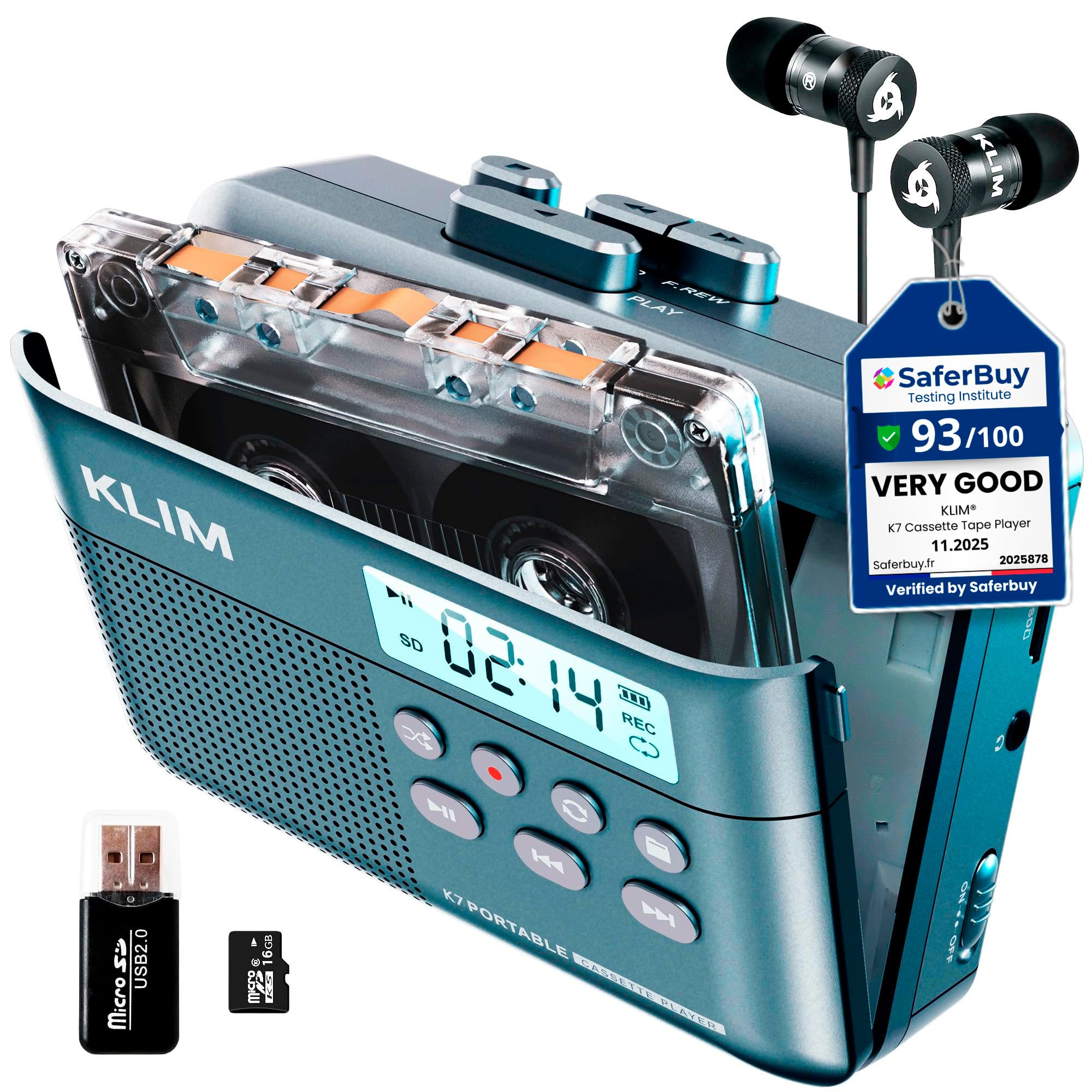
The KLIM K7 solves the most common frustration in cassette digitization: complexity. Most budget recorders require you to connect to a computer with an analog line-in cable and third-party software. The K7 records directly to MP3 on the included 16GB micro SD card with one button press. Insert a cassette, insert the SD card, press Play and Record simultaneously, and the unit encodes at a fixed bitrate (likely 128–192 kbps) with gain set to avoid clipping. The result is a clean TAPE001.MP3 file ready to drag onto any device via the bundled SD card reader. No drivers, no latency, no fuss.
The 1000mAh rechargeable lithium battery charges via USB-C in about two hours and runs through roughly two full C-90 cassettes per charge. The built-in speaker is tiny—suitable only for quick confirmation that the tape is playing—but the included earbuds are adequate for monitoring. The K7 also functions as a basic MP3 player for SD card content and includes a built-in microphone for voice recording to the card. Build quality is respectable for the segment: the plastic shell is dense and free of creaks, though the tape door requires a careful pull to open without straining the hinge.
Digitized files are saved sequentially without track splitting, so expect to use free software like Audacity to divide a 45-minute mix into individual songs. There is no Dolby NR, and the recording level is fixed, so very quiet passages may sound compressed and very loud passages lack headroom. The total absence of motor noise in the recording path is a strong point—confirmed by multiple users with decades-old tapes. If your priority is bulk digitization of spoken word or mixtapes with minimal investment, the K7 is the practical choice.
Why it’s great
- True one-touch digitization to MP3 without a computer
- Includes 16GB SD card and USB card reader out of the box
- USB-C charging with 1000mAh battery for portability
Good to know
- Does not split recordings into individual tracks—requires manual editing
- Tape door hinge feels delicate and requires careful handling
- Fixed recording level with no headroom adjustment for dynamic content
7. KLIM Boombox KLCD-7124
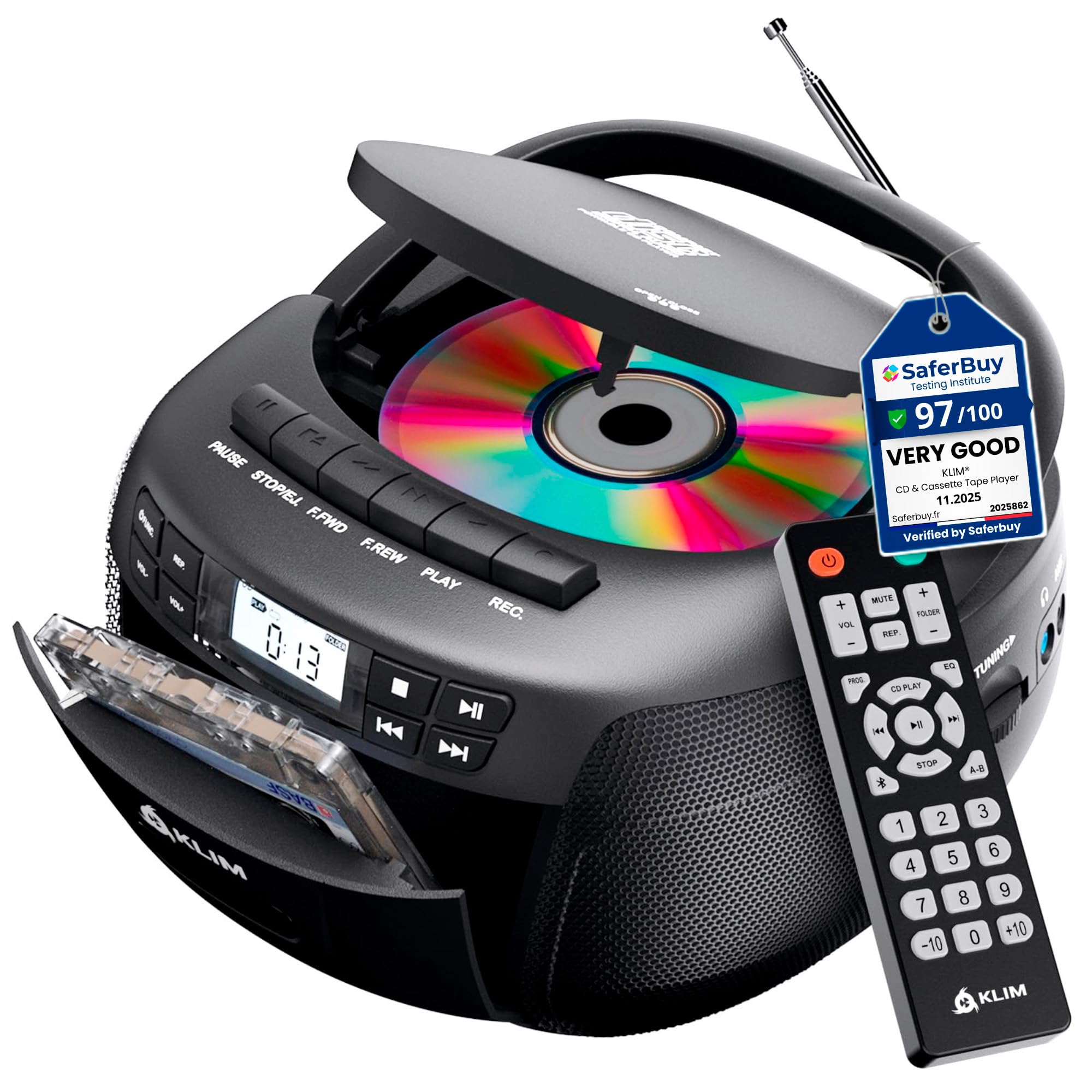
The KLIM KLCD-7124 is a straightforward three-in-one (CD, cassette, FM/AM radio) with Bluetooth 5.1 streaming, designed for the buyer who wants a single box that does everything adequately. The cassette deck plays standard Type I tapes with predictable quality: the head alignment is factory-set and doesn’t drift, the transport runs at correct speed within the first five seconds, and there’s no audible wow under normal listening conditions. The recording function uses the built-in mic or line input and works, but the mono recording head yields lower fidelity than stereo units.
The CD player handles CD, CD-R, and CD-RW discs with MP3/WMA file playback, and the AM/FM tuner uses digital synthesis with drift-free reception. The dual 3W speakers produce crisp high mids but lack any low-frequency extension below 200 Hz, so bass-heavy genres like hip-hop or electronic music sound thin. The remote control works for CD and radio functions but has no cassette transport buttons—you must operate the tape deck from the unit itself. The built-in carrying handle is a nice touch for moving between rooms, though the ~3.3-pound weight is manageable.
Build quality is mixed: the CD tray opens and closes smoothly, but the cassette door on some units requires extra finger pressure to close completely. There are isolated reports of units that require holding the power button continuously for operation, which suggests a control board QC issue on early production runs. The headphone jack on the front panel outputs clean audio and is the best way to bypass the small speakers entirely. For a budget-friendly entry point into the three-in-one world, the KLIM Boombox works—just keep expectations appropriately sized.
Why it’s great
- CD/Cassette/AM-FM plus Bluetooth 5.1 in one compact unit
- Digital FM tuner with drift-free performance
- Headphone jack provides audio quality above the built-in speakers
Good to know
- Cassette door can be finicky to close on some units
- Reported issue with some units needing continuous button press to operate
- Built-in speakers lack any meaningful bass response
FAQ
Do modern cassette players include Dolby noise reduction?
Can I connect a cassette player to my Bluetooth headphones?
What is the typical battery life of a rechargeable cassette player?
Final Thoughts: The Verdict
For most users, the best cassette player winner is the FiiO CP13 because it combines audiophile-grade analog circuitry with a durable all-metal chassis and exceptional battery life, delivering the warm, stable playback that serious collectors demand. If you want a compact boombox that records tapes from Bluetooth and offers wireless headphone transmission, grab the Greadio GB-W16. And for bulk digitizing decades of family mixtapes without needing a computer, nothing beats the one-touch simplicity of the KLIM K7.

Mo Maruf
I created WellFizz to bridge the gap between vague wellness advice and actionable solutions. My mission is simple: to decode the research and give you practical tools you can actually use.
Beyond the data, I am a passionate traveler. I believe that stepping away from the screen to explore new environments is essential for mental clarity and physical vitality.