Our readers keep the lights on and my smoothie glass nicely filled. As an Amazon Associate, I earn from qualifying purchases.
A subwoofer on your desk changes everything. That first explosion in a game, the low hum of a bassline, the rumble of an engine — it’s not just sound, it’s a physical sensation. But separating a 2.1 system that delivers tight, controlled bass from one that just rattles and distorts requires knowing exactly what to look for in the subwoofer, the satellite drivers, and the amplifier power.
I’m Mohammad Maruf — the founder and writer behind WellFizz. I’ve spent countless hours pouring through datasheets, comparing driver sizes, decoding THX certifications, and analyzing customer feedback across the price spectrum to find the 2.1 computer speakers that actually earn their place on your desk.
This guide cuts through the marketing to compare seven of the most compelling 2.1 computer speakers available right now, helping you match the right system to your audio priorities and desk space.
How To Choose The Best 2.1 Computer Speakers
A 2.1 system adds a dedicated subwoofer to stereo satellites, bridging the gap between built-in laptop speakers and a full home theater. The right choice depends on your room size, listening habits, and whether you prioritize bone-shaking bass or balanced accuracy.
Subwoofer Size and Design
The subwoofer’s driver diameter directly dictates how low and how much air it can move. A 4-inch driver in a ported enclosure can produce surprising mid-bass punch, while a 6.5-inch or larger driver delivers the deeper, tactile rumble for explosions and synth drops. Side-firing and down-firing designs affect placement flexibility — down-firing subs can be tucked tighter into a corner without muddying the sound.
Satellite Driver Configuration
Satellites handle everything above the subwoofer’s crossover frequency. Full-range single-driver satellites (like those with a 2.5-inch or 3-inch driver) are simple and efficient, but a two-way design with a separate tweeter and midrange driver offers superior clarity, soundstage separation, and reduced distortion at higher volumes. Silk dome tweeters tend to produce smoother highs than metal ones.
Amplifier Power and Connectivity
Look for RMS (continuous) wattage rather than inflated peak numbers — 30W RMS can power a nearfield desk setup to satisfying levels, while 200W RMS fills a large room. Wired connections (USB, 3.5mm AUX, RCA, Optical) offer zero-latency, lossless audio. Bluetooth is convenient for phone pairing, but introduces compression and slight delay that matters for gaming or video sync. THX certification ensures a standardized level of performance across frequency response, distortion, and output.
Quick Comparison
On smaller screens, swipe sideways to see the full table.
| Model | Category | Best For | Key Spec | Amazon |
|---|---|---|---|---|
| Klipsch ProMedia 2.1 | Premium | THX-certified balanced power | 6.5″ side-firing subwoofer | Amazon |
| Logitech Z623 | Premium | High-power room-filling audio | 200W RMS / 400W peak power | Amazon |
| Edifier Hecate | Mid-Range | Compact RGB gaming setup | 2.75″ full-range drivers | Amazon |
| Creative Pebble X Plus | Mid-Range | Compact USB-C audio upgrade | Passive radiator subwoofer | Amazon |
| Nylavee 2.1 | Mid-Range | Balanced sound with Bluetooth 5.4 | 5.25″ subwoofer driver | Amazon |
| FIFINE AmpliGame A22 | Budget | RGB and multi-connectivity | 18 RGB lighting modes | Amazon |
| Creative Pebble Plus | Budget | USB-powered entry-level 2.1 | 4″ down-firing subwoofer | Amazon |
In‑Depth Reviews
1. Klipsch ProMedia 2.1 THX Certified

The Klipsch ProMedia 2.1 has defined the premium computer audio category for nearly two decades, and for good reason. Its 6.5-inch side-firing, ported subwoofer delivers extraordinarily deep, tactile bass that fills a room without distorting, while the two-way satellites with MicroTractrix horn-loaded tweeters provide crisp, articulate highs and a wide soundstage that makes nearfield listening feel immersive rather than confined.
At 200 watts peak power (110dB maximum output), this system has legitimate headroom for both quiet late-night sessions and party-level volumes. The satellites’ 3-inch midrange drivers blend seamlessly with the subwoofer’s crossover, avoiding the common “hole” between the sub and satellites that plagues lesser systems. The included wired control pod gives you both master volume and subwoofer gain — essential for dialing in the right bass level for your room and content.
The THX certification isn’t just marketing — it guarantees a minimum standard of frequency response accuracy, low distortion, and output capability that few competitors at this level can claim. The satellites’ fixed tilt angle is optimized for desktop listening, though the lack of an on/off switch and the permanently bright power LED are minor ergonomic compromises.
Why it’s great
- THX certification ensures balanced, powerful sound with minimal distortion
- 6.5-inch ported subwoofer delivers deep, room-filling bass
- Separate subwoofer and volume controls for precise tuning
Good to know
- No on/off switch — must unplug or use a power strip
- Satellites have a fixed tilt, not adjustable for different desk heights
- Some users report a bright, always-on power LED
2. Logitech Z623 400 Watt

The Logitech Z623 is the brute-force option in the premium tier, delivering 400 watts peak (200W RMS) from a 7-inch subwoofer and 2.5-inch full-range satellite drivers. Its THX certification assures a minimum performance standard, and the sheer power reserve means this system can fill a large living room or gaming den with authoritative, ground-shaking bass that you feel in your chair during action sequences.
The satellites use a simple full-range driver rather than a two-way design, which means the upper mids and treble clarity aren’t as refined as the Klipsch ProMedia’s horn-loaded setup. Some listeners find the out-of-box sound a touch bass-heavy with a slight recession in the midrange — EQ calibration through your PC’s audio software can dramatically improve tonal balance. The subwoofer’s output is genuinely impressive for the category, with tight, clean bass down to around 50Hz before rolling off.
Build quality is robust, but be aware that the satellite-to-subwoofer connection uses a proprietary VGA-like cable that limits replacement options. The lack of a built-in treble control means you’re dependent on software EQ to tame the upper end, and the power button can develop static over time — a known issue that’s resolvable with contact cleaner.
Why it’s great
- Monstrous 400W peak power for room-filling volume
- 7-inch subwoofer delivers deep, physical bass
- THX certification guarantees a reliable performance baseline
Good to know
- No treble control; out-of-box sound may need EQ
- Proprietary satellite cable limits replacement options
- Power button static issue reported after extended use
3. Edifier Hecate RGB Gaming Speakers
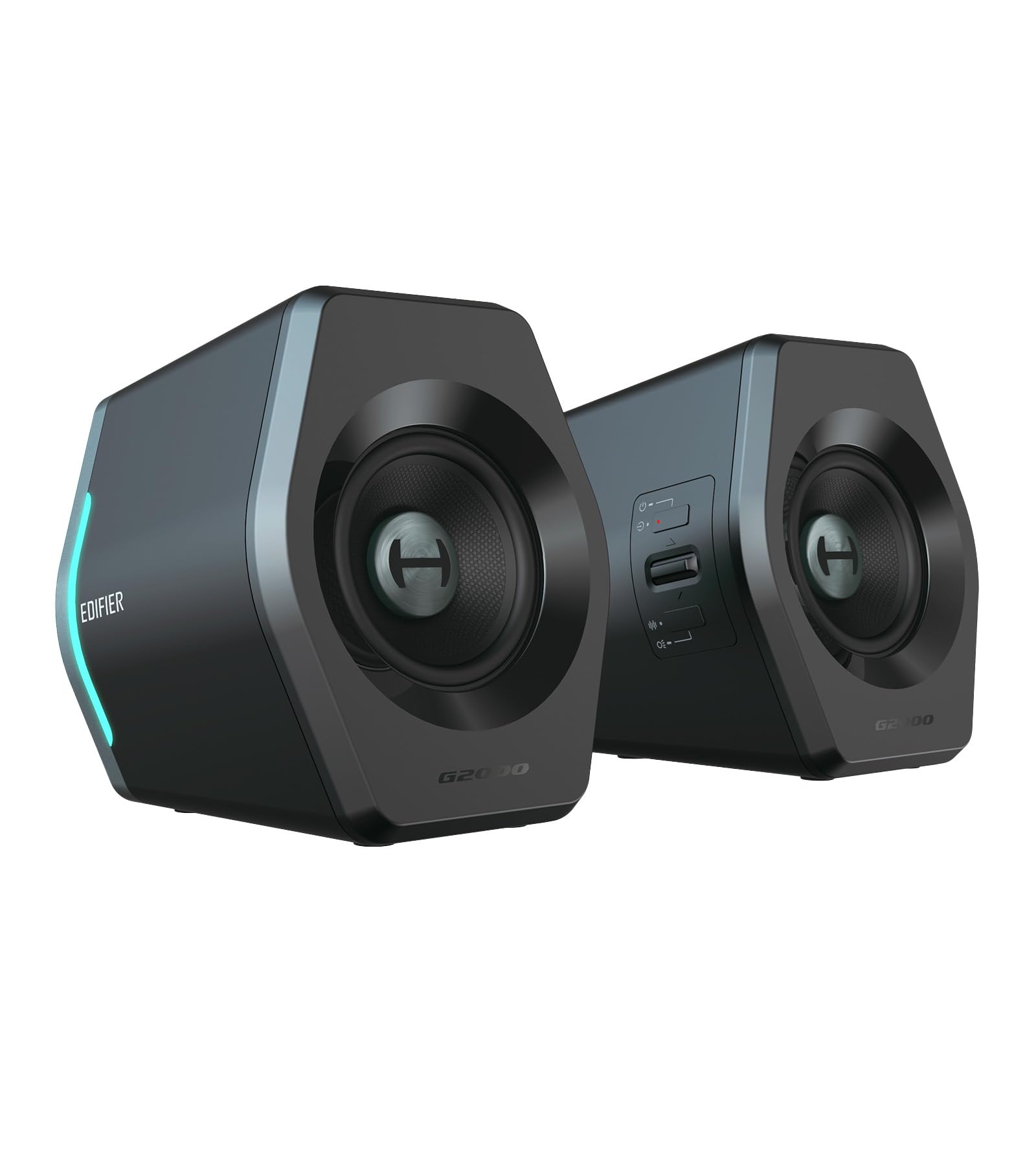
The Edifier Hecate proves that a 2.1 system doesn’t require a bulky subwoofer to deliver satisfying impact. With 32W peak power driving 2.75-inch full-range drivers, these compact satellites produce surprisingly authoritative sound for their size, with punchy mid-bass and clear, articulate highs that work well for competitive gaming where footstep and directional audio precision matters more than chest-thumping lows.
The 12 customizable RGB lighting modes, controlled via a metal knob on the satellite, sync with your game audio or cycle through effects to match your desk aesthetic. Edifier’s three EQ presets (Game, Movie, Music) genuinely alter the frequency response — the Game mode slightly boosts midrange clarity for positional audio, while Music mode widens the soundstage. The build quality is excellent, with matte panels and a scratch-resistant finish that feels more premium than the price suggests.
Bluetooth 5.1, USB sound card, and 3.5mm AUX inputs give you three ways to connect, though the USB connection offers the best audio quality and lowest latency. The 10-degree upward tilt of the satellites is optimized for desktop listening, and the anti-slip pads keep them stable during intense gameplay. The lack of a dedicated subwoofer means the deepest sub-bass extension is limited, but for nearfield gaming on a compact desk, this is a focused, refined package.
Why it’s great
- Compact satellite design fits easily under most monitors
- 12 customizable RGB lighting effects with audio sync
- Three dedicated EQ modes for gaming, movies, and music
Good to know
- Lacks a standalone subwoofer for deep sub-bass extension
- Peak power is lower than full-size 2.1 systems
- Gimmicky power-on/power-off sounds may annoy some users
4. Creative Pebble X Plus

The Creative Pebble X Plus is a masterclass in compact design engineering. Its subwoofer uses passive radiators rather than a traditional ported or sealed enclosure, allowing it to produce full, punchy mid-bass from a very small cabinet — ideal for desks where floor space for a larger subwoofer is at a premium. The satellites feature 45-degree elevated drivers with a 2-inch full-range driver, angling sound directly toward your ears for a focused sweet spot.
Connectivity is the star here: a single USB-C cable carries both power and audio data, bypassing your PC’s potentially noisy internal DAC for a clean digital audio path. Bluetooth 5.3 adds wireless convenience for phone pairing, and the headphone/mic combo jack on the right satellite is a thoughtful addition for late-night sessions. The sound signature is impressively balanced for the size, with a wide soundstage and minimal distortion until pushed to extreme volumes.
The system requires wall power to deliver its full performance — USB power alone won’t drive it to maximum output. The subwoofer’s passive radiator design trades absolute sub-bass extension for speed and clarity, so you won’t get the deepest 30Hz rumble, but the bass it produces is tight, controlled, and musical. The customizable RGB lighting is subtle rather than gaudy, and the understated design fits easily into a professional workspace without screaming “gamer.”
Why it’s great
- Single USB-C cable handles power and audio for clean digital signal
- Passive radiator subwoofer delivers punchy bass in a small footprint
- Bluetooth 5.3 and headphone/mic jack add versatility
Good to know
- Subwoofer cable is relatively short, limiting placement options
- Maximum volume could be louder; not for party-level listening
- Headphone amp has a slight hiss with sensitive headphones
5. Nylavee 2.1 Computer Speakers
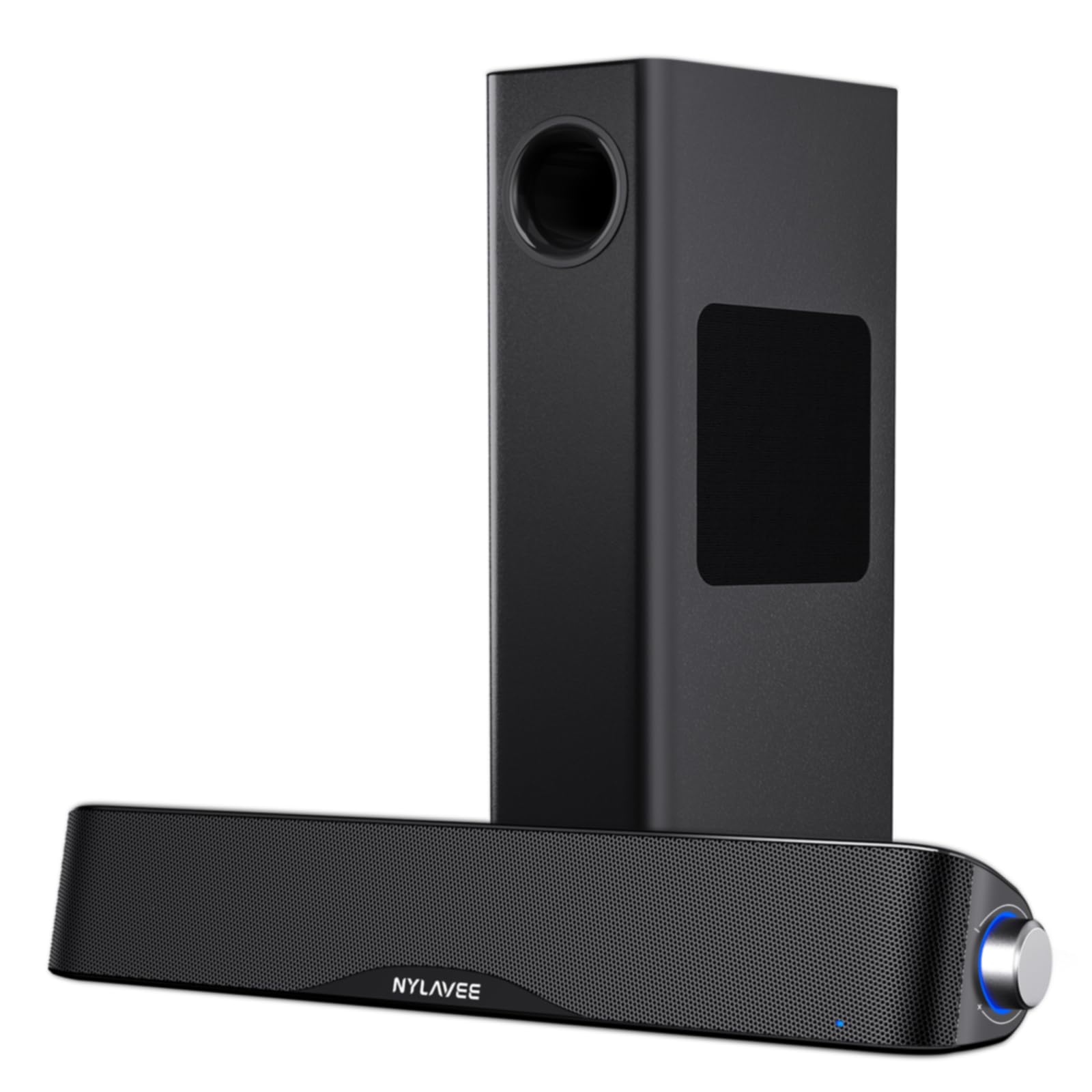
The Nylavee 2.1 system strikes an impressive balance between price and performance, offering a dedicated 5.25-inch subwoofer with 60W peak power (30W RMS) alongside a soundbar-style satellite unit equipped with dual soft-dome silk tweeters and full-range drivers. The soundbar format makes it a natural fit for setups where two separate satellite speakers are impractical, delivering clear, detailed highs and well-defined mids without the harshness common in cheaper metal tweeters.
The 60W peak power is enough to fill a medium-sized room with clean, undistorted audio. The subwoofer produces satisfying, punchy bass down to the lower mid-bass region, though the deepest sub-bass extension is naturally limited by the driver size. A side-mounted knob handles power, volume, mode switching, and Bluetooth pairing — it’s a clean, uncluttered control solution that keeps your desktop tidy. The Bluetooth 5.4 connection is fast and stable with minimal latency for video watching.
Setup is genuinely plug-and-play, with the included RCA and 3.5mm cables covering most connection scenarios. The soundbar design means you sacrifice some stereo separation compared to a traditional two-satellite layout, but for many users the convenience gain outweighs the subtle soundstage difference. The acrylic build is lightweight but feels solid enough for daily use.
Why it’s great
- Soundbar satellite saves desk space without sacrificing audio quality
- Dual silk dome tweeters deliver smooth, non-fatiguing highs
- 60W peak power provides clean volume for most room sizes
Good to know
- Soundbar design limits stereo separation compared to two-satellite systems
- Plastic ABS enclosure doesn’t feel as premium as wooden or metal options
- Sub-bass extension is limited; not ideal for bass-heavy music purists
6. FIFINE AmpliGame A22

The FIFINE AmpliGame A22 brings a full RGB arsenal to the budget-friendly 2.1 market, offering 18 dynamic lighting modes — including audio-sync, breathing, and color cycling — that pulse and shift in real-time with your game audio or music. The two satellite speakers use 2.5-inch full-range drivers, while the compact subwoofer adds low-end body that rounds out the sound for gaming and movies without overwhelming the mids.
Connectivity flexibility is a strong point here: 3.5mm AUX, optical, USB OTG, and Bluetooth 5.0 give you four ways to connect to PCs, consoles, TVs, or mobile devices. The top-mounted control buttons let you adjust volume, cycle through EQ presets (Game, Movie, Music), and control playback without reaching behind your monitor. The 2.1-channel stereo sound provides a genuine upgrade over built-in speakers, with clearer dialogue and more impactful explosions than any soundbar alone.
Sound quality is clean and clear for the category, though the bass is more about presence and punch than deep, tactile rumble. The plastic construction keeps weight low but doesn’t convey the same solidity as pricier options. Some users have reported a low-volume buzz on the AUX connection, and one of the RGB zones on a satellite may occasionally be non-functional — quality control isn’t as tight as the mid-range tier.
Why it’s great
- 18 RGB lighting modes with audio sync create immersive desk ambiance
- Four connection options (AUX, optical, OTG, Bluetooth) for wide device compatibility
- Top-mounted controls make EQ and volume adjustments easy
Good to know
- Overall bass depth is limited; more punch than sub-bass rumble
- Some units may have minor QC issues like non-functional RGB zones
- AUX connection can introduce buzz at low volume levels
7. Creative Pebble Plus 2.1

The Creative Pebble Plus is the most accessible entry point into 2.1 audio, offering a standalone 4-inch down-firing ported subwoofer that provides a genuine low-end foundation for music and gaming — a significant step up from the basic 2.0 Pebble. The 45-degree elevated satellite drivers with 2-inch full-range drivers angle sound directly toward your ears, creating a focused soundstage that’s impressive for the system’s size and power constraints.
One of the Pebble Plus’s defining features is its USB-powered operation — a single USB cable powers the entire system, eliminating the need for a wall outlet. A High Gain Mode switch boosts output to 8W RMS when used with a 5V 2A USB adapter (sold separately), providing noticeably stronger bass and louder overall volume. At its standard power level, it’s best suited for moderate listening volumes where clarity matters more than chest-thumping impact.
The design is minimalist and attractive, with a dark bronze-on-black color scheme that looks refined on any desk. The front-mounted volume control is convenient, though the lack of a headphone jack is a notable omission. Sound quality is very good for the price, with clear mids and highs, though the subwoofer’s passive design means deeper bass notes (below 60-70Hz) are largely absent. Wires management is straightforward, but the included cables are just barely long enough for standard setups.
Why it’s great
- USB-powered convenience eliminates the need for a wall outlet
- 45-degree angled drivers create a focused soundstage for desktop listening
- Minimalist design looks clean and professional on any desk
Good to know
- No integrated headphone jack — requires a separate adapter
- High Gain Mode requires a separate 2A USB adapter not included
- Deep sub-bass extension is limited; best for moderate listening volumes
FAQ
Is a 2.1 system better than a soundbar for a computer desk?
How much power do I really need for desktop 2.1 speakers?
Should I connect via USB, AUX, optical, or Bluetooth?
Can I use 2.1 computer speakers with a TV or gaming console?
What does THX certification actually guarantee?
Final Thoughts: The Verdict
For most users, the 2.1 computer speakers winner is the Klipsch ProMedia 2.1 because it delivers THX-certified, room-filling bass and horn-loaded clarity that outperforms nearly everything in its class. If you want a compact USB-C audio upgrade with surprisingly punchy bass for a small desk, grab the Creative Pebble X Plus. And for an entry-level 2.1 experience that proves a subwoofer doesn’t have to break the bank or require a wall outlet, nothing beats the Creative Pebble Plus.

Mo Maruf
I created WellFizz to bridge the gap between vague wellness advice and actionable solutions. My mission is simple: to decode the research and give you practical tools you can actually use.
Beyond the data, I am a passionate traveler. I believe that stepping away from the screen to explore new environments is essential for mental clarity and physical vitality.