Our readers keep the lights on and my smoothie glass nicely filled. As an Amazon Associate, I earn from qualifying purchases.
Compact digital cameras are making a serious comeback, not because phone cameras got worse, but because a dedicated camera with a real zoom lens, a larger sensor, and physical controls delivers a fundamentally different photographic experience. The pocket-sized body hides a world of optical reach and image quality your phone simply cannot replicate, especially when you need to capture a distant subject, shoot in raw, or leave your phone battery for the rest of the day.
I’m Mohammad Maruf — the founder and writer behind WellFizz. For this guide, I spent hours dissecting specification sheets, cross-referencing sensor types, zoom ranges, and stabilization systems across nine of the most compelling compact and compact-interchangeable cameras on the market right now.
This guide pinpoints the exact model that fits your specific balance of portability, zoom reach, and image quality so you can confidently choose the best compact digital camera for your next adventure, vlog, or daily carry.
How To Choose The Best Compact Digital Camera
Choosing a compact camera today means selecting between three distinct architectures: the ultra-portable point-and-shoot with a built-in zoom lens, the rugged adventure camera built to survive the elements, and the compact interchangeable-lens mirrorless system that trades some pocketability for a larger sensor. Each serves a different primary use case, and the best choice depends entirely on your shooting environment and subjects.
Sensor Size and Image Quality
The sensor is the single largest determinant of image quality in a compact camera. A 1-inch type sensor (found in the Sony RX100 II) is roughly four times larger than the typical phone sensor, offering significantly better dynamic range and low-light performance. Micro Four Thirds sensors (OM System E-M10 Mark IV) are larger still, while APS-C sensors (Canon EOS R100, Sony ZV-E10, Nikon Z 30) provide the best balance of pixel density and sensitivity, rivaling many full-frame cameras of a decade ago. For extreme low light or professional-level image quality, a larger sensor is non-negotiable.
Zoom Range and Optical Reach
Your phone may say “5x zoom,” but that is invariably digital cropping or a telephoto lens switching in from a fixed second camera. A true optical zoom lens like the Panasonic ZS99’s 30x (24-720mm equivalent) or the KODAK PIXPRO FZ55’s 5x (28-140mm) retains full resolution across the entire range. For travel, concerts, or wildlife, a longer optical zoom is invaluable. For everyday snapshots, a modest 3x-5x zoom in a slimmer body reduces bulk while still offering useful framing flexibility.
Stabilization and Low-Light Handling
Camera shake at telephoto lengths or in dim environments ruins more photos than any other single variable. Optical image stabilization (OIS) built into the lens steadies the viewfinder image and the recorded photo. In-body image stabilization (IBIS) shifts the sensor itself to compensate for motion, and is found on advanced models like the OM System E-M10 Mark IV. For handheld video and handheld long exposures, prioritize a camera with at least one form of stabilization, and ideally both.
Quick Comparison
On smaller screens, swipe sideways to see the full table.
| Model | Category | Best For | Key Spec | Amazon |
|---|---|---|---|---|
| Canon EOS RP | Mirrorless | Full-frame travel | 26.2MP full-frame sensor | Amazon |
| Sony ZV-E10 Kit | Mirrorless | Vlogging and video | 24.2MP APS-C, 425 AF points | Amazon |
| Nikon Z 30 Kit | Mirrorless | Streaming and creators | 20.9MP APS-C, 209 AF points | Amazon |
| OM System E-M10 Mark IV | Mirrorless | Stylish all-rounder | 20MP Micro Four Thirds, 5-axis IBIS | Amazon |
| Canon EOS R100 Kit | Mirrorless | Entry-level mirrorless | 24.1MP APS-C, 4K video | Amazon |
| Panasonic ZS99 | Point & Shoot | Long zoom travel | 30x optical zoom (24-720mm) | Amazon |
| OM System Tough TG-7 | Rugged | Adventure and underwater | Waterproof to 15m (50ft) | Amazon |
| Sony RX100 II | Premium Compact | Pocketable quality | 20.2MP 1-inch sensor, f/1.8 lens | Amazon |
| KODAK PIXPRO FZ55 | Budget Point & Shoot | Simple everyday use | 16MP, 5x optical zoom | Amazon |
In‑Depth Reviews
1. Canon EOS RP with RF24-105mm Lens

The Canon EOS RP is the most affordable entry point into full-frame mirrorless photography, and its compact body — barely larger than many APS-C rivals — makes it a surprisingly travel-friendly system. Paired with the RF 24-105mm F4-7.1 IS STM lens, you get a versatile 4.4x zoom range with optical stabilization rated at 5 stops, allowing handheld shooting in conditions that would force a smaller sensor to raise ISO into noisy territory. The 26.2MP sensor produces images with the subject separation and dynamic range that full-frame sensors are known for, and the Dual Pixel CMOS AF system locks focus quickly even on moving subjects.
Video shooters will appreciate the clean 4K output and the ability to use the camera as a high-quality webcam via USB. The tilt-out touchscreen is intuitive for both vlogging and low-angle composition. Some reviewers note the kit lens can be soft in the extreme corners at wide apertures, but stopping down to f/8 sharpens the center significantly. Battery life is adequate for a day of casual shooting, though heavy video users will want a spare.
This is not a camera for fast-action sports or bird-in-flight sequences — the burst rate and older DIGIC 8 processor show their limits there. But for landscape, portrait, architectural, and travel photography, the Canon EOS RP delivers full-frame image quality in a package that slips into a small messenger bag with room to spare. It is the top-tier choice for anyone wanting the largest feasible sensor without the bulk of a traditional DSLR system.
Why it’s great
- Full-frame sensor delivers exceptional low-light performance and depth of field
- RF 24-105mm lens offers versatile reach with effective optical stabilization
- Compact and lightweight body for a full-frame system
Good to know
- Kit lens aperture narrows to f/7.1 at telephoto, reducing low-light ability
- Burst shooting is slower than APS-C competitors in the same price bracket
- No built-in flash — relies on hotshoe for external flash
2. Sony ZV-E10 with 16-50mm Lens

The Sony ZV-E10 is purpose-built for video-first creators, combining a 24.2MP APS-C sensor with features designed to simplify vlogging and livestreaming. The vari-angle touchscreen flips forward for self-recording, the built-in three-capsule microphone with windscreen captures clean on-camera audio, and the dedicated background defocus button instantly creates a soft bokeh look for product reviews or talking-head shots. The 425-phase-detection autofocus points provide fast eye-tracking for both human and animal subjects, a major advantage when shooting moving subjects without a dedicated focus puller.
The included 16-50mm f/3.5-5.6 OSS lens provides Optical SteadyShot for smooth handheld video, though the variable aperture means a drop in performance at telephoto. Oversampled 4K video is detailed and cinematic, and the USB-C port supports simultaneous power and data for extended streaming sessions. Some reviewers note the lack of in-body stabilization in the camera body itself, making gimbal use advisable for walking shots. The bundled kit often includes a memory card, bag, and tripod, offering strong value for new creators.
For anyone stepping up from a phone or a basic point-and-shoot to a proper mirrorless system focused on video and live content, the ZV-E10 offers the most streamlined interface in its class. The E-mount lens ecosystem means you can upgrade to primes or telephoto lenses later. It is a mid-range powerhouse for vlogging that leaves room to grow into more advanced video work.
Why it’s great
- 425-point AF with real-time eye-tracking for humans and animals
- Oversampled 4K video with great detail and color science
- Vari-angle screen and dedicated vlogging features reduce setup time
Good to know
- No in-body image stabilization — relies on lens OIS for steady shots
- Kit lens variable aperture limits low-light performance at telephoto
- Small battery capacity requires spares for extended shooting days
3. Nikon Z 30 with 16-50mm Lens

The Nikon Z 30 is the company’s smallest and lightest mirrorless stills and video camera, weighing just 405 grams including battery. Flip the touchscreen forward for selfie-mode recording, and the red REC light provides clear confirmation when rolling. The 20.9MP APS-C sensor and EXPEED 6 processor produce sharp, color-accurate images with excellent low-light performance, and the 209-point hybrid autofocus system includes eye detection for both people and pets. Vloggers will appreciate the built-in stereo microphone with adjustable sensitivity and the ability to control the camera remotely via the SnapBridge smartphone app.
Streamers benefit from the plug-and-play USB-C connection, which works as a high-quality webcam for Zoom or OBS at Full HD 60p. The Z 30 runs cool during extended 4K recordings, with no overheating issues reported — a distinct advantage over some competing compact mirrorless models. The 16-50mm zoom lens covers wide selfie angles and everyday focal lengths effectively, though the variable f/3.5-6.3 aperture means performance drops at telephoto. The lack of an electronic viewfinder is a trade-off for the size reduction, but the rear screen displays exposure accurately in most conditions.
For creators who prioritize portability and live streaming over advanced video controls, the Nikon Z 30 is a compelling mid-range choice. Its compatibility with the entire NIKKOR Z lens lineup means you can add a fast prime lens later for even better low-light capability. Reviewers consistently praise its intuitive controls, ergonomic grip, and the clarity of the 4K footage straight from the camera.
Why it’s great
- Exceptionally lightweight and compact design for all-day carry
- Plug-and-play USB webcam operation with no software hassle
- No overheating reported during unlimited 4K recording
Good to know
- No built-in electronic viewfinder — framing relies entirely on rear screen
- Kit lens variable aperture reduces light gathering at telephoto
- Battery life is standard for mirrorless; spares recommended for heavy use
4. OM System E-M10 Mark IV with 14-42mm Lens

The OM System (formerly Olympus) E-M10 Mark IV is a beautifully retro-styled Micro Four Thirds camera that delivers image quality and stabilization far beyond its compact frame. Its 20-megapixel Live MOS sensor produces sharp, color-rich images with excellent dynamic range, but the headline feature is the 5-axis in-body image stabilization rated at 4.5 shutter speed steps. This means you can shoot handheld at 1/4 second exposures and get sharp results — a capability that outpaces many larger-sensor cameras without IBIS. The flip-down monitor activates a dedicated selfie mode automatically, making it one of the most elegant selfie cameras available.
The 14-42mm EZ pancake lens retracts to a remarkably flat profile, allowing the entire system to fit in a jacket pocket. The camera supports 4K video at 30p, 16 art filters including the new Instant Film effect, and in-camera panorama stitching. 121 contrast-detect autofocus points handle general shooting confidently, though it is not as quick as phase-detect systems for tracking action. The OLED viewfinder and tilting touchscreen provide two independent framing options.
For photographers who want a compact, stylish system that delivers exceptional stabilization and easy smartphone connectivity (Bluetooth always-on via OI Share), the E-M10 Mark IV is a standout mid-range option. The Micro Four Thirds lens ecosystem is vast and affordable, allowing you to adapt almost any legacy lens with a simple adapter. Reviewers consistently note the excellent value, build quality, and the remarkably effective IBIS as the defining reasons to choose this camera over its peers.
Why it’s great
- 5-axis IBIS provides incredible handheld stabilization — a class-leading feature
- Compact pancake lens makes the system genuinely pocketable
- Excellent image quality and dynamic range for the Micro Four Thirds sensor size
Good to know
- Contrast-detect AF is slower than phase-detect systems for fast action
- No USB-C charging — uses proprietary charger and older connection
- Large lens ecosystem but native fast primes can add bulk
5. Canon EOS R100 with 18-45mm Lens

The Canon EOS R100 is the smallest and most affordable body in the EOS R mirrorless series, designed specifically for beginners and casual creators who want the image quality of a 24.1MP APS-C sensor without the complexity of high-end systems. The 18-45mm kit lens provides a versatile standard zoom range with a retractable design that keeps the package compact. Despite its entry-level positioning, the R100 includes Dual Pixel CMOS AF with human face and eye detection, covering 143 autofocus zones across the frame. This is the same proven autofocus technology found in higher-tier Canon models, ensuring sharp focus on faces even when composing through the viewfinder.
The DIGIC 8 processor enables 4K video at up to 24 fps, Full HD at 60 fps, and HD at 120 fps for slow motion. The 6.5 fps continuous shooting in One-Shot AF mode is adequate for casual action shots. The GUI uses a guided interface that walks beginners through settings without feeling overwhelming. However, the R100 does not include a touchscreen, which is a notable omission in 2024. Battery life is suitable for a full day of casual shooting, though heavy video users will need spares.
For the price-conscious buyer entering the mirrorless ecosystem, the Canon EOS R100 offers the best gateway to RF-mount lenses and Canon’s outstanding color science. Reviewers emphasize that paired with a affordable prime lens like the RF 50mm f/1.8, the image quality punches well above its weight class. It trades some video flexibility and touchscreen convenience for a lower entry cost, making it a smart mid-range pick for photography-focused beginners.
Why it’s great
- Dual Pixel CMOS AF with eye detection — a standout feature at this level
- 24.1MP APS-C sensor delivers excellent image quality for the size and price
- Small and lightweight body, ideal for travel and casual use
Good to know
- No touchscreen — relies on physical buttons for menu navigation
- 4K video limited to 24 fps, not ideal for smoother motion capture
- Single SD card slot with limited high-speed burst support
6. Panasonic LUMIX ZS99 (TZ99)

The Panasonic LUMIX ZS99 (also known as the TZ99) is a travel zoom powerhouse that packs a 24-720mm equivalent Leica DC lens with 30x optical zoom into a body that fits in a pocket. This class-leading zoom range covers everything from wide architectural shots to distant mountain peaks or concert performers, all while maintaining full sensor resolution across the entire optical zoom range. The 5-Axis HYBRID O.I.S. stabilization system allows relatively steady handheld shots at the long end of the zoom, though a tripod is recommended for critical sharpness at 720mm.
The camera records 4K video at 30p and supports 4K PHOTO burst mode at 30 fps for extracting single frames from motion. The 1,840k-dot tiltable touchscreen provides comfortable framing from high or low angles, and the integrated Bluetooth v5.0 with a dedicated Send Image button simplifies transferring images to a phone. The 20-megapixel sensor with a 1/2.3-inch format is typical for this class; image quality is excellent in good light but the small sensor does show noise above ISO 1600. The f/3.3-6.4 aperture means the lens becomes slower at telephoto, but the raw zoom reach compensates for many shooting scenarios.
For travelers, concert-goers, and outdoor enthusiasts who need maximum zoom in a truly portable package, the ZS99 is the best mid-range option available. The user interface offers both automatic modes for casual shooting and manual controls for creative flexibility. Color aberrations at the edges of the frame are occasionally noticeable at wide angles, but the overall image quality, build feel, and portability make it a top contender in the travel zoom compact category.
Why it’s great
- 30x optical zoom (24-720mm equivalent) is unbeatable for a pocket camera
- 5-Axis HYBRID O.I.S. provides effective stabilization at telephoto
- Tiltable touchscreen and Bluetooth connectivity for easy sharing
Good to know
- Small 1/2.3-inch sensor limits low-light performance
- Contrast-detect AF with only 1 point is slow for fast-moving subjects
- Color fringing can appear at wide-angle corners in high-contrast scenes
7. OM System Tough TG-7

The OM System Tough TG-7 is the definitive rugged compact camera for outdoor adventurers, offering waterproofing to 15 meters (50 feet), shockproof certification from 2.1 meters (7 feet), crushproof resistance up to 100 kgf (220 lbf), and freezeproof operation down to -10°C (14°F). The F2.0 maximum aperture lens captures more light than typical compact lenses, aiding underwater and low-light composition, and the TruePic VIII image processor handles the 12-megapixel back-illuminated CMOS sensor delivering vivid, detailed images in bright conditions.
The variable macro system is genuinely unique — a dedicated microscope mode allows focusing as close as 1 centimeter from the lens tip, revealing details invisible to the naked eye or any phone camera. Five dedicated underwater modes, including underwater HDR and underwater microscope, ensure optimal color reproduction when snorkeling or diving. The camera shoots 4K video at 30p and supports 120 fps high-speed movie recordings. RAW support gives advanced users flexibility in post-processing, and the replaceable battery system means you can swap in a fresh cell without USB charging.
The TG-7 has a smaller sensor typical of rugged compacts, meaning low-light performance is its weakest trait — noise is visible above ISO 800, and the built-in flash is essential for indoor shots. But for its intended environment (rainforests, beaches, mountains, ski slopes, and dive sites), the TG-7 outperforms any non-rugged camera because it survives conditions that would destroy other equipment. The click sound present in the TG-6 has been resolved in the TG-7, making it a better choice for silent video recording. This is the definitive mid-range waterproof choice for anyone who needs a camera that doubles as a field tool.
Why it’s great
- Waterproof to 15m, shockproof to 2.1m, and crushproof to 100 kgf — built for extremes
- Microscope mode and underwater HDR provide unique capture capabilities
- RAW shooting and manual controls for advanced underwater photography
Good to know
- Small sensor delivers noticeable noise above ISO 800 in low light
- 12MP resolution is lower than most competitors in this price range
- Flash is essential for indoor or night shots; no hotshoe for external strobe
8. Sony RX100 II

The Sony RX100 II remains a landmark in compact camera design, combining a 1-inch type 20.2MP Exmor R CMOS sensor with a bright F1.8 Carl Zeiss Vario-Sonnar T* lens in a truly pocketable body. The 1-inch sensor is approximately four times larger than the sensor in a typical point-and-shoot or smartphone, providing dramatically better light gathering, dynamic range, and image detail at comparable ISOs. The 28-100mm equivalent zoom range with a maximum aperture of f/1.8 at wide angle allows excellent background blur and low-light performance that still rivals many current compacts.
The RX100 II introduced a tilting LCD screen (3-inch, 1,229,000 dots) for waist-level or overhead shooting, built-in Wi-Fi with NFC for instant image transfer, and a multi-interface shoe that supports external flash, microphones, and a viewfinder accessory. Continuous shooting at 10 fps captures action effectively, and the 1080p 60fps video with full exposure control produces smooth, editable footage. The lens is sharp across the frame at optimal apertures, with slight edge distortion at 28mm correctable in post.
This model lacks 4K video — a feature standard today — and the contrast-detect autofocus with only 25 points is slower than modern hybrid systems. The battery life is average for its era, and the lack of a built-in viewfinder means bright sunlight can wash out the screen. However, for pure image quality per cubic centimeter, the RX100 II still holds its own, and for budget-conscious photographers wanting pocketable professional-grade stills, it remains a compelling entry into the premium compact category. Reviewers consistently describe it as a “mini-NEX” that rivals early APS-C cameras in output quality.
Why it’s great
- 1-inch sensor with f/1.8 lens delivers class-leading image quality in a pocket
- Built-in Wi-Fi/NFC and tilting screen add modern convenience
- RAW shooting and full manual control for advanced photographers
Good to know
- No 4K video recording — limited to 1080p at 60fps
- Contrast-detect AF with 25 points is slow in low-contrast scenes
- No electronic viewfinder; screen can be hard to read in bright sunlight
9. KODAK PIXPRO FZ55
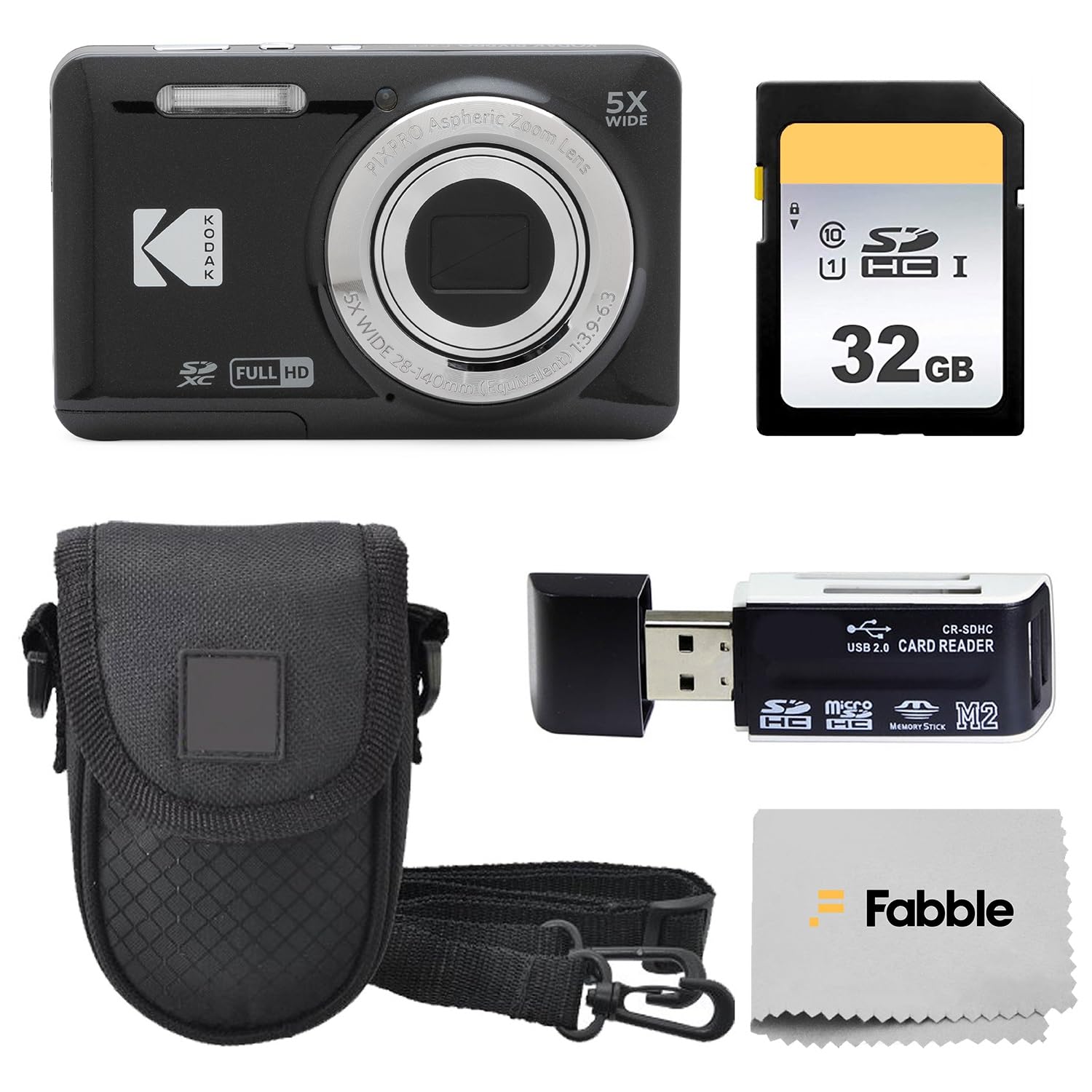
The KODAK PIXPRO FZ55 is a straightforward, no-frills point-and-shoot camera that focuses on ease of use and accessibility. With a 16-megapixel sensor and a 5x optical zoom lens (28mm wide-angle to 140mm equivalent), it covers the most common framing needs for family events, casual travel, and everyday snapshots. The 2.7-inch LCD screen allows easy composition and review, and the Full HD 1080p video recording at 30 fps captures home movies with adequate detail. The bundle typically includes a 32GB SD card, a protective case, and a card reader, delivering immediate usability straight out of the box.
The camera features built-in flash, digital and optical image stabilization, and contrast-detect autofocus with 179 points. Battery life is reported at 6-8 hours of normal use, which is strong for a compact camera. The f/2.8 maximum aperture at wide angle helps in moderate indoor lighting, though the small 1/2.3-inch sensor will struggle in low-light scenarios and produce noise above ISO 800. The camera is very small, fitting easily in a small bag or an oversized pocket, though it may feel cramped for users with large hands.
For first-time camera buyers, children, or anyone needing a dedicated camera that simply works without a learning curve, the KODAK PIXPRO FZ55 is the most affordable entry point. Image quality is good in bright daylight and acceptable in controlled indoor settings. It does not offer raw capture, manual controls, or any advanced feature, but for documenting everyday life at the lowest possible investment, it outperforms phone cameras in zoom reach and avoids draining your phone’s battery. It is the clear budget-friendly choice for contented simplicity.
Why it’s great
- Very low entry price with included memory card and case for instant use
- 5x optical zoom provides useful focal range beyond phone capabilities
- Reported battery life of 6-8 hours is competitive in this class
Good to know
- Small sensor and no raw capture limit image quality and editing flexibility
- No manual controls — full auto operation only
- Small body design may feel cramped for users with larger hands
FAQ
Is a compact digital camera better than my current smartphone camera?
What is the real-world benefit of a 1-inch sensor over a 1/2.3-inch sensor?
What does the magnification ratio mean for a compact camera’s zoom lens?
Can I use my compact camera for live streaming on a computer?
Is in-body image stabilization worth paying more for in a compact camera?
Final Thoughts: The Verdict
For most users, the best compact digital camera winner is the OM System E-M10 Mark IV because it uniquely combines a pocketable interchangeable-lens system, class-leading 5-axis in-body stabilization, excellent Micro Four Thirds image quality, and a vast lens ecosystem at a mid-range price. If you want maximum zoom in a truly portable body, grab the Panasonic LUMIX ZS99. And for adventure and underwater shooting, nothing beats the OM System Tough TG-7 for robust durability paired with unique macro and underwater features.

Mo Maruf
I created WellFizz to bridge the gap between vague wellness advice and actionable solutions. My mission is simple: to decode the research and give you practical tools you can actually use.
Beyond the data, I am a passionate traveler. I believe that stepping away from the screen to explore new environments is essential for mental clarity and physical vitality.