Our readers keep the lights on and my smoothie glass nicely filled. As an Amazon Associate, I earn from qualifying purchases.
The difference between a good camp trip and a great one often comes down to whether your gear stays powered. Camp solar panels let you run lights, charge devices, and even keep a fridge cold without hunting for a plug or burning fuel. But the market is flooded with wattage claims that rarely hold up in real sunlight, so choosing the right one means understanding how efficiency, cell type, and voltage actually behave under a canopy or a cloud.
I’m Mohammad Maruf — the founder and writer behind WellFizz. I’ve spent hundreds of hours cross-referencing panel specifications, customer test results, and real-world output data to find the panels that deliver what they promise when you’re off-grid.
My research zeroed in on the models that balance weight, waterproofing, and true wattage output so you don’t get stuck with a panel that only works in a lab. This guide breaks down the best camp solar panels by real-world performance, not marketing numbers.
How To Choose The Best Camp Solar Panels
Camp solar panels are a long-term investment in off-grid freedom, but picking the wrong one means carrying dead weight—literally. Focus on these four factors to match a panel to your real camping habits.
Cell Efficiency and Type
The efficiency percentage tells you how much of the sunlight hitting the panel gets converted into electricity. Standard panels hover around 22-23%, while N-Type and IBC cells push past 25%. Higher efficiency means you generate more power from a smaller panel, which matters when you’re packing into a tent or strapping gear to a roof rack.
Waterproofing and Build Quality
A camp solar panel lives outside, so its dust and water resistance rating directly determines its lifespan. IP65 handles light splashes, IP67 survives rain and brief submersion, and IP68 handles continuous immersion. The coating material matters too: ETFE resists heat and scratches better than PET, and reinforced seams prevent moisture from wicking into the solar cells.
Voltage and Connector Compatibility
Not every panel works with every power station. Low-voltage panels (around 18-23V) are fine for small 12V systems, but high-voltage panels (40-50V) charge larger 1kWh+ generators faster. Always check your power station’s maximum input voltage before buying—a 50V panel can damage a unit that only accepts 24V.
Portability and Deploy Speed
Camp panels range from 7 pounds to over 22 pounds. The lightest models fold into the size of a laptop bag and set up in seconds with magnetic closures. Heavier panels deliver more wattage but can be awkward to reposition as the sun moves. Kickstands with multiple angle settings help you capture more sunlight without propping the panel against a rock.
Quick Comparison
On smaller screens, swipe sideways to see the full table.
| Model | Category | Best For | Key Spec | Amazon |
|---|---|---|---|---|
| Renogy 200W E.Flex | Premium Mid-Weight | Versatile car camping | 25% N-Type 16BB cells | Amazon |
| Jackery SolarSaga 200W | Premium | Jackery ecosystem users | 26.7% IBC bifacial cells | Amazon |
| ZOUPW 350W | High-Wattage | Large generator charging | 50.2V N-Type cells | Amazon |
| MHPOWOS 220W | High-Voltage | 40V-compatible stations | 40V monocrystalline cells | Amazon |
| HQST 200W | Ultra-Light | Backpacking light loads | 25% N-Type cells | Amazon |
| Renogy 100W E.Flex | Lightweight | Solo trips & small loads | 7.3 lbs / 25% cells | Amazon |
| ZOUPW 100W | Versatile | Universal power station fit | 5-in-1 connector cable | Amazon |
| EBL Solar 100W | Budget-Mid | First-time buyers | 45° kickstand angle | Amazon |
| Luvknit 100W | Entry-Level | Low-cost starter setup | 24% monocrystalline cells | Amazon |
In‑Depth Reviews
1. Renogy 200W Portable Solar Panel
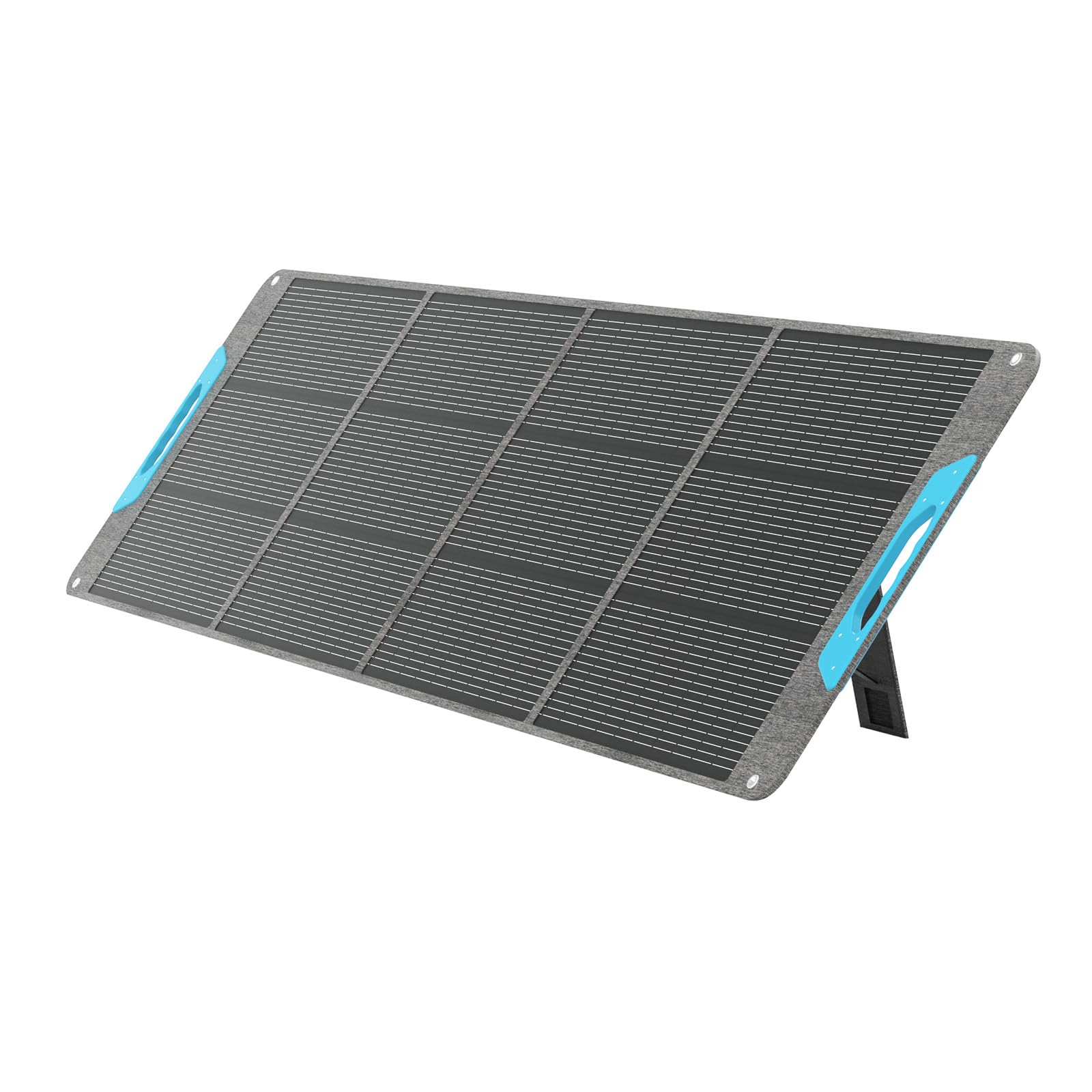
The Renogy 200W E.Flex strikes a near-perfect balance between power, weight, and durability for camp use. Its N-Type 16BB cells deliver 25% efficiency, which means it keeps producing meaningful current even under hazy skies or when the panel isn’t perfectly angled. The quadfold design collapses to just under two inches thick and weighs under 14 pounds, so you can move it around camp as the sun shifts without straining your back.
Real-world tests show sustained output around 170-180W in full sun, with occasional bursts past the rated 200W in bright coastal or high-altitude light. The MC4 output pairs cleanly with most major power stations, and the three built-in USB ports (one USB-C PD at 45W plus two USB-A) let you charge phones and tablets directly without a generator in between. The IP65 rating means rain won’t ruin the panel, though you’ll want to dry the fabric pouch before folding it away.
Some users report the kickstands feel a bit stiff when deploying, and the included carrying case is basic rather than padded. But for the combination of high cell efficiency, reasonable weight, and the safety of a UL 61730-certified panel backed by a two-year warranty, this is the camp panel most people should buy.
Why it’s great
- 25% N-Type cells outperform standard 9BB panels
- Built-in USB-C PD port at 45W for direct device charging
- Lightweight quadfold design with magnetic closures
Good to know
- Kickstands can feel stiff during initial deployment
- Basic carry bag offers minimal padding
2. Jackery SolarSaga 200W

Jackery’s SolarSaga 200W uses IBC (Interdigitated Back Contact) technology combined with a bifacial design, meaning both the front and back of the panel can harvest light. This gives it the highest efficiency rating in this lineup at 26.7%, and it pays off in real-world use—users report hitting 198W in direct sun at altitude, and the bifacial rear face pulls in reflected light from snow, sand, or light-colored tent fabric.
The panel folds down to 24×21.7×1.8 inches and sets up in about ten seconds with no tools. It’s built to Jackery’s usual high standards with an IP68 waterproof rating, so it can handle rain, dust, and even accidental submersion better than most camp panels. The included 9.8-foot cable has DC8020/DC7909 connectors plus USB-A and USB-C ports, but those USB ports are not weatherproof, so you’ll want to keep them dry.
The biggest drawback is price—this is the most expensive panel per watt in the list. It also tends to blow over in moderate wind because the bifacial design doesn’t have a solid backplate for staking. If you’re already invested in the Jackery ecosystem, the integration and warranty make the premium worth swallowing. If you’re mixing brands, check voltage limits closely.
Why it’s great
- 26.7% IBC bifacial cells for top efficiency
- IP68 waterproof rating handles harsh weather
- Ten-second setup with ergonomic handle
Good to know
- Premium price per watt compared to competitors
- Blows over easily in wind without staking
3. ZOUPW 350W Portable Solar Panel
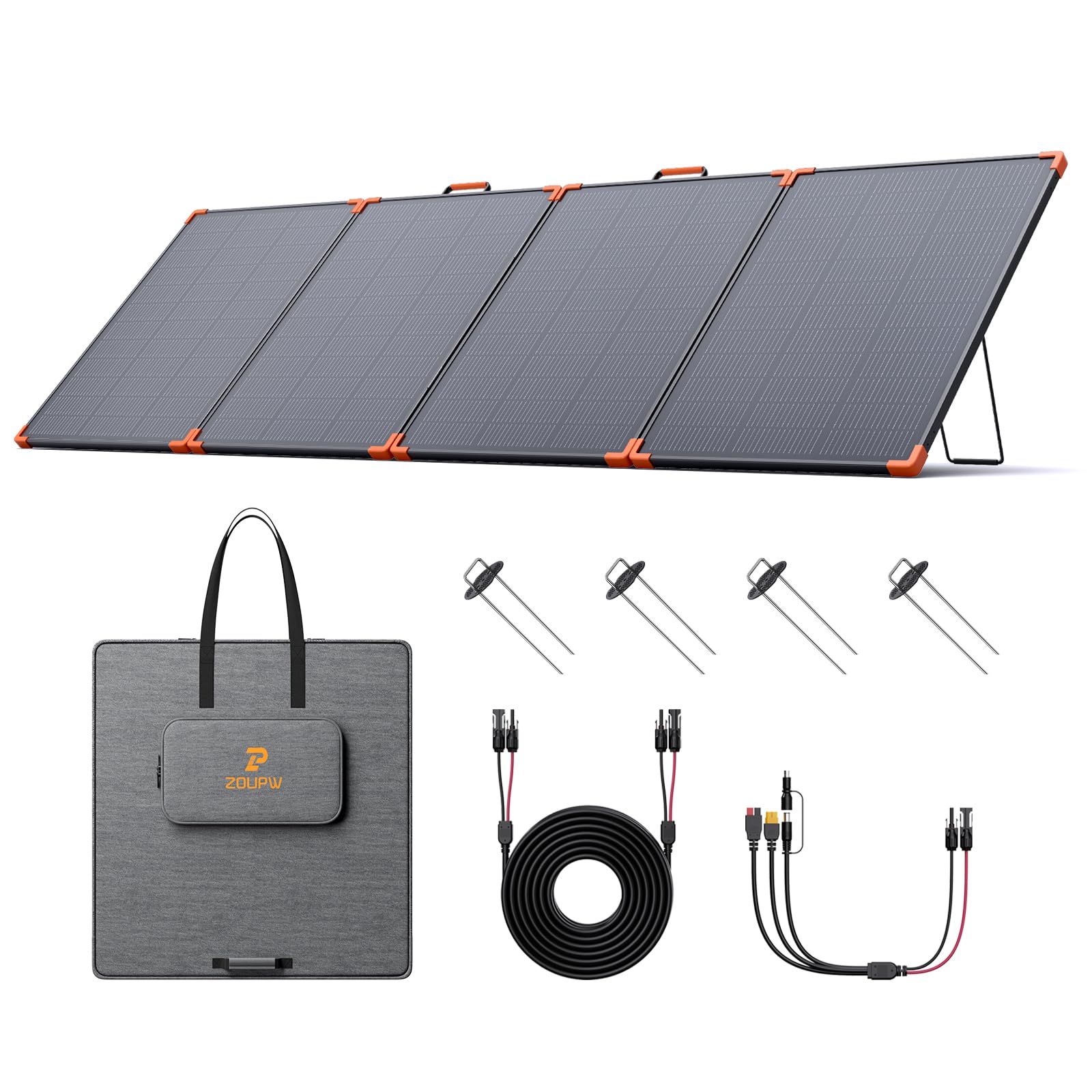
The ZOUPW 350W is a serious power plant for campers who need to recharge large 1kWh+ power stations in a single afternoon. Its N-Type 16BB cells hit 25% efficiency, but the real differentiator is the 50.2V open-circuit voltage—it charges high-voltage generators much faster than standard 18V panels. Real-world tests show sustained output between 300-340W, and some users report peaks above 380W in optimal winter sun.
Despite its 350W rating, the panel folds into a compact briefcase shape (23.82 x 33.15 x 3.44 inches) and weighs 22.2 pounds. The IP68 waterproof ETFE coating means you can leave it out in the rain without worry, and the four adjustable kickstands let you angle it at 45 degrees for 30% more sunlight capture than flat laying. The magnetic handle and padded storage bag make transport manageable, though you’ll still feel the weight on a long hike from the car.
This panel is not for small 12-20V power stations—the 50.2V output can damage units with lower voltage limits. The kickstands are sturdy but the angle adjustment is limited to about 45 degrees, which isn’t ideal for winter sun at high latitudes. For large solar generators and serious off-grid setups, this panel delivers unbeatable wattage per dollar.
Why it’s great
- 350W output charges large generators fast
- 50.2V N-Type cells with 25% efficiency
- IP68 waterproof with durable ETFE coating
Good to know
- Not compatible with 12-20V power stations
- 22.2 lbs is heavy for backpacking
4. MHPOWOS 220W Portable Solar Panel

The MHPOWOS 220W sits in an interesting middle ground—it offers high voltage (40V) and high wattage at a price point well below the ZOUPW 350W and Jackery 200W. Its monocrystalline cells achieve 23.5% efficiency, and owners regularly report peak outputs between 190-207 watts in strong sun, with typical performance around 170-190W. That’s better than many 200W-rated panels from bigger brands.
The panel is built for mobility, folding down to 23.5 x 21.25 x 2.3 inches. At about 17.8 pounds, it’s lighter than the ZOUPW 350W but still heavy enough that you’ll want a short carry from the car to the campsite. The four kickstands do a solid job of keeping the panel stable, though the Velcro attachments for the legs can be annoying to reseat each time you pack up. The IP67 waterproof rating means rain is not a concern.
The biggest catch is the 40V output: some power stations have a maximum input voltage below 40V, so you must check your generator’s specs before buying. The included 7-in-1 connector covers most popular brands, but the cable length is a bit short for flexible positioning. For anyone with a compatible 40V station, this is a strong value proposition for high-wattage camp power.
Why it’s great
- Real-world output often exceeds 200W
- 40V high-voltage charging for fast generator top-ups
- IP67 waterproof with durable build
Good to know
- 40V incompatible with some power stations
- Kickstand Velcro attachments can be fiddly
5. HQST 200W Ultra-Light Portable Solar Panel
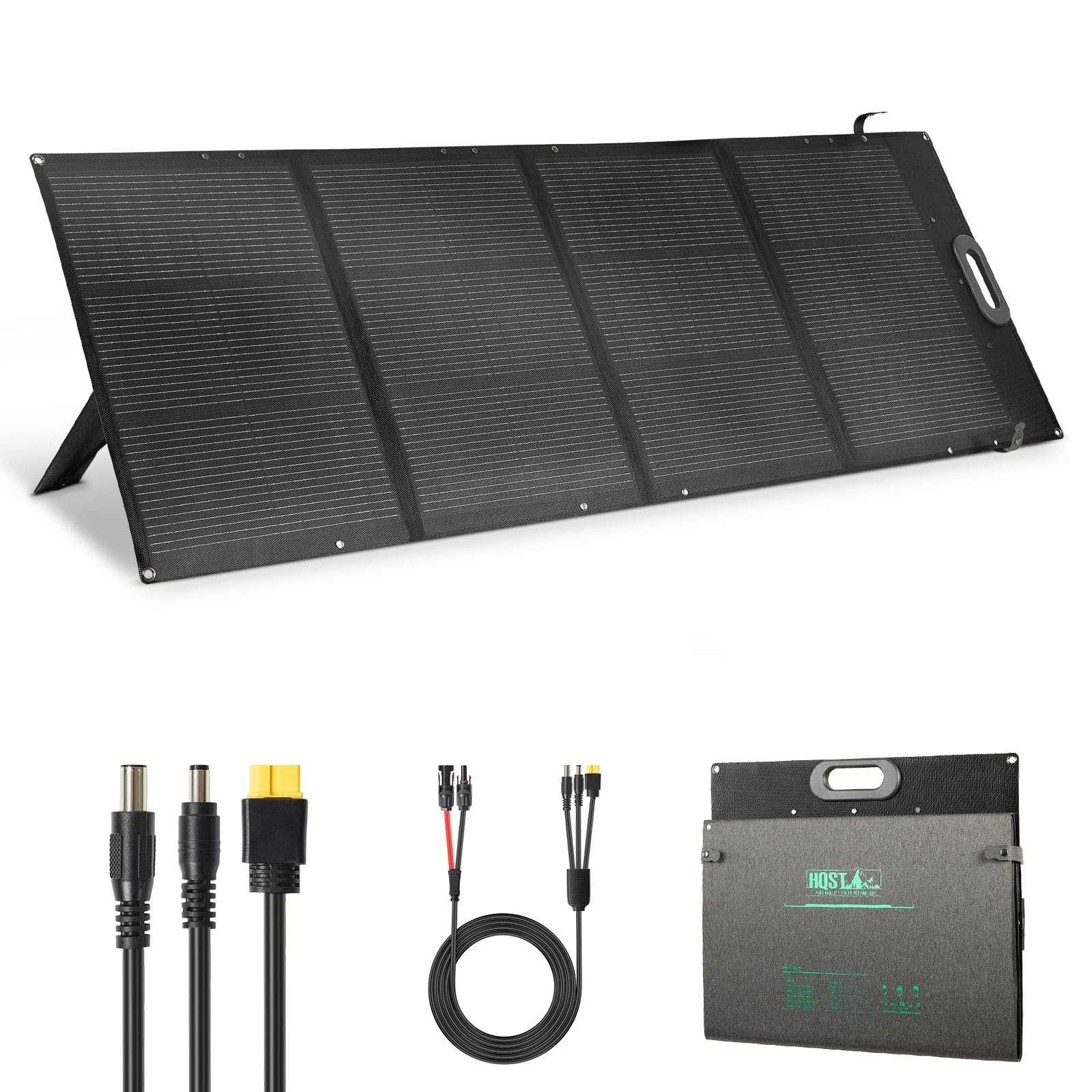
HQST’s 200W panel targets the camper who wants 200 watts of charging capacity without the usual 18-22 pound carry weight. At just 11 pounds, it’s up to 37% lighter than competing 200W panels, and it folds to just 1.97 inches thick—thin enough to slide under a truck seat or into a backpack’s laptop sleeve. The weight savings come from N-Type 16BB cells that hit 25% efficiency, letting the panel produce competitive power from a thinner, lighter package.
Performance in the field is solid, with users reporting reliable charging for power stations up to 1kWh. The two adjustable kickstands support a 40-60 degree angle range, and the rigid panel design prevents the sagging that plagues some soft-case panels. The IP67 waterproof rating and fully laminated construction mean no stitched seams for moisture to sneak through, so rain and morning dew are not threats.
The trade-off for the light weight is a slightly smaller real-world wattage ceiling—most users see sustained outputs around 150-170W rather than the full 200W. The 4.9-foot 3-in-1 cable is short enough that you may need to position the panel closer to your power station than you’d like. For backpackers and minimalist campers who prioritize pack weight above all else, this is the best compromise of wattage and portability.
Why it’s great
- 11 lbs is exceptionally light for a 200W panel
- 25% N-Type cells with good low-light performance
- IP67 waterproof with no stitched seams
Good to know
- Real-world output typically 150-170W
- Short 4.9ft cable limits placement options
6. Renogy 100W Portable Solar Panel

The Renogy 100W E.Flex shares the same N-Type 16BB cell technology as its 200W sibling, offering the same 25% efficiency in a much lighter, more packable package. At only 7.3 pounds, it’s the lightest 100W panel in this guide, folding to 22.99 x 22.54 x 1.57 inches—small enough to fit in a daypack alongside your camp kitchen gear. The magnetic closure system is genuinely satisfying to use, snapping shut without fiddling with straps.
Output in full sun typically hits 85-95W, with some owners reporting the full 100W under ideal conditions. The three-angle kickstand (40/50/60 degrees) helps you dial in the optimal tilt, and the four “small ear” ground studs keep it planted in moderate wind. The MC4 output connects easily to most power stations, and the built-in USB-C port delivers up to 45W for direct device charging—enough to fast-charge a laptop.
The MC4 cable is only about 3 feet long, which can force awkward positioning if your power station doesn’t sit right next to the panel. The USB ports are not fully weatherproof, so you’ll want to keep the zippered pouch closed in rain. For solo campers, bikepackers, or anyone who needs reliable power without heavy gear, this is the best lightweight option available.
Why it’s great
- 7.3 lbs with 25% N-Type efficiency
- Magnetic closure for easy pack/unpack
- Three-angle kickstand for optimal sun tracking
Good to know
- Short 3ft MC4 cable limits placement
- USB ports not fully weatherproof
7. ZOUPW 100W Portable Solar Panel

The ZOUPW 100W panel earns its spot not through raw efficiency—its 23.5% Grade A+ cells are solid but not class-leading—but through its exceptional connector compatibility. The included 5-in-1 cable covers DC8020, XT60, Anderson, DC7909, and DC5521 connectors, meaning it works out of the box with Jackery, EcoFlow, Anker, Bluetti, and most other major power station brands without needing extra adapters.
Real-world performance is strong, with users reporting sustained 85-95W output and quick charging for power stations like the Jackery Explorer 300 and EcoFlow River. The IP67 waterproof rating with ETFE coating gives it better moisture protection than many competitors, and the two adjustable kickstands let you tilt the panel to 45 degrees for improved sun capture. The magnetic handle and easy-carry design make it simple to reposition through the day.
The panel weighs 9.48 pounds, which is slightly above average for a 100W unit but still manageable for car camping. The kickstands lack angle adjustability beyond the single 45-degree setting, which limits winter performance when the sun sits lower in the sky. For campers who own multiple power station brands or want a backup panel that can mate with any generator, this is the most universally compatible option on the list.
Why it’s great
- 5-in-1 connector fits nearly every power station
- IP67 waterproof with durable ETFE coating
- Strong real-world output of 85-95W
Good to know
- 9.48 lbs is heavier than some 100W rivals
- Kickstands only offer one angle setting
8. EBL Solar 100W Portable Solar Panel
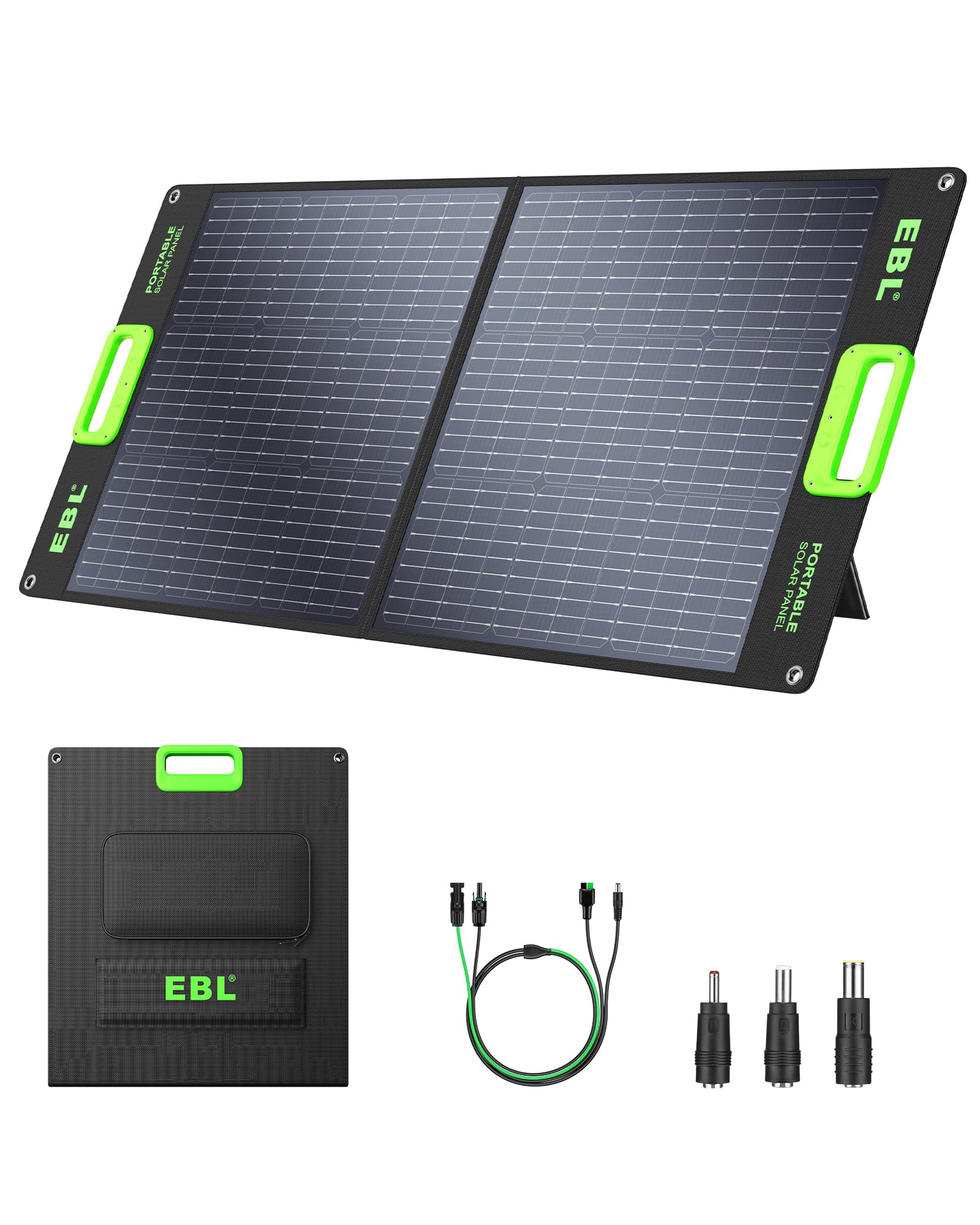
EBL’s Apollo 100W panel sits at the budget-friendly end of the mid-range, offering decent monocrystalline efficiency (23%) at a price that undercuts many competitors. It uses an upgraded monocrystal cell that outperforms the brand’s older models, and the 45-degree kickstand delivers 20% more sunlight capture than laying the panel flat. The magnetic handle and foldable design make setup and storage straightforward.
Customer reports show real-world output typically around 65-85W, which is lower than the top-tier 100W panels but respectable for the price point. The included accessories cover most popular connector types (MC4 to Anderson, MC4 to DC5521, plus multiple adapters), though some users have needed additional adapters for specific Jackery models. The IP65 water resistance means it can handle light rain, but EBL advises against leaving it out in a downpour.
The most common complaint is that the panel’s output drops sharply in anything less than full, direct sun—partly cloudy conditions can see output fall to 1-2W. The cable length is around 6 feet, which is adequate but not generous. For first-time camp solar buyers who want a working setup without a big investment, this panel is a practical entry point, provided you’re willing to chase the sun.
Why it’s great
- Budget-friendly price for a 100W panel
- Includes multiple adapters for broad compatibility
- 45-degree kickstand improves energy capture
Good to know
- Output drops sharply in cloudy conditions
- IP65 rating not suitable for heavy rain
9. Luvknit 100W Portable Solar Panel

The Luvknit 100W panel is the most affordable unit in this guide, making it a natural choice for campers who want to test the waters of solar charging without a major financial commitment. Despite the low entry cost, it uses premium monocrystalline cells with a claimed 24% conversion efficiency, and real-world tests from buyers show sustained output around 85-96W—competitive with panels that cost significantly more.
The panel folds to 21 x 23.6 inches and weighs 8.16 pounds, which is reasonable for a 100W unit. The IP65 water resistance and reinforced zippers give it enough durability for fair-weather camping, and the included power controller plus a set of adapters (DC5521 to Anderson, XT60, and others) means you can connect to most common power stations. The fabric-covered kickstands are a weak point—they’re prone to blowing over in 10mph wind—but they do keep the panel angled toward the sun.
The main durability concern is the USB 3.0 port, which has a history of the plastic connector snapping under regular use. The brand’s customer service has a good reputation for replacing defective units, but it’s an inconvenience during a trip. For short weekend campouts where you need basic device charging and power station top-ups without breaking the bank, this panel delivers surprising value for the price.
Why it’s great
- Very affordable entry into camp solar
- Real-world output often hits 85-96W
- Includes power controller and multiple adapters
Good to know
- Kickstands are flimsy in wind
- USB 3.0 port prone to connector breakage
FAQ
Can I use a 40V solar panel with my 12V power station?
How much power does a 100W camp solar panel produce in real-world conditions?
What does N-Type cell technology mean for camp solar panels?
Do I need a charge controller between the solar panel and my power station?
Final Thoughts: The Verdict
For most users, the camp solar panels winner is the Renogy 200W E.Flex because it pairs 25% N-Type efficiency with a portable 13.89-pound design and versatile USB-C/MC4 outputs, handling everything from weekend tent trips to week-long RV stays. If you want the absolute highest efficiency in the smallest package, grab the Jackery SolarSaga 200W. And for large-scale off-grid charging where wattage trumps portability, nothing beats the ZOUPW 350W.

Mo Maruf
I created WellFizz to bridge the gap between vague wellness advice and actionable solutions. My mission is simple: to decode the research and give you practical tools you can actually use.
Beyond the data, I am a passionate traveler. I believe that stepping away from the screen to explore new environments is essential for mental clarity and physical vitality.