Our readers keep the lights on and my smoothie glass nicely filled. As an Amazon Associate, I earn from qualifying purchases.
A board game doesn’t need a high price tag to deliver a great family night. The sweet spot for instant fun, strong replayability, and high-quality components often sits well below the twenty-dollar mark — a budget constraint that forces clever design over expensive plastic. The challenge is finding the right mix of rules that are simple enough for young kids yet strategic enough to keep adults engaged, packable enough for travel, and durable enough to survive repeated shuffling and sliding.
I’m Mohammad Maruf — the founder and writer behind WellFizz. I’ve spent many hours analyzing game mechanics, component quality, customer satisfaction data, and playtime efficiency to separate the truly replayable from the one-and-done party fillers in this exact price tier.
The key is matching the game to your group’s size and energy level. Whether you need a fast-paced team activity or a quiet travel companion, this roundup of the best board games under $20 highlights the real winners that earn their space on your shelf.
How To Choose The Best Board Games Under $20
Finding a high-quality game at this price point is about prioritizing the right specs. You want a game that hits the sweet spot of playtime, player count, and strategic depth without sacrificing component durability. Focus on the factors that actually affect your experience, not the box art.
Playtime vs. Setup Complexity
Games under $20 lean toward shorter play sessions — typically between 15 and 30 minutes. That’s perfect for multiple rounds but only if the rules are simple enough to teach in under two minutes. Skip anything with a rulebook longer than a few pages unless you’re committed to a dedicated game group.
Player Count Flexibility
The best budget games scale from 2 players up to 8 or more without awkward downtime. Look for a player count that matches your typical gathering — a family of four needs a different game than a 12-person party. Team-based games often stretch player counts further than free-for-all formats.
Component Quality and Replayability
You want coated cards that resist bending, chips that don’t split, and a board (if included) that folds cleanly. Durability directly correlates to replayability. Games with modular decks or randomized setups also extend lifespan by keeping each round fresh.
Quick Comparison
On smaller screens, swipe sideways to see the full table.
| Model | Category | Best For | Key Spec | Amazon |
|---|---|---|---|---|
| Sequence | Strategy | Large groups & mixed ages | 135 chips, 2 card decks | Amazon |
| Skyjo | Card Game | Quick rounds & travel | 150 cards, 30-min playtime | Amazon |
| Monopoly Knockout | Party | Active, sliding action | Gameboard over 3 ft long | Amazon |
| Runs in The Family | Family | Bonding & conversation | 200+ topic cards | Amazon |
| QUOKKA What Would You Choose | Card Game | Road trips & icebreakers | 500+ questions, 100 cards | Amazon |
In‑Depth Reviews
1. Sequence
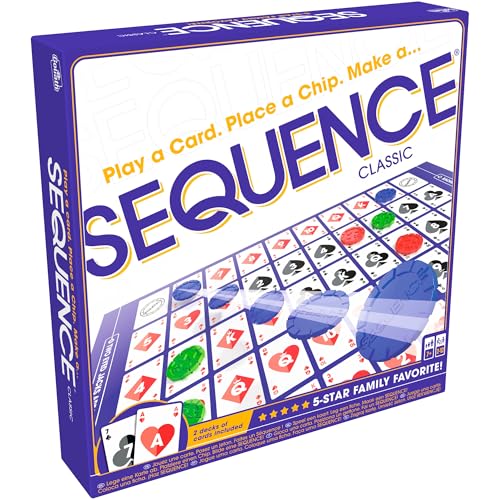
Sequence is the rare game that works equally well with two players or a full party of twelve. The premise is brilliantly simple — play a card from your hand, place a chip on the matching space on the board, and try to get five in a row. The folding board measures 19.75 by 15.25 inches, which is large enough for a group to see clearly without dominating the table.
The included 135 chips are thick and durable, and the two decks of cards are coated to resist wear. What makes this a standout in the sub-$20 category is the balance between luck and strategy — drawing the right card matters, but so does blocking opponents and positioning your chips on the board. Games rarely drag because the five-in-a-row target is close enough to feel achievable every turn.
For families with ages seven and up, Sequence is the most versatile pick in this roundup. It teaches strategy and spatial reasoning without feeling like homework, and the team format keeps weaker players in the game. The only downside is that some users report an uneven chip distribution, so you may end up using only two colors instead of three for larger games.
Why it’s great
- Scalable from 2 to 12 players with no rule changes
- Durable folding board and coated cards hold up to repeated use
- Easy 5-minute rules teachable to all ages
Good to know
- Occasional chip count variance in the box
- Red chips are fewer than blue and green in some batches
2. Skyjo

Skyjo is a card game that rewards patience and memory. The goal is to collect the fewest points across several rounds by strategically revealing, exchanging, and discarding cards. With 150 cards and a compact box measuring 7.64 by 3.98 inches, it’s easy to toss into a bag for travel or a restaurant wait.
The rules are simple enough for an eight-year-old but the strategy — deciding when to swap a high-value card or when to push for a column closure — keeps adults engaged. Negative scoring cards add a clever twist that can flip the leaderboard in the final round. The game pad helps track scores across multiple rounds without extra paper.
Because Skyjo is round-based, you can flexibly set the total playtime from 15 minutes to an hour. The cards are slightly thicker than standard playing cards, giving them a reassuring feel during shuffling. Made in Germany, the build quality is noticeably solid for the price bracket. The only minor complaint is that the printed instructions can be a bit small for older eyes.
Why it’s great
- Teaches calculation and probability in a fun context
- Compact and portable for travel or restaurant use
- Negative scoring keeps every round tense
Good to know
- Instructions can be hard to read due to small font size
- Not ideal for players who dislike math-adjacent scoring
3. Monopoly Knockout

Monopoly Knockout trades property trading for sliding tokens and physical action. The board is over three feet long and players slide colored tokens down the lane, aiming for Monopoly property spaces to earn cash while trying to knock opponents’ tokens into Jail or Luxury Tax. It plays in about 20 minutes — a fraction of classic Monopoly’s marathon sessions.
The game includes 16 plastic sliding tokens in four colors, a money pack, and reference cards. The shuffleboard-style mechanic makes it a physically active party game that gets families standing and moving. For 2 to 8 players, it scales well and the round-based format means everyone stays engaged without long waits.
Hand-eye coordination matters more than reading comprehension, which makes it accessible to younger players around age eight. The downside is that the game requires a smooth, flat surface to slide the tokens effectively — a thick rug or carpet can ruin the physics. Also, the tokens are lightweight plastic, so aggressive sliding can occasionally send them flying off the board.
Why it’s great
- Active, shuffleboard-style gameplay gets the family standing
- Fast 20-minute rounds prevent boredom
- Teaches hand-eye coordination and spatial aiming
Good to know
- Needs a smooth surface — not ideal for carpeted play
- Plastic tokens are light and can fly off the board
4. Runs in The Family

Runs in The Family is a conversation-driven game that rewards how well you know your relatives. Players draw a topic card and score points when their answer matches another player’s — the more you sync, the higher your score. With over 200 topic cards and a 15-minute playtime, it’s designed for quick, laughter-filled sessions rather than deep strategy.
The game is lightweight — just 4.5 inches long and barely an inch thick — making it easy to pack for holidays or road trips. Ages 8 to 60 can play together, and the content stays clean and family-friendly.
The main downside is that the game works best with 2 to 5 players — larger groups may feel left out because not everyone gets to play each turn. Also, the replayability depends on your group’s willingness to revisit topics, though the mix of 200 cards provides enough variety for multiple sessions. It’s more of a bonding tool than a competitive challenge.
Why it’s great
- Encourages real conversations and shared memories
- Ultra-portable size fits in a jacket pocket
- Inclusive for all ages from 8 to 60+
Good to know
- Best with 2-5 players — larger groups may feel excluded
- Focus on family knowledge, not strategic depth
5. QUOKKA What Would You Choose

What Would You Choose is a no-setup-required card game built around silly and thought-provoking dilemmas. Each of the 100 cards contains multiple questions, giving you over 500 unique prompts. Players simply pick between two options — Section A or Section B — and the hilarity comes from seeing who makes the weirdest choice.
The cards are plastic-coated, which adds significant durability compared to paper cards that warp after a few uses. The box is compact — 3.35 by 1.54 by 4.88 inches — making it ideal for restaurant tables or airplane trays. For ages 5 to adult, the game scales naturally because the prompts are universally funny rather than age-specific.
The biggest limitation is that it’s a pure icebreaker — there’s no scoring, no strategy, and no winner. It thrives as a warm-up activity or a travel companion for passing time. Some families may find the lack of competitive structure less engaging after multiple rounds, but for the price, the sheer volume of content is unmatched.
Why it’s great
- 500+ questions offer massive replay value for the price
- Plastic-coated cards resist bending and spills
- Zero setup — open the box and start playing
Good to know
- No scoring or competitive structure — pure conversation
- May feel repetitive for groups who prefer strategic games
FAQ
How many players do I need for the games in this price range?
Are these games suitable for young children?
Final Thoughts: The Verdict
For most users, the board games under $20 winner is the Sequence because it scales from a quiet two-player game to a full party of twelve without any rule changes, and the durable components justify the price per play. If you want a portable, strategic card game for travel and quick rounds, grab the Skyjo. And for active families who need to burn energy while playing, nothing beats the Monopoly Knockout. Each of these picks earns its spot by delivering real replayability and quality components at a price that leaves room for a second game.

Mo Maruf
I created WellFizz to bridge the gap between vague wellness advice and actionable solutions. My mission is simple: to decode the research and give you practical tools you can actually use.
Beyond the data, I am a passionate traveler. I believe that stepping away from the screen to explore new environments is essential for mental clarity and physical vitality.