Our readers keep the lights on and my smoothie glass nicely filled. As an Amazon Associate, I earn from qualifying purchases.
Capturing fast-moving athletes without blur or missed focus is the central challenge of sports videography. Whether you are filming a soccer match from the sideline, tracking a mountain biker through a forest, or recording a basketball game for player development, the gear you choose determines whether those split-second moments become usable footage or frustrating artifacts. Frame rates, autofocus speed, stabilization, and sensor size are not marketing buzzwords here—they are the difference between a highlight reel and a missed opportunity.
I’m Mohammad Maruf — the founder and writer behind WellFizz. I’ve spent countless hours analyzing sensor readout speeds, phase-detection coverage maps, and rolling shutter measurements to separate cameras that merely claim sports-readiness from those that actually deliver frame-consistent tracking in real-world conditions.
This guide evaluates eleven distinct models across action cams, mirrorless systems, and AI-powered recorders to help you find the best camera for sports video that matches your specific sport, budget, and workflow demands.
How To Choose The Best Camera For Sports Video
Sports video demands a specific set of camera capabilities that general-purpose or stills-focused models may lack. The following factors directly affect your ability to capture clean, usable footage of fast-moving subjects.
Frame Rate and Shutter Speed
Frame rate determines how smooth motion appears during playback. For standard-speed sports, 60 frames per second is the baseline. For slow-motion replay of critical plays, you need at least 120 fps at a usable resolution — preferably 240 fps in full HD. Shutter speed should be at least double your frame rate to avoid motion blur. A camera that lets you independently control shutter speed while maintaining high frame rates gives you the most flexibility during fast-action sequences.
Autofocus Coverage and Tracking
Phase-detection autofocus with a high number of coverage points is essential for keeping an athlete sharp when they accelerate laterally or change direction abruptly. Look for systems that offer real-time eye and subject tracking for people and animals, as these algorithms predict motion rather than simply react to it. Wider AF coverage across the sensor means you can keep the subject in the frame corner without losing focus lock.
Stabilization and Rolling Shutter
Handheld sports footage introduces micro-jitters that ruin the viewing experience. In-body image stabilization (IBIS) and electronic stabilization like HyperSmooth or RockSteady help smooth out panning and running motion. Rolling shutter — the skew effect visible when the camera or subject moves quickly laterally — is more pronounced in sensors with slower readout speeds. Cameras with stacked sensors or global shutter technology minimize this distortion, keeping vertical lines straight during fast pans.
Quick Comparison
On smaller screens, swipe sideways to see the full table.
| Model | Category | Best For | Key Spec | Amazon |
|---|---|---|---|---|
| Canon EOS R6 Mark II | Mirrorless | Pro hybrid sports | 40fps e-shutter / 6K oversampled 4K60 | Amazon |
| Sony a7 III | Mirrorless | Full-frame all-rounder | 693 phase-detection AF points | Amazon |
| Canon EOS R8 | Mirrorless | Lightweight action shooter | 40fps e-shutter / 4K60 uncropped | Amazon |
| Nikon Z50 II | Mirrorless | Beginner sports hybrid | 4K UHD/60p / 120p slo-mo | Amazon |
| Sony ZV-E10 | Mirrorless | Vlog-style sideline capture | 4K30p / 120fps HD slow-mo | Amazon |
| Canon EOS RP | Mirrorless | Entry-level full-frame video | 4K UHD 2160p / 5-stop IS | Amazon |
| Insta360 X5 | 360° Action | Reframe-after-capture sports | 8K30 360° / FlowState stabilization | Amazon |
| DJI Osmo Action 6 | Action | High-res POV action | 8K24 / Variable aperture f/2.0–f/4.0 | Amazon |
| DJI Osmo Action 5 Pro | Action | Long-run POV endurance | 4K120 / 4hr battery life | Amazon |
| GoPro HERO13 Black | Action | Versatile POV bundle | 5.3K60 / HyperSmooth 6.0 | Amazon |
| XbotGo Falcon | AI Tracker | Auto-tracking team sports | 4K / 6 TOPS AI processor | Amazon |
In‑Depth Reviews
1. Canon EOS R6 Mark II

The R6 Mark II is a hybrid powerhouse that balances high-speed photography with serious video capabilities. Its 24.2MP full-frame sensor paired with the DIGIC X processor enables electronic shutter bursts up to 40 fps with full AF tracking — fast enough to catch a sprint finish or a basketball dunk sequence without dropping frames. The 6K oversampled 4K60p video delivers exceptional detail and color depth, while Dual Pixel CMOS AF II provides subject detection for people, animals, and vehicles, including horses and trains, making it versatile for multi-sport use.
The vari-angle touchscreen and in-body image stabilization rated at up to 8 stops give you flexibility when shooting handheld from the sideline or from unconventional angles. The 3.69-million-dot OLED EVF with 120 fps refresh rate ensures you see the action clearly even in bright daylight. Rolling shutter is well controlled thanks to the sensor readout speed, though the mechanical shutter tops out at 12 fps, so most sports shooters will lean on the electronic shutter for maximum burst rate.
Battery life is significantly improved over the original R6, supporting longer game-day sessions without swapping. The dual UHS-II SD card slots provide redundancy for professional use. The R6 Mark II is a complete sports video solution for serious enthusiasts and working professionals who need one camera that excels at both stills and motion.
Why it’s great
- 40 fps burst with full AF tracking captures every split-second moment
- Excellent 4K60p oversampled from 6K with C-Log 3 for grading
- 8-stop IBIS makes handheld sideline footage usable without a gimbal
Good to know
- Body-only, so you need a separate RF lens purchase
- No built-in flash; requires hotshoe accessory for fill light
2. Sony a7 III

The Sony a7 III remains a benchmark full-frame mirrorless camera for sports video, even years after its launch. Its 24.2MP back-illuminated Exmor R sensor offers 15 stops of dynamic range, which means you can recover shadow detail in under-exposed sideline footage without introducing noise. The 693 phase-detection AF points covering 93% of the sensor area provide reliable tracking for athletes moving across the frame, and the real-time Eye AF for humans and animals locks onto faces quickly during fast-paced games.
Video recording goes up to 4K30p with full pixel readout and no pixel binning, plus 1080p at 120 fps for smooth slow-motion playback. The 5-axis in-body stabilization reduces handheld shake, though it is not as aggressive as Canon’s IBIS in the R6 Mark II. The NP-FZ100 battery delivers approximately 710 shots per charge, which translates to extended video recording sessions without frequent swaps — a genuine advantage over many mirrorless rivals.
The kit 28-70mm f/3.5-5.6 lens is a competent starter but benefits from upgrading to faster glass for indoor sports where light is limited. The menu system is dense and takes time to configure for optimal video settings, but once set up, the a7 III is a reliable, consistent performer. Rolling shutter is moderate, so fast panning may show some skew, but for most recreational and semi-professional sports shooting, it remains a highly capable tool.
Why it’s great
- 693-point AF with 93% frame coverage tracks fast lateral movement
- 15-stop dynamic range preserves detail in harsh lighting conditions
- Exceptional battery life for long recording sessions on the field
Good to know
- Menu system is complex and not beginner-friendly out of the box
- Rolling shutter is noticeable during rapid panning movements
3. Canon EOS R8

The Canon EOS R8 brings flagship-level speed into a body that weighs under a pound. Its 24.2MP full-frame CMOS sensor and DIGIC X processor support electronic shutter bursts of 40 fps with continuous autofocus tracking, matching the R6 Mark II’s burst rate in a much lighter package. The Dual Pixel CMOS AF II system covers up to 100% of the frame vertically and horizontally, with subject detection for people, animals, and vehicles, including aircraft and trains, making it adept at tracking any fast-moving subject.
Video features include uncropped 4K60p oversampled from 6K, which delivers sharp, detailed footage ideal for sports highlights. High-frame-rate recording at 180 fps in Full HD allows for dramatic slow-motion replay. Internal Canon Log 3 support provides flexibility for color grading, and the UVC/UAC support means you can use it as a high-quality webcam for live-streaming games. The vari-angle LCD touchscreen helps when shooting from low tripod positions or overhead angles.
The trade-off for the compact size is a smaller battery — you will want multiple LP-E17 spares for a full day of shooting. The R8 also lacks in-body stabilization, so pairing with an IS-equipped RF lens is strongly recommended for handheld work. Rolling shutter is slightly more pronounced than on the R6 Mark II, but for the price and weight, the R8 offers an exceptional frame-rate-to-dollar ratio for sports shooters who prioritize mobility.
Why it’s great
- 40 fps burst rate in a sub-pound body is ideal for travel-heavy shooters
- Uncropped 4K60p oversampled from 6K delivers excellent video sharpness
- Dual Pixel CMOS AF II with full-frame coverage locks onto athletes reliably
Good to know
- No in-body stabilization requires a lens with IS for smooth handheld footage
- Battery life is below average; spare batteries are essential for extended sessions
4. Nikon Z50 II

The Nikon Z50 II is a compact APS-C mirrorless camera designed for users transitioning from smartphone to dedicated camera for sports and outdoor recording. The dual-lens kit covers a useful 16-50mm wide-angle and 50-250mm telephoto range, giving you 24-375mm equivalent reach — enough to frame players at midfield or compress the background for cleaner shots. The 20.9MP DX sensor delivers lifelike colors and solid dynamic range, and the 31 built-in Picture Control presets let you apply film-like looks directly in camera without post-processing.
Autofocus supports subject detection for people, dogs, cats, birds, and vehicles, with dedicated bird and airplane modes for improved accuracy. Video shoots at 4K UHD/60p with in-camera 120p slow-motion at Full HD, allowing for smooth replay captures. Electronic VR helps stabilize footage when shooting handheld, though it introduces a crop. The built-in flash is useful for fill light in dimmer gymnasiums, and the Night Portrait mode produces natural-looking flash portraits in low-light settings.
The SnapBridge app enables quick wireless transfer to a smartphone for sharing clips mid-game. The 16-50mm kit lens is compact and decently sharp, but the telephoto lens is where the Z50 II really shines for sports, providing reach without requiring heavy, expensive glass. The electronic viewfinder and vari-angle touchscreen make it easy to compose shots from different heights. Beginner shooters will appreciate the intuitive control layout, but experienced users may find the single UHS-I card slot limiting for professional workflows.
Why it’s great
- Two-lens kit provides wide-to-telephoto coverage out of the box
- Subject detection for people, birds, and vehicles improves focus reliability
- Lightweight APS-C body is easy to carry for a full day of sideline shooting
Good to know
- Single UHS-I card slot limits backup options for professional use
- 4K60p has a slight crop compared to the full sensor width
5. Sony ZV-E10

The Sony ZV-E10 bridges the gap between vlogging convenience and interchangeable-lens versatility, making it a strong candidate for parents, coaches, or recreational shooters capturing sports. The 24.2MP APS-C Exmor CMOS sensor paired with the BIONZ X processor delivers 4K30p video with full pixel readout and 1080p at 120 fps for slow-motion clips. The 425-point phase-detection AF provides reliable tracking with Real-Time Eye AF for humans, which keeps a player’s face sharp even when they transition from facing the camera to turning away mid-play.
The bundled kit includes two 64GB SD cards, an LED video light, tripod, steady grip pod, filter kit, macro attachments, and extra batteries — everything needed to start shooting immediately. The 16-50mm power zoom lens covers a useful range for sideline use, and the side flip-out touchscreen makes it easy to frame yourself for post-game commentary or team analysis videos. The Product Showcase Mode automatically shifts focus to held objects, which is useful for reviewing gear or technique on camera.
The ZV-E10 lacks in-body stabilization, so reliance on the Optical SteadyShot in the kit lens or a gimbal is necessary for smooth motion. The renewed condition means lower upfront cost, but verify the shutter count and warranty upon arrival. The built-in microphone is adequate for ambient sound but benefits significantly from an external mic for clear voice-over during game reviews. Overall, the ZV-E10 is a capable entry point for sports video that also doubles as a content creation platform.
Why it’s great
- 425-point phase-detection AF with Real-Time Eye AF tracks faces reliably
- Comprehensive bundle includes all accessories for immediate shooting
- Compact APS-C mirrorless body with flip-out screen for vlogging analysis
Good to know
- No in-body stabilization; needs lens IS or a gimbal for smooth footage
- Renewed unit may have varied wear; confirm warranty and shutter count
6. Canon EOS RP

The Canon EOS RP offers the most affordable path to full-frame video for sports shooting. Its 26.2MP CMOS sensor and RF mount compatibility lens system provide a wider field of view and better low-light performance than any APS-C camera near its price point. The Dual Pixel CMOS AF covers approximately 88% of the frame width and has excellent face detection, though it lacks the more advanced subject tracking modes found in the R8 and R6 Mark II. Video maxes out at 4K24p with a 1.6x crop factor, which is limiting for wide shots but can be leveraged for telephoto reach when paired with a fast lens.
The RF 24-105mm f/4-7.1 IS STM kit lens includes optical stabilization with up to 5 stops of shake correction, which compensates for the RP’s lack of IBIS. The vari-angle touchscreen makes it easy to compose from low angles typical of sideline shooting. For the parent or coach recording youth sports games, the 4K crop actually provides extra reach to bring distant players closer without needing a longer lens immediately.
The RP uses the LP-E17 battery, which delivers around 250 shots per charge, so multiple spares are essential for extended shoots. Rolling shutter is moderate but noticeable during quick pans. Autofocus speed is adequate for slow-to-moderate sports like baseball or track field events, but fast action like basketball drives may challenge the tracking system. It is a capable starter full-frame option for those committed to the Canon RF ecosystem without the premium expense of higher-tier bodies.
Why it’s great
- Full-frame sensor at the lowest entry price in the Canon RF lineup
- 1.6x 4K crop provides effective telephoto reach with standard lenses
- Compatible with a wide range of RF and EF lenses via adapter for growth
Good to know
- 4K video is limited to 24p with a significant crop factor
- Autofocus tracking is not as responsive for very fast directional changes
7. Insta360 X5

The Insta360 X5 completely changes the sports shooting workflow by capturing a full 360° sphere of video that you can reframe into a conventional flat shot after the fact. Two 1/1.28-inch sensors shoot 8K at 30 fps, giving you enough resolution to punch into standard 1080p or 4K exports while still having the freedom to change the camera’s “direction” in post. This is a game-changer for solo coaches or climbers who cannot simultaneously operate a camera and perform the sport — just mount the X5 on the invisible selfie stick or a helmet and choose your angles later.
FlowState stabilization combined with 360° Horizon Lock keeps the horizon level regardless of the camera’s physical orientation during motion. The triple AI chip design improves low-light noise reduction, making dusk games or indoor courts more viable. The new 4-mic array with an advanced Wind Guard improves audio clarity for vlogs and narration during action sequences. Waterproof to 49 feet without a housing, and the battery lasts up to 208 minutes — fast-chargable to 80% in 20 minutes for quick turnarounds between two halves.
The trade-off is the editing workflow: you will need the Insta360 app (phone or desktop) to reframe and export each clip. This adds a post-processing step before you can share the final footage. The lens guards are recommended for durability, and the microSD card is sold separately. For anyone who regularly misses the perfect angle because they could not point the camera in time, the X5 eliminates that limitation entirely.
Why it’s great
- Reframe any angle in post with 8K 360° capture — never miss the action
- FlowState stabilization and 360° Horizon Lock deliver smooth, level footage
- 208-minute battery with 20-minute fast charge keeps you running all game day
Good to know
- Post-reframing requires app-based editing before final export
- Standard lens guards recommended for durability; microSD card sold separately
8. DJI Osmo Action 6
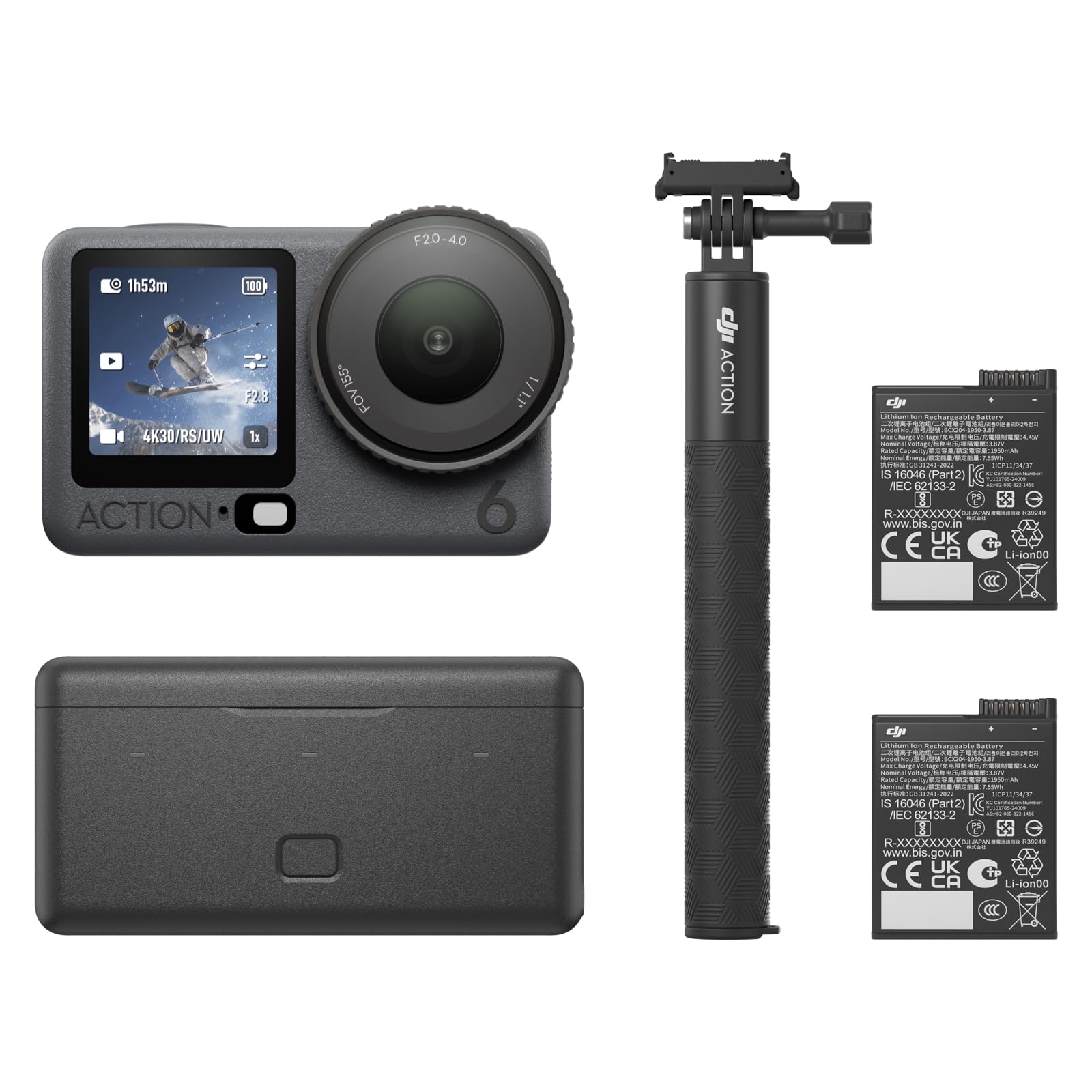
The DJI Osmo Action 6 pushes action camera resolution to 8K24, providing enough pixel density to crop into standard 4K frames while maintaining sharpness. The 1/1.1-inch square sensor is larger than typical action camera sensors, contributing to better dynamic range and low-light performance. The standout feature is the variable aperture — spanning f/2.0 to f/4.0 — which allows you to adjust exposure without relying solely on shutter speed or ND filters, giving you more flexibility for changing lighting conditions during outdoor sports.
RockSteady 3.0 and HorizonSteady provide stabilization that handles everything from bike handlebar vibrations to quick head-turns during POV filming. The Enhanced Combo includes two Extreme Battery Plus packs (1950mAh each) and a multifunctional battery case, offering up to 4 hours of total recording time. The front and rear OLED touchscreens make framing easy in bright sunlight, and the 50GB of built-in storage provides a buffer before you need to swap microSD cards.
Audio is clean via the built-in mics but benefits from the direct wireless connection to the DJI Mic 2 for voice-overs. The 20m waterproof rating without a housing means you can take it straight into poolside or rainy games. The magnetic quick-release mount system attaches and detaches rapidly, which is useful for switching between a helmet mount and tripod between events. The main limitation is the 2x digital zoom, which is sufficient for cropping not for true telephoto reach.
Why it’s great
- Variable aperture f/2.0–f/4.0 provides exposure control without ND filters
- 8K24 capture enables high-resolution zoom-ins in post without quality loss
- 4-hour total battery life with included dual-battery kit supports long events
Good to know
- Digital zoom only — no optical telephoto reach for distant subjects
- Built-in audio is adequate but improves significantly with external DJI Mic 2
9. DJI Osmo Action 5 Pro
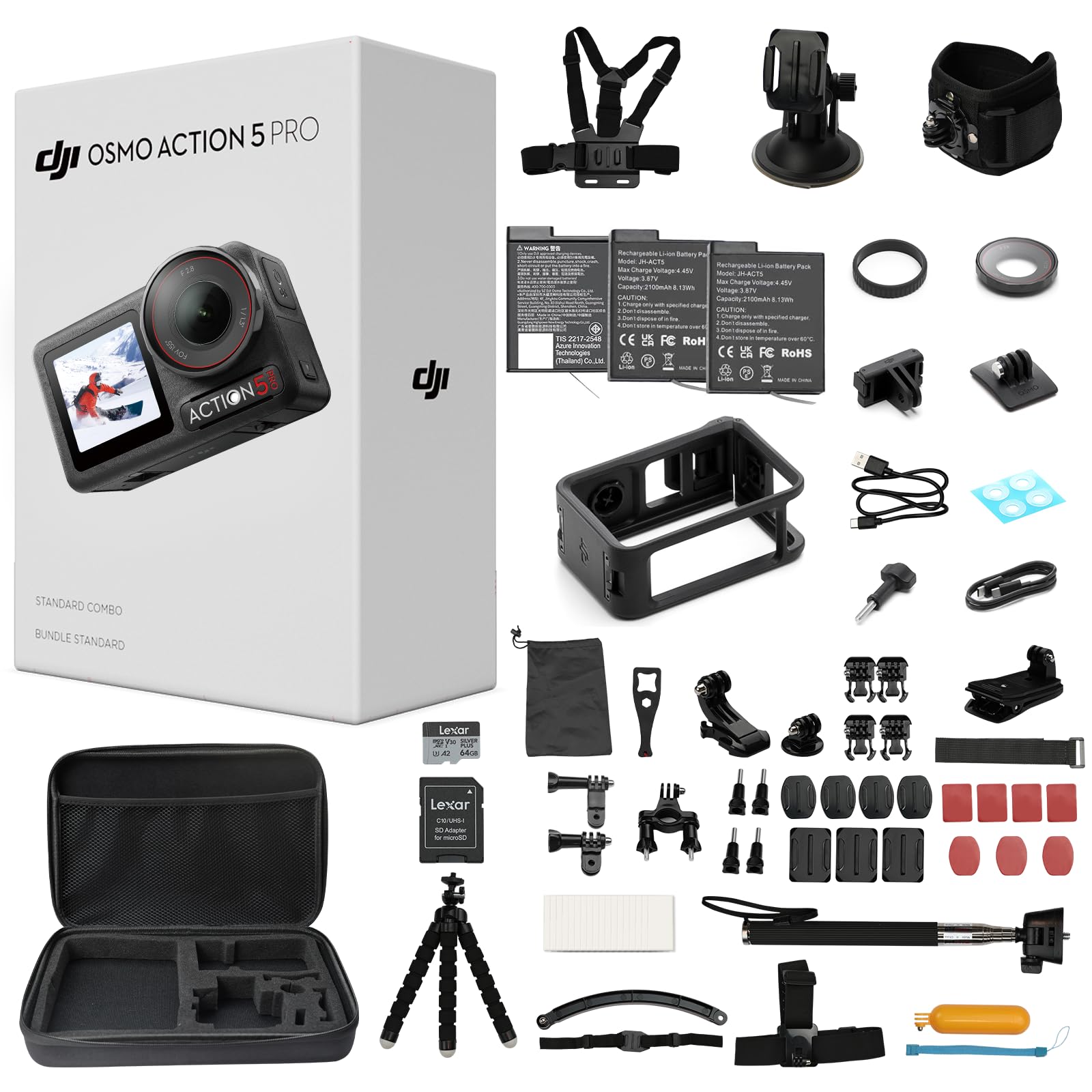
The DJI Osmo Action 5 Pro distinguishes itself with industry-leading battery life, capable of recording up to 4 hours in standard conditions and 3.6 hours at -4°F. For anyone filming an entire soccer match or mountain bike ride without stopping to swap batteries, this endurance alone makes it a top contender. The 1/1.3-inch sensor with 2.4µm large pixels delivers strong low-light performance, and the 13.5-stop dynamic range means you retain detail in both shadowed areas and bright sky during outdoor sports.
Video options include 4K at 120 fps for smooth slow-motion replay, and HorizonSteady stabilization eliminates roll-axis shakes up to 360°, keeping the horizon level regardless of how aggressively you move. The dual OLED touchscreens are bright enough for direct sunlight framing. The included bundle adds two extra batteries, a 64GB microSD card, and a 58-piece accessory kit that includes helmet mounts, chest harness parts, and adhesive bases, covering most POV use cases out of the box.
Voice control allows hands-free operation while strapped into a harness or helmet. The 47GB of built-in storage acts as a buffer before writing to the microSD card, reducing the risk of corrupt files. Waterproof to 20 meters without a housing. The wireless magnetic quick-release system makes mounting and swapping simple. Some users report a file transition glitch at the 4.7GB mark, which is a minor inconvenience considering the overall reliability and image quality.
Why it’s great
- 4-hour battery life outperforms almost every action camera for extended shoots
- 4K120fps with HorizonSteady delivers smooth slow-motion with level horizon
- Comprehensive accessory bundle covers helmet, chest, and tripod mounting
Good to know
- Minor file transition glitch at 4.7GB may require file management awareness
- Built-in mic wind noise can be mitigated with an external foam windsock
10. GoPro HERO13 Black
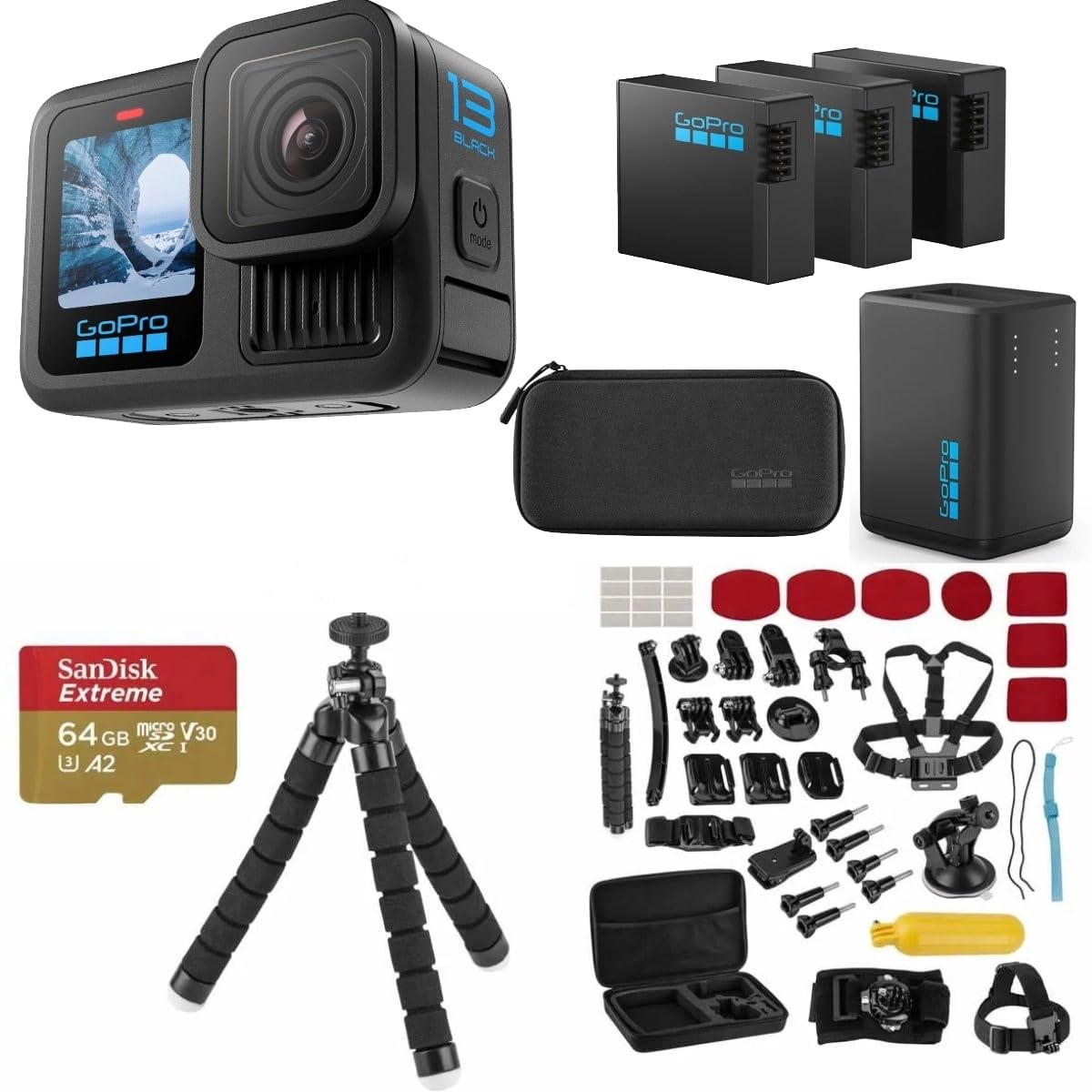
The GoPro HERO13 Black remains the benchmark for POV sports video, offering 5.3K60 HDR video with 91% more resolution than standard 4K. HyperSmooth 6.0 stabilization includes Horizon Lock that keeps the horizon level during 360° rotations, making it ideal for motocross, snowboarding, and cycling footage. The GP-Log and 10-bit color support provide flexibility for color grading, and the HB-Series auto-detect lens system allows you to swap lenses for different field of views without manual setting adjustments.
The bundled kit is the most comprehensive in this roundup, including three 1900mAh Enduro batteries, a dual-battery charger, a 64GB SanDisk microSD card, adhesive helmet mounts, a camera case, and a 47-piece adventure accessory kit. The Enduro batteries are rated for over 1.5 hours of continuous 5.3K30 or 4K30 recording and perform reliably down to 14°F. The dual charger charges two batteries simultaneously, reducing downtime during halftime breaks.
The waterproof design rated to 33 feet means you can take it through mud, rain, or underwater sports without a housing. The front and rear LCD screens support selfie framing for vlogging during warmups or post-game reactions. Bluetooth audio support allows connection to wireless microphones. The minor caveat is that some users report battery charging inconsistencies with third-party chargers, so sticking with the included GoPro setup ensures reliable performance. For versatility, durability, and accessory ecosystem depth, the HERO13 Black is a proven workhorse.
Why it’s great
- 5.3K60 HDR with 91% higher resolution than 4K delivers ultra-sharp footage
- HybridSmooth 6.0 and Horizon Lock stabilize extreme motion without a gimbal
- 47-piece accessory kit covers nearly all POV mounting needs immediately
Good to know
- Some users experience battery charging inconsistencies with non-GoPro chargers
- 5.3K files are large; require fast microSD cards for consistent recording
11. XbotGo Falcon
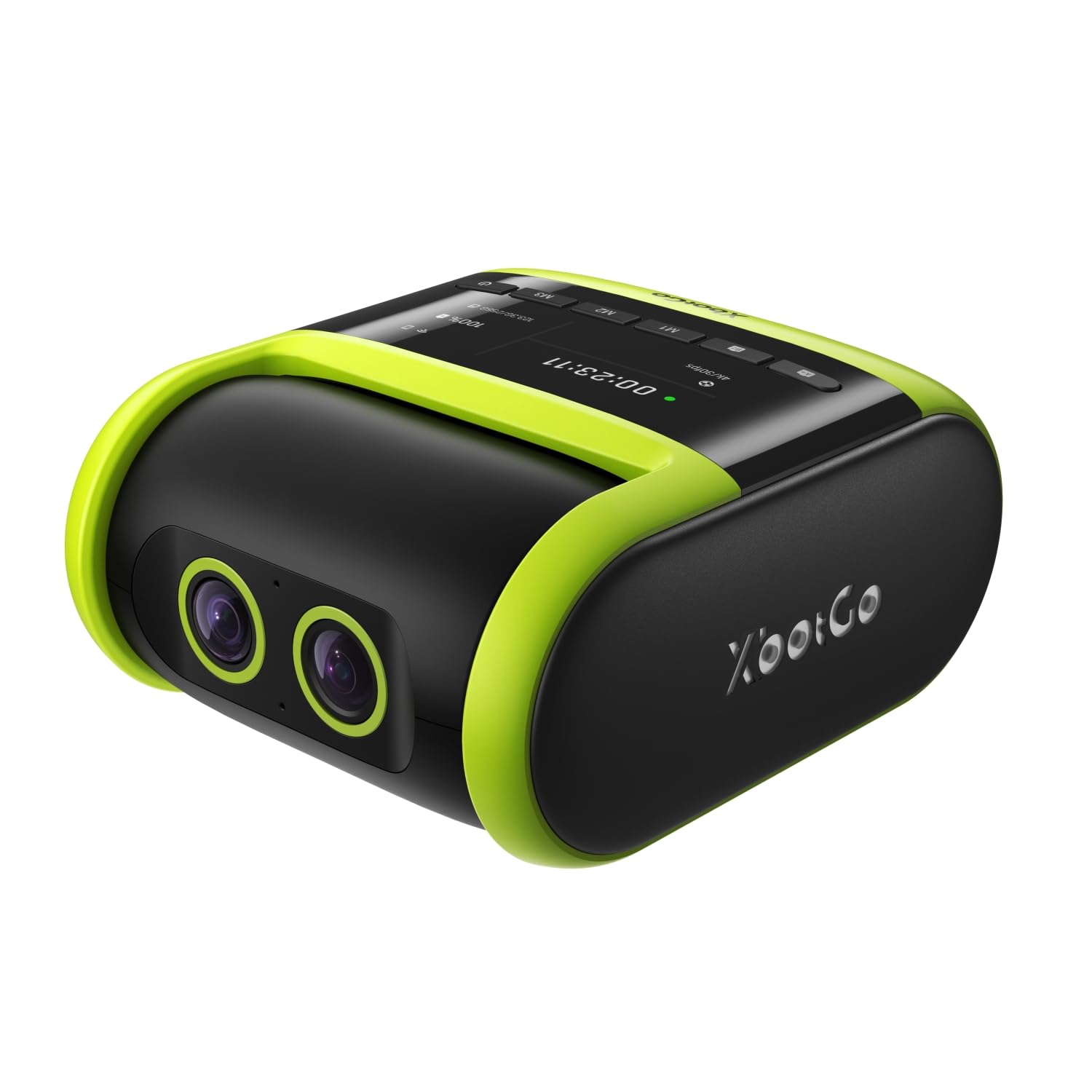
The XbotGo Falcon is purpose-built for team sports recording, featuring an AI auto-tracking system that follows players and the ball without human intervention. The dual-lens system — a 4K recording lens paired with a dedicated AI-assisted tracking lens — uses a 6 TOPS AI processor and 8-core CPU to keep the subject centered during fast-break plays and cross-field runs. This means a coach or parent can set the camera on a tripod and focus on the game, knowing the camera will follow the action automatically.
Video records in 4K with 1.6x digital zoom, and the 1/4-inch standard screw mount fits any tripod. The IPX5 water-resistant rating allows use in light rain. Built-in Wi-Fi supports instant live streaming directly to platforms, so remote family members can watch the game in real time. No subscription is required for the AI tracking features — a rare selling point among auto-tracking systems. The carrying case and charging cable are included; you will need to provide your own microSD card for recording.
Some users have reported the live stream can be glitchy with pixelation under poor Wi-Fi conditions, and the tracking may lag slightly during very rapid direction changes but self-corrects quickly. The camera is slightly heavier than standard action cameras, requiring a more robust tripod for stability. The auto-tracking works best for soccer, basketball, and football where movement patterns are relatively predictable. For hands-off sideline recording, the Falcon eliminates the need for a dedicated operator, making it unique in this lineup.
Why it’s great
- AI auto-tracking follows the play without requiring a human operator
- No subscription fee for the tracking software — a rare and cost-saving feature
- Built-in live streaming lets remote viewers watch games in real time
Good to know
- Live stream quality depends on Wi-Fi strength; can pixelate on weak networks
- Heavier than typical action cameras; requires a stable tripod for smooth tracking
FAQ
What frame rate do I need for sports slow-motion replay?
Is in-body stabilization or electronic stabilization better for handheld sports shooting?
Should I get an action camera or a mirrorless camera for sports video?
What does rolling shutter mean and why does it matter for sports?
Final Thoughts: The Verdict
For most users, the best camera for sports video winner is the Canon EOS R6 Mark II because it combines a 40 fps burst with reliable Dual Pixel AF II, in-body stabilization, and excellent 4K60p video quality in a body that handles all-day shooting. If you want an action camera for POV sports filming with the best battery life and stabilization, grab the DJI Osmo Action 5 Pro with its 4-hour battery and HorizonSteady. And for hands-free sideline recording where you cannot operate the camera yourself, nothing beats the XbotGo Falcon with its AI auto-tracking that follows the play without a dedicated operator.

Mo Maruf
I created WellFizz to bridge the gap between vague wellness advice and actionable solutions. My mission is simple: to decode the research and give you practical tools you can actually use.
Beyond the data, I am a passionate traveler. I believe that stepping away from the screen to explore new environments is essential for mental clarity and physical vitality.