Our readers keep the lights on and my smoothie glass nicely filled. As an Amazon Associate, I earn from qualifying purchases.
A cluttered desk with tangled cables is a distraction that kills focus before you even start typing. The right wireless combo cuts that mess entirely, giving you a clean slate and the freedom to work from any angle without tripping over wires.
I’m Mohammad Maruf — the founder and writer behind WellFizz. I spend hundreds of hours combing through technical specs, user feedback across dozens of verified reviews, and market data to find the wireless combos that actually deliver on their promises without draining your wallet.
Whether you’re outfitting a home office, a dorm room, or just want to simplify your setup, this guide to the best budget wireless keyboard and mouse combos covers the real-world performance, battery life, and typing feel that matter most for daily use.
How To Choose The Best Budget Wireless Keyboard And Mouse
When you’re shopping on a budget, every dollar needs to earn its place. The cheapest option isn’t always the best value if the keys feel mushy or the mouse dies in a week. Focus on the specs that define the daily experience: connection stability, battery endurance, ergonomic support, and noise level. These four factors separate a frustrating combo from one you’ll use for years.
Connection Type: 2.4 GHz vs. Bluetooth
Nearly every budget wireless keyboard and mouse combo uses a 2.4 GHz USB receiver. This offers a dedicated, low-latency connection that’s plug-and-play with no pairing menus. The trade-off is that you occupy a USB port and the tiny dongle can be lost easily. Bluetooth gives you more flexibility to switch between devices, but budget Bluetooth combos often suffer from lag or inconsistent reconnection. For a pure desktop setup, 2.4 GHz is the safer, more reliable choice.
Battery Life: Months vs. Weeks
Look for keyboards rated in months and mice rated in months, not weeks. A keyboard that lasts 36 months on two AAA batteries means you’ll probably forget it even needs power. Mice with 12-month ratings are common in premium budget combos. Anything with a rechargeable battery is convenient but check the real-world charge cycle — some need a top-up every five days during heavy use, which defeats the purpose of wireless freedom.
Ergonomics and Typing Comfort
Don’t underestimate the importance of a proper wrist rest and adjustable tilt legs. A 1.5-inch palm rest may not sound like much, but it changes the angle of your wrist and reduces fatigue over a full workday. Full-size layouts with a number pad are non-negotiable if you do any data entry. Compact keyboards save desk space but force you to reach awkwardly for arrow keys and function shortcuts — a common source of buyer’s remorse.
Noise Level: Silent vs. Click
In shared spaces — offices, libraries, dorm rooms — noise matters. Membrane keyboards with low-profile keys are inherently quieter than mechanical switches, but not all membrane boards are equal. Look for combos that explicitly mention noise reduction percentages (95% or higher is good) and optical mice with silent micro-switches. A quiet combo costs little more than a clicky one and earns goodwill from everyone around you.
Quick Comparison
On smaller screens, swipe sideways to see the full table.
| Model | Category | Best For | Key Spec | Amazon |
|---|---|---|---|---|
| Logitech MK270 | Mid-Range | Longest Battery Life | 36-month keyboard battery | Amazon |
| HP 330 | Mid-Range | Stylish Design & LED Indicators | 1600 DPI mouse sensor | Amazon |
| VEILZOR RGB | Premium | RGB Backlight & Rechargeable | USB-C rechargeable, 9 RGB effects | Amazon |
| SABLUTE KM23D | Premium | Wide Wrist Rest & Phone Holder | 2.8-inch wrist rest, 10° tilt | Amazon |
| Trueque KM31 | Budget | Quiet Typing & Phone Holder | 97% noise reduction | Amazon |
In‑Depth Reviews
1. Logitech MK270

The Logitech MK270 is the gold standard for budget wireless combos because it nails the fundamentals: a rock-solid 2.4 GHz connection that reaches up to 33 feet, a full-size keyboard with eight dedicated multimedia hotkeys, and a compact ambidextrous mouse that tracks smoothly on most surfaces. The low-profile, quiet keys provide a comfortable typing experience that doesn’t wake up the whole room.
Battery life is the headline feature here. The keyboard runs for up to 36 months on two AAA batteries, while the mouse lasts up to 12 months on a single AA — both have on/off switches to preserve power. The spill-resistant design adds peace of mind for coffee-drinkers, and the adjustable tilt legs let you find the right angle. Real-world user reports confirm the keyboard can survive a decade of daily use before keys show wear, making it an exceptional long-term investment at its price point.
The mouse is relatively small, which may not suit users with larger hands, and it lacks a dedicated DPI switch. Some users report that the mouse scroll wheel can become unresponsive after extended use, though this is not a widespread issue given the volume of positive reviews. Overall, this combo is the most reliable, best-supported option in the budget category.
Why it’s great
- Industry-leading battery life with 36-month keyboard rating
- Spill-resistant design and durable keycaps
- Plug-and-play setup with single USB receiver
Good to know
- Compact mouse may feel small for large hands
- No DPI adjustment or backlighting
2. HP 330 Wireless Keyboard and Mouse Combo

The HP 330 stands out with its sleek, modern aesthetic and chiclet-style keys that offer a crisp, laptop-like typing feel. Twelve top-row shortcut keys provide instant access to common functions like volume, play/pause, and email, which boosts productivity without needing to memorize multi-key combos. The keyboard also features LED indicators for Num Lock, Caps Lock, and Scroll Lock — a small but appreciated detail that saves you from accidental toggling.
The mouse uses a 1600 DPI optical sensor for smooth, lag-free tracking on virtually any surface, and its compact, portable design makes it easy to toss into a bag. Both keyboard and mouse run on a single AAA battery each, keeping replacement costs low. The single 2.4 GHz USB receiver connects both devices, and setup is genuinely plug-and-play — no software or pairing required.
Some users report that the mouse drains batteries faster than expected, with one noting that switching to a rechargeable 1.5V Li-ion cell solved the issue. A more concerning pattern involves the keyboard occasionally auto-repeating the last pressed key until another key is struck — a behavior that affects password entry and appears on multiple units, suggesting a firmware quirk. Despite these issues, the HP 330 remains a stylish and functional choice for users who prioritize design and shortcut keys.
Why it’s great
- Attractive chiclet key design with laptop-style typing feel
- 12 dedicated shortcut keys for one-touch functions
- Clear LED indicators for lock keys
Good to know
- Occasional key repeat issue noted by multiple users
- Mouse battery life may require frequent swaps
3. VEILZOR 2.4G Rechargeable RGB Keyboard and Mouse

The VEILZOR combo breaks the budget mold by offering nine RGB backlight effects with three brightness levels, plus a built-in phone holder and ergonomic wrist rest — features typically reserved for more expensive gaming peripherals. The full-size keyboard uses a membrane design that reduces typing noise significantly, and the mouse claims 99.99% noise reduction for near-silent clicks. The contoured mouse includes a thumb rest and three DPI settings (800/1200/1600) for precise cursor control.
Power comes from a built-in USB-C rechargeable battery in both keyboard and mouse, eliminating disposable batteries entirely. Users report the combo lasts weeks between charges with moderate daily use, though heavy RGB usage or constant backlight brightness can reduce that to about five to six days. The 2-in-1 USB-A/C receiver stores neatly in the keyboard’s underside, reducing the chance of losing the dongle.
Some users experienced a non-functional mouse wheel on the first unit, though the brand’s customer support quickly sent a replacement. The backlight illuminates the area around the keys rather than directly on top of them, which may not be bright enough for users with certain visual conditions. Overall, this is the most feature-rich budget combo available, particularly appealing if you want RGB lighting and rechargeable convenience.
Why it’s great
- Nine customizable RGB backlight effects with brightness control
- USB-C rechargeable — no disposable batteries needed
- Quiet keys and near-silent mouse clicks
Good to know
- Backlight is around keys, not directly on keycaps
- Recharge interval may be as short as 5-6 days with heavy RGB use
4. SABLUTE KM23D Wireless Keyboard and Mouse
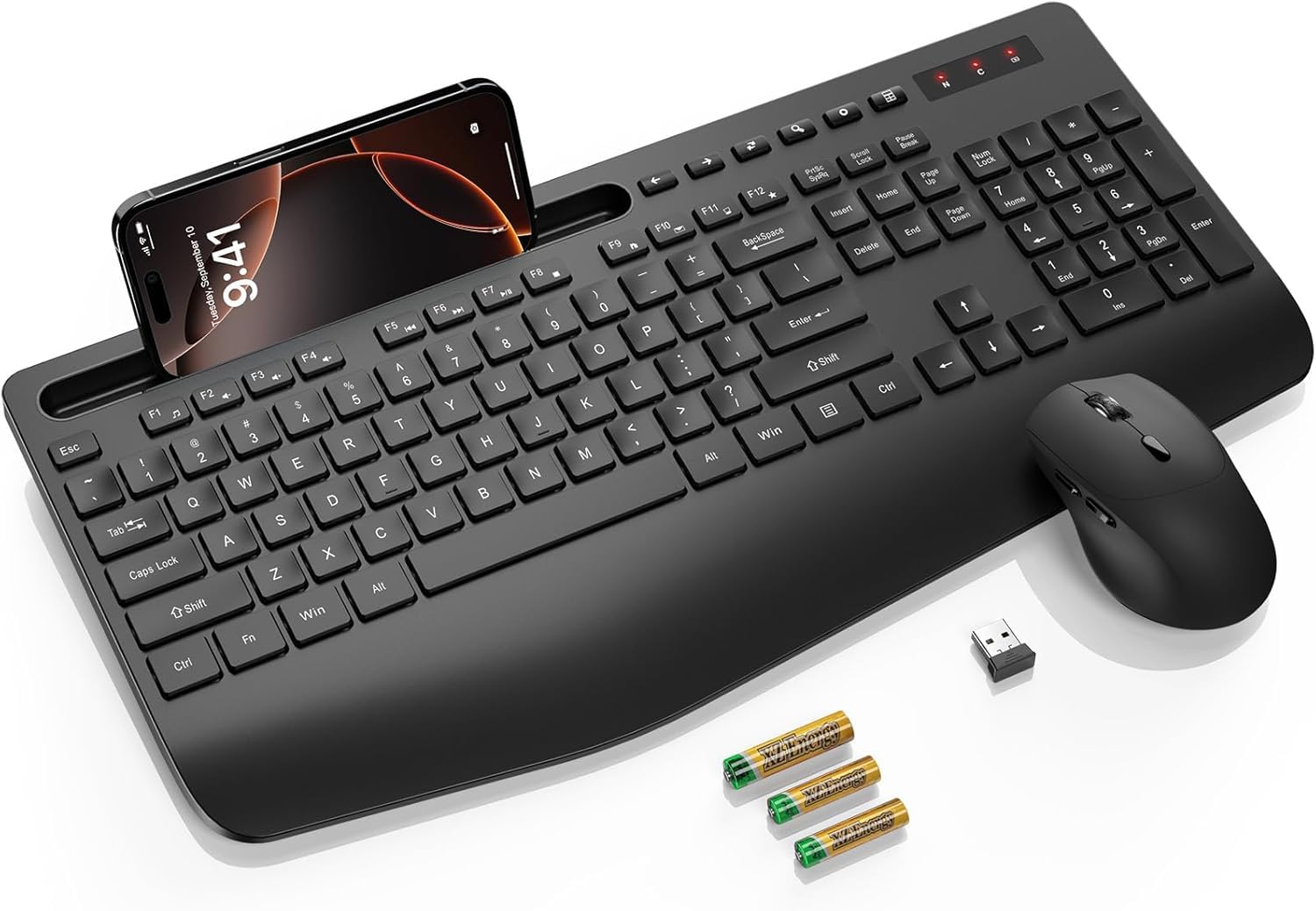
The SABLUTE KM23D is designed for users who spend long hours typing and need serious ergonomic support. Its 2.8-inch wide wrist rest is significantly larger than the palm rests found on most budget combos, and the 10° tilt angle positions your wrists in a more neutral, strain-reducing posture. A built-in phone holder accommodates devices up to 11.9 inches, making it easy to monitor notifications or follow along with video calls without lifting your hands from the keyboard.
The keyboard features six multimedia hotkeys (forward, back, refresh, search, stop, calculator) and a 6-button mouse with three DPI levels (800/1200/1600) plus forward/backward navigation buttons. The soft membrane keys reduce typing noise by 95%, and the mouse’s Silent Micro Motion technology makes clicks nearly inaudible. The combo runs on included batteries (2 AAA for keyboard, 1 AA for mouse) and includes a smart sleep mode to extend battery life.
A small number of users experienced initial pairing issues where the keyboard did not work out of the box, though most reported that the problem resolved after removing and reinserting the batteries or waiting a few minutes. The mouse is right-hand oriented, so left-handed users may find it less comfortable. The keyboard also lacks a USB-C dongle storage slot, making it easier to misplace the receiver. For comfort-focused buyers, this combo delivers the best ergonomic features in the budget range.
Why it’s great
- Extra-wide 2.8-inch wrist rest reduces typing fatigue
- 10° tilt angle for better wrist alignment
- Integrated phone holder fits large devices
Good to know
- Mouse is right-hand dominant only
- No built-in receiver storage on the keyboard
5. Trueque KM31 Wireless Keyboard and Mouse
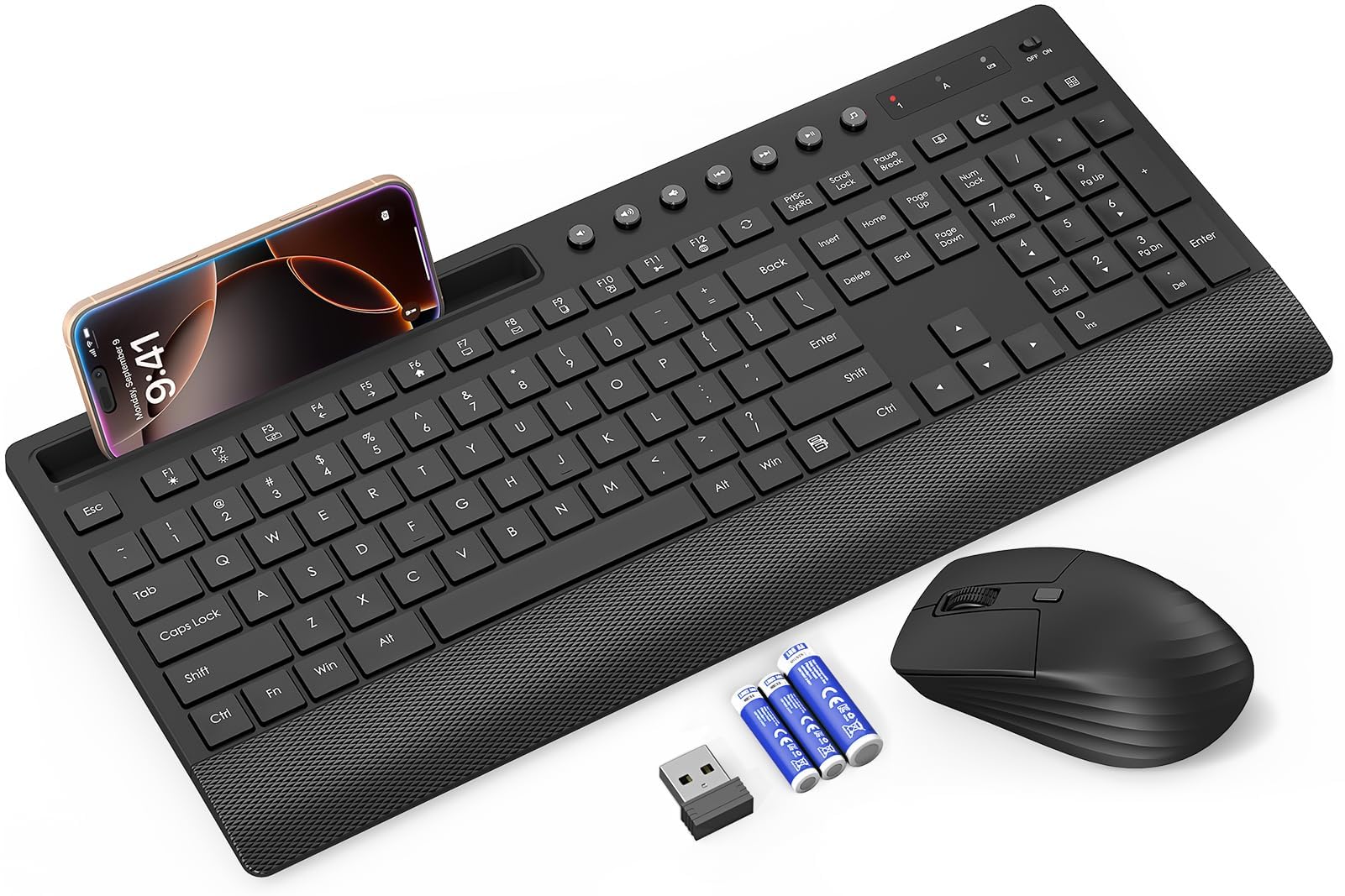
The Trueque KM31 punches above its weight class by packing a full-size quiet keyboard, a built-in 7.8-inch phone holder, a palm rest, and 7 multimedia keys into one of the lowest-priced combos on the market. The low-profile keys deliver over 97% noise reduction compared to standard keyboards, and the mouse features a rubber scroll wheel that glides silently. The 7° tilt legs provide a comfortable typing angle, and the included wrist rest reduces strain during extended sessions.
Battery life is rated at up to 90 days for the keyboard and 30 days for the mouse on included batteries, with a smart sleep mode and on/off switches to conserve power. The 2.4 GHz USB receiver supports a range of up to 10 meters and shares a single dongle between both devices. Setup is genuinely plug-and-play — insert the receiver, and both keyboard and mouse work immediately with Windows and ChromeOS systems.
Some users reported that the printed key labels began to wear off after about three weeks of daily use, which is a concern for long-term legibility. The keyboard is a membrane type, so the key feel is softer and less tactile than a mechanical board. For the price, you get an impressive feature set, but the durability of the keycaps may not match that of more established brands like Logitech or HP. Ideal for short-term setups or users who don’t mind replacing the combo after a year or two.
Why it’s great
- Extremely quiet typing with 97% noise reduction
- Built-in phone holder and full palm rest
- Batteries included out of the box
Good to know
- Keycap labels may fade with heavy daily use
- Membrane key feel is softer than chiclet or mechanical designs
FAQ
Will a budget wireless keyboard and mouse work with a Mac or Chromebook?
How often do I need to replace batteries in a budget wireless combo?
Can I use the mouse and keyboard separately with different receivers?
Why does my wireless mouse feel laggy or skip across the screen?
Is a membrane keyboard good enough for everyday typing?
Final Thoughts: The Verdict
For most users, the best budget wireless keyboard and mouse winner is the Logitech MK270 because it combines proven reliability, spill resistance, and exceptional battery life that puts it miles ahead of the competition in long-term value. If you want RGB backlighting and the convenience of USB-C rechargeable batteries, grab the VEILZOR. And for maximum ergonomic support with an extra-wide wrist rest and phone holder, nothing beats the SABLUTE KM23D.

Mo Maruf
I created WellFizz to bridge the gap between vague wellness advice and actionable solutions. My mission is simple: to decode the research and give you practical tools you can actually use.
Beyond the data, I am a passionate traveler. I believe that stepping away from the screen to explore new environments is essential for mental clarity and physical vitality.