Our readers keep the lights on and my smoothie glass nicely filled. As an Amazon Associate, I earn from qualifying purchases.
Yet most drivers rely on the dashboard warning light or a simple voltage reading, which tells them nothing about the battery’s true ability to deliver power under load.
I’m Mohammad Maruf — the founder and writer behind WellFizz. This guide distills hundreds of hours of spec analysis across digital analyzers and heavy-duty load testers to separate tools that deliver real diagnostic value from those that only offer false confidence.
Whether you are a weekend DIYer or a professional technician, finding the best battery tester means matching features like internal resistance measurement, CCA range, and physical load capacity to the specific batteries you maintain.
How To Choose The Best Battery Tester
Not all battery testers are created equal. A cheap unit that only reads voltage will leave you stranded, while an industrial-grade load tester may be overkill for a single sedan. Focus on the test method, the battery chemistries it supports, and the safety features it includes to find the right match for your toolkit.
Digital Conductance vs. Carbon Pile Load Testers
Digital testers measure internal resistance and calculate CCA, state of health, and state of charge in seconds without draining the battery. They are ideal for AGM, EFB, and Gel batteries because they do not stress the cells. Carbon pile testers apply a real load (typically 100 to 130 amps) and measure voltage drop, which remains the gold standard for flooded lead-acid batteries but requires cooldown periods between tests.
CCA Range and Battery Standards
Check the tester’s supported CCA range against your vehicle’s spec. Most car batteries fall between 400 and 800 CCA, but trucks and heavy equipment can exceed 1500 CCA. Also verify which standards the tester supports — SAE, DIN, EN, IEC, and JIS do not measure the same thing, and a mismatch can give a false “replace battery” reading.
Safety Protections That Matter
Reverse polarity protection prevents damage if you accidentally swap the clamps. Spark-proof technology reduces ignition risk when making the final connection, especially near hydrogen gas released by charging batteries. A tester lacking these protections is a liability, not a tool.
Quick Comparison
On smaller screens, swipe sideways to see the full table.
| Model | Category | Best For | Key Spec | Amazon |
|---|---|---|---|---|
| OTC 3181 | Analog Load Tester | Professional use, heavy-duty testing | 130 Amp carbon pile load | Amazon |
| TOPDON BT50 | Digital Analyzer | Home mechanics, quick diagnostics | Conductance testing, 100-2000 CCA | Amazon |
| Battery Tender 026-0020 | Analog Load Tester | Starter and deep cycle batteries | 100 Amp load at 12V | Amazon |
| Quicklynks BM2 | Bluetooth Monitor | Continuous voltage tracking | Bluetooth 4.0, low-volt alarm | Amazon |
| Veepeak 591b7076 | Digital Analyzer | Entry-level, multi-vehicle households | 0.01V resolution, 100-2000 CCA | Amazon |
In‑Depth Reviews
1. OTC 3181

The OTC 3181 is the definitive carbon pile load tester for anyone who demands real-world results — it applies a true 130-amp load to 12V batteries and reads the voltage drop on a large 0-16 volt analog gauge. There is no algorithm or guesswork involved: a battery either holds voltage under load or it does not. The uniquely designed clamps grip securely on both top-post and side-post terminals, a detail budget testers often ignore.
The ergonomic handle and robust build make it feel at home in a commercial garage, yet the operation is simple enough for a driveway mechanic. A 10-second test is all it takes to confirm whether a battery is good, bad, or marginal. The side tabs for clamp storage and back brackets for wall mounting keep the workspace organized.
Because the load tester generates heat during testing, a cooldown period equal to the test time is required between cycles. This is standard for any carbon pile unit and not a flaw. The heavy-duty internal coil and first-class clamps justify the investment for anyone maintaining multiple vehicles or doing professional diagnostic work.
Why it’s great
- True 130-amp load test delivers definitive battery health results
- Heavy-duty clamps with superior grip on top and side terminals
- Built-in storage and wall-mounting brackets
Good to know
- Requires manual cooldown between tests
- Analog gauge may not suit users who prefer digital readouts
2. TOPDON BT50

The TOPDON BT50 is a compact digital analyzer that uses conductance testing to evaluate 12V lead-acid batteries, including AGM, Flooded, and Gel types. It measures battery health, cranking capability, and charging system efficiency in under ten seconds without discharging the battery. The upgraded algorithm delivers lab-grade accuracy that catches degradation trends before a battery fails.
Spark-free technology and reverse polarity protection make it safe for home mechanics who may not have extensive electrical experience. The bright LCD display and single-button operation keep the interface clean, while the six-language menu (including English, Spanish, and French) broadens its appeal. At only 0.7 inches thick, it slips into a glove box without complaining.
The clamps are the weakest point — the grips lack the bite of professional-grade units, and the leads could be longer for testing batteries deep inside engine bays. For routine checks on cars, trucks, and motorcycles, the accuracy and speed are impressive. The 12-month warranty and lifetime technical support add peace of mind for a mid-range investment.
Why it’s great
- Conductance test provides fast results without draining the battery
- Spark-free and reverse polarity protection
- Ultra-compact design fits in a glove box
Good to know
- Clamp grips are not as robust as professional models
- Leads could be longer for deep-set batteries
3. Battery Tender 026-0020
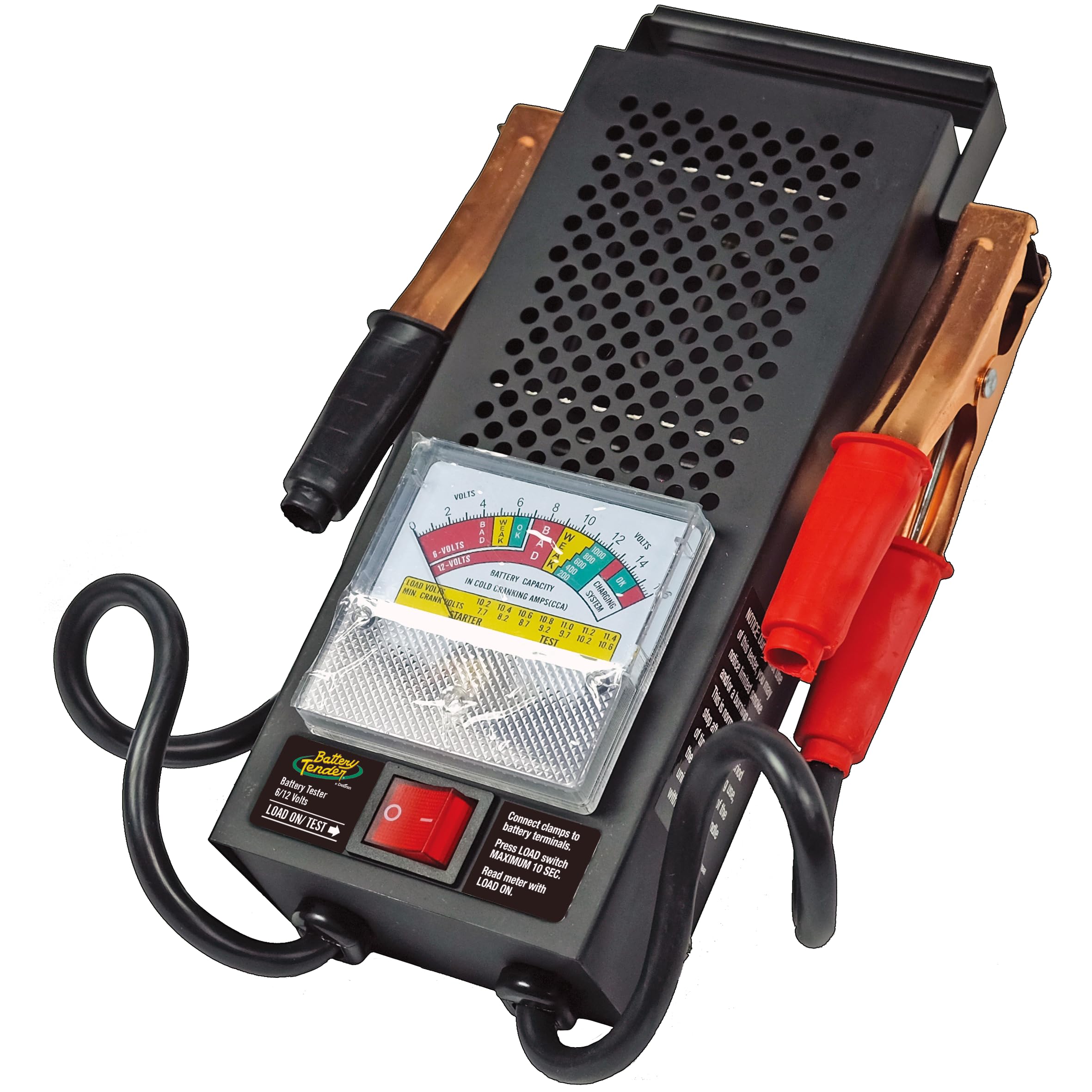
The Battery Tender 026-0020 is a versatile analog load tester that handles both 12V batteries at 100 amps and 6V batteries at 50 amps, covering starter and deep cycle types for cars, motorcycles, RVs, and boats. The rubber-insulated carrying handle and color-coded heavy-duty clamps make it safe and easy to transport. The color-coded meter display lets you read battery condition at a glance without decoding numbers.
It is compatible with vehicles that have up to 1,000 cranking amps, which covers most passenger vehicles, SUVs, and light trucks. The single toggle switch simplifies operation — connect the clamps, flip the switch, and read the result. Users report consistent accuracy over years of use, making it a long-term companion for routine battery checks.
The mild smell during the first few uses is normal for analog load testers as the internal components break in. Following the recommended run and cool times is essential to prevent coil damage. This unit sits in a sweet spot between entry-level digital testers and premium commercial units, offering genuine load testing at an accessible tier.
Why it’s great
- Works with both 6V and 12V batteries
- Color-coded gauge for instant readability
- Rubber-insulated handle and heavy-duty clamps
Good to know
- Cooldown period required between load tests
- Not suitable for batteries above 1,000 CCA
4. Quicklynks BM2

The Quicklynks BM2 is not a traditional handheld tester — it is a Bluetooth battery monitor that stays connected to your 12V battery permanently and reports voltage, charge cycles, and starting system performance through a free app on iOS and Android. Once installed by clipping directly onto the battery terminals, it records data at one-minute intervals and stores up to 30 days of history for review.
The low-voltage alarm alerts your phone when the battery drops below a set threshold, which is a critical feature for vehicles that sit idle for long periods — RVs, classic cars, boats, and seasonal equipment. The app displays voltage trends over time, helping you detect parasitic drains or alternator issues before they escalate. Bluetooth range is approximately 10 meters, though the metal hood can shorten effective distance.
Installation is straightforward: pair with the app (not through your phone’s standard Bluetooth menu) and the device auto-connects whenever you are nearby. The alarm settings use percentage-based thresholds rather than precise tenths-of-a-volt, which is a minor limitation. For continuous monitoring rather than one-time testing, this unit brings a unique data-driven perspective that handheld testers cannot match.
Why it’s great
- Continuous voltage monitoring with 30-day history
- Low-voltage push notification alerts
- Works for solar systems, RVs, and infrequently used vehicles
Good to know
- Bluetooth range limited by metal obstacles
- Alarms use percentage thresholds instead of precise voltage settings
5. Veepeak 591b7076

The Veepeak 591b7076 is a digital battery analyzer that punches well above its tier, offering voltage testing accuracy of 0.01V and support for a massive 100-2000 CCA range across SAE, EN, DIN, JIS, and IEC standards. It tests state of charge, state of health, internal resistance, and cranking voltage for all 12V lead-acid types including Flooded, AGM Flat Plate, AGM Spiral, GEL, and EFB. The high-performance chip and premium clamps deliver reliability up to 99.9%.
The plug-and-play design works with batteries in or out of the vehicle, and the spark-proof connections and reverse polarity protection make it safe for first-time users. The compact form factor (5 by 2.85 by 0.87 inches) stores easily in a glove compartment or tool bag. Real-world testing against store equipment has shown identical results, confirming the accuracy claims.
The included clamps and wires are functional but feel less substantial than those on more expensive units. The color-coded display is straightforward, though it lacks the multi-language menu of the TOPDON BT50. For a household with multiple vehicles — cars, trucks, motorcycles, boats, ATVs — this unit provides all the diagnostic depth most owners will ever need at an entry-level investment.
Why it’s great
- 0.01V resolution and support for 2000 CCA
- Works with AGM, GEL, EFB, and flooded batteries
- Spark-proof and reverse polarity protected
Good to know
- Leads and clamps feel budget-tier
- No multi-language options or advanced data logging
FAQ
What is the difference between a digital analyzer and a load tester?
Can a battery tester work on motorcycles and lawn mowers?
Final Thoughts: The Verdict
For most users, the best battery tester winner is the OTC 3181 because its 130-amp carbon pile load test leaves no room for doubt — a battery either holds voltage or it does not. If you want fast digital diagnostics without draining the battery, grab the TOPDON BT50. And for continuous remote monitoring of a vehicle that sits idle, nothing beats the Quicklynks BM2.

Mo Maruf
I created WellFizz to bridge the gap between vague wellness advice and actionable solutions. My mission is simple: to decode the research and give you practical tools you can actually use.
Beyond the data, I am a passionate traveler. I believe that stepping away from the screen to explore new environments is essential for mental clarity and physical vitality.