Our readers keep the lights on and my smoothie glass nicely filled. As an Amazon Associate, I earn from qualifying purchases.
Distributing free over-the-air television to every room in your house starts with a single well-placed antenna in the attic. Without the right antenna and a proper signal splitter, you will face pixelation on the second TV or lose half your channels on the third. The attic is the ideal location because it sits above roof obstructions yet remains protected from wind and rain.
I’m Mohammad Maruf — the founder and writer behind WellFizz. This guide is built on many hours of cross-referencing real customer installations, measured gain figures, and amplifier architectures to separate attic-ready performers from marketing claims.
You will learn which antennas distribute strong UHF and VHF signals across multiple televisions without needing an external preamp for every room. This is your complete resource for choosing the best attic antenna for multiple tvs.
How To Choose The Best Attic Antenna For Multiple TVs
Selecting an attic antenna for a multi-television setup is different from picking a single-TV model. You must balance raw gain, amplification noise figure, and the signal loss incurred by splitters. The three factors below matter most when every room relies on one roof-mounted or attic-mounted antenna.
Gain and directivity versus omnidirectional coverage
A high-gain directional Yagi or stacked-boom antenna collects more signal from a specific tower direction, which helps compensate for the signal loss introduced by a two-way, three-way, or four-way splitter. Omnidirectional antennas simplify aiming but usually deliver less gain per TV. For multi-TV distribution, a directional design with at least 12 dBi of UHF gain typically provides a stronger margin.
Built-in amplifier noise figure and 5G filtering
An amplifier raises signal strength, but only if it adds minimal noise. Look for an amplifier with a noise figure of 1 dB or lower. Higher noise figures degrade the signal-to-noise ratio and reduce the number of channels your TVs can lock onto. Integrated LTE and 5G filtering also prevents cellular towers from overwhelming the amplifier, which is increasingly important in suburban and urban attic installations.
Splitter loss and cable run length
Splitting the signal to two TVs introduces roughly 3.5 dB of loss per split; a four-way splitter costs about 7 dB. Pre-existing coax runs of 50 feet or more add another 2–4 dB of loss. The antenna plus amplifier must deliver enough output to overcome these losses while still leaving a clean signal at each tuner. A preamp or a self-amplified antenna with 20+ dB of gain handles common residential multi-TV configurations.
Quick Comparison
On smaller screens, swipe sideways to see the full table.
| Model | Category | Best For | Key Spec | Amazon |
|---|---|---|---|---|
| Televes DAT BOSS Mix LR 149884 | Premium | Extreme fringe multi-TV | 46 dBi UHF gain, stacked triple boom | Amazon |
| Winegard Elite 7550 | Premium | Wide beam multi-room | Embedded 1 dB noise figure amp | Amazon |
| Televes DiNova Boss Mix 144286 | Premium | Compact attic with HOA limits | 29/34 dBi per band, radome housing | Amazon |
| Five Star Outdoor HDTV Antenna | Mid-Range | Multi-TV with included splitter | 200 mi range, includes 4-way splitter | Amazon |
| Channel Master Omni+ 50 | Mid-Range | 360° attic distribution | 50 mi omnidirectional, separate VHF/UHF | Amazon |
| RCA Compact Yagi ANT751Z | Value | Budget-friendly attic install | 75 mi range, pre-assembled design | Amazon |
| PIBIDI UHD-8903 | Value | Entry-level multi-TV start | 200 mi claim, large receiving elements | Amazon |
In‑Depth Reviews
1. Televes DAT BOSS Mix LR 149884
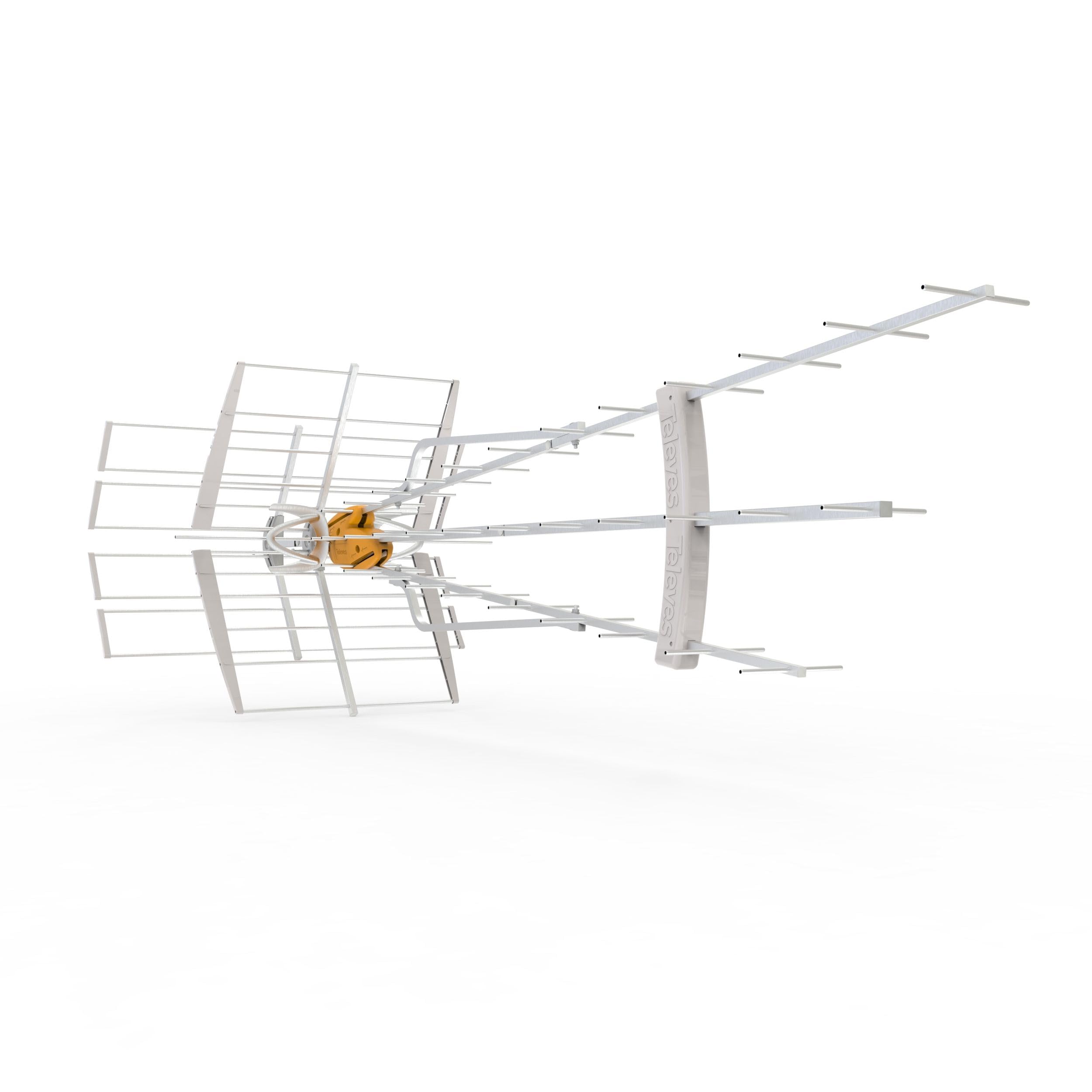
This is the highest-gain consumer antenna in the guide, with 46 dBi of UHF amplification and a stacked triple-boom design that focuses signal like a professional rig. Users 60 to 70 miles from towers in rural Wisconsin and the Dallas fringe report pulling in 80 to 114 channels after installing it at 32 feet. The TForce intelligent gain control adjusts amplification per band automatically, which prevents overload on strong signals while still amplifying weak distant stations.
The integrated FM, LTE, 4G, and 5G filtering is critical for attic installations near cell towers. The amplifier passes signals cleanly through a multi-way splitter without the noise floor rising. The entire assembly is mostly metal with stainless steel hardware, so it holds alignment for years. At 84 inches long, it requires attic space and a clear line of sight toward towers.
For a household with three or four televisions where the antenna must overcome heavy splitter loss and fringe conditions, this model delivers the highest margin. It works in passive mode if the power inserter fails, so you never lose signal entirely.
Why it’s great
- Highest raw UHF gain in this group, ideal for deep splits
- BOSS-Tech prevents amplifier overload in mixed-signal areas
- Heavy-duty metal construction handles attic heat cycles
Good to know
- Very large footprint requires dedicated attic space
- Premium price reflects professional-grade components
2. Winegard Elite 7550
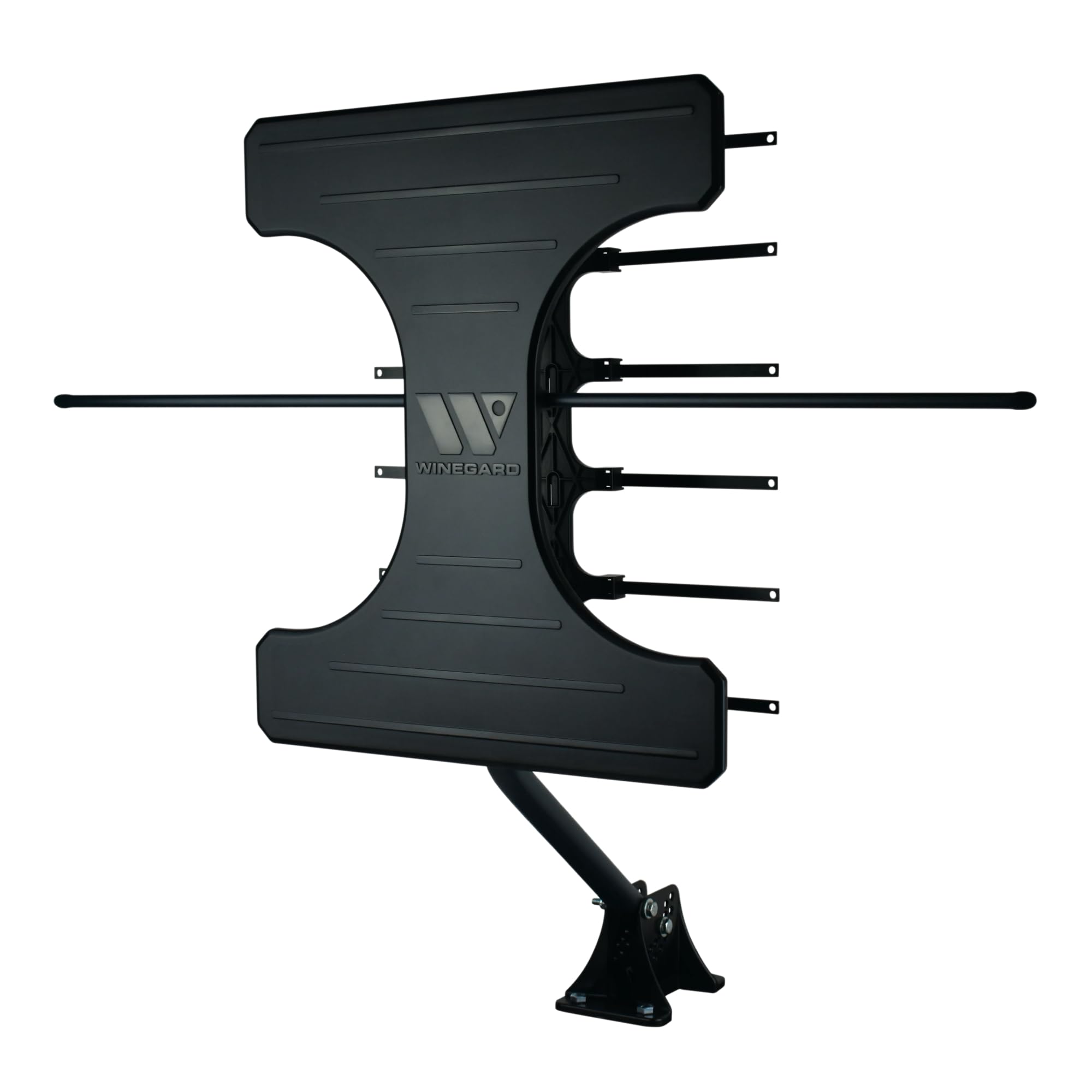
The Winegard Elite 7550 embeds an ultra-low-noise amplifier directly into the antenna body, keeping the noise figure at 1 dB. This matters for multi-TV setups because a low-noise amp preserves signal quality before the splitter reduces strength. Users in Charlotte, NC, reported 59 strong channels with a single splitter run to multiple rooms. The wide beam pattern captures signals from a broader arc than a tight Yagi, which helps when towers sit at different compass points.
The included 5-volt power inserter and USB adapter simplify attic wiring. The antenna is lightweight at 16 ounces, so it places minimal stress on attic rafters or mounting brackets. Some users noted that the housing is mostly plastic with self-tapping screws, so careful assembly is required to avoid stripping the holes. The amplifier draws very little power and includes a green LED indicator.
For a mid-range premium option that works well across two to three televisions without excessive signal loss, the Elite 7550 balances gain, noise performance, and price effectively. It is directional but forgiving enough to catch stations 30 degrees off boresight.
Why it’s great
- Industry-leading 1 dB noise figure for cleaner multi-room splits
- Lightweight construction eases attic mounting
- Winegard app helps locate optimal tower direction
Good to know
- Plastic housing may degrade under extreme attic heat over many years
- Some users found it slightly overpriced for the build materials
3. Televes DiNova Boss Mix 144286

The DiNova Boss Mix is Televes’s compact premium option with a built-in preamplifier that delivers 29 dBi on high VHF and 34 dBi on UHF. The TForce system adjusts gain independently for each band, so strong local VHF stations do not swamp weaker UHF channels. Users in hilly rural areas reported adding 20 channels after moving the antenna from indoors to just below the roofline, with no pixelation on distant stations.
The weather-resistant ABS radome housing protects the electronics from attic humidity and temperature swings. No assembly is required — the antenna arrives fully assembled, which is rare in this category. The dual-output power inserter supplies 12 volts and can be placed at the basement or utility room, keeping the wiring clean. The directional UHF microstrip array covers a 50-mile range reliably.
For homeowners who need a sleek, low-profile antenna that works well with a two-way or three-way splitter in suburban attic environments, the DiNova avoids the industrial look of large Yagis while still providing enough gain for a multi-television household.
Why it’s great
- No assembly needed, open box and mount
- Independent band gain prevents VHF overload
- Radome housing guards against attic moisture
Good to know
- Maximum range of 50 miles limits fringe use
- Mounting fasteners not included
4. Five Star Outdoor HDTV Antenna

The Five Star antenna ships with a J-pole mounting bracket and a four-way TV splitter, making it the only model in this guide that includes everything needed to connect multiple televisions out of the box. The 46-inch-long elements provide strong UHF and VHF reception. Users 45 miles from Houston towers pulled in 128 channels, and another user at 7,300 feet elevation with a 46-mile aim received 90 channels with 72 clear.
The antenna supports ATSC 3.0 and is advertised for 200-mile range, though real-world reception drops significantly beyond 60 miles depending on terrain. The 75-ohm impedance matches standard RG6 coax, and the included splitter introduces roughly 7 dB of loss. For a two or three TV setup, this antenna compensates well with its large element surface area. Assembly is straightforward but the instructions miss the VHF vibrator alignment detail — the screw heads must face the same direction.
This is a strong mid-range choice for buyers who want a single-box solution for splitting to multiple rooms without buying separate components. It works best in suburban to urban fringe zones.
Why it’s great
- Four-way splitter and J-pole included, saves extra purchases
- Large element surface delivers strong gain for multi-room splits
- ATSC 3.0 ready for future NextGen broadcasts
Good to know
- Longer cable runs beyond 80 feet lose low-power stations
- Assembly instructions lack one critical alignment detail
5. Channel Master Omni+ 50

The Channel Master Omni+ 50 uses a 360-degree omnidirectional pattern, which eliminates the need to aim the antenna toward a single tower cluster. This is uniquely useful when broadcast towers surround your location. Users in metropolitan areas with antennas 10 miles away picked up all major stations and ran the signal through a splitter for a second TV with no noticeable drop. The separate UHF and VHF components, including a rotatable VHF dipole, give you fine control over the low-band reception.
The antenna is rated for 50 miles and works best in suburban or urban zones where towers are less than 35 miles away. In flat Florida terrain, one user pulled in 53 stations with the unit surviving heavy rain on an outdoor mount. The design is lightweight and includes a mounting bracket for wall, mast, or existing satellite mounts. No preamp is built in, so for multi-TV splitting beyond two sets you may need an external distribution amplifier.
For households where towers point in multiple directions and you need to feed two televisions without rotating the antenna, the Omni+ is the simplest install. It does not match the gain of a directional Yagi, but it removes the alignment variable entirely.
Why it’s great
- No aiming needed, receives signal from all directions
- Separate UHF and VHF components for independent adjustment
- Compact profile fits tight attic spaces
Good to know
- 50-mile maximum range limits fringe reception
- No built-in amplifier, may need external distribution amp for 3+ TVs
6. RCA Compact Yagi ANT751Z

It includes an easy-lock fold-out UHF reflector and snap-lock elements, making assembly straightforward for attic installation. Users consistently report 70 to 80 channels with signal strengths above 80% and a cleaner picture than cable. One user mounted it in the attic with a Winegard LNA-200 preamp and recorded 51 channels with full signal strength on both VHF and UHF.
The antenna is light at 2 pounds and comes with a mast clamp, mounting hardware, and a 75-ohm matching transformer. The 75-mile range rating is realistic for suburban areas within 25 to 40 miles of towers. Some users have noted that it is UHF-dominant and may miss VHF-low channels like ABC in specific markets. The antenna does not include an amplifier, so a separate preamp is recommended when splitting to multiple televisions to compensate for splitter loss.
For the price, the RCA delivers reliable signal on a budget. It pairs well with an external distribution amplifier for two or three TV setups where the budget needs to stay low.
Why it’s great
- Proven track record of reliable attic performance
- Tool-less snap-lock assembly saves installation time
- Compatible with RCA Signal Finder app for alignment
Good to know
- May struggle with VHF-low channels in some markets
- No amplifier included; external preamp needed for multi-split
7. PIBIDI UHD-8903

The PIBIDI UHD-8903 is an entry-level outdoor-antenna design with very large receiving elements intended to capture weak distant signals. Users in Oregon and upstate South Carolina reported 64 to 86 channels after proper aiming. One reviewer living 65 miles from Eugene and 55 miles from Portland received a strong channel count but noted difficulty receiving a specific MeTV-toon subchannel. The antenna is mostly pre-assembled and requires only a few snap-on elements, making it one of the faster installs in this tier.
The manufacturer claims 200-mile range, but customer reports confirm the antenna works best within 40 to 60 miles of towers. The design includes lightning protection and grounding provisions, which is helpful for attic mounting where static buildup can occur. It does not include a built-in amplifier, and no splitter is included, so you will need to add a distribution amplifier for multi-television setups. A user in a rural setting saw far superior performance versus a larger, more expensive 12-year-old antenna.
For a single-TV or two-TV household on a tight budget, the PIBIDI provides a solid entry point. It lacks the gain and filtering sophistication needed for four or more televisions but covers basic cord-cutting needs adequately.
Why it’s great
- Large element design pulls in channels where smaller antennas fail
- Minimal assembly required, installs in under 30 minutes
- Included grounding provisions meet basic safety needs
Good to know
- 200-mile range claim is optimistic; realistic range is 40–60 miles
- No amplifier or splitter included for multi-TV distribution
FAQ
Can I use one attic antenna for three televisions without a distribution amplifier?
Why does my attic antenna get fewer channels after adding a splitter for the second TV?
Does ATSC 3.0 compatibility matter for a multi-TV attic antenna?
Should I mount the antenna in the attic or on the roof for better multi-TV signal?
Final Thoughts: The Verdict
For most users, the best attic antenna for multiple tvs winner is the Televes DAT BOSS Mix LR 149884 because its 46 dBi gain and triple-boom design provide enough headroom to cleanly feed three or four televisions even in fringe reception areas. If you want a compact antenna that fits in tight attic spaces without assembly, grab the Televes DiNova Boss Mix 144286. And for a budget-friendly entry into multi-TV cord cutting, nothing beats the included splitter kit and J-pole of the Five Star Outdoor HDTV Antenna.

Mo Maruf
I created WellFizz to bridge the gap between vague wellness advice and actionable solutions. My mission is simple: to decode the research and give you practical tools you can actually use.
Beyond the data, I am a passionate traveler. I believe that stepping away from the screen to explore new environments is essential for mental clarity and physical vitality.