Our readers keep the lights on and my smoothie glass nicely filled. As an Amazon Associate, I earn from qualifying purchases.
Choosing a camera for filmmaking means balancing the sensor’s latitude, the codec’s flexibility, and the ecosystem’s lens support into a single tool that matches your specific production workflow. Every camera on this list delivers genuine cinema-quality output, but each prioritizes a different combination of dynamic range, color science, and recording capability.
I’m Mohammad Maruf — the founder and writer behind WellFizz. I’ve spent hundreds of hours analyzing sensor specifications, codec performance, and lens system adaptability across every major camera brand to separate true cinema tools from consumer-grade cameras dressed in video modes.
Whether you need internal RAW recording, dual-native ISO for low-light shoots, or a compact form factor for run-and-gun documentary work, this guide to the best camera for cinematography covers models ranging from entry-level cinema bodies to full-frame hybrid powerhouses built for serious productions.
How To Choose The Best Camera For Cinematography
A true cinema camera is defined by its ability to capture a wide dynamic range in a log gamma profile, record at a high bit depth for color grading flexibility, and accept interchangeable lenses through a robust mount. Consumer stills cameras with video modes often clip highlights or compress color information in ways that break when you try to push the grade. For dedicated cinematography, look for three pillars: sensor latitude, recording codec, and professional connectivity.
Sensor and Dynamic Range
The sensor determines how much detail survives in shadows and highlights. A Super 35 sensor offers a classic film look with deep depth of field control, while full-frame sensors provide wider coverage and better low-light performance at the expense of more aggressive rolling shutter on some models. Regardless of format, look for at least 13 stops of dynamic range in a log recording mode. That latitude is what lets you recover highlights and lift shadows without introducing banding or noise.
Recording Codec and Bit Depth
The codec determines how much color information gets retained in the file. 10-bit 4:2:2 or higher is essential for clean grading — 8-bit footage falls apart quickly when you push saturation or adjust white balance. RAW recording gives the most post-production flexibility, but requires larger storage and more processing power. ProRes and Blackmagic RAW offer a practical middle ground with excellent quality at manageable file sizes.
Quick Comparison
On smaller screens, swipe sideways to see the full table.
| Model | Category | Best For | Key Spec | Amazon |
|---|---|---|---|---|
| Sony FX30 | Cinema | Indie filmmaking | 6K oversampled 4K | Amazon |
| Nikon RED Z Cinema | Cinema | Professional production | 6K full-frame R3D RAW | Amazon |
| Blackmagic 6K Pro | Cinema | Run-and-gun cinema | Internal ND filters | Amazon |
| Canon EOS R5 Mark II | Hybrid | Hybrid stills/video | 8K internal recording | Amazon |
| Blackmagic 4K | Cinema | Value cinema | 13 stops dynamic range | Amazon |
| Canon EOS R5 | Hybrid | High-res hybrid work | 45MP 8K video | Amazon |
| Nikon Z6 III | Hybrid | 6K internal RAW | 6K/60p N-RAW | Amazon |
| Sony a7 III | Hybrid | Full-frame value | 24.2MP BSI sensor | Amazon |
| Canon EOS 5D Mark IV | DSLR | Durable DSLR rig | 30.4MP 4K video | Amazon |
| Sony a6400 | Mirrorless | Budget mirrorless | 0.02 sec AF speed | Amazon |
| Nikon D7500 | DSLR | Budget DSLR video | 4K UHD 30fps | Amazon |
| Canon EOS R50 | Mirrorless | Entry-level hybrid | 24.2MP 4K video | Amazon |
| Sony ZV-1 | Compact | Vlogging/compact | 1″ sensor 4K HDR | Amazon |
In‑Depth Reviews
1. Sony FX30

The Sony FX30 delivers 90 percent of the FX3’s cinema capabilities at roughly half the entry point, making it one of the most compelling Super 35 cinema cameras available. Its 20.1MP Exmor R APS-C sensor captures 6K oversampled 4K footage with S-Cinetone color science straight out of the box, so you can achieve a cinematic look without heavy grading sessions. Dual base ISO gives you clean low-light performance at 640 and 2500, covering most indoor and outdoor scenarios with minimal noise.
Active cooling is a standout feature — the internal fan prevents overheating during hour-long 4K 60fps recordings, a critical advantage over hybrid cameras that throttle in warm environments. The electronic viewfinder is absent by design, replaced by a large flip-out LCD that suits gimbal and cage setups. Professional connectivity includes a full-size HDMI port and dual SD card slots, letting you record proxy files alongside your main footage.
Battery life hovers around 90 minutes of continuous recording, which is standard for a cinema body of this class. Pair it with a V-mount battery plate or external USB-C power to extend run times on set. The E-mount opens access to Sony’s extensive lens library as well as third-party glass from Sigma and Tamron, making the FX30 a flexible foundation for any indie production.
Why it’s great
- Active cooling enables unlimited recording without thermal shutdown
- S-Cinetone produces rich, filmic color straight from the camera
- Dual base ISO provides exceptional low-light performance
Good to know
- No built-in ND filters; requires external VND or matte box
- Battery life is moderate; plan for extra cells on long shoots
2. Nikon RED Z Cinema

The Nikon RED Z Cinema camera merges RED’s legendary color science with Nikon’s engineering in a 1.18-pound body that shoots 6K full-frame REDCODE RAW internally. With over 15 stops of dynamic range and dual base ISO, this sensor captures exceptional highlight detail and shadow depth in a single take. The 32-bit float audio recording supports external microphones directly, eliminating the need for a separate audio recorder in most production scenarios.
The Z mount is described by Nikon as the widest and most adaptable full-frame mount on the market as of late 2025, giving you compatibility with a broad range of cinema lenses through adapters. The 4-inch DCI-P3 touchscreen monitor swivels for low-angle and over-head shots, and the body integrates easily with cages and control grips for rigged setups. R3D files open in DaVinci Resolve and RED’s own software, offering the same grade latitude that made RED the standard on major film sets.
File sizes are substantial — a single minute of 6K R3D footage can exceed 3GB, so fast CFexpress Type B cards and a robust storage workflow are mandatory. The camera does not include an in-box charger, nor does it feature electronic stabilization, so plan for a cage and a gimbal or tripod for steady shots. For dedicated video work without stills compromises, this is a professional cinema tool in a compact footprint.
Why it’s great
- RED color science and R3D RAW workflow in a compact body
- 32-bit float audio eliminates need for external recorder in many setups
- Wide Z mount with strong adapter support for third-party cinema glass
Good to know
- No in-box charger; requires separate purchase
- Large R3D file sizes demand fast storage and high-capacity media
3. Blackmagic 6K Pro

Blackmagic’s Pocket Cinema Camera 6K Pro addresses the biggest limitation of its predecessor — external ND filters — by integrating 2, 4, and 6-stop ND filters directly into the body. The Super 35 sensor captures 6144 x 3456 resolution with 13 stops of dynamic range, and the dual gain ISO up to 25,600 ensures clean images in challenging light. The 5-inch HDR tilting LCD is bright enough for outdoor monitoring without an external display.
The active EF lens mount gives you immediate access to Canon EF and Sigma Art lenses, one of the most affordable and varied cinema lens ecosystems available. Recording options include Blackmagic RAW at 12-bit and Apple ProRes up to 4K, giving you the flexibility to choose between grade-friendly RAW files or smaller ProRes proxies for faster editing. The included DaVinci Resolve Studio activation key provides a full post-production suite at no extra cost.
Battery life with the included NP-F570 runs about 45 minutes, so the NP-F battery sled design is a practical feature — you can swap to high-capacity NP-F970 cells for all-day shoots. The mini XLR input with phantom power supports professional microphones, and the USB-C port allows direct recording to external SSDs. The camera’s bulk requires a cage and shoulder rig for handheld work, but the internal ND system alone justifies the investment for run-and-gun filmmakers.
Why it’s great
- Built-in ND filters (2, 4, 6 stops) eliminate the need for matte boxes
- Blackmagic RAW at 12-bit gives excellent grading latitude
- Active EF mount compatible with Canon and Sigma lens systems
Good to know
- Standard NP-F570 battery lasts under an hour; upgrade to larger cells
- No autofocus performance comparable to Sony or Canon mirrorless systems
4. Canon EOS R5 Mark II

The Canon EOS R5 Mark II updates the R5 formula with a back-illuminated stacked 45MP CMOS sensor that reads out 40 percent faster, reducing rolling shutter significantly. It captures 8K internally at up to 60fps with C-Log 2 and Canon Log 3 profiles, giving colorists a wide gamma curve to work with in post. The 30fps electronic shutter in stills mode and improved Eye Control AF make it a hybrid machine for those who need both high-resolution stills and cinema-quality video.
Action Priority is a new AF mode that predicts subject movement in sports or wildlife scenarios, maintaining focus even when the subject is partially obscured. The dedicated photo/video switch lets you toggle between stills and video settings without digging through menus. Heat management has been improved over the original R5, allowing extended 4K 120fps and 8K recording without the overheating warnings that plagued its predecessor in warm conditions.
Battery life is similar to the original R5 at around 350 shots or 60 minutes of video, which is acceptable for a compact hybrid body. The RF mount limits lens selection to Canon RF and adapted EF glass, but the growing RF cinema lens lineup, including the CN-R primes, makes this a viable A-camera for professional narrative work. At this tier, the R5 Mark II competes directly with the Sony a7S III and Nikon Z8 as a premium hybrid cinema tool.
Why it’s great
- Improved heat management allows extended 8K and 4K 120fps recording
- Action Priority AF predicts and tracks subjects through occlusion
- C-Log 2 and Canon Log 3 provide professional color grading flexibility
Good to know
- High 45MP resolution requires fast storage and careful shooting technique
- RF lens ecosystem is still growing; EF adapter adds bulk
5. Blackmagic 4K

The Blackmagic Pocket Cinema Camera 4K remains one of the most affordable entry points into true cinema recording. Its 4/3-inch sensor delivers 13 stops of dynamic range and dual gain ISO up to 25,600, producing images that grade beautifully in DaVinci Resolve — which comes bundled with the camera. The active Micro Four Thirds mount gives access to a vast and inexpensive lens ecosystem, including vintage glass that pairs perfectly with the sensor’s texture and color response.
Recording options include 12-bit Blackmagic RAW and Apple ProRes, letting you choose between maximum grading flexibility and smaller file sizes for faster workflows. The CFast 2.0 and SD UHS-II card slots provide redundant recording, and the USB-C port connects directly to external SSDs for long-form recording without media swaps. The 5-inch touchscreen LCD is large and bright enough for manual focus pulling in most indoor conditions.
The camera lacks in-body stabilization and continuous autofocus, so it relies entirely on manual focus and a gimbal or tripod for smooth shots. Battery life with the included LP-E6 is limited to about 30 minutes, making an external battery solution or cage with a V-mount plate almost essential for serious shoots. At this price point, the image quality rivals cameras costing several times more, making it the go-to choice for filmmakers building their first dedicated cinema rig.
Why it’s great
- 13 stops of dynamic range in a compact body at a low entry point
- 12-bit Blackmagic RAW and ProRes recording with bundled DaVinci Resolve Studio
- MFT mount supports inexpensive manual and vintage cinema lenses
Good to know
- No in-body stabilization; requires gimbal or tripod for smooth footage
- LP-E6 battery lasts only 30 minutes; external power is recommended
6. Canon EOS R5

When it launched, the Canon EOS R5 redefined what a hybrid camera could achieve by packing 8K internal RAW recording into a compact full-frame mirrorless body. The back-illuminated 45MP sensor delivers exceptional detail and dynamic range, while the DIGIC X processor enables 4K at 120fps with autofocus for slow-motion capture. The Dual Pixel CMOS AF system with 1,053 points covers the entire frame and locks onto subjects with reliability that rivals dedicated cinema cameras.
The 8K mode records 10-bit 4:2:2 internally, and the 4K HQ mode oversamples from the full 8K readout for incredibly sharp results. IBIS provides five stops of shake reduction, making handheld gimbal-free shots practical for documentary and run-and-gun work. The RF mount’s short flange distance means that adapted EF lenses, including Canon’s L-series cinema glass, perform as well as native glass with full AF and IS support.
Overheating received extensive discussion at launch, but real-world firmware updates have improved endurance — you can expect 20 minutes of 8K or up to 40 minutes of 4K 60fps in moderate temperatures. Battery life hovers around 60 minutes of video or 320 stills, which is reasonable given the processing demands. For filmmakers who also need a high-resolution stills camera for production stills or commercial work, the R5 remains a unique dual-purpose tool.
Why it’s great
- 8K internal RAW and 4K 120fps in a single compact hybrid body
- Dual Pixel CMOS AF with full-frame coverage and eye tracking
- IBIS enables smooth handheld footage without a gimbal
Good to know
- 8K recording duration is limited by heat management; plan for cooldowns
- Battery life is moderate; external power is useful for extended video shoots
7. Nikon Z6 III

The Nikon Z6 III delivers 6K/60p internal N-RAW recording with a full-frame 24.5MP sensor that offers excellent low-light performance and 15 stops of dynamic range. The 4000-nit electronic viewfinder is best-in-class for outdoor shooting, providing a clear, natural view even in bright sunlight. The 120fps EVF refresh rate eliminates blackout during continuous shooting, which is useful for capturing precise moments in action scenes.
Video features include oversampled 4K UHD from the 6K readout, 4K 120p for slow motion, and Full HD 240p for extreme slow-motion capture. The AF system uses deep learning subject recognition with detection down to -10EV, allowing reliable focus in near-dark conditions. The Z mount accepts the growing Nikon S-line lenses and adapts well to PL and EF cinema glass through third-party adapters.
The body is weather-sealed and comfortable in the hand, with dual card slots supporting CFexpress Type B and SD UHS-II media. Battery life is around 2 hours of mixed use, which is competitive for a full-frame mirrorless body. The AF system, while improved, still tracks slightly behind Sony’s latest Real-time Tracking in fast-paced scenarios. For filmmakers seeking internal RAW at this price point, the Z6 III is a compelling option that competes directly with the Sony a7 IV and Panasonic S5 II.
Why it’s great
- 6K/60p internal N-RAW provides professional-grade grading flexibility
- 4000-nit EVF with 120fps refresh is best-in-class for outdoor shooting
- Excellent low-light performance with -10EV AF detection
Good to know
- AF tracking is good but not class-leading compared to Sony
- Battery life is adequate but spare cells are recommended for video
8. Sony a7 III

The Sony a7 III remains a strong entry point into full-frame cinema work, offering 15 stops of dynamic range and 4K 30fps with full-pixel readout. The 24.2MP back-illuminated sensor delivers clean images up to ISO 12,800, and the 693-point phase-detect AF system covers 93 percent of the frame. S-Log 2 and S-Log 3 profiles provide the gamma curves needed for color grading without heavy noise in the shadows.
Battery life is exceptional for a mirrorless camera — the NP-FZ100 battery delivers over 700 stills or approximately 2 hours of continuous video, making it ideal for all-day documentary shoots without frequent battery swaps. The E-mount ecosystem is the largest of any full-frame mirrorless system, with lenses ranging from ultra-wide cine primes to compact zooms for run-and-gun work. The body is lightweight and compact enough to mount on a gimbal without excessive strain.
The 4K output has an 8-bit 4:2:0 limit internally, which means aggressive grading can introduce posterization and banding in skies and skin tones. The kit lens is functional but lacks the optical quality for critical cinema work — pairing the body with a dedicated cinema zoom or prime set will unlock its full potential. For filmmakers transitioning from crop-sensor to full-frame, the a7 III offers a proven platform with massive upgrade potential through lens and accessory investment.
Why it’s great
- Full-frame 24.2MP BSI sensor with excellent low-light and 15-stop DR
- Exceptional battery life for all-day shoots
- Massive E-mount lens ecosystem with affordable cinema options
Good to know
- Internal 4K is limited to 8-bit 4:2:0, which can show banding in graded footage
- Kit lens is underwhelming; a better cinema zoom or prime set is recommended
9. Canon EOS 5D Mark IV

The Canon EOS 5D Mark IV is a workhorse DSLR that brought 4K recording to the iconic 5D line, offering a 30.4MP full-frame sensor with approximately 12 stops of dynamic range. The 61-point AF system with 41 cross-type sensors delivers reliable focus tracking for filmmaking, and the 4K DCI recording at 24p or 30p produces clean footage with Canon’s renowned color science. The optical viewfinder provides zero-latency shooting for those who prefer traditional DSLR ergonomics.
Dual pixel CMOS AF enables smooth focus transitions during video, and the touchscreen LCD allows intuitive focus point selection. The EF lens system is the most mature cinema lens ecosystem available, from budget-friendly to PL-mount adapted glass. The camera’s weather sealing and robust build quality make it suitable for challenging location shoots where mirrorless bodies might struggle with heat or dust ingress.
The 4K crop factor of approximately 1.74x changes the effective focal length significantly, making wide-angle shooting difficult without specialized lenses. The absence of eye AF for video means keeping subjects in focus requires more manual attention or pulling focus with a dedicated follow-focus system. For filmmakers who already own Canon EF glass and prefer an optical viewfinder for stills alongside 4K video, the 5D Mark IV remains a proven, durable choice.
Why it’s great
- Proven weather-sealed build durable for demanding field production
- Canon color science with Dual Pixel CMOS AF for smooth video transitions
- Access to the mature EF lens ecosystem with extensive cinema options
Good to know
- 4K mode has a significant 1.74x crop factor
- No eye-tracking AF for video; requires manual focus or puller
10. Sony a6400

The Sony a6400 is a compact APS-C mirrorless camera with the world’s fastest autofocus at the time of its release — 0.02 seconds with Real-time Eye AF and Real-time Tracking. The 24.2MP Exmor CMOS sensor captures 4K video with full-pixel readout and no pixel binning, delivering sharp, detailed footage. The flip-up 180-degree touchscreen makes it a practical option for vlogging and self-recording content creators who need portability without sacrificing AF performance.
With 425 phase-detection and 425 contrast-detection points covering 84 percent of the sensor, the a6400 locks onto subjects with reliability that rivals cameras costing twice as much. The compact body fits easily in a small gimbal or even a jacket pocket with a pancake lens attached. S-Log 2 and S-Log 3 gamma curves are available for color grading, though the 8-bit internal recording limits how far you can push the footage before seeing artifacts.
The lack of in-body image stabilization means you need stabilized lenses or a gimbal for smooth handheld footage, and the absence of a headphone jack prevents audio monitoring during recording. Rolling shutter is noticeable in fast panning shots, and the electronic viewfinder is small compared to larger mirrorless bodies. For filmmakers on a strict budget who need reliable autofocus and 4K quality in a pocketable package, the a6400 is an effective B-cam or EDC option.
Why it’s great
- Blazing 0.02-second autofocus with Real-time Eye and subject tracking
- Compact body ideal for gimbal work or pocket carry with small lenses
- 4K with full-pixel readout delivers sharp, detailed footage
Good to know
- No in-body stabilization; requires stabilized lenses or a gimbal
- 8-bit internal recording limits aggressive color grading
11. Nikon D7500

The Nikon D7500 is a 20.9MP APS-C DSLR that punches above its weight with a sensor and metering system derived from the D500. It records 4K UHD at 30fps with stereo sound and offers power aperture control and auto ISO during video capture — features typically found on higher-end cinema cameras. The 51-point AF system with 15 cross-type sensors and group-area AF provides reliable focus for controlled shooting scenarios.
The 3.2-inch tilting touchscreen LCD offers intuitive menu navigation and touch focus during video, though the optical viewfinder provides zero-latency composition for stills. The 18-140mm VR kit lens covers a versatile range from wide to telephoto, making it suitable for documentary and travel filmmaking. The weather-sealed body and excellent battery life (over 900 shots) make it a dependable workhorse for outdoor productions where charging opportunities are limited.
Video AF is contrast-based in 4K and can hunt in challenging lighting, so manual focus is recommended for critical cinema work. The lack of focus peaking and zebra striping in standard video modes reduces exposure and focus assistance compared to dedicated cinema cameras. For filmmakers on a tight budget who need a durable, long-running DSLR with 4K output and a comprehensive lens system, the D7500 remains a reliable entry-level option.
Why it’s great
- D500-derived sensor and metering system with excellent dynamic range
- Weather-sealed body with exceptional battery life for field shooting
- Versatile 18-140mm VR kit lens covers wide to telephoto range
Good to know
- Video AF is contrast-based and can hunt; manual focus is recommended
- Lacks focus peaking and zebra tools in standard video modes
12. Canon EOS R50
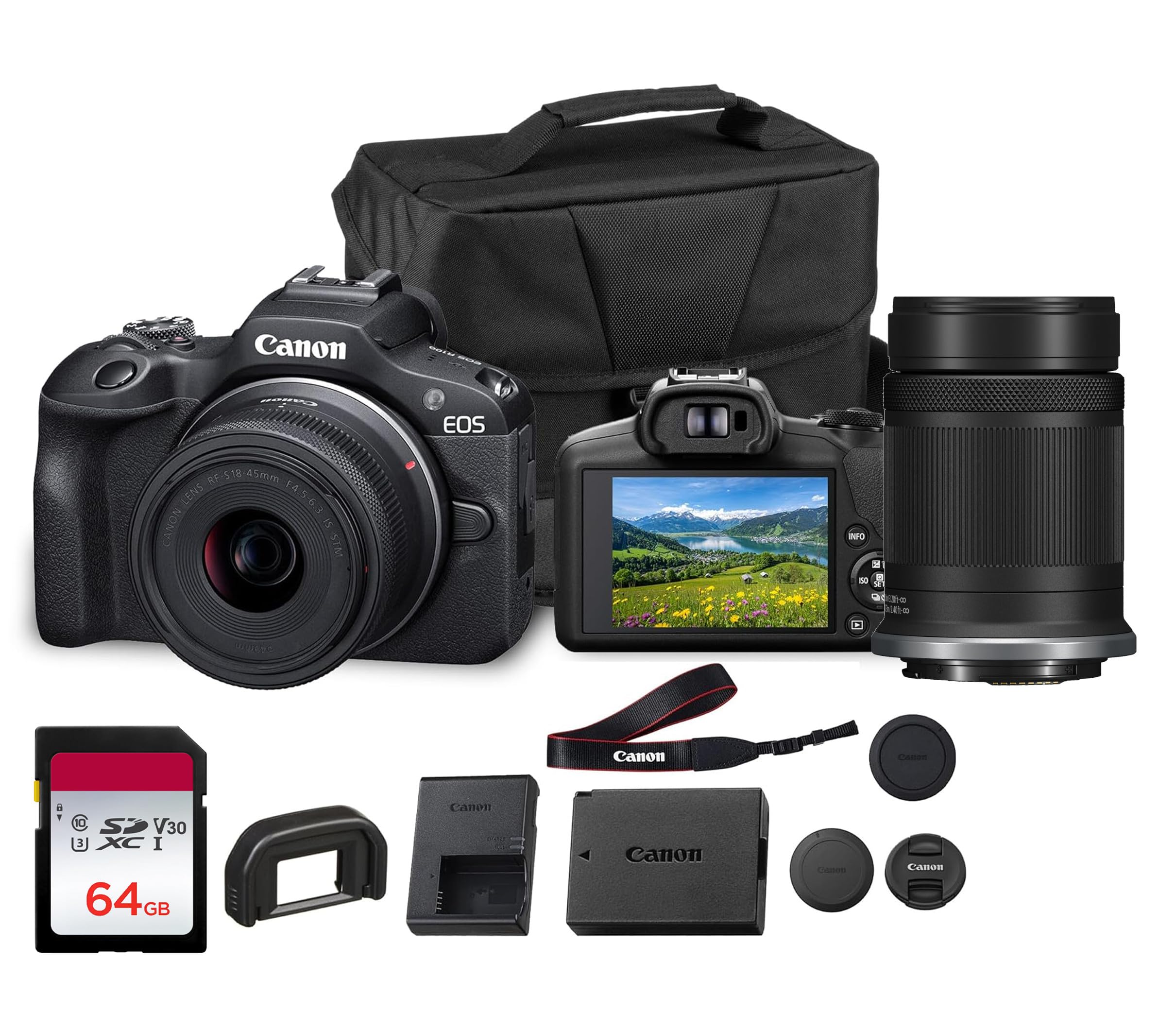
The Canon EOS R50 is a compact APS-C mirrorless camera designed for beginners entering hybrid shooting. Its 24.2MP sensor and DIGIC X processor deliver 4K 30fps video oversampled from 6K with Dual Pixel CMOS AF for reliable subject tracking. The kit bundle includes both an 18-45mm standard zoom and a 55-210mm telephoto zoom, covering a wide range of focal lengths without additional investment in glass.
The body is lightweight and easy to handle with one hand, and the flip-out touchscreen supports selfie-style composition and intuitive touch-to-focus during video. Built-in Wi-Fi and Bluetooth enable wireless image transfer and remote camera control via a smartphone, which is useful for solo creators managing their own shots. The bundle also includes a shoulder bag and 64GB memory card, providing immediate readiness for production.
The RF mount is compatible with Canon’s growing lens lineup, though native RF-S lenses remain limited compared to the extensive EF system (with adapter). The lack of in-body stabilization means smooth handheld footage requires stabilized RF lenses or a gimbal. The autofocus is reliable for vlogging and casual narrative work, but it lacks the fine-grained control and customization options found on higher-tier cinema cameras. For beginners building their first filmmaking kit, the R50 twin-lens bundle offers exceptional value and ease of use.
Why it’s great
- Two-lens kit covers wide to telephoto range without extra spending
- DIGIC X processor and Dual Pixel CMOS AF deliver reliable autofocus
- Compact, lightweight body with flip-out touchscreen and wireless connectivity
Good to know
- No in-body stabilization; handheld shots need stabilized lenses or gimbal
- RF-S lens ecosystem is still limited compared to adapted EF lenses
13. Sony ZV-1
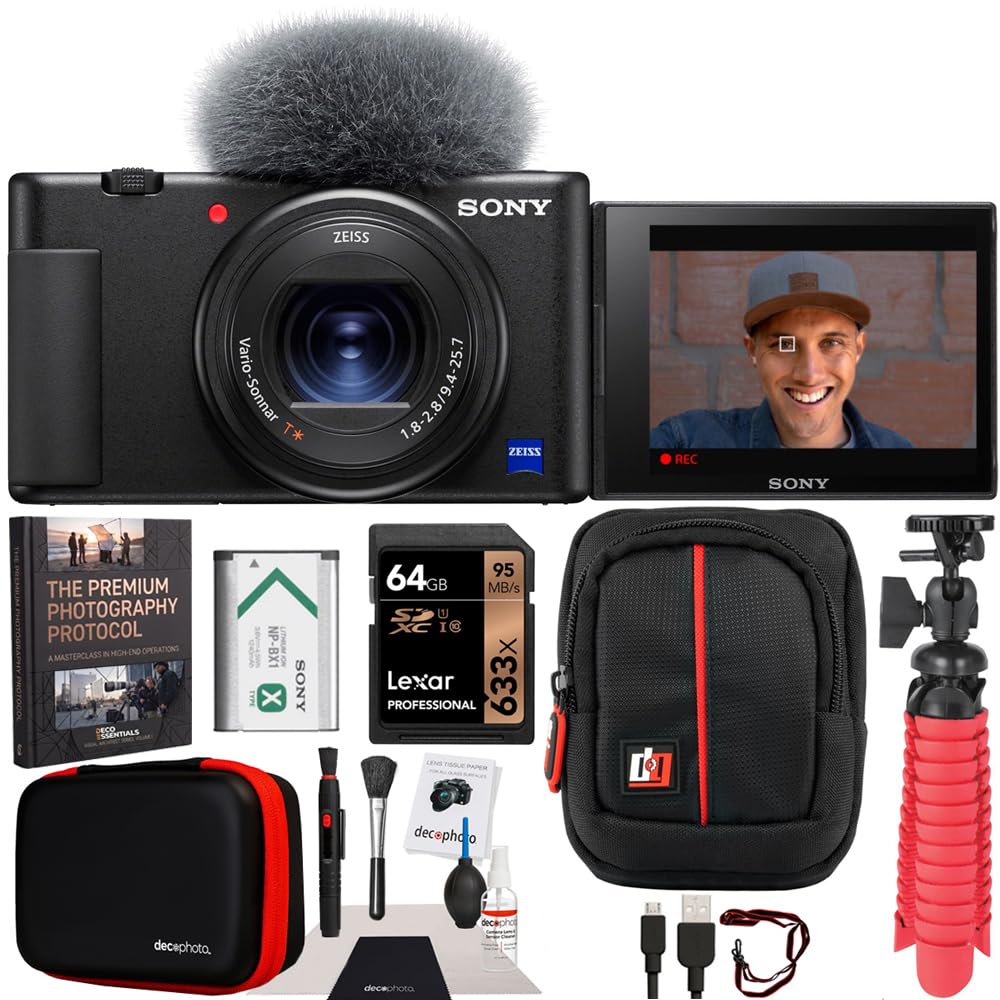
The Sony ZV-1 is a compact 1-inch sensor camera purpose-built for vloggers and content creators who need cinematic features in a pocketable device. The 20.1MP stacked Exmor RS sensor with a Zeiss Vario-Sonnar T* 24-70mm f/1.8-2.8 lens delivers sharp 4K footage with natural background blur using the dedicated Bokeh Switch. The directional 3-capsule microphone with windscreen captures clean audio, reducing the need for an external mic in quiet environments.
The side flip-out touchscreen stays visible when using an external microphone in the MI shoe, and the Product Showcase Setting shifts focus smoothly between face and handheld objects. Image stabilization suppresses walking shake effectively, and the Face-priority AE adjusts exposure when moving between bright and shaded areas. The bundled kit includes a 64GB memory card, tripod grip, and carrying case, making it production-ready out of the box.
The 1-inch sensor cannot match the dynamic range and low-light performance of APS-C or full-frame cameras, and the fixed 24-70mm equivalent lens limits compositional flexibility. Battery life is around 2 hours at 120fps and less when recording 4K, so spare batteries are essential for extended shoots. For filmmakers who prioritize portability and ease of use for vlogging, product reviews, or travel documentation, the ZV-1 delivers impressive cinematic quality in a truly pocketable form.
Why it’s great
- Compact 1-inch sensor with fast f/1.8-2.8 Zeiss zoom in a pocket size
- Dedicated Bokeh Switch, Product Showcase Setting, and directional mic
- Image stabilization and Face-priority AE for smooth vlogging footage
Good to know
- Small sensor limits dynamic range and low-light quality compared to larger formats
- Fixed zoom lens restricts compositional flexibility
FAQ
Is full-frame always better than Super 35 for cinematography?
What makes a camera a cinema camera rather than a stills camera with video?
Do I need a gimbal for every cinema camera?
How important is dual card slot recording for filmmaking?
Final Thoughts: The Verdict
For most filmmakers, the best camera for cinematography winner is the Sony FX30 because it delivers professional S-Cinetone color, 6K oversampled 4K, and active cooling in a compact body at a price that undercuts most true cinema cameras. If you need the grading flexibility of REDCODE RAW with professional audio, grab the Nikon RED Z Cinema. And for run-and-gun filmmakers who want built-in ND filters without sacrificing dynamic range, nothing beats the Blackmagic 6K Pro.

Mo Maruf
I created WellFizz to bridge the gap between vague wellness advice and actionable solutions. My mission is simple: to decode the research and give you practical tools you can actually use.
Beyond the data, I am a passionate traveler. I believe that stepping away from the screen to explore new environments is essential for mental clarity and physical vitality.