Our readers keep the lights on and my smoothie glass nicely filled. As an Amazon Associate, I earn from qualifying purchases.
Nothing tests your patience quite like a glob of plastic trim or a plastic bracket that refuses to stick to a concrete wall. The porous, alkaline surface of concrete and the slick, low-surface-energy nature of plastic form one of the most frustrating material pairs in home repair. Standard white glues or all-purpose adhesives almost always fail here, leaving you with a sticky mess and a part that falls off the moment you look away.
I’m Mohammad Maruf — the founder and writer behind WellFizz. I’ve spent countless hours digging into polymer chemistry, tensile strength charts, and real-world user experiences to find the adhesives that actually solve this specific bonding problem.
Whether you’re fixing a cracked sprinkler base, mounting a plastic junction box on a basement wall, or attaching a PVC trim board to a foundation, you need an adhesive engineered to bridge the gap between two chemically different surfaces. After thorough analysis, this guide to the best adhesive for plastic to concrete cuts through the marketing to reveal products that deliver durable, load-bearing bonds.
How To Choose The Best Adhesive For Plastic To Concrete
Bonding plastic to concrete is a challenge because the two materials have fundamentally different surface energies. Concrete is porous and alkaline, while common plastics like polypropylene, PVC, and ABS are smooth and chemically inert. An adhesive must physically key into the concrete’s pores while chemically gripping the plastic. Choosing the wrong type means a bond that fails under the first load or temperature swing.
Adhesive Chemistry: Epoxy vs. Construction Adhesive vs. Acrylic Fortifier
Two-part epoxies like J-B Weld create a hard, load-bearing fill that is machineable and resistant to heat and chemicals. Their ability to bridge gaps and fill imperfections on both surfaces makes them ideal for structural repairs. Construction adhesives like Loctite or Gorilla offer flexible bonds that handle vibration and thermal expansion, but their grip on smooth plastic is less aggressive and requires a perfectly clean, sometimes roughened, surface. Acrylic fortifiers like SikaLatex are designed specifically for cementitious bonding: they are mixed into mortar or used as a primer to create a chemical and mechanical lock between concrete and a plastic or tile overlay.
Mechanical Keying and Surface Preparation
No adhesive can overcome an unprepared surface. Concrete must be free of dust, oils, and laitance — a wire brush or an acid etch is often necessary. Plastic must be scuffed with sandpaper (80–120 grit) to create micro-grooves for the adhesive to flow into. For non-porous plastics like polyethylene or polypropylene, a specialized primer may be required before applying any adhesive. Skipping these steps ensures failure, regardless of the product’s claimed strength.
Cure Time and Environmental Resistance
Read the full cure time, not just the set time. Many adhesives claim a 24-hour cure, but a four-hour window of vulnerability means the joint can creep or separate under stress. Temperature is critical: some construction adhesives remain tacky below 40°F, while epoxies cure more slowly in cold weather. For outdoor or wet applications, look for waterproof, freeze-thaw resistant adhesives that can handle the expansion and contraction of both materials across seasonal temperature swings.
Quick Comparison
On smaller screens, swipe sideways to see the full table.
| Model | Category | Best For | Key Spec | Amazon |
|---|---|---|---|---|
| J-B Weld 8281 | Epoxy | Structural repairs with high load | Tensile Strength: 5020 PSI | Amazon |
| Loctite Power Grab Ultimate | Construction Adhesive | Invisible bonding, finishing work | Temp Range: 0°F – 140°F | Amazon |
| Gorilla Max Strength | Construction Adhesive | Gap-filling and waterproof repairs | Waterproof, 2x stronger than Heavy Duty formula | Amazon |
| Sika SikaLatex R | Acrylic Fortifier | Bonding plastic overlays to concrete slabs | Bond Strength: 500 PSI | Amazon |
| 3M Hi-Strength 94 ET | Spray Adhesive | Large surface laminations, insulation | Open Time: Up to 60 minutes | Amazon |
In‑Depth Reviews
1. J-B Weld 8281 Professional Size Steel Reinforced Epoxy

J-B Weld Original is the gold standard for when a plastic-to-concrete bond must bear real weight. With a tensile strength of 5020 PSI, this two-part epoxy cures into a dark grey material that is steel-reinforced and machineable. It handles temperatures up to 550°F, making it suitable for repairs near engines, outdoor pipes, or any environment where heat and cold cycle aggressively. The 1:1 mix ratio produces a paste that fills gaps on both concrete’s irregular surface and plastic’s smooth face, creating a true mechanical interlock as it hardens.
User reports confirm its reliability on slippery plastic surfaces: one reviewer successfully repaired a rain barrel valve on brown plastic bonded to a galvanized pipe, while another fixed a broken concrete frog statue with no subsequent failure. The full cure takes 15 to 24 hours, and during that window the bond must remain undisturbed. The epoxy is messy to mix and requires clamps or tape to hold the parts in place. It’s also worth noting that some users have reported up to a third of the tube volume being air, which reduces the usable product.
For structural repairs where failure isn’t an option — securing a plastic mounting plate to a garage floor, reattaching a broken plastic handle to a concrete tool — this epoxy outperforms every single-component adhesive. It can be drilled, tapped, filed, and sanded once cured, allowing you to finish the repair flush with the surrounding surface. This is your pick if the bond must be permanent and load-bearing from the moment it’s cured.
Why it’s great
- Extremely high tensile strength (5020 PSI) for heavy-duty loads.
- Withstands high heat and chemical exposure, including petroleum.
- Cured material can be drilled, tapped, and sanded for finishing.
Good to know
- Requires precise 1:1 mixing and is messy to apply.
- Full cure takes 15-24 hours; bond is vulnerable during that period.
- Some tubes contain significant air gaps, reducing actual volume.
2. Loctite Power Grab Ultimate Crystal Clear Construction Adhesive
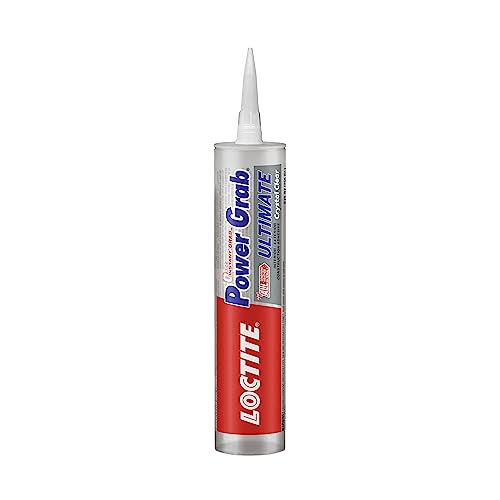
When the bond must be invisible, Loctite’s Power Grab Ultimate Crystal Clear is the clear choice. This single-component construction adhesive dries to a completely transparent finish that disappears on clear plastics, white trim, or finished surfaces. It is formulated to bond materials like wood, MDF, tile, and plastic to concrete, and it works on wet surfaces — a rare and useful trait for basement or exterior work. The manufacturer states it remains effective from 0°F to 140°F, handling the freeze-thaw cycles that often break weaker adhesives.
User feedback highlights its effectiveness in finish work: one customer used it to install decorative ceiling tiles, while another applied it to a stainless steel backsplash, noting the adhesive dries to a rubbery consistency that passed a five-pound load test. The quick initial tack reduces the need for bracing, though the 24-hour full cure time remains. The formula shows no shrinkage, which prevents visible dimples or gaps in the glue line. One reviewer reported that in sub-freezing outdoor conditions, the bond remained tacky even after 24 hours with supplementary heat, contradicting the cold-weather claims.
This adhesive excels where aesthetics matter — bonding clear plastic brackets to concrete walls, attaching plastic trim around a concrete pillar, or mounting plastic panels where the glue line will be visible. It requires a caulking gun for application, and the tip must be capped to prevent hardening inside the cartridge. For projects where strength is secondary to a clean, invisible finish on slightly porous plastics and concrete, this is the top contender.
Why it’s great
- Dries completely clear with no shrinkage, perfect for visible repairs.
- Works on damp surfaces and has a wide temperature tolerance.
- Quick initial tack reduces the need for bracing or nailing.
Good to know
- Requires a caulking gun; tip can harden if not sealed.
- Below-freezing weather slows cure significantly; not reliable in cold.
- Dries to a rubbery consistency rather than a hard solid.
3. Gorilla Max Strength Construction Adhesive Clear
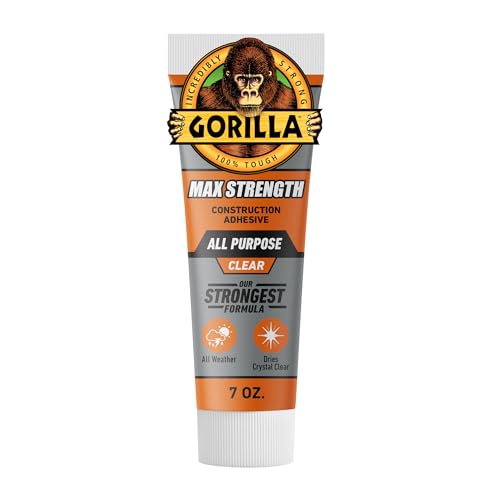
Gorilla’s Max Strength Construction Adhesive claims to be twice as strong as its own Heavy Duty formula, a statement backed by its dense, paste-like consistency that excels at gap-filling. The clear formula leaves a discreet finish, making it suitable for repairs where a visible glue line is undesirable. It bonds an advertised range of materials including fiberglass, foam, glass, stone, wood, and plastic to concrete, and it is explicitly waterproof — even suggested for underwater applications. The squeeze tube format allows controlled dispensing without a caulking gun.
Real-world users confirm its aggressive tack and quick grab: one reviewer described it as bonding in 30 seconds with a five-minute repositioning window, which is generous for such a strong adhesive. Another user reported that it held magnets inside a car armrest despite interior heat, and sealed a wood cover for an AC unit, providing waterproofing. The 24-hour full cure is a standard requirement, and clamping is essential during the early hours to prevent the bond from sliding on vertical surfaces. The adhesive is extremely sticky and hard to remove from skin, so gloves are a must.
This adhesive is the right choice when your plastic part has irregular contours that need gap-filling, or when the joint will be exposed to moisture. The clear finish on non-porous plastics like PVC trim or acrylic sheets bonded to concrete steps or foundations will hold securely. It is not a structural-grade epoxy, but for general household and light outdoor repairs where flexibility and waterproofing matter more than extreme tensile strength, the Gorilla delivers a reliable, easy-to-apply bond.
Why it’s great
- Very fast initial tack with a 5-minute repositioning window.
- Waterproof and suitable for outdoor and submerged applications.
- Squeeze tube enables precise, controlled application without extra tools.
Good to know
- Full 24-hour cure time; clamping required to prevent sliding.
- Hard to remove from skin; gloves are essential during application.
- Dries to a shiny, hard-rubber finish, which may be visible on matte surfaces.
4. SIKA SikaLatex R Concrete Adhesive Glue

SikaLatex R is not a typical construction adhesive or epoxy — it is an acrylic-polymer latex designed as an admix for Portland-cement mortar or as a bonding primer for concrete. When applied as a grout or coating, it creates a chemical bond between the concrete substrate and a top layer of cementitious material, achieving 500 PSI bond strength. This makes it a unique solution for bonding plastic overlays or tiles to concrete slabs, especially in environments subject to freeze-thaw cycles. It comes in a one-gallon pail and does not require dilution, simplifying preparation.
User reports confirm its long-term durability: one buyer used it to mix with concrete and replace bricks in steps, and the repair held for years until a full renovation. Another applied it to a concrete pillar, brushed on the adhesive, then topped it with a rock patch, leaving the pillar looking like new. The product has a shelf life of approximately one year, so checking the expiration date on the pail is important before starting a large project. It won’t produce a vapor barrier, which is a critical advantage for concrete applications where moisture vapor transmission must remain unrestricted.
SikaLatex R is the best option when you are working on a large concrete surface — a floor, step, or wall — and need to embed or tile plastic elements like drainage grates, junction box covers, or PVC pipe penetrations. It bridges the material gap at the chemical level rather than just the surface level. The 30-day full cure time is exceptionally long compared to other adhesives, but for concrete work, this is a standard timeline as the cement itself must hydrate and cure. If your project involves fresh concrete or mortar, this is the correct tool for the job.
Why it’s great
- Creates a true chemical bond with concrete, not just surface adhesion.
- Resists freeze-thaw damage, ideal for exterior concrete repairs.
- Does not create a vapor barrier, crucial for concrete breathability.
Good to know
- Full cure takes 30 days, far longer than other adhesives.
- Requires mixing with cement mortar or concrete, not a direct glue.
- One-year shelf life; expiration date must be verified before use.
5. 3M Hi-Strength 94 ET Spray Adhesive Glue
3M Hi-Strength 94 ET is an industrial-grade spray adhesive that is designed for large-surface laminations, particularly for bonding materials like plastic foam, rubber, carpet, metal, and wood to a variety of substrates including concrete. Its defining feature is a long open time of up to 60 minutes, which allows you to position and reposition the plastic component before the bond becomes permanent. This is a massive advantage for complex assemblies or when aligning large plastic sheets or panels onto a concrete floor or wall.
Users have confirmed its aggressive tack even in cold temperatures: one reviewer used it to stick foam soundproofing to plastic within a hunting blind, reporting the bond held in freezing conditions. Another described it as a spray contact cement for foam cushions and reupholstery, noting that one can lasts approximately 18 months. The product is GREENGUARD certified, contributes to LEED credits, and has low VOC content, making it more suitable for indoor applications than traditional solvent-based spray adhesives. The smell is still noticeable and described as similar to airplane glue, so ventilation and a respirator are recommended.
This spray adhesive is ideal for thin plastic sheets, foam insulation boards, or carpet and rubber mats being bonded directly to a concrete surface. It is not designed for high-load structural repairs or bonding thick, rigid plastic parts to concrete — for those applications, the J-B Weld or construction adhesives are better choices. But for covering large areas with plastic-backed materials, 3M 94 ET saves time and effort. The 24-hour full cure time is standard, and the 60-minute open window gives you the flexibility to align and adjust without rushing.
Why it’s great
- Exceptionally long open time (60 min) allows for precise positioning.
- Low VOC and GREENGUARD certified, better for indoor air quality.
- Holds well even in cold temperatures and on smooth plastic surfaces.
Good to know
- Requires proper ventilation and mask due to strong odor.
- Not for heavy structural loads; best for sheet goods and laminations.
- Must test readiness by touching adhesive — can be tricky to gauge.
FAQ
Can I use standard super glue to bond plastic to concrete?
Do I need to sand the plastic before applying adhesive?
How do I prepare concrete for a strong bond with plastic?
What temperature range is safe for applying these adhesives?
Final Thoughts: The Verdict
For most users, the best adhesive for plastic to concrete winner is the J-B Weld 8281 because its 5020 PSI tensile strength and heat resistance make it the right choice for both structural repairs and general bonding. If you need an invisible finish for a visible repair, grab the Loctite Power Grab Ultimate Crystal Clear. And for large surface laminations of plastic sheets or foam to concrete floors, nothing beats the repositionable 60-minute open time of the 3M Hi-Strength 94 ET Spray Adhesive.

Mo Maruf
I created WellFizz to bridge the gap between vague wellness advice and actionable solutions. My mission is simple: to decode the research and give you practical tools you can actually use.
Beyond the data, I am a passionate traveler. I believe that stepping away from the screen to explore new environments is essential for mental clarity and physical vitality.