Our readers keep the lights on and my smoothie glass nicely filled. As an Amazon Associate, I earn from qualifying purchases.
PETG’s notorious adhesion personality — either it welds itself to the build plate or curls up at the edges — makes choosing the right surface critical. A textured PEI sheet offers the grip you need, but the wrong pick can bond so aggressively that you risk chipping the print or damaging the coating.
I’m Mohammad Maruf — the founder and writer behind WellFizz. I’ve spent hundreds of hours analyzing build plate chemistries, customer failure reports, and adhesion science to pinpoint which surfaces genuinely tame PETG without requiring glue stick bandaids.
The consensus among experienced makers is that the best build plate for petg balances aggressive hot adhesion with a clean cold release, and the options below deliver exactly that.
How To Choose The Best Build Plate For PETG
PETG adheres aggressively when hot and contracts as it cools — a combination that demands a build plate surface with a specific release window. The wrong surface either holds so tight that the print fuses to the coating or releases too early, causing warping. Understanding the interaction between surface texture, bed temperature, and the material’s glass transition point is the difference between a perfect first layer and a ruined sheet.
Surface Material: PEI vs Garolite vs Polymer Coatings
Textured PEI provides a mechanical grip that holds PETG firmly during printing, and its spring steel base allows a satisfying flex when the bed cools below 35°C. Garolite G10 — a fiberglass-epoxy composite — offers a glass-like smooth finish and releases PETG automatically upon cooling without any bending. Newer polymer-coated plates like BIQU’s CryoGrip use a multi-layer coating that achieves strong adhesion at lower bed temperatures, saving energy and reducing wait times. Each material has a distinct release signature; PEI demands a temperature drop, Garolite relies on thermal contraction, and polymer plates often require a brief cool-down before flexing.
Bed Temperature Window
PETG prints ideally between 70°C and 85°C on the bed. Surfaces that recommend 60°C for PETG will often lack sufficient grip for large parts, while running a PEI plate at 85°C can bond the print so tenaciously that the coating delaminates during removal. Look for a plate that specifies a PETG temperature range — a well-designed plate will hold firmly at 70-75°C and release completely once the bed drops below 40°C.
Release Mechanism
Some plates rely entirely on the shrinkage of the print as it cools — cool to room temperature and the print pops off by itself. Others require a deliberate flex of the spring steel to break the bond. The best build plates for PETG use a combination: strong thermal adhesion while hot and a clear release threshold when cold. Plates that force you to use a scraper risk scratching the surface; plates that release too early risk warped corners during the print.
Quick Comparison
On smaller screens, swipe sideways to see the full table.
| Model | Category | Best For | Key Spec | Amazon |
|---|---|---|---|---|
| BIQU CryoGrip Pro Glacier (Bambu) | Polymer Coated | Low-temp PETG printing | 60-75°C bed temp range | Amazon |
| BIQU CryoGrip Pro Glacier (Prusa) | Polymer Coated | Energy-saving PETG workflow | 7-layer cobalt oxide coating | Amazon |
| Garolite G10 Plate | Fiberglass Composite | Glass-smooth PETG bottom finish | 2mm thickness, semi-flexible | Amazon |
| FLASHFORGE PEI Powder-Coated | Textured PEI | Tool-free PETG removal | Double-sided powder-coated PEI | Amazon |
| Sovol SV06 Plus PEI Sheet | Textured PEI | Budget PETG adhesion | 80-85°C recommended bed temp | Amazon |
In‑Depth Reviews
1. BIQU CryoGrip Pro Glacier Panda (Bambu-Lab)

BIQU’s CryoGrip Pro Glacier redefines what a PETG build plate can do. Its proprietary 7-layer polymer coating achieves firm adhesion at bed temperatures as low as 60°C for PETG — saving energy and reducing wait time. Users report prints sticking securely even with the auxiliary fan running, eliminating the drafts that typically cause edge warping. The honeycomb handle stays cool enough to touch after printing, allowing immediate plate removal without waiting for the bed to cool down.
The double-sided fine textured spring steel sheet fits Bambu Lab X1C, P1S, P1P, A1, and X2D printers. Disabling “Build Plate Detection” on X2D and P2S is required, but the included AR code stickers simplify recognition on X1C. The surface cleans easily with soap and water or alcohol, and the self-recovering coating restores adhesion after simple wiping. This plate truly excels with PLA and PETG, and handles ABS and PA as well.
A few users note that the adhesion is so strong that stubborn parts may require a brief freezer session before flexing. Never use acetone on this surface — stick to warm water and dish soap to maintain the coating’s longevity. For makers printing large PETG parts who want to skip glue sticks and lower their bed temperature, this is the plate to beat.
Why it’s great
- Low-temp PETG printing saves energy
- No glue or release agent needed
- Cool-touch handle for immediate removal
Good to know
- Acetone will damage the coating
- Very stubborn prints may need freezer
- Only fits Bambu Lab printers
2. BIQU CryoGrip Pro Glacier (Prusa)
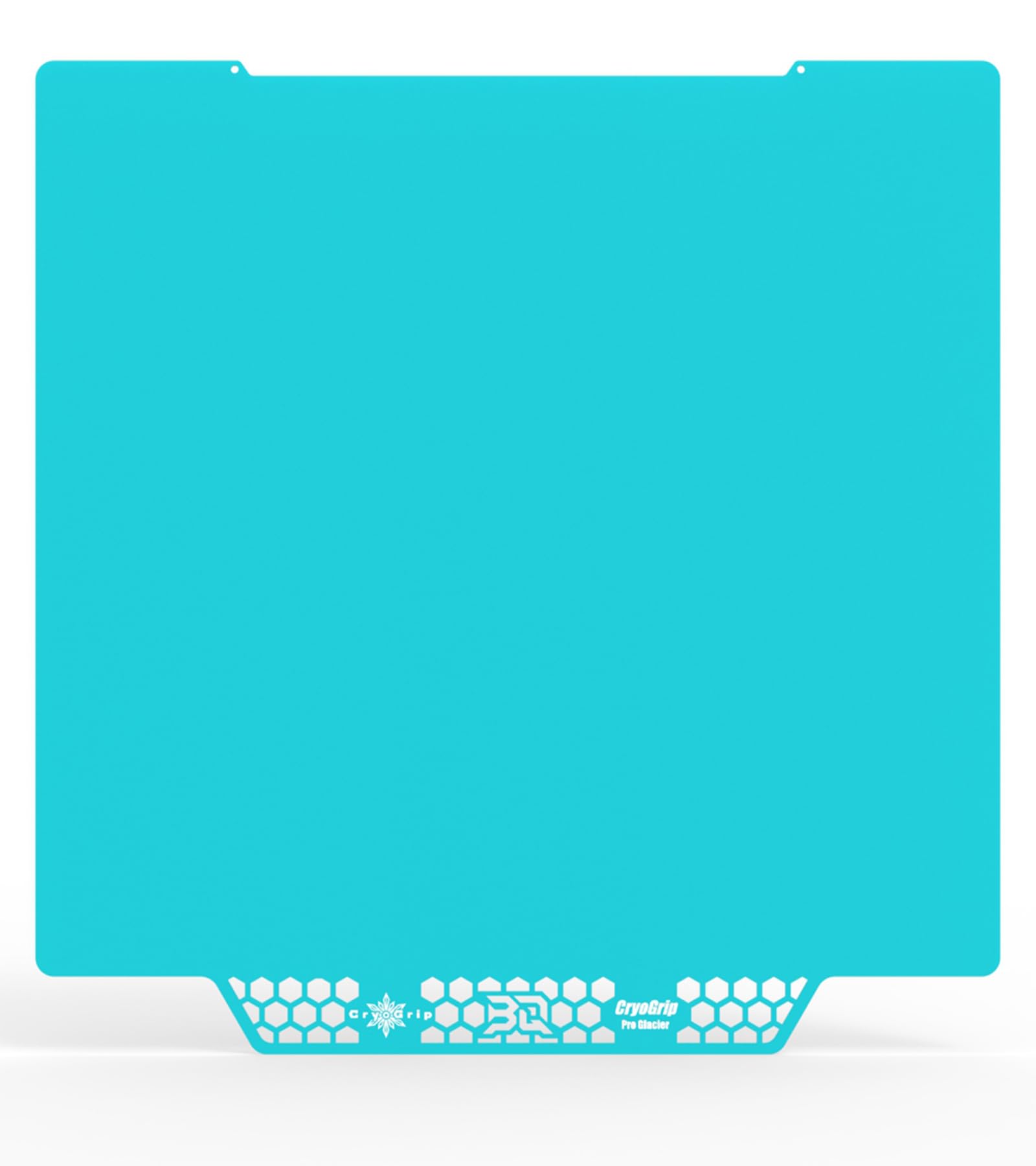
This Prusa-specific version of BIQU’s CryoGrip Pro Glacier delivers the same groundbreaking low-temperature performance. The 7-layer cobalt oxide coating provides impact and corrosion resistance, and users report successful PETG prints at bed temperatures 5-10°C lower than standard PEI plates. The textured surface sits between smooth and traditional PEI in finish, producing a subtle matte bottom that looks clean and uniform.
The hollow-out handle design stays cool enough to grab immediately after a print finishes, allowing rapid plate swaps without waiting for cooldown. This saves considerable time in a production workflow. Users who ran the plate 24/7 for two weeks reported no drop in adhesion and no ghosting from previous prints. The surface cleans with warm water and a gentle dish soap — never acetone — and the coating’s self-recovering nature makes maintenance minimal.
While the adhesion is phenomenal for PETG, PLA, and ABS, some users found that ABS still warped with an open chamber, so enclosure management remains important for high-temp materials. The plate fits Prusa MK4, MK4S, MK3, MK3S, CORE One, and CORE One+ without modification. For Prusa owners who print a lot of PETG, this is the definitive upgrade.
Why it’s great
- Works 5-10°C cooler than standard plates
- Cool-touch handle for immediate swapping
- Low maintenance with self-recovering coating
Good to know
- Not as grippy as Frostbite for PLA
- ABS warping still possible in open chamber
- Prusa-specific sizing only
3. Garolite G10 Build Surface Plate

Garolite G10 is the oddball that PETG lovers swear by. This 2mm thick fiberglass-epoxy composite offers a smooth, glass-like surface that yields a flawless bottom finish on PETG prints. The magic is in the thermal release: prints stick aggressively when the bed is hot (70-85°C for PETG) and pop off on their own once the bed cools to room temperature. No bending, no scraping, no glue — just clean thermal contraction.
The semi-flexible nature of G10 means it does not require a magnetic base; you secure it with binder clips or thermal tape. PETG and PLA adhere beautifully, while nylon is the primary use case. Users report that the plate demands perfect leveling and a precise z-offset — there is zero forgiveness for poor first-layer tuning. The smooth surface eliminates any texture on the print bottom, making it ideal for parts where aesthetics matter.
On the downside, the 2mm thickness acts as a heat sink, slowing bed heat-up and cool-down cycles. If the nozzle crashes into the bed during a failed print, the rigid G10 does not flex, which can trigger heat runaway or damage the hotend. Thin prints can also be difficult to remove since there is no flex to break the bond. Despite these quirks, for makers who prioritize a perfect PETG bottom surface, G10 remains a unique and highly effective option.
Why it’s great
- Glass-smooth PETG bottom finish
- Prints self-release when cool
- Works with high-temp materials like nylon
Good to know
- Requires perfect leveling and z-offset
- Slow heat-up due to thickness
- Thin prints are hard to remove
4. FLASHFORGE Adventurer 5M Double Sided PEI Platform

Flashforge’s double-sided PEI powder-coated platform is a direct OEM replacement for the Adventurer 5M, 5M Pro, and AD5X, but its performance with PETG makes it a worthy standalone mention. The textured PEI side creates a mechanical grip that holds PETG firmly at standard bed temperatures, while the smooth PEI side offers a glossy bottom finish. Users report that prints adhere without glue and release easily after cooling to room temperature and bending the flexible steel.
The platform heats up quickly and distributes temperature evenly across the 235x235mm surface. PETG users noted that the smooth PEI side provides slightly better adhesion than the textured side, and prints release with a satisfying pop after flexing. The steel spring base is robust — it maintains flatness after hundreds of flex cycles. The plate also includes a smooth PC platform option for advanced materials like ABS and ASA, though the PEI sides handle PETG perfectly.
Some users mentioned that using aftermarket glue on the plate ruined the coating, so sticking to a clean, glue-free PETG workflow is essential. The plate is a direct drop-in replacement and requires no modification. For Flashforge owners who print primarily PETG, this is the best OEM option available, and at this price point, buying a spare is a smart move.
Why it’s great
- OEM quality for Flashforge printers
- Excellent adhesion without glue
- Heats up fast and evenly
Good to know
- Aftermarket glue can ruin coating
- Only fits Flashforge Adventurer 5M series
- Textured side may need release agent for PETG
5. Sovol SV06 Plus PEI Flexible Steel Platform

Sovol’s PEI platform offers the largest print area in this roundup at 310x320mm, making it an ideal budget choice for large-format printers like the SV06 Plus, SV04, Ender-3 Max, and CR-10 series. The textured PEI surface provides solid adhesion for PETG at bed temperatures between 80-85°C. Users report that prints stick firmly during the job and release cleanly once the bed cools to room temperature with a gentle flex of the spring steel.
The magnetic bottom sheet with adhesive backing installs easily onto any flat heated bed. The maximum bed temperature rating is 130°C, so it handles PETG comfortably without risk. Some users note that PETG can bond too aggressively to the textured PEI surface — a light application of hairspray or glue stick as an interface layer prevents the print from fusing to the coating. PLA, on the other hand, releases with a satisfying click. The surface is coarser than typical stock plates, leaving a textured matte finish on the print bottom.
Documentation is sparse, so first-time users will need to research bed temperature and surface preparation. The plate is noticeably cheaper than branded options, but the PEI coating holds up well under regular use. For makers running large-format printers who need a cost-effective PETG surface, this plate delivers dependable performance without breaking the budget.
Why it’s great
- Large 310x320mm print area
- Strong magnetic hold
- Excellent adhesion for PLA and PETG
Good to know
- PETG may bond too strongly — use interface layer
- Sparse documentation included
- Heats slightly slower due to size
FAQ
Do I need glue stick for PETG on a textured PEI plate?
Will a Garolite G10 plate work with PETG without glue?
Can I use a CryoGrip plate at standard PETG bed temperatures?
Why does PETG sometimes ruin a PEI build plate?
How do I clean a build plate after printing PETG?
Final Thoughts: The Verdict
For most users, the best build plate for petg winner is the BIQU CryoGrip Pro Glacier (Bambu) because it delivers strong adhesion at lower bed temperatures, eliminates the need for glue, and offers a cool-touch handle for instant plate removal. If you want a glass-smooth bottom finish with zero surface texture, grab the Garolite G10 plate. And for a budget-friendly large-format option, nothing beats the Sovol SV06 Plus PEI Sheet for its massive print area and reliable grip.

Mo Maruf
I created WellFizz to bridge the gap between vague wellness advice and actionable solutions. My mission is simple: to decode the research and give you practical tools you can actually use.
Beyond the data, I am a passionate traveler. I believe that stepping away from the screen to explore new environments is essential for mental clarity and physical vitality.