Our readers keep the lights on and my smoothie glass nicely filled. As an Amazon Associate, I earn from qualifying purchases.
Building a budget sound system often feels like a compromise between cost and clarity, but the right components—whether a compact stereo with a CD player or a pair of passive bookshelf speakers—can prove that a limited budget doesn’t mean limited performance. Many buyers jump at the cheapest all-in-one box, only to find muddy mids and a lack of headroom, while others chase specs without understanding how a receiver’s power rating interacts with a speaker’s sensitivity.
I’m Mohammad Maruf — the founder and writer behind WellFizz. After countless hours sorting through specs, user reports, and real-world test results, I’ve narrowed down the field to the configurations that actually deliver on their promise without forcing you into upgrade fatigue.
Buying a budget sound system means walking a tightrope between price and performance, but the right pick rewards you with clear highs and controlled bass that rivals setups costing several times more. The best budget sound system balances thoughtful engineering with accessible pricing, and this guide breaks down exactly where that line falls.
How To Choose The Best Budget Sound System
When the wallet is tight, every dollar needs to pull audible weight. Knowing where to spend—and where to save—makes the difference between a system that fatigues after ten minutes and one that keeps you listening for years.
Passive vs. Active: The First Fork in the Road
Active (powered) speakers plug straight into a wall and are simple to set up. Passive speakers require an external amplifier but let you mix and match components over time. For strict budgets, passive pairs plus a small chip-amp often deliver superior stereo separation and upgrade paths compared to entry-level active monitors.
Sensitivity and Impedance
A speaker with 86dB sensitivity and 4-ohm impedance needs more current than an 89dB, 8-ohm speaker from the same amplifier. Mismatching these can starve the sound of dynamics or overheat a cheap receiver. Look for 6-to-8 ohm nominal impedance combined with at least 87dB sensitivity for solid volume without a powerful amp.
Woofer Size and Cabinet Volume
Physics still applies at any price. A 5.25-inch woofer in a ported cabinet will reach lower than a 4-inch sealed driver. But bigger cabinets eat desk or shelf space. Measure your room and surface area before choosing. For small rooms, a quality 4-inch long-throw woofer can still deliver satisfying bass without a subwoofer.
Quick Comparison
On smaller screens, swipe sideways to see the full table.
| Model | Category | Best For | Key Spec | Amazon |
|---|---|---|---|---|
| Micca RB42 | Passive | Nearfield listening | 4-inch long-throw woofer | Amazon |
| Sony CS Speakers | Passive | 3-way clarity | 5.12-inch woofer | Amazon |
| ULTIMEA Aura A40 | Soundbar | TV surround | 330W peak power | Amazon |
| Micca MB42X G2 | Passive | Budget hifi entry | 4-inch carbon fiber woofer | Amazon |
| MEVOSTO DS19 | Active | Desktop gaming | 5-inch woofer, 36W RMS | Amazon |
| Pyle Bookshelf Pair | Passive | Vintage receiver pairing | 6.5-inch woven glass fiber woofer | Amazon |
| Pyle PDA77BU Receiver | Amplifier | Karaoke/garage setups | 800W peak power | Amazon |
| Panasonic SC-PM270PP-K | Micro System | Kitchen/office | 10cm woofer, 20W RMS | Amazon |
| HANLIM HL-616 | Micro System | CD listeners | 2x 15W silk tweeter | Amazon |
In‑Depth Reviews
1. Micca RB42 Reference Bookshelf Speaker

The RB42 redefines what a compact bookshelf can do, packing a long-throw 4-inch woofer that produces bass weight and extension you would not expect from a box this small. The 10-element crossover with 18dB/octave slopes on both drivers keeps the tweeter and woofer in phase across a wide listening window, reducing lobing and creating a stable center image at close distances.
That bass authority comes with a catch: the RB42 is only 84dB sensitive and presents a 4-ohm nominal load, meaning it demands a quality 50-60W amplifier before it wakes up. Pair it with a budget chip-amp and the sound will be polite; feed it from a discrete stereo receiver and the dynamics open up dramatically. The silk dome tweeter remains smooth and never sibilant, even at higher volumes.
Finish quality is a standout for the price range. The dark walnut vinyl wrap is convincing, the magnetic grille snaps off cleanly, and the internal bracing reduces cabinet resonance noticeably compared to the MB42X G2. For nearfield listening in a small-to-medium room, these speakers punch far above their weight class and represent the highest ceiling for any passive speaker under .
Why it’s great
- Bass extension and weight defy the small cabinet size
- Premium 10-element crossover with steep slopes for excellent off-axis response
- Solid build with magnetic grille and minimal cabinet resonance
Good to know
- Requires at least 50W of clean power; weak amps will leave them starved
- Port noise can become audible when pushed hard with bass-heavy tracks
- 4-ohm load limits compatibility with some entry-level receivers
2. Sony CS Speakers, SS-CS5M2 3-Way Bookshelf Pair

The SS-CS5M2 brings a true 3-way driver topology to the budget segment, separating the woofer, dedicated midrange, and tweeter/super-tweeter array. This physical division lowers intermodulation distortion compared to a 2-way design, allowing vocals and lead instruments to retain clarity even when the bass line is busy. The frequency response stretches from 53Hz up to 50kHz, covering high-resolution audio content without losing composure.
They are rear-ported, so placement matters: you need at least six inches of breathing room behind the cabinet to avoid bass bloat. Sensitivity sits around 87dB with a 6-ohm impedance, making them a friendlier match for mid-range receivers than the 4-ohm RB42. The reinforced cellular cone woofer stays rigid during dynamic peaks, though the bass is tight rather than thunderous—adding a subwoofer transforms them into a genuinely capable full-range setup.
Mids and highs are where these Sony speakers excel. The super-tweeter widens the soundstage noticeably, creating an airy top end that reveals details in cymbal decays and room ambience. They can sound slightly bright on poorly recorded tracks, but for jazz, acoustic, and classical material the resolution is exceptional for the money. A compelling choice if you plan to build a 2.1 system over time.
Why it’s great
- True 3-way driver array minimizes distortion and separates instruments cleanly
- Super-tweeter produces an expansive, airy soundstage
- Easier to drive (6 ohms, 87dB) than many budget competitors
Good to know
- Rear port requires clearance behind the speaker for proper bass response
- Bass is detailed but lacks weight without a subwoofer
- Can sound bright with aggressive recordings or thin electronics
3. ULTIMEA 7.1ch Sound Bar Aura A40

For buyers who prioritize cinematic immersion over stereo purity, the Aura A40 delivers a 7.1-channel virtual surround experience using a soundbar, a wired subwoofer, and four satellite speakers. Two front satellites connect via cables to the main bar, while the rear pair connect wirelessly to the output of the rear right speaker, reducing floor clutter. The SurroundX processing claims 99.99% detail accuracy and does a convincing job of panning effects across the room.
The companion Ultimea Home app unlocks a 10-band equalizer plus 121 preset matrices covering Bass, Pop, Classical, and Rock profiles. This level of DSP control is rare at this price tier and lets you dial out the boxy midrange that plagues many entry-level soundbars. BassMX technology pushes the wired subwoofer to produce rumble that fills a small-to-medium living room without rattling the cabinets.
Dialogue clarity is a strong point thanks to the three dedicated main channels. The system lacks Dolby Atmos height virtualization, so overhead effects are minimal, but horizontal panning is smooth and coherent. Occasional Bluetooth dropouts have been reported after extended use, though the optical input bypasses the wireless stage entirely. Great for TV and gaming in spaces where a full AVR setup is impractical.
Why it’s great
- Four dedicated satellite speakers create genuine surround immersion
- App-based 10-band EQ and 121 preset matrices provide deep tuning control
- Dialogue is clear and centered with three dedicated main channels
Good to know
- No Dolby Atmos height virtualization for overhead effects
- Wireless rear speakers require power outlets at each location
- Intermittent Bluetooth cutouts reported after long listening sessions
4. Micca MB42X G2 Passive Bookshelf Speakers

The MB42X G2 is a carefully measured evolution of an already respected budget speaker. The biggest changes are a switch to a 4-inch carbon fiber woofer with a rubber surround and a redesigned crossover that tames the slightly forward upper midrange of the original. The result is a more neutral, less fatiguing listen that maintains the original’s surprising detail retrieval for the price.
At 86dB sensitivity with a nominal 4-8 ohm impedance, these speakers pair well with small chip-amps or entry-level stereo receivers. The 0.75-inch silk dome tweeter is the same class as the RB42 but with a simpler 12dB/octave crossover, so off-axis performance is slightly narrower. Still, within a 15-degree window the imaging is stable and the soundstage feels appropriately wide for desktop or small-room use.
Bass extension is decent for the size—55Hz according to the spec sheet—but the ported cabinet produces a gentle roll-off below 80Hz rather than a sharp cutoff. For casual music listening and TV dialogue, the MB42X G2 is a legitimate entry point into passive audio. Just budget for speaker wire and a separate amplifier, and consider a subwoofer later if your taste leans toward deep low-end.
Why it’s great
- Refined tonal balance is less fatiguing than the original MB42X
- Carbon fiber woofer remains tight and controlled at moderate volumes
- Excellent value as the lowest-cost passive entry point
Good to know
- Requires at least 50 hours of break-in for the woofer to loosen up
- Bass is lean without a subwoofer; best as part of a 2.1 system
- Off-axis performance is limited by the simpler crossover design
5. MEVOSTO DS19 Active Bookshelf Speakers

The MEVOSTO DS19 is a powered bookshelf system that cuts out the need for a separate amplifier, making it a clean solution for desktop and small-room setups. Each speaker houses a 5-inch woofer and a 1-inch silk dome tweeter, fed by 36W RMS of internal amplification. The analog bass and treble knobs on the front let you adjust the voicing without entering a menu—a simple and satisfying tactile experience.
Bluetooth 5.4 connection is fast and stable, but the real standout is the USB digital input, which bypasses the Bluetooth codec and delivers lossless audio with zero perceptible latency. This is especially useful for gamers who need sound effects to align perfectly with on-screen action. The remote control adds convenience for volume and input switching from across the room.
The wood-veneer cabinet looks more expensive than it is and provides some acoustic damping. Bass is punchy for a 5-inch driver, though it starts to distort if pushed near maximum volume. Keeping the volume dial around 70-80% keeps the sound clean and detailed. For a straightforward desktop or turntable setup, the DS19 offers strong value with minimal complexity.
Why it’s great
- USB digital input provides zero-latency, lossless audio from a PC
- Front-panel bass and treble knobs allow instant tonal adjustment
- Bluetooth 5.4 pairs instantly and maintains a solid connection
Good to know
- Bass distorts if the volume is pushed past 80% on low-frequency tracks
- No HDMI input; optical or USB required for TV connection
- Bluetooth introduces a slight audio delay; best to use USB for gaming
6. Pyle 6.5″ Home Audio Bookshelf Speakers Pair
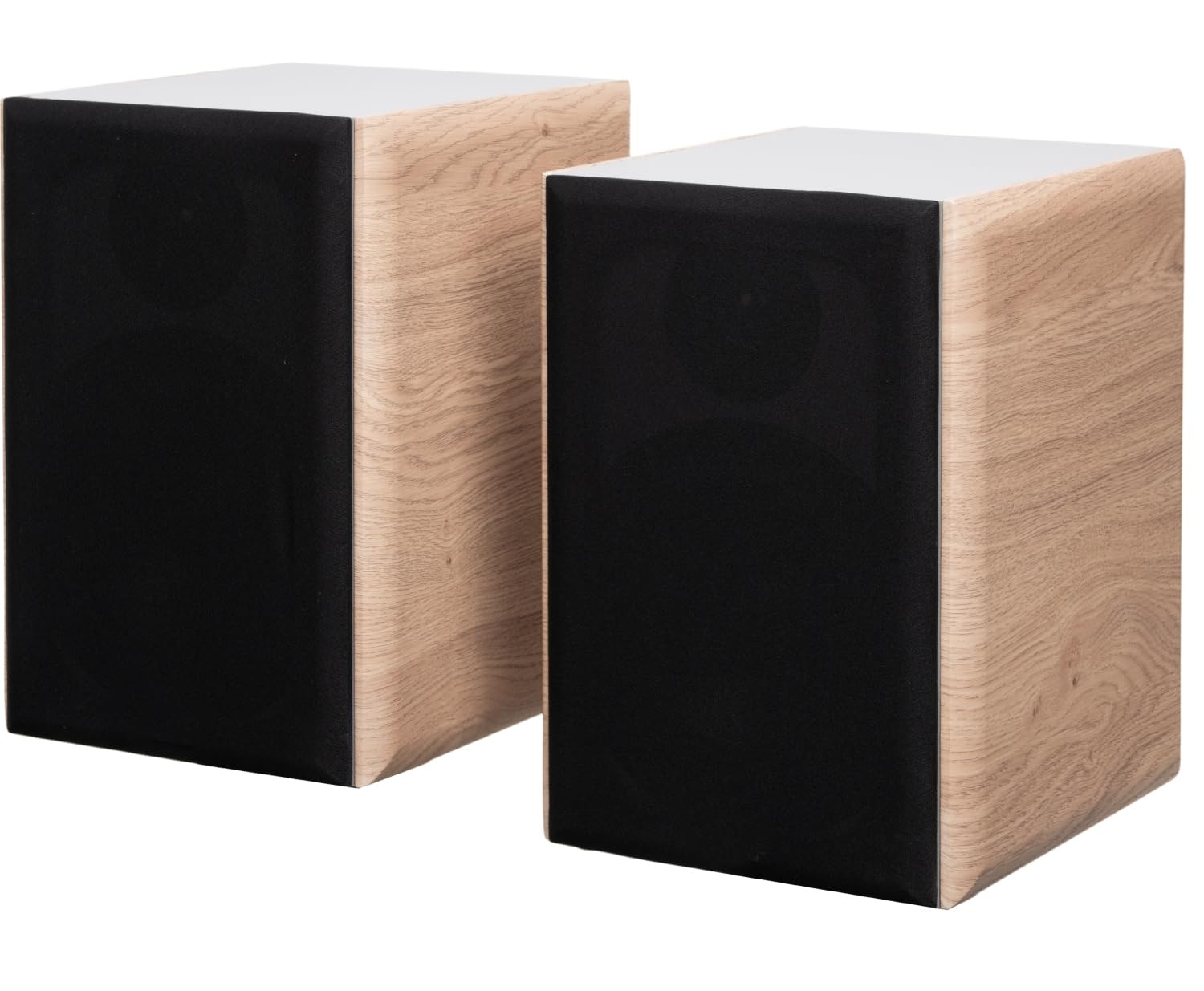
The Pyle 6.5-inch bookshelf pair brings a surprisingly large woofer to the budget passive market. The 6.5-inch woven glass fiber cone moves enough air to produce bass that smaller speakers can only imitate, with a 12dB crossover at 3kHz splitting duties to a 0.75-inch silk dome tweeter. The result is a warm, full-bodied presentation that suits classic rock, jazz, and spoken-word content.
Construction uses 12mm MDF with a wood-grain vinyl wrap that looks clean on a shelf or stand. Gold-plated 5-way binding posts accept banana plugs, spades, or bare wire, which simplifies hookup. Sensitivity is on the lower end—claiming 50W RMS per speaker—so a decent amp with at least 40-50W per channel is recommended to bring out the dynamics. Mated with a vintage Kenwood or Pioneer receiver, the sound is distinctly satisfying for the cost.
Bass is punchy but not subwoofer-tight; the rubber surround helps control the woofer’s excursion, but the ported cabinet can sound a bit boomy in corners. For smaller rooms—12×12 feet or less—they fill the space without strain. These are a solid choice if you want big-driver authority without the big-driver price tag and already have an amplifier in your chain.
Why it’s great
- 6.5-inch woofer delivers genuine bass weight for the price
- Gold-plated binding posts accept banana plugs for easy connection
- Includes wall-mount brackets and magnetic grilles
Good to know
- Needs at least 40-50W per channel to sound dynamic and open
- Bass can become boomy in untreated rooms or near corners
- Build quality is decent but not as refined as Micca or Sony options
7. Pyle Home Stereo Receiver PDA77BU

The Pyle PDA77BU is not a speaker; it is the control center for a DIY budget sound system. This 4-channel amplifier claims 800W peak power and includes Bluetooth 5.0, FM radio, USB/SD media playback, and two 1/4-inch microphone inputs with independent reverb controls. At this price point, it is an exceptionally flexible box for garage, party, or karaoke setups.
Power delivery is clean at moderate volumes—enough to drive a pair of 6-ohm bookshelf speakers to satisfying levels for a medium room. The digital LED display is basic but functional, and the included remote covers volume, input, and EQ presets. The dual mic inputs with reverb make this a natural fit for anyone hosting open-mic nights or family singalongs.
Bluetooth reconnection can be inconsistent with some TVs, occasionally requiring a manual re-pair. The amplifier’s fan is audible in quiet listening sessions, so it is best placed in a cabinet or away from the listening position. If you plan to build a flexible system from scratch and need a hub that does everything, the PDA77BU is a strong foundation.
Why it’s great
- Dual mic inputs with reverb make karaoke and presentations easy
- Massive connectivity: Bluetooth, USB, SD, FM, RCA, and AUX
- Compact form factor with front-panel controls and full-function remote
Good to know
- Bluetooth reconnection with some smart TVs is unreliable
- Internal fan produces audible noise in quiet listening environments
- Peak power rating is marketing; real-world headroom is moderate
8. Panasonic Compact Stereo System SC-PM270PP-K

For listeners who still spin CDs and want a no-fuss all-in-one, the Panasonic SC-PM270PP-K delivers a complete stereo in a single box. The main unit houses a CD player, FM tuner, Bluetooth receiver, and USB port, driving two separate speakers each with a 10cm woofer and 6cm tweeter. At 20W RMS total, it is designed for small rooms—kitchens, bedrooms, offices—rather than filling a living room.
Sound quality is balanced and clean at moderate levels, with the bass reflex port on each speaker adding a gentle low-end lift. The Bluetooth Re-Master feature attempts to compensate for compression artifacts, resulting in playback that sounds fuller than typical budget Bluetooth streaming. The My Sound presets and manual bass/treble controls make it easy to shape the tonality to your preference.
The matte black front panel with a large volume knob looks modern and feels solid. Lacks an AUX input and headphone jack, so external devices must connect via Bluetooth or USB. The radio cannot store presets, which is a minor annoyance for FM users. For a simple, reliable system that just works out of the box, the Panasonic is a safe buy.
Why it’s great
- Compact all-in-one design with CD, Bluetooth, and FM radio
- Bluetooth Re-Master improves compressed audio quality
- Easy to set up and use right out of the box
Good to know
- No AUX input or headphone jack limits wired connectivity
- Radio cannot store preset stations
- 20W RMS output is only suitable for small rooms
9. HANLIM HL-616 CD Stereo System

The HANLIM HL-616 is the most affordable complete system in this guide, combining a CD player, FM tuner, Bluetooth, AUX input, and USB playback in one compact package. The main unit drives two passive speakers with 15W per channel, fed through silk dome tweeters and braided carbon fiber woofers. Preset EQ modes—Pop, Jazz, Rock, Classic, Flat, and Bass—let you quickly tailor the sound to the genre.
Setup is straightforward: connect the two speakers to the main unit with the included cables, plug in the power, and you are ready to play. The remote control covers all essential functions including CD track skip and volume. For a child’s room, a home office, or a casual listening nook, the HL-616 provides a surprising amount of musical enjoyment for the outlay.
Limitations include short 3-foot speaker wires that restrict placement options, and the lack of adjustable treble and bass controls beyond the preset EQs. Some users report audible distortion when pushing the volume past 80% with bass-heavy music. If you keep expectations realistic and stick to moderate volumes, the HL-616 is a friendly, functional entry-level music system.
Why it’s great
- Most affordable complete system with CD, Bluetooth, and radio
- Six preset EQ modes allow quick tonal adjustment
- Simple, fast setup for non-technical users
Good to know
- Speaker wires are only 3 feet long, limiting placement flexibility
- Bass distorts at high volume levels
- No continuous bass and treble knobs; only preset EQs available
FAQ
Can I mix passive speakers from different brands in one system?
How do active and passive budget sound systems compare for TV use?
What size room is a 20W stereo system like the Panasonic SC-PM270 suitable for?
Final Thoughts: The Verdict
For most users, the best budget sound system winner is the Micca RB42 because it delivers bass depth and tonal coherence that challenge speakers triple its price, especially in nearfield setups. If you want a hassle-free, all-in-one solution with CD playback, grab the Panasonic SC-PM270PP-K. And for immersive TV surround sound without an AVR, nothing beats the ULTIMEA Aura A40 for the price.

Mo Maruf
I created WellFizz to bridge the gap between vague wellness advice and actionable solutions. My mission is simple: to decode the research and give you practical tools you can actually use.
Beyond the data, I am a passionate traveler. I believe that stepping away from the screen to explore new environments is essential for mental clarity and physical vitality.