Our readers keep the lights on and my smoothie glass nicely filled. As an Amazon Associate, I earn from qualifying purchases.
A night spent tossing on a deflating mattress or feeling every rock through a thin pad can ruin a camping trip. The right sleeping surface means the difference between waking up refreshed for a hike or crawling out of the tent with a stiff back. Camping air beds have evolved far beyond the leaky vinyl rafts of the past, now offering foam cores, pressure-mapped support zones, and insulation systems that rival a home mattress.
I’m Mohammad Maruf — the founder and writer behind WellFizz. I’ve spent countless hours cross-referencing foam densities, R-values, valve designs, and packed dimensions to separate the genuinely comfortable sleeping pads from the marketing fluff. This guide focuses on the measurable specs that determine how well an air bed will perform in the backcountry or at a crowded campground.
Whether you are car camping with the family or solo tenting in cold weather, finding the best air bed for camping comes down to choosing the right combination of thickness, insulation, and inflation method for your specific needs.
How To Choose The Best Air Bed For Camping
Camping air beds vary widely in construction, insulation, and portability. Understanding the core specs will help you avoid the common mistake of buying a pad that is too thin for cold ground or too bulky for your vehicle. Focus on these three factors before making a decision.
R-Value and Insulation
The R-value measures a sleeping pad’s resistance to heat loss. A pad with an R-value of 1 to 3 is suitable for summer camping, while values above 5 provide reliable warmth into freezing temperatures. For four-season use, look for an R-value of 6 or higher. Foam-filled pads naturally insulate better than hollow air mattresses because the foam traps still air and blocks conductive heat loss to the ground.
Thickness and Support
Thickness directly correlates with comfort, especially for side sleepers. A pad under 3 inches often causes hip and shoulder pressure points against the ground. Pads between 3 and 4.5 inches provide enough cushioning for most sleepers, while thicker models offer plush, bed-like support. However, extra thickness usually means more weight and a larger packed volume, which matters when space in the tent or car is limited.
Inflation Method and Packed Size
Self-inflating pads contain open-cell foam that expands when the valve opens, drawing in air automatically. They are convenient but take a few minutes to reach full thickness. Pure air mattresses require a pump or manual inflation and pack smaller, but they lack insulation and can feel cold. Hybrid foam-and-air designs offer the best of both worlds: compact packing with good insulation. Always check the packed dimensions against your storage space.
Quick Comparison
On smaller screens, swipe sideways to see the full table.
| Model | Category | Best For | Key Spec | Amazon |
|---|---|---|---|---|
| Lost Horizon Air & Foam | Premium | Luxury car camping | R-Value 13 / 4.5″ thick | Amazon |
| Therm-a-Rest MondoKing 3D | Premium | Extreme cold comfort | R-Value 7 / 4.25″ thick | Amazon |
| Acacia 4″ Self Inflating Pad | Mid-Range | Couples camping | R-Value 6 / 4.3″ thick | Amazon |
| Hikenture 4″ Self Inflating Pad | Mid-Range | Four-season solo camping | R-Value 9.5 / 4″ thick | Amazon |
| Therm-a-Rest LuxuryMap | Premium | Pressure point relief | R-Value 6 / 3″ thick | Amazon |
| SoundAsleep Dream Series | Mid-Range | Family car camping | Double height / 21 air coils | Amazon |
| CYMULA 3″ Memory Foam Pad | Budget | Cot sleeping | 3″ memory foam / 6.4 lbs | Amazon |
In‑Depth Reviews
1. Lost Horizon Air & Foam Camping Mattress
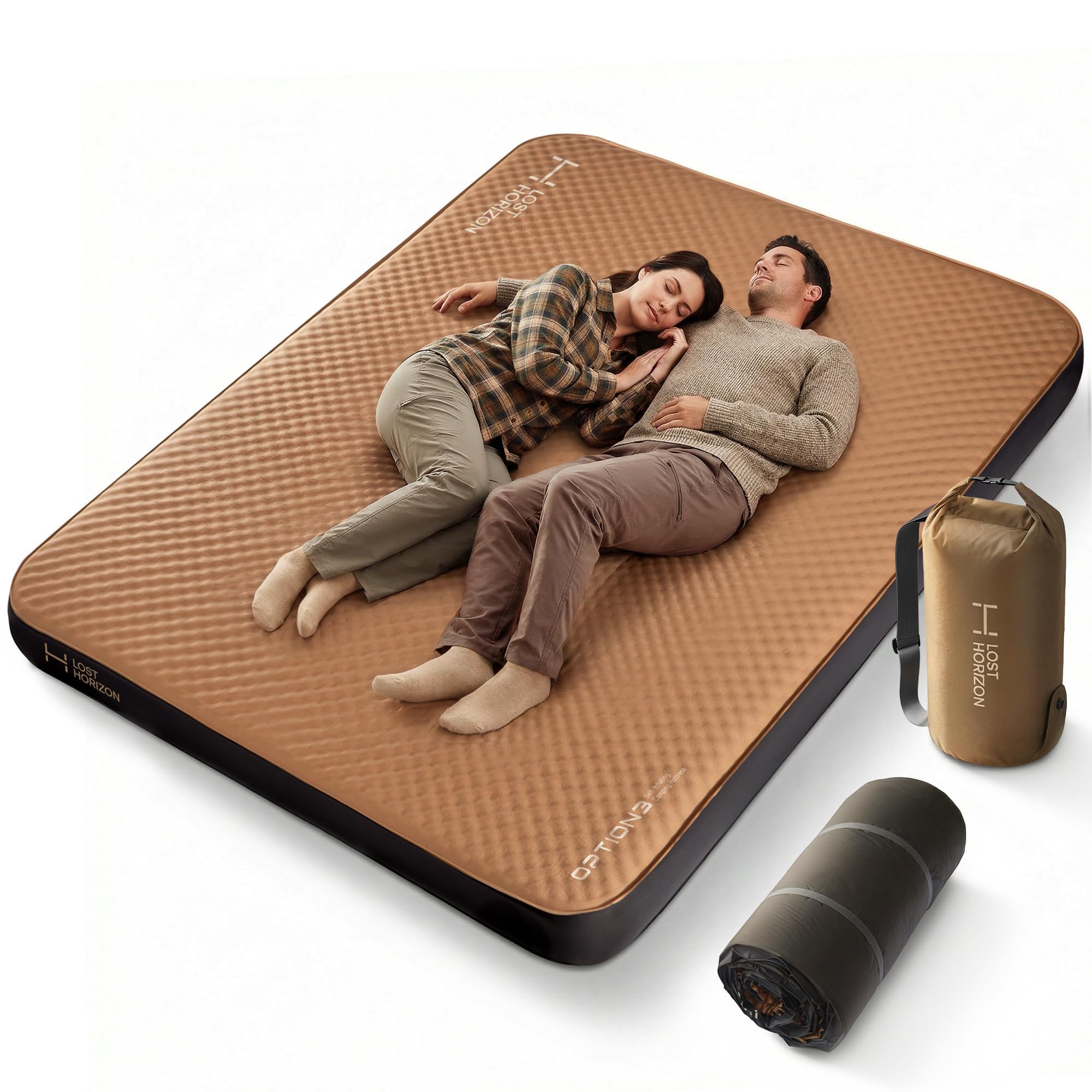
The Lost Horizon Air & Foam mattress redefines car camping comfort with a 4.5-inch thickness and 13 pounds of foam filling. The R-value of 13 is the highest in this lineup, providing serious insulation against freezing ground temperatures. Its queen-sized surface measures 80 by 60 inches, giving couples and individuals ample room to stretch out without feeling confined.
The hybrid air-and-foam construction allows adjustable firmness by adding or releasing air through the included pump. Users report that it feels like a home mattress, with no air loss over multiple nights and minimal noise during movement. The 30D stretch fabric cover resists abrasion, and the cordless pump inflates the pad in roughly one minute.
At 17.6 pounds, this mattress is strictly for car camping or glamping. The packed size is substantial, but the trade-off is unmatched comfort for those who prioritize sleep quality. The 440-pound weight capacity accommodates most body types, and the adjustable softness makes it suitable for side and back sleepers alike.
Why it’s great
- Exceptional R-value of 13 for winter camping
- Adjustable firmness with air-and-foam hybrid design
- High weight capacity of 440 pounds
Good to know
- Heavy at 17.6 lbs, not for backpacking
- Packed size is bulky for small vehicles
2. Therm-a-Rest MondoKing 3D Self-Inflating Pad

Therm-a-Rest’s MondoKing 3D earns its name with a 4.25-inch thickness and a 7.0 R-value, making it a top contender for extreme cold camping. The StrataCore construction uses a continuous layer of thermal foam between alternating ridges of air and foam, which improves both warmth and compression when packed. The XX-Large size at 80 by 30 inches offers generous width for larger sleepers.
The TwinLock valve system separates inflation and deflation into two one-way valves, speeding up setup and tear-down. The stretch knit fabric layer provides a soft, noiseless surface that doesn’t crinkle during movement. Users weighing up to 300 pounds report excellent support without bottoming out, and the pad maintains firmness all night without needing a top-up.
Packed size is 26 by 10.3 inches, and at 5.5 pounds, it is lighter than many foam pads of similar thickness. The included pump sack works for inflation, but the pad also self-inflates within minutes. It is durable enough for years of car camping and made in the USA with a limited lifetime warranty.
Why it’s great
- R-value 7 handles sub-freezing temperatures
- Stretch knit fabric is quiet and soft
- TwinLock valves simplify setup and deflation
Good to know
- Not suitable for backpacking due to packed size
- Valve issues reported on rare units
3. Acacia 4″ Thick Self Inflating Sleeping Pad
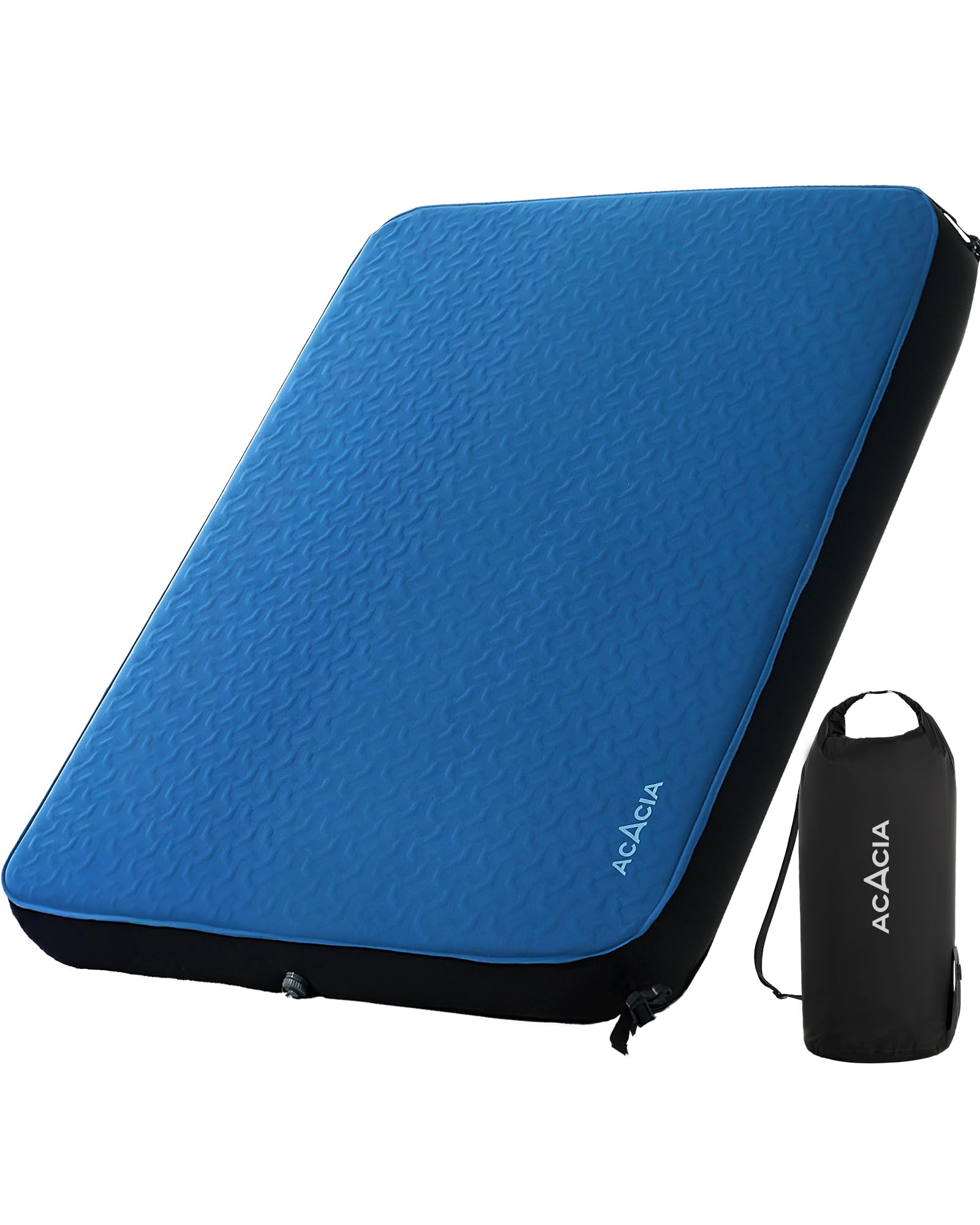
The Acacia 4-inch pad uses a unique Y-shaped telescopic foam structure that reduces packed volume by up to 60 percent compared to traditional foam pads, making it one of the more portable options among thick self-inflating models. At 4.3 inches thick with an R-value of 6, it offers year-round comfort for most three-season campers and mild winter conditions. The 440-pound weight capacity ensures it supports larger frames without sagging.
The soft, noiseless polyester surface prevents the crinkle sound that plagues many air mattresses, and the built-in side buckles allow two pads to be connected for couples camping. The two-way valve handles most inflation and deflation automatically, while the included pump sack fine-tunes firmness. Users note that the pad compresses to roughly the size of a laundry basket, which is manageable for car camping but too large for backpacking.
Durability comes from rugged 30D elastic fabric with a TPU-reinforced coating that resists abrasions and punctures. Heat-molded seams keep air locked in, addressing the common leak issue found in lower-end pads. The pad stores best when left partially inflated, which prevents foam fatigue and extends its lifespan.
Why it’s great
- Y-shaped foam reduces packed volume significantly
- Side buckles connect two pads for couples
- R-value 6 works for three-season and mild winter camping
Good to know
- Packed size still bulky for small cars
- Learning curve to use pump sack effectively
4. Hikenture 4″ Self Inflating Sleeping Pad

The Hikenture 4-inch pad delivers an impressive R-value of 9.5 at a mid-range price point, making it a strong option for budget-conscious campers who need reliable insulation in cold conditions. The self-inflating design uses open-cell foam that expands within minutes, and the patented two-way valve prevents air from re-entering during deflation. The 80 by 28-inch surface fits tall sleepers up to 6 feet 3 inches comfortably.
The polyester surface feels gentle against skin and produces minimal noise during sleep. Users consistently report that the pad stays fully inflated all night, with no noticeable air loss even after multiple nights of use. The included pump sack allows fine-tuning of firmness, though the pad reaches close to full thickness through self-inflation alone.
At 6.5 pounds, it is relatively light for its thickness and insulation level. The packed size is compact enough for car camping but still too large for backpacking. The memory foam and air combo provides plush support that side sleepers appreciate, and the pad fits under a standard twin fitted sheet for a more bed-like feel.
Why it’s great
- R-value 9.5 rivals premium pads at a lower price
- Self-inflates quickly with easy valve system
- Fits tall users up to 6’3″ comfortably
Good to know
- Not suitable for backpacking
- Some users report valve durability concerns
5. Therm-a-Rest LuxuryMap Self-Inflating Pad

The Therm-a-Rest LuxuryMap uses pressure mapping technology to vary foam density across the pad, providing softer support under the shoulders and hips while maintaining firmer support elsewhere. This targeted approach reduces pressure points for side sleepers who often wake with sore hips. The 3-inch thickness and R-value of 6 make it suitable for three-season use and mild winter conditions.
The TwinLock valve system includes separate inflation and deflation valves, allowing fast setup and tear-down. At 4 pounds 3 ounces, it is the lightest premium pad in this guide, making it a viable option for minimalist car campers who still want foam insulation. The Large size measures 77 by 25 inches, which fits most sleepers comfortably but may feel narrow for those who sprawl.
The self-inflating foam core reaches full thickness in about 30 minutes, and a few breaths through the valve finalize firmness. Users report that the pad holds air exceptionally well, with no noticeable deflation overnight. The PFAS-free stuff sack is an environmentally conscious touch, and the pad is made in the USA with durable materials.
Why it’s great
- Pressure-mapped foam reduces hip and shoulder pain
- Lightweight at 4 lbs 3 oz
- Made in the USA with durable construction
Good to know
- 3-inch thickness may not suit everyone
- Actual foam area is slightly narrower than pad edges
6. SoundAsleep Dream Series Luxury Air Mattress

The SoundAsleep Dream Series is a traditional raised air mattress with a double-height design reaching 18 inches off the ground. ComfortCoil Technology uses 21 internal air coils to maintain firmness and prevent sagging, while the SureGrip bottom keeps the mattress from sliding on tent floors. This is the best choice for families who want a bed-like experience without the bulk of foam pads.
The patented one-click internal pump inflates the twin size in under 3 minutes, and the adjustable firmness setting lets users customize the feel. The extra-thick waterproof flocked top prevents sheets from slipping and provides a quiet surface that does not crinkle. The twin size measures 73 by 38 inches, which is narrower than foam pads but acceptable for solo sleepers.
Puncture-resistant eco-friendly PVC adds durability, though the 13-pound weight makes it less portable than foam alternatives. Users consistently praise the customer service response to leak issues, with replacements sent quickly. This mattress is best for car camping where weight is not a concern and the elevated height makes getting in and out easier for those with mobility issues.
Why it’s great
- Double-height design is easy to get in and out of
- Built-in pump inflates in under 3 minutes
- ComfortCoil technology prevents sagging
Good to know
- Heavy at 13 lbs, not for backpacking
- Some units develop slow leaks over time
7. CYMULA 3″ Memory Foam Camping Pad
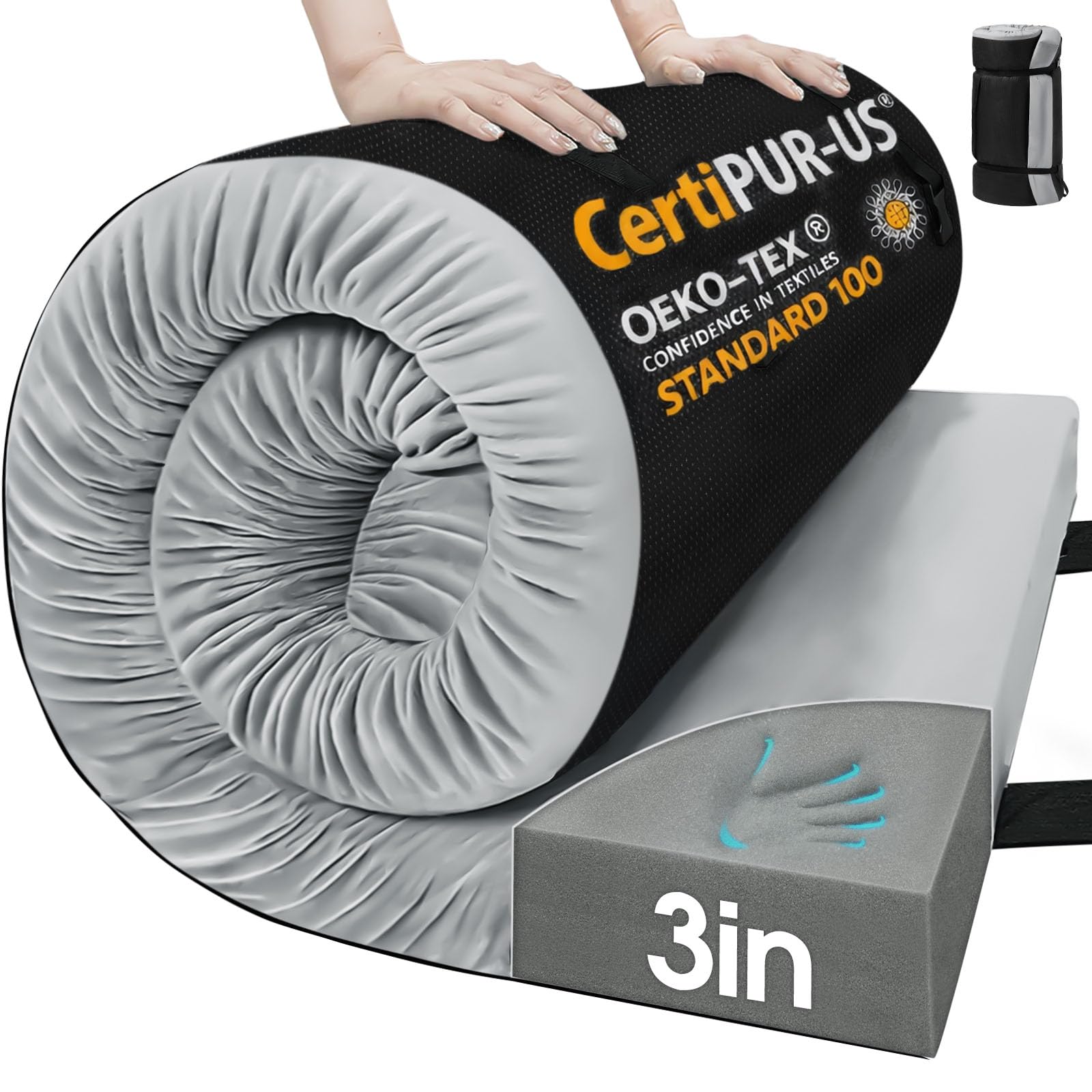
The CYMULA 3-inch memory foam pad offers an affordable entry point for campers who want foam comfort without the cost of self-inflating technology. It uses carbon-fiber high-elasticity memory foam with a high-density base layer, providing a plush feel on cots, tent floors, or truck beds. The cotton cover is removable and machine-washable, which helps maintain hygiene after muddy trips.
The waterproof bottom with rubberized anti-slip dots prevents shifting on smooth surfaces, while built-in straps secure the pad in place. At 6.4 pounds, it is lighter than many foam pads of similar size, but the roll-up design still creates a bulky package that is best for car camping. Users report excellent comfort for side sleepers, with no back pain after waking.
Initial odor is noticeable and requires airing out before first use. The included straps are functional but not heavy-duty, and some users replace them with stronger alternatives. This pad works well on a cot where the height off the ground compensates for the 3-inch thickness, making it a solid budget choice for occasional campers.
Why it’s great
- Affordable memory foam comfort for cot sleeping
- Removable and machine-washable cover
- Waterproof bottom prevents dampness
Good to know
- Initial odor requires ventilation
- Bulky when rolled, not for backpacking
FAQ
Can I use a camping air bed on a cot?
How do I store a self-inflating pad long term?
What R-value do I need for winter camping?
Why does my air mattress deflate overnight?
Final Thoughts: The Verdict
For most users, the best air bed for camping winner is the Lost Horizon Air & Foam because it offers the highest R-value in this guide at 13, a plush 4.5-inch thickness, and adjustable firmness for under 18 pounds — an unmatched combination for car camping comfort. If you want targeted pressure relief in a lighter package, grab the Therm-a-Rest LuxuryMap. And for extreme cold conditions where insulation is the priority, nothing beats the Therm-a-Rest MondoKing 3D with its 7.0 R-value and durable American-made construction.

Mo Maruf
I created WellFizz to bridge the gap between vague wellness advice and actionable solutions. My mission is simple: to decode the research and give you practical tools you can actually use.
Beyond the data, I am a passionate traveler. I believe that stepping away from the screen to explore new environments is essential for mental clarity and physical vitality.