Our readers keep the lights on and my smoothie glass nicely filled. As an Amazon Associate, I earn from qualifying purchases.
There is a specific texture to a frame of 35mm film that no digital filter has ever truly matched. It is the grain, the color shift, the tiny imperfections that turn a simple snapshot into a stored memory with weight. Choosing a camera to start that path — or to return to it — means deciding between a disposable tool for a single event and a mechanical instrument built to last decades. The format, the lens glass, and the way you advance the frame all change what kind of photographer you become.
I’m Mohammad Maruf — the founder and writer behind WellFizz. I’ve spent hundreds of hours researching film camera specifications, analyzing build quality across price tiers, and cross-referencing user experiences from disposable units to fully mechanical SLR bodies to find the real contenders in this revived analog market.
This guide covers nine models ranging from single-use compacts to premium half-frame and mirrorless hybrids, each evaluated for its lens sharpness, light meter accuracy, film compatibility, and build durability. Whether you want the simplicity of a point-and-shoot or the full manual control of a vintage SLR, you will find a clear recommendation in this best film camera breakdown.
How To Choose The Best Film Camera
Film cameras are not interchangeable devices. A disposable unit serves an afternoon at a party, while a fully mechanical SLR body can outlast a decade of daily use. The most important decision is not the brand — it is the format and the control system that matches how you shoot.
Format: Full Frame vs Half Frame vs Disposable
Full-frame 35mm cameras produce a 24x36mm negative, yielding the highest resolution and widest dynamic range from standard film stocks. Half-frame cameras capture two vertical 17x24mm images per standard 36-exposure roll, effectively giving you 72 shots per roll at a slight cost in grain and detail. Disposable cameras pre-load a roll of film in a sealed plastic body and are designed for single use — no reusability, no lens interchangeability, no settings control. For beginners wanting to experiment with composition and film characteristics, a half-frame camera offers the lowest cost per shot and the most forgiving learning curve.
Lens Quality and Mount Compatibility
A glass multi-element lens with anti-reflective coating delivers sharper edges, better contrast, and reduced flare compared to a single-element plastic lens. Interchangeable lens mounts — such as the Canon FD mount or Pentax K mount — allow you to upgrade optics over time, while fixed-lens point-and-shoot cameras limit you to the focal length built into the body. If you plan to explore different perspectives (wide-angle, telephoto, macro), an SLR with a standard 50mm f/1.8 kit lens and the ability to swap glass is the smarter long-term investment.
Exposure Control: Manual, Automatic, or Program
Manual exposure forces you to set both aperture and shutter speed independently, which teaches you the exposure triangle but also risks missed shots in fast-changing light. Automatic exposure cameras select shutter speed based on a built-in light meter, making them ideal for street photography and casual use. Program mode — found on cameras like the Canon AE-1 Program — selects both aperture and shutter speed automatically, giving you full point-and-shoot convenience with the option to switch to manual when you want creative control. The reliability of the light meter itself is a critical factor; a faulty meter can ruin an entire roll of film.
Quick Comparison
On smaller screens, swipe sideways to see the full table.
| Model | Category | Best For | Key Spec | Amazon |
|---|---|---|---|---|
| Pentax 17 | Half-Frame | Everyday creative shooting | 25mm f/3.5 HD coated lens | Amazon |
| FUJIFILM X Half Mirrorless | Digital Hybrid | Film simulation experience | 1-inch 18MP sensor, Instax Mini | Amazon |
| Canon AE-1 Program | SLR | Versatile auto/manual control | FD mount, Program AE mode | Amazon |
| Vintage Canon AE-1 | SLR | Classic shutter-priority shooting | Shutter-speed-priority TTL metering | Amazon |
| Pentax K1000 | Manual SLR | Learning full manual exposure | Battery-free mechanical operation | Amazon |
| Canon Rebel 2000 | Autofocus SLR | Modern autofocus on film | 7-point AF, 28-80mm zoom lens | Amazon |
| KODAK Snapic A1 | Point-and-Shoot | Entry-level reusable camera | 3-element glass lens, 2-zone focus | Amazon |
| Fujifilm QuickSnap Flash 400 | Disposable | Party or event single-use | ISO 400, 27 exposures, built-in flash | Amazon |
| Kodak PIXPRO FZ55 | Digital Point-and-Shoot | Digital nostalgia on a budget | 16MP, 5X optical zoom, 1080p video | Amazon |
In‑Depth Reviews
1. Pentax 17 35mm Half-Frame Film Camera

The Pentax 17 is a brand-new manufactured half-frame camera that captures two vertical 17x24mm images on each standard 35mm frame, giving you 72 shots from a 36-exposure roll. Its 25mm f/3.5 lens is treated with Pentax’s HD coating, delivering sharpness and contrast that rivals much older premium glass. The zone-focus system divides distances into six marks — from close-ups to infinity — letting you set focus without looking away from the viewfinder
The body uses a manual film advance lever that recreates the tactile feel of a classic SLR, and the top and bottom covers are solid magnesium alloy rather than cheap plastic. It accepts ISO 50 to 3200 film, giving you flexibility across different lighting conditions. The shutter is quieter than most point-and-shoot cameras, making it effective for candids and street photography without drawing attention.
Some photographers will find the zone-focus system less precise than a rangefinder or autofocus camera, and the fixed lens means you cannot change focal lengths. The price positions it as a premium entry point, but for a new-manufacture half-frame body with this build quality, the value is clear for anyone who wants to shoot film regularly without high per-roll costs.
Why it’s great
- 72 shots per roll drastically lowers cost per frame
- HD coated glass lens produces sharp, contrasty images
- Magnesium alloy body feels solid and durable
Good to know
- Zone-focus system has a learning curve for precise focusing
- Fixed 25mm lens limits compositional flexibility
- Premium price compared to some refurbished full-frame SLRs
2. FUJIFILM X Half Mirrorless Camera

The FUJIFILM X Half is a digital mirrorless camera designed specifically to simulate the experience of shooting a half-frame film camera. It uses a 1-inch 18MP sensor and features a dedicated film mode that prevents image preview, forcing you to compose and shoot without chimping — exactly like a film body. The retro dial-based control system puts aperture, shutter speed, and exposure compensation at your fingertips without digging through menus.
It includes 26 analog-inspired film simulations, including Classic Chrome, Acros, and Velvia, and you can print directly to a compatible Instax printer or transfer images via the dedicated app. The 2-in-1 mode lets you capture both a still and a short video clip with one press, adding a creative layer that no pure film camera can match. The body is pocketable and the build quality feels refined, with a charcoal silver finish that resists scratches.
The camera only shoots JPEG, not RAW, which limits post-processing flexibility for purists. The thumb lever advance lacks the tension and tactile feedback of a real film winder, which may disappoint those seeking an authentic analog feel. The price sits in a premium bracket, but the combination of film simulation fidelity and modern sensor performance makes it a strong choice for photographers who want the look of film without the cost of developing.
Why it’s great
- Excellent film simulations deliver convincing analog color and grain
- Pocketable size with intuitive dial-based manual controls
- No-preview mode encourages disciplined composition
Good to know
- JPEG only — no RAW output for heavy editing
- Digital advance lever lacks the mechanical feel of a real film camera
- Premium price point comparable to higher-end point-and-shoot digitals
3. Canon AE-1 Program 35mm SLR Film Camera Kit

The Canon AE-1 Program takes the classic AE-1 body and adds a fully automatic Program mode that selects both aperture and shutter speed based on the built-in light meter. This makes it arguably the most versatile vintage SLR for both beginners and experienced shooters — you can hand it to a friend for quick snaps or switch to manual mode for full creative control. The included 50mm f/1.8 FD lens provides a fast, natural field of view with excellent light-gathering ability.
The viewfinder features a split-image rangefinder and microprism collar that makes manual focus accurate and fast. The camera accepts Canon FD and FL lenses, giving you access to decades of high-quality glass at reasonable prices. The kit often includes a power winder, which saves your thumb during long shooting sessions and keeps the camera balanced in hand.
As a refurbished unit, the condition varies by seller, and some units arrive with dust in the viewfinder or sticky light seals that require replacement. The camera relies on batteries for both the meter and the Program mode, so a dead battery leaves you without a functional camera. For shooters who want one camera that can do it all — from full auto to full manual — the AE-1 Program is the most flexible vintage SLR available at a reasonable price.
Why it’s great
- Program AE mode offers true point-and-shoot convenience
- Bright viewfinder with split-image manual focusing aids
- Extensive FD lens ecosystem at accessible prices
Good to know
- Battery-dependent — no meter or shutter function without power
- Refurbished condition varies; inspect seals and light meter on arrival
- Plastic top plate feels less durable than all-metal SLR bodies
4. Vintage Canon AE-1 35mm SLR Camera with 50mm f/1.8 Lens

The original Canon AE-1 was the camera that brought shutter-priority automatic exposure to the masses, and the refurbished units available today still deliver that experience. You select the shutter speed (from 1/1000 to 2 seconds, plus Bulb), and the camera’s TTL metering system picks the appropriate aperture automatically. This gives you control over motion blur and camera shake without needing to fiddle with the aperture ring in changing light.
The metal body construction gives the AE-1 a substantial feel in the hand, and the 50mm f/1.8 FD lens that typically ships with refurbished kits is sharp from f/2.8 onward. The camera accepts ISO 12 to 3200 film, covering everything from slow fine-grain stocks to high-speed black-and-white emulsions. The split-image focusing screen is bright and easy to use even in moderate light.
Shutter-priority automation means you cannot directly set aperture in auto mode — you must switch to manual and use the needle meter in the viewfinder to match the correct exposure. Light seals on refurbished units can be dried out or missing, which causes light leaks on your negatives. Despite these quirks, the AE-1’s build quality, lens compatibility, and intuitive operation keep it as one of the most recommended film cameras for new analog shooters.
Why it’s great
- Shutter-priority auto exposure is intuitive for controlling motion
- Robust metal body with classic chrome finish
- Extensive FD lens selection with very good standard prime lens
Good to know
- No aperture-priority or Program mode
- Light seals degrade with age; check and replace on refurbished units
- Battery required for shutter and light meter operation
5. Pentax K1000 Manual Focus SLR Film Camera with 50mm Lens

The Pentax K1000 is the camera that introduced generations of photography students to full manual exposure. It has no automation whatsoever — you set the aperture on the 50mm f/2 lens, you set the shutter speed on the dial, and you focus with the split-image viewfinder. The camera does not even need a battery to fire the shutter; the only battery-dependent component is the built-in light meter, which uses a single LR44 cell that lasts over a year with regular use.
The K1000 uses the Pentax K mount, one of the most widespread lens mounts ever produced, meaning you can find compatible glass from Pentax, Vivitar, Tamron, and many others at low cost. The body is entirely mechanical, so there is no circuit board to fail or motor to burn out. This simplicity makes it reliable in extreme temperatures and conditions where electronic cameras stop working.
Refurbished units vary widely in light meter accuracy — some buyers report dead or drifting meters that require servicing. There is no built-in flash, no auto-wind, and no auto-rewind, so every roll requires manual advancing and rewinding with the lever. If you want to learn exposure from the ground up and own a camera that will outlast any electronic model, the K1000 is the standard.
Why it’s great
- Fully mechanical shutter works without any battery
- Pentax K mount offers massive lens compatibility at low prices
- Simple, durable design that is easy to repair
Good to know
- Light meter accuracy is inconsistent on refurbished units
- No built-in flash or auto-advance features
- Slower shooting pace than any automatic camera
6. Canon Rebel 2000 SLR Film Camera with 28-80mm EF Lens
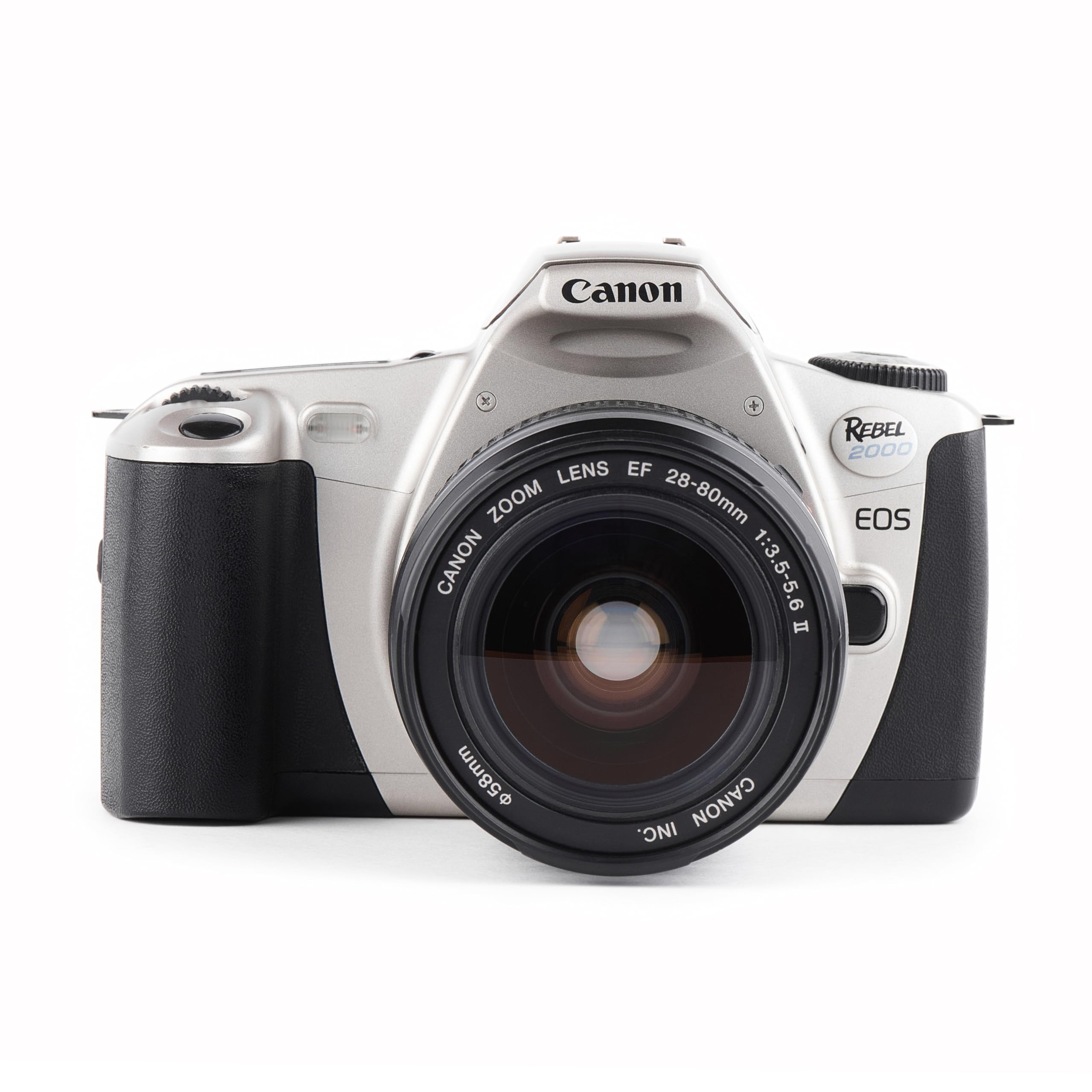
The Canon Rebel 2000 is a late-model 35mm film SLR that uses the same EF lens mount as modern Canon digital DSLRs, meaning you can use current EF and EF-S lenses (with some caveats) on a film body. The 7-point autofocus system is fast and accurate by film-era standards, and the camera offers Program AE, aperture priority, shutter priority, and full manual exposure modes. The built-in pop-up flash is useful for fill light in outdoor portraits or emergency indoor shots.
The automatic film loading, advancing, and rewinding make this one of the most hassle-free film cameras for someone accustomed to digital convenience. The included 28-80mm zoom lens provides flexibility from wide-angle to short telephoto, covering most everyday shooting scenarios without needing to swap glass. The camera uses two CR123A batteries that are still widely available.
The plastic body feels less premium than metal-bodied SLRs, and the kit zoom lens has noticeable chromatic aberration at the edges of the frame. Some refurbished units arrive with battery corrosion or sticky shutter blades from long storage. For a photographer who already owns Canon EF glass and wants to try film without learning a new system, the Rebel 2000 is the most seamless entry point.
Why it’s great
- EF lens mount is compatible with modern Canon DSLR lenses
- Reliable 7-point autofocus system for sharp results
- Full range of exposure modes from full auto to manual
Good to know
- Plastic body construction lacks the durability of metal SLRs
- Kit zoom lens shows edge softness and chromatic aberration
- Refurbished condition varies; check battery compartment and shutter
7. KODAK Snapic A1 35mm Film Camera
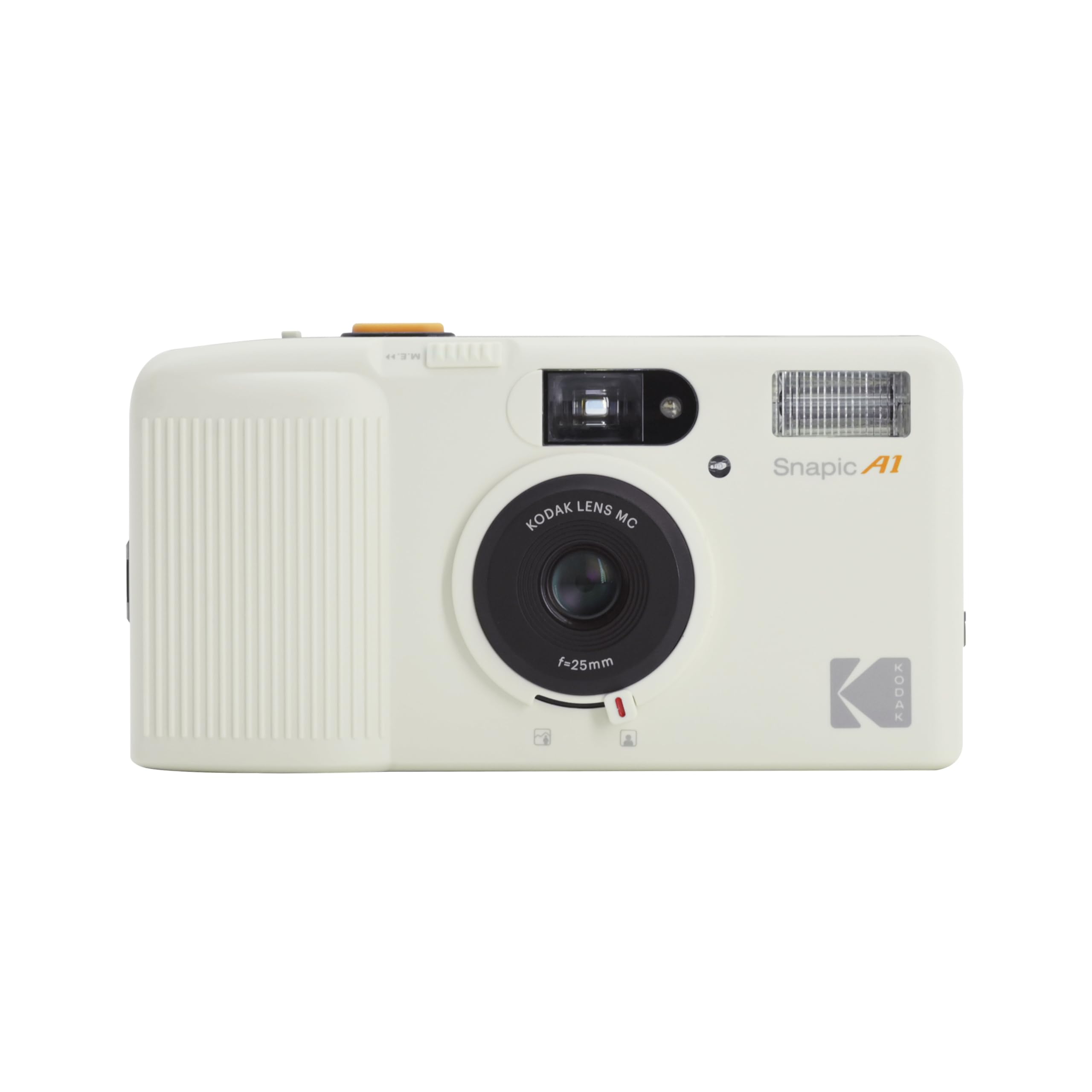
The KODAK Snapic A1 is a point-and-shoot camera that bridges the gap between disposable units and full-featured SLRs. It uses a 3-element glass lens — a meaningful upgrade over the single plastic element found in disposable cameras — and offers a 2-zone focus system that lets you switch between near and far subjects. The built-in auto flash includes red-eye reduction, and the multiple exposure feature lets you layer two scenes onto one frame for creative effects.
The camera is compact, lightweight at 117 grams, and runs on a single AAA battery. It fully automates film advance and rewind, making it as simple to use as a disposable camera but reusable with any 35mm film stock you choose. The metallic plastic build feels sturdier than its price suggests, and the retro styling in Ivory White looks attractive without being bulky.
The flash button is easy to press accidentally, which can drain the battery or fire the flash when you do not want it. The camera struggles in low light, producing underexposed images unless you are within flash range. For someone who wants the film look without the mechanical learning curve or the ongoing cost of disposable cameras, the Snapic A1 offers a practical middle ground.
Why it’s great
- Glass lens produces noticeably sharper images than disposables
- Reusable with any standard 35mm film, lowering long-term cost
- Multiple exposure mode adds creative flexibility
Good to know
- Flash button placement leads to accidental activation
- Poor low-light performance without flash
- Plastic construction feels less premium than metal-bodied alternatives
8. Fujifilm QuickSnap Flash 400 Disposable 35mm Camera, 4-Pack
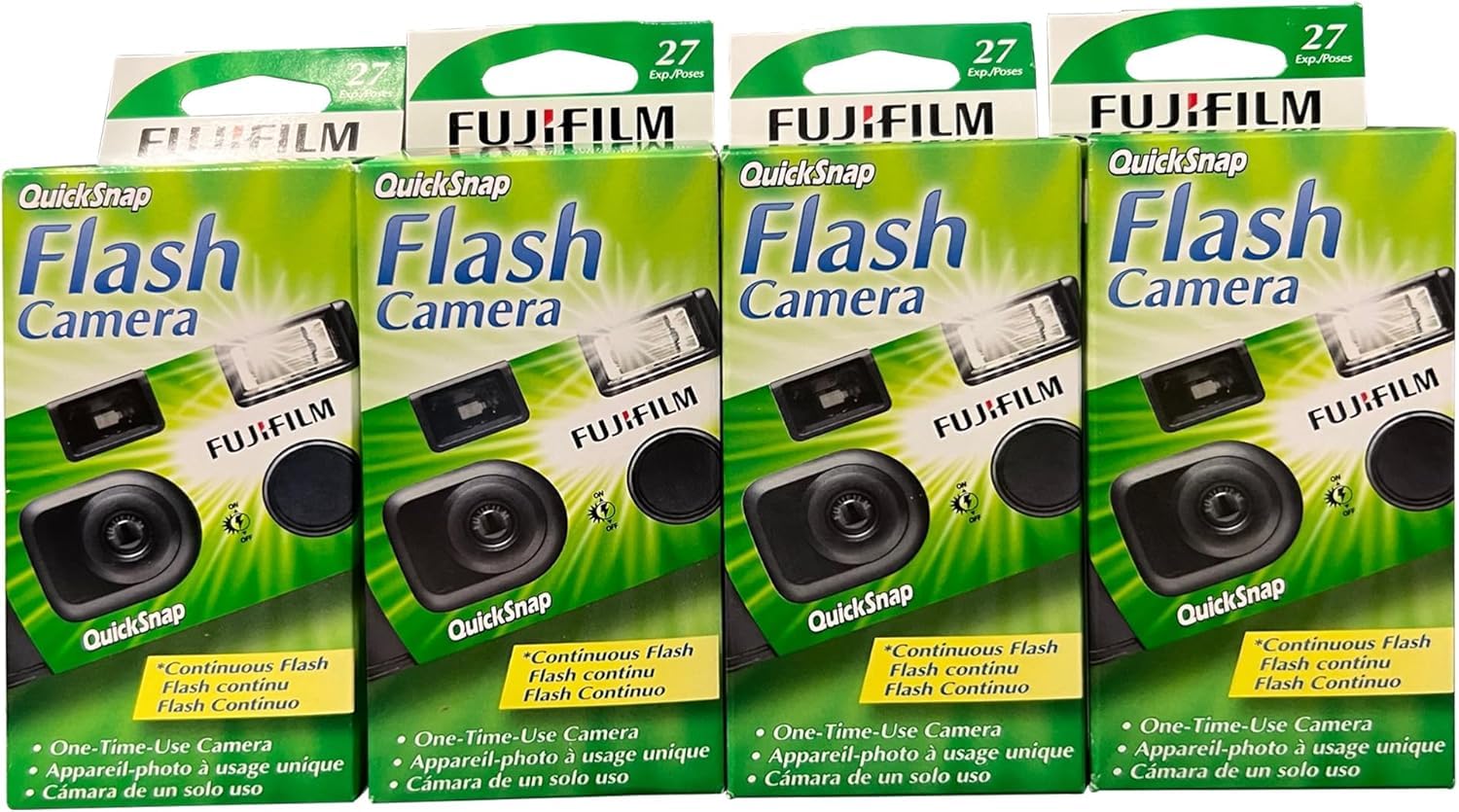
The Fujifilm QuickSnap Flash 400 is the most straightforward way to shoot film today. Each unit is pre-loaded with Superia X-TRA 400 film, rated at ISO 400 for balanced daylight and indoor flash performance. The built-in flash works effectively up to about 10 feet, and the manual on/off switch gives you control over when you want fill light. The fixed-focus lens and automatic exposure mean you point and press the shutter — no settings, no loading, no winding.
The compact plastic body is lightweight and durable enough to survive the bottom of a beach bag or a school backpack without damage. The 27-exposure count per camera means each unit covers a full afternoon event or party. The 4-pack provides enough film for multiple occasions or for distributing to guests at a wedding or gathering.
The cost per shot is significantly higher than a reusable camera, and the single-element plastic lens cannot match the sharpness or contrast of a glass lens. The fixed focus means subjects closer than 4 feet will be blurry. For events where you want candid, nostalgic images without worrying about a camera’s safety, the QuickSnap 4-pack provides reliable fun at a predictable per-camera cost.
Why it’s great
- Zero setup or learning curve — point and shoot
- Durable, lightweight body safe for any environment
- Built-in flash works well for indoor and night shots
Good to know
- High cost per frame compared to reusable cameras
- Single-element plastic lens yields lower sharpness
- Fixed focus causes blur on subjects closer than 4 feet
9. Kodak PIXPRO FZ55 Digital Point & Shoot Camera

The Kodak PIXPRO FZ55 is a digital point-and-shoot camera that appeals to the same nostalgic impulse that drives film camera interest, but it stores images on an SD card rather than on film. The 16MP CMOS sensor captures detailed images, and the 5X optical zoom (28mm wide-angle to 140mm equivalent) provides framing flexibility that most film point-and-shoots cannot match. The 2.7-inch LCD screen makes composition and review immediate.
The camera records 1080p full HD video, which no film camera can do, and supports SDXC cards up to 512GB. The rechargeable lithium-ion battery charges via USB, eliminating the need for specialty batteries. The compact blue body is purse-sized and weighs noticeably less than any film SLR, making it a practical everyday carry for casual snapshots.
This is a digital camera, not a film camera, so it cannot deliver the chemical grain structure or dynamic range of 35mm negative film. The sensor is smaller than a full-frame digital sensor, and the kit lens aperture (f/3.9 at wide, f/6.3 at tele) limits low-light performance. For someone who wants the tactile, deliberate shooting experience of a dedicated camera without the development process or ongoing cost of film, the FZ55 provides a modern alternative with a nostalgic design language.
Why it’s great
- Immediate image review and no ongoing film or development cost
- 5X optical zoom and 1080p video in a pocket-sized body
- Rechargeable battery with USB charging is convenient
Good to know
- Digital sensor cannot replicate film grain or dynamic range
- Small sensor and slow aperture limit low-light performance
- Not a film camera — does not provide the analog shooting process
FAQ
What is the difference between a disposable and a reusable film camera?
Should I buy a film camera with a built-in light meter?
What does half-frame mean and why would I want it?
How do I avoid buying a film camera with a bad light meter?
Final Thoughts: The Verdict
For most users, the best film camera winner is the Canon AE-1 Program because it combines the convenience of program auto exposure with full manual control and access to the superb Canon FD lens system at a mid-range price. If you want to double your shots per roll and shoot with a brand-new modern body, grab the Pentax 17 half-frame camera. And for the purest learning experience that builds your exposure skills from the ground up with a camera that will never need a battery to fire, nothing beats the Pentax K1000.

Mo Maruf
I created WellFizz to bridge the gap between vague wellness advice and actionable solutions. My mission is simple: to decode the research and give you practical tools you can actually use.
Beyond the data, I am a passionate traveler. I believe that stepping away from the screen to explore new environments is essential for mental clarity and physical vitality.