Our readers keep the lights on and my smoothie glass nicely filled. As an Amazon Associate, I earn from qualifying purchases.
PVC is a notoriously low-energy surface, meaning most general-purpose glues simply bead up and fail. Without a chemically formulated adhesive that actually etches the polymer, you are left with a joint that separates under the slightest water pressure or physical stress. The difference between a repair that lasts a season and one that lasts a decade comes down to the specific solvent chemistry in the cement you choose.
I’m Mohammad Maruf — the founder and writer behind WellFizz. I’ve spent countless hours analyzing solvent compositions, cure rates, and application methods for PVC adhesives to separate marketing hype from measurable bond strength in real-world conditions.
After comparing bond flexibility, set times, VOC profiles, and material compatibility across multiple formulations, I have identified the options that deliver a reliable, watertight seal. This guide covers the top contenders for the best adhesive for pvc across different repair scenarios and project scales.
How To Choose The Best Adhesive For PVC
Selecting the wrong adhesive for a PVC project is a common and frustrating mistake. The most important factor is understanding the difference between a solvent-weld cement, which chemically fuses the PVC molecules together, and a contact cement, which creates a flexible mechanical bond. Your choice depends entirely on whether you are joining rigid plumbing pipes or repairing flexible vinyl sheet goods.
Solvent Chemistry and Set Time
For rigid PVC pipe and fittings, a solvent cement like the Weld-On 735 chemically softens the PVC, allowing the two pieces to fuse into a single homogenous joint. The set time — the window you have to align the pieces before the bond locks — is critical. Fast-setting cements (under 10 seconds) require confident assembly, while medium-bodied formulas offer a few more seconds for complex layouts. For wet environment plumbing, a wet-rated cement ensures the solvent displaces water rather than being blocked by it.
Flexibility vs. Rigidity
For repairs on inflatables, pool liners, tarps, and other flexible PVC (vinyl), a solvent-weld cement is too brittle. You need a flexible contact cement that can withstand movement, air pressure, and thermal expansion. These adhesives, like the HOOK UP Vinyl Cement, create a durable, rubbery bond that flexes with the material. The key spec here is flexibility after cure, not raw tensile strength.
Quick Comparison
On smaller screens, swipe sideways to see the full table.
| Model | Category | Best For | Key Spec | Amazon |
|---|---|---|---|---|
| Weld-On 735 | Solvent Cement | Rigid PVC pipe & fittings | Low-VOC, sets in ~3 sec | Amazon |
| HOOK UP Vinyl Cement | Contact Cement | Flexible vinyl repair | 4 oz, waterproof, flexible | Amazon |
| Oatey All-Purpose Cement | Solvent Cement | General PVC plumbing | 16 oz, 2-hour full cure | Amazon |
| Bellisinno Vinyl Cement | Contact Cement | Pool liner & inflatable patch | 4.4 oz, 24hr full cure | Amazon |
| Titebond PVC Trim | CA Glue | PVC trim joints & models | 4 oz, 8hr full cure | Amazon |
In‑Depth Reviews
1. Weld-On 735 Wet ‘N Fast PVC Cement
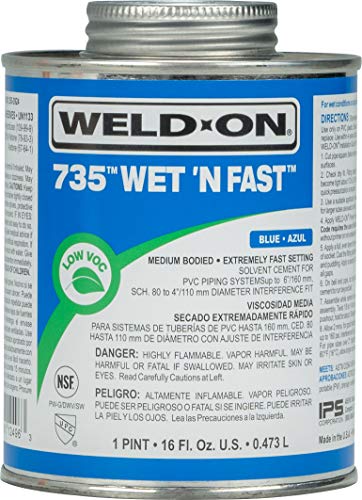
The Weld-On 735 is a medium-bodied solvent cement engineered for extremely fast setting in both dry and wet conditions. It is purpose-built for interference-fit joints in rigid PVC pipe up to six inches in diameter, including Schedule 80 up to four inches. The low-VOC formula meets stringent air quality standards like SCAQMD Rule 1168/316A and contributes to LEED v4 credits, making it a solid choice for professional and environmentally conscious users.
Customer feedback repeatedly highlights the near-instantaneous set time — roughly three seconds on dry PVC — which demands confident and exact placement with zero wobble. This is not a forgiving glue for complex assemblies with multiple joints. However, for straightforward pipe connections in irrigation, pool plumbing, or pressure systems, its speed and wet-application capability are major advantages.
The medium body of 735 means it applies smoothly without excessive dripping, and the 24-hour full cure time ensures a permanent, pressure-rated bond. The one-pint container is a practical size for most residential and light commercial jobs, though users note the cost is higher per ounce than basic hardware-store PVC cement. For projects where fast turnaround and wet installation are critical, this is the standard.
Why it’s great
- Extremely fast set time allows immediate handling of pipe.
- Works reliably on wet PVC surfaces without compromise.
- Low-VOC formula is safer to work with indoors.
Good to know
- Too fast for complex layouts with multiple unglued joints.
- Must be sealed airtight after each use or it hardens.
- Higher cost per ounce compared to all-purpose cements.
2. Oatey All-Purpose PVC Cement

Oatey is a household name in plumbing solvent cements, and their All-Purpose 16-ounce can is the workhorse for general PVC and CPVC pipe connections. This medium-viscosity paste cement offers a much longer working time than the ultra-fast Weld-On 735, making it the smarter choice for multi-joint assemblies like sprinkler manifolds or drain systems where alignment speed is not a constraint. The 2-hour full cure is also notably faster than the 24-hour standard of many other cements.
User reviews confirm its dependable performance in varied weather conditions and its ability to bond both PVC and CPVC without issue. One user even used it to adhere ABS to PVC, which speaks to its broad material compatibility beyond just rigid PVC pipes. The clear finish is aesthetically invisible on light-colored pipe.
A minor but consistent complaint is that the can’s applicator and lid system can lead to the product thickening if not kept perfectly sealed. The low-VOC claim has also been questioned by some users, who find the solvent odor still quite strong. If you need a reliable, bargain-friendly cement for standard PVC plumbing with a comfortable set window, this is the one to grab.
Why it’s great
- Longer working time is ideal for complex plumbing layouts.
- 2-hour full cure is faster than many competitors.
- Compatible with both PVC and CPVC materials.
Good to know
- Not designed for wet-surface application.
- Can thicken quickly if the can is not sealed tightly.
- Solvent odor is still present despite low-VOC label.
3. HOOK UP Vinyl Cement

This contact cement from HOOK UP is specifically formulated for flexible PVC materials — think pool liners, inflatable boats, air mattresses, and hot tub covers. Unlike solvent-weld cements that fuse rigid pipe, this adhesive creates a flexible, waterproof seal that can handle movement and air pressure. The 4-ounce can includes a built-in brush for precise application to tears, punctures, and seams.
Real-world reviews from users who repaired underwater pool patches and high-speed boat covers confirm the bond’s tenacity. One user drove 400 miles at 75 mph with no seam failure on a repaired cover. Another successfully patched a large underwater pool leak from the outside without draining the water. The adhesive dries clear and remains flexible, which is essential for materials that expand and contract.
The built-in brush is convenient but tends to get messy if you overload it, and the solvent fumes are potent — outdoor or ventilated application is mandatory. It is not suitable for rigid PVC pipe connections or bonding vinyl decals to glass, but for any flexible vinyl repair project, it delivers reliable, long-lasting results.
Why it’s great
- Forms a flexible bond that resists air and water pressure.
- Works well for underwater pool patch applications.
- Dries clear for low-visibility repairs.
Good to know
- Built-in brush can be messy with heavy application.
- Strong fumes require good ventilation.
- Not intended for use on non-porous surfaces like glass.
4. Bellisinno Vinyl Cement

Bellisinno positions its vinyl cement as a high-strength, waterproof adhesive specifically for flexible materials. It shares the same contact-cement chemistry as the HOOK UP but includes a higher 4.4-ounce volume and promises superior resistance to salt, chemicals, and hot water. The medium-to-high viscosity rating allows for thicker applications that can fill small gaps in damaged seams.
Customer experiences mirror the HOOK UP’s performance — successful repairs on pinhole leaks in large above-ground pools without draining, and strong bonds on inflatable kayaks and vinyl upholstery. The included brush applicator is praised for precise control, though users recommend using pliers to open the tight-sealing lid that prevents the glue from hardening between uses. The 24-hour full cure time produces a clear, UV-resistant finish that resists yellowing.
This is essentially a premium-tier equivalent to the HOOK UP, offering slightly more volume and a targeted claim for chemical resistance. The silicone-based material type noted in the specs differentiates it from pure vinyl-based formulas. If you need extra confidence for repairs in chemically treated pool water or saltwater environments, this is the upgrade.
Why it’s great
- Excellent resistance to salt, chemicals, and hot water.
- UV-resistant clear finish prevents yellowing over time.
- Thicker viscosity fills small gaps in damaged seams.
Good to know
- Tight lid can be difficult to open without tools.
- Full 24-hour cure requires patience before pressurizing.
- Not formulated for rigid PVC pipe connections.
5. Titebond PVC Trim Joint Adhesive

Titebond’s PVC Trim Joint Adhesive represents a different class of PVC adhesive altogether — a thick cyanoacrylate (CA) glue, not a solvent cement or contact adhesive. It is formulated for constructing PVC trim miter, shiplap, and scarf joints, as well as column wrap installation. Its primary advantage is gap-filling capability and an extremely fast initial grab, typically within 60 seconds with clamping.
User reviews highlight its effectiveness for precise trim work and hobby applications like model making, where the thick, shock-resistant bond is appreciated. However, several experienced users note that this is essentially a specialized super glue — it is not superior to standard PVC solvent cement for large surface areas or plumbing applications. The 4-ounce bottle tends to dry out after opening, so it is best used for specific trim projects rather than general stock.
For DIYers working on PVC trim boards, this adhesive eliminates the need for mechanical fasteners on mitered corners. But for any project involving water pressure, pipe joints, or flexible material repair, one of the previous three options will perform better. It is a niche tool for a specific aesthetic task.
Why it’s great
- Thick CA formula fills gaps in imperfect trim joints.
- Grab time of 60 seconds allows quick clamping and work.
- Creates a permanent, waterproof bond on PVC trim.
Good to know
- Bottle dries out quickly after first opening.
- Not suitable for plumbing or flexible material repair.
- Higher cost per volume compared to solvent cements.
FAQ
Can I use PVC cement on flexible vinyl inflatables?
How do I bond PVC to materials like ABS or metal?
What does low-VOC PVC cement mean for safety?
Final Thoughts: The Verdict
For most users, the best adhesive for pvc winner is the Weld-On 735 because it delivers the fastest, most reliable solvent weld for rigid pipe in wet or dry conditions. If you need a flexible bond for repairing vinyl inflatables or pool liners, grab the HOOK UP Vinyl Cement. And for precise PVC trim work in construction or model building, nothing beats the Titebond PVC Trim Joint Adhesive.

Mo Maruf
I created WellFizz to bridge the gap between vague wellness advice and actionable solutions. My mission is simple: to decode the research and give you practical tools you can actually use.
Beyond the data, I am a passionate traveler. I believe that stepping away from the screen to explore new environments is essential for mental clarity and physical vitality.