Our readers keep the lights on and my smoothie glass nicely filled. As an Amazon Associate, I earn from qualifying purchases.
Upgrading your home network to a multi-gigabit plan is pointless if your router cannot pass that speed to your wired devices. The 2.5Gb Ethernet port has become the new baseline for fiber and cable internet, yet many consumer routers still cap wired connections at 1 Gbps, creating a bottleneck that kills download speeds and local file transfers before they even start.
I’m Mohammad Maruf — the founder and writer behind WellFizz. I’ve spent hundreds of hours combing through router firmware menus, verifying port configurations, and analyzing real-world throughput tests to find the routers that actually deliver on their multi-gig promises.
This guide breaks down the nine most compelling models on the market so you can confidently pick the best 2.5gb router for your home office, gaming rig, or smart home setup.
How To Choose The Best 2.5Gb Router
A 2.5Gb router does not automatically give every device 2.5 Gbps. The real-world result depends on the port layout, Wi-Fi generation, and processor power.
Count the 2.5Gb Ports
The WAN port that plugs into your modem must be 2.5Gb, but if all four LAN ports are still 1Gb, your wired desktop and NAS will never exceed gigabit speeds. Look for models with at least two 2.5Gb LAN ports if you plan to hardwire more than one device.
Match Wi-Fi Generation to Your Clients
Wi-Fi 7 (802.11be) can theoretically push past 5 Gbps, but it requires Wi-Fi 7 adapters on your laptop or phone. Wi-Fi 6 with OFDMA and 160MHz channels still provides excellent multi-gig performance for most households today. Tri-band models add a third 6 GHz band to reduce congestion in dense environments.
Check Processor and RAM
Routing 2.5Gb traffic, running VPNs, and managing QoS simultaneously requires a multi-core processor (ideally 1.5 GHz or higher) and at least 512 MB of RAM. Routers with weak CPUs will choke on multi-gig workloads, causing bufferbloat and latency spikes.
Quick Comparison
On smaller screens, swipe sideways to see the full table.
| Model | Category | Best For | Key Spec | Amazon |
|---|---|---|---|---|
| ASUS RT-BE88U | Premium | Wired home lab with 10G | 2x 10G + 4x 2.5G ports | Amazon |
| Ubiquiti UDR7 | Prosumer | UniFi ecosystem control | 10G SFP+ + 2.5GbE WAN | Amazon |
| TP-Link Archer BE600 | Premium | Future-proof Wi‑Fi 7 gaming | 10G + 2.5G + 3x 2.5G LAN | Amazon |
| GL.iNet Flint 3 | Mid-Range | VPN power users | 680 Mbps WireGuard/OpenVPN | Amazon |
| NETGEAR Nighthawk RS200 | Mid-Range | Plug-and-play Wi‑Fi 7 | 6.5 Gbps Wi‑Fi 7 speed | Amazon |
| NETGEAR Nighthawk RS180 | Mid-Range | Reliable multi-gig for home | 2.5 Gig internet port | Amazon |
| GL.iNet Flint 3e | Mid-Range | AdGuard + VPN combo | 5x 2.5G Ethernet ports | Amazon |
| TP-Link Archer AX80 | Value | Balanced performance per dollar | 2.5 Gbps WAN/LAN port | Amazon |
| Cudy WR3600H | Budget | Entry-level Wi‑Fi 7 | 2.5G WAN + 4x 1G LAN | Amazon |
In‑Depth Reviews
1. ASUS RT-BE88U

The ASUS RT-BE88U is the wired-capacity champion in this lineup. With two 10G ports (one SFP+, one RJ45) and four additional 2.5Gb LAN ports, total WAN/LAN capacity hits 34 Gbps — enough to simultaneously feed a NAS, a gaming PC, and a media server without any single bottleneck. The quad-core 2.6 GHz processor ensures that even with all ports saturated, latency stays negligible.
On the wireless side, dual-band Wi-Fi 7 with 4K-QAM and Multi-Link Operation delivers up to 7,200 Mbps aggregate throughput. The unit covers roughly 3,000 square feet, and early users report strong signals through multiple floors. AiProtection Pro (powered by Trend Micro) adds commercial-grade security without a subscription fee.
A few owners noted that the router loses its WAN connection if firmware auto-updates trigger during off-hours, requiring a manual reboot. Others wished for a 6 GHz band, as the BE88U routes Wi-Fi 7 traffic through 5 GHz only. Still, for anyone building a serious wired multi-gig home network, this ASUS is the undisputed hardware king.
Why it’s great
- Unmatched wired port selection with dual 10G + quad 2.5G
- AiProtection Pro security with no subscription
- AiMesh compatible for whole-home mesh expansion
Good to know
- Lacks a dedicated 6 GHz Wi‑Fi band
- Firmware auto-update can cause momentary WAN dropouts
2. Ubiquiti Networks UDR7
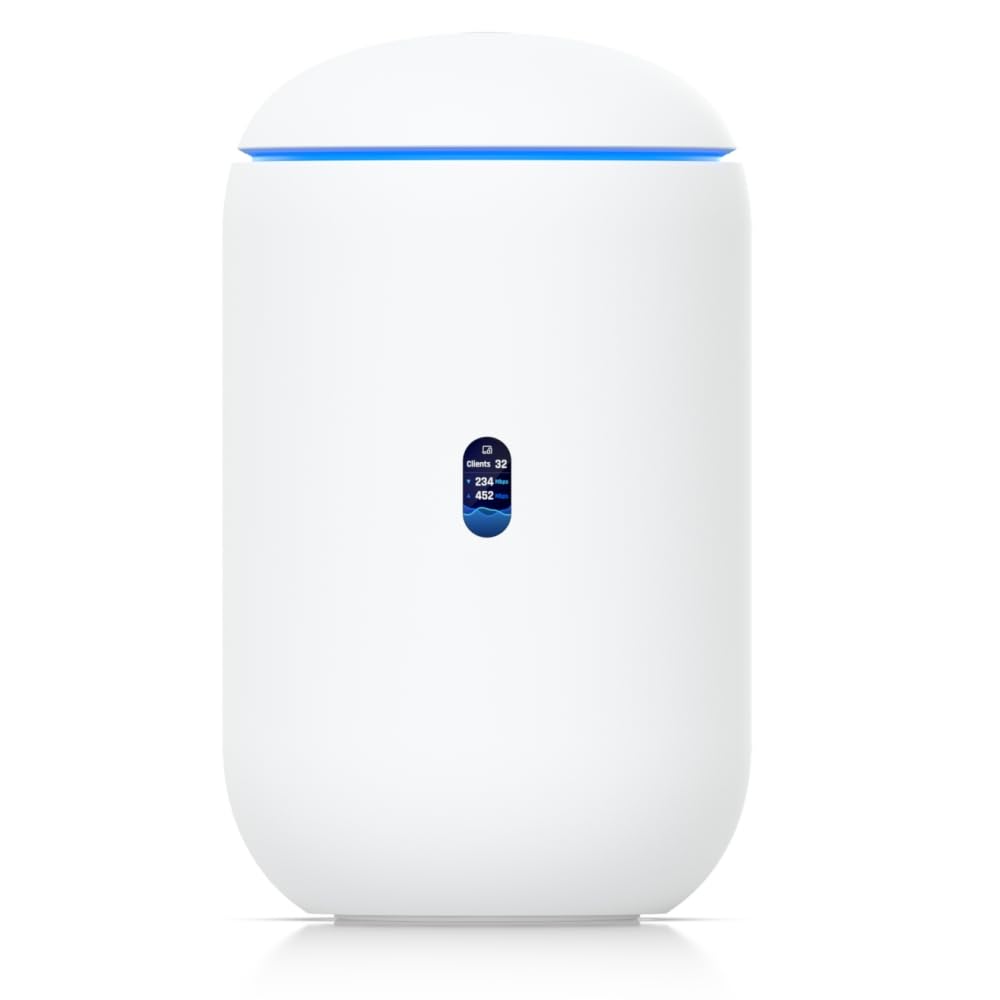
The Ubiquiti UniFi Dream Router 7 is not just a router — it is the control center for an entire UniFi ecosystem. The 10G SFP+ WAN port provides direct fiber termination, while the 2.5GbE RJ45 WAN offers a fallback for cable modems. A built-in four-port switch with one PoE port lets you power access points or cameras directly.
Integrated six-stream Wi-Fi 7 with 6 GHz support covers typical homes, but the real draw is the UniFi application suite. You get granular traffic analysis, client management, firewall rules, and deep packet inspection — all from a single dashboard. The UDR7 also supports 30+ UniFi devices and 300+ clients, making it overkill for small apartments but ideal for growing smart homes or small businesses.
Setup takes under ten minutes via the mobile app, though the initial internet provisioning can be finicky if your ISP requires PPPoE credentials. Some users report that the Wi-Fi range (especially on 5 GHz) is slightly less than competing consumer routers, so you may need a separate UniFi access point for large homes. For those who value control and visibility over raw speed, the UDR7 is unmatched.
Why it’s great
- Full UniFi ecosystem — switch, AP, and camera management
- 10G SFP+ WAN for direct fiber connectivity
- Built-in security and deep traffic analytics
Good to know
- Wi‑Fi range may require separate AP for larger homes
- Initial setup can be tricky with PPPoE ISPs
3. TP-Link Archer BE600 (BE9700)

The TP-Link Archer BE600 brings true tri-band Wi-Fi 7 to the party. A 10 Gbps WAN/LAN port and a dedicated 2.5 Gbps WAN/LAN port give you dual multi-gig uplink options, and the three additional 2.5 Gbps LAN ports ensure your wired gaming rig and NAS never share a single gigabit bottleneck. The BE9700 speed rating breaks down to 5,765 Mbps on 6 GHz, 2,882 Mbps on 5 GHz, and 1,032 Mbps on 2.4 GHz.
Multi-Link Operation (MLO) is a standout feature here — it bonds multiple frequency bands simultaneously to reduce latency and improve reliability, especially when you are moving around your home. The router also supports HomeShield, TP-Link’s security suite, and both VPN client and server modes. The Tether app makes initial setup nearly painless.
A portion of early buyers experienced sporadic 2.4 GHz disconnections that took firmware updates to resolve. Others noted that the router reboots under heavy Wi-Fi load, which defeats the purpose of a multi-gig upgrade. These issues are not universal, but they suggest the BE600 is still maturing in firmware. For early adopters willing to tinker, this tri-band router offers the best speed-per-dollar ratio in the premium tier.
Why it’s great
- True tri-band Wi‑Fi 7 with MLO for low latency
- 10G + 2.5G + 3x 2.5G port configuration
- HomeShield security and VPN support included
Good to know
- Some units experience 2.4 GHz dropout issues
- May reboot under heavy Wi‑Fi traffic load
4. GL.iNet Flint 3 (GL-BE9300)

The Flint 3 is built for users who need encrypted tunnels without sacrificing throughput. Its WireGuard and OpenVPN engines both hit 680 Mbps, meaning you can run a full-device VPN without bottlenecking your 2.5Gb internet plan. Five 2.5GbE ports give you plenty of wired headroom for a NAS, gaming PC, and streaming boxes.
Tri-band Wi-Fi 7 with MLO and support for 4K-QAM pushes aggregate speeds near 9 Gbps, though real-world Wi-Fi throughput from the 5 GHz band typically lands around 750 Mbps on a 1 Gbps service. Built-in AdGuard Home blocks ads and trackers at the DNS level across all connected devices. The open-source-friendly interface is accessible via IP login — no app required, though the optional mobile app works fine.
Wi-Fi range is the Flint 3’s most common criticism. Coverage is rated for 2,000 square feet, and several users report that the signal struggles to penetrate multiple floors beyond that area. The USB 3.0 port also underperforms for NAS-style file sharing, capping throughput at around 30 MB/s. If VPN speed is your priority and your home is compact, this router is a bargain.
Why it’s great
- Industry-leading WireGuard/OpenVPN throughput at 680 Mbps
- Five 2.5GbE ports for multi-gig wired LAN
- AdGuard Home built-in for network-wide ad blocking
Good to know
- Wi‑Fi range limited to approximately 2,000 square feet
- USB 3.0 file transfer speeds disappoint (~30 MB/s)
5. NETGEAR Nighthawk RS200

The Nighthawk RS200 delivers Wi-Fi 7 speeds up to 6.5 Gbps in a compact, antenna-less chassis that blends into a bookshelf or media cabinet. The 2.5 Gig internet port connects to your modem and passes multi-gig speeds to the Wi-Fi and wired LAN ports. This is a dual-band configuration, so it lacks the 6 GHz band found on tri-band models.
Setup is genuinely quick via the Nighthawk app — most users report being online within five minutes. The RS200 also supports guest networks and channel selection, and several owners noted a 50 percent speed improvement compared to their ISP’s gateway. Coverage is rated at 2,500 square feet, with strong signals reaching garages and basements in most homes.
One common pain point after a power outage: the RS200 does not auto-recover its internet connection, requiring a manual hard reset. The app also becomes inaccessible when the internet is down, blocking admin access. For households that rarely lose power, the RS200 offers a clean, reliable Wi-Fi 7 upgrade with none of the gamer aesthetic.
Why it’s great
- Compact, discreet design with hidden antennas
- Quick five-minute setup via Nighthawk app
- Strong coverage across 2,500 sq. ft.
Good to know
- No auto-recovery after internet outage
- App is inaccessible when WAN is down
6. NETGEAR Nighthawk RS180

The RS180 is the more affordable Nighthawk sibling, rated for BE5500 speeds (up to 5.5 Gbps) and covering 2,500 square feet. It shares the same 2.5 Gig internet port and the same compact, hidden-antenna design as the RS200. For households on gigabit or 2-gig fiber plans, the RS180 provides full-speed wired pass-through without needing tri-band Wi-Fi.
Real-world user reports praise the RS180 for solving connectivity issues that other routers could not. One owner replaced a Spectrum Wi-Fi 7 gateway because the RS180 eliminated buffering on Roku devices. Another upgraded from a Netgear R8000 and saw immediate improvements in coverage and stability. The router works with any ISP-provided modem, and the free expert help line is a welcome bonus for non-technical users.
The main complaint is that the range, while good, does not match the advertised 2,500 square feet for every home. Several users say the signal reaches most rooms but fades before covering the entire property. If your home is compact or you are willing to add a mesh extender, the RS180 is a reliable, no-fuss entry into Wi-Fi 7 multi-gig.
Why it’s great
- Compact bookcase-friendly design
- Solved streaming buffering issues where other routers failed
- Free expert help line included
Good to know
- Range may fall short for very large homes
- Lacks a 6 GHz band for tri-band speeds
7. GL.iNet Flint 3e (GL-BE6500)
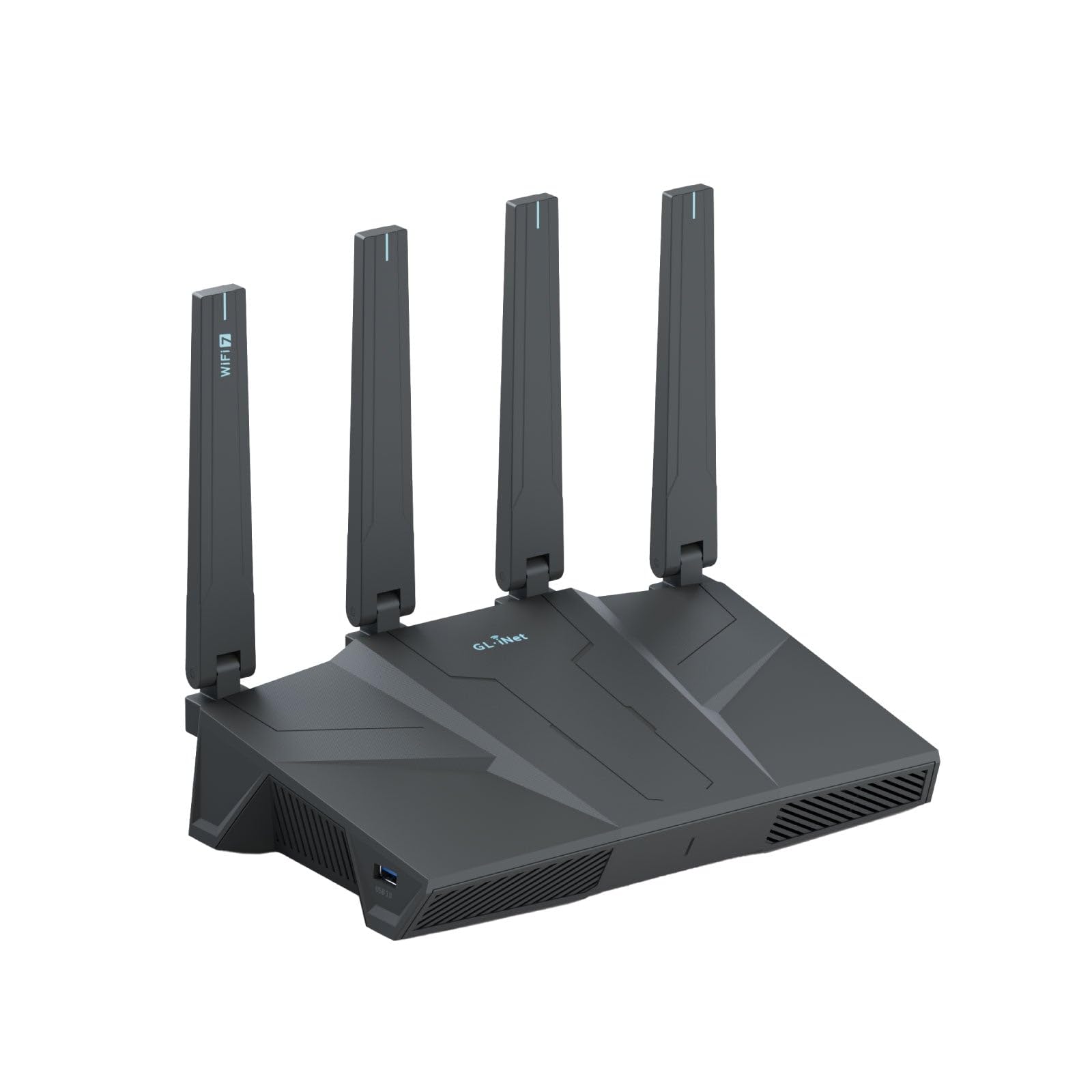
The Flint 3e packs five 2.5GbE ports into a compact shell, making it the best pure multi-gig wired switch-plus-router combo in the mid-range class. Dual-band Wi-Fi 7 with MLO and 4K-QAM delivers up to 6.5 Gbps aggregate wireless throughput, and the 1 GB DDR4 RAM keeps the web interface snappy even with dozens of active clients.
GL.iNet routers are beloved by the open-source community for their flexibility. The Flint 3e supports AdGuard Home out of the box, plus multiple VPN protocols (WireGuard, OpenVPN, Tailscale, Zerotier). The app and web admin panel are straightforward, and users report that setup takes minutes. The device also includes a USB port for 4G/5G modem failover, a rare feature at this price point.
The weak link is customer support — one frustrated user waited over 24 hours for a phone appointment, and a few others encountered Ethernet port failures out of the box. When it works (which is most of the time), the Flint 3e offers the best per-port value in the class. Just be prepared for potentially slow service if hardware issues arise.
Why it’s great
- Five 2.5GbE ports for extensive wired connectivity
- AdGuard Home and multi-VPN support included
- USB modem failover for backup internet
Good to know
- Customer support response times are very slow
- Intermittent reports of defective Ethernet ports
8. TP-Link Archer AX80

The Archer AX80 is the smart choice for buyers who want 2.5Gb wired connectivity without paying the Wi-Fi 7 premium. Wi-Fi 6 technology provides up to 4,804 Mbps on 5 GHz and 1,148 Mbps on 2.4 GHz — more than enough for gigabit internet and local streaming. Eight fixed high-gain antennas with Beamforming deliver coverage that many users say outperforms their previous three-AP mesh setup.
The 2.5 Gbps WAN/LAN port is the key feature here, letting you take full advantage of a multi-gig fiber plan on your hardwired desktop. On the wireless side, OneMesh compatibility means you can add a range extender later for a single seamless network. TP-Link HomeShield provides free basic security, parental controls, and QoS. Setup is simple via the web UI or Tether app.
A few users found the Quick Install scan useless (it redirects to Xfinity activation), and the router is incompatible with Starlink’s CGNAT, causing moderate NAT issues on Xbox. QoS also caused dropouts for one reviewer before they disabled it. For standard cable or fiber ISPs, the AX80 is arguably the best value-to-performance ratio on this list.
Why it’s great
- Exceptional range — often replaces multi-AP mesh setups
- 2.5G WAN/LAN port at a Wi‑Fi 6 price point
- OneMesh compatible for easy whole-home coverage
Good to know
- Quick Install scan is broken for some ISPs
- Not compatible with Starlink’s CGNAT
9. Cudy WR3600H

The Cudy WR3600H is a Wi-Fi 7 dual-band router that hits the lowest price of any model in this guide. It includes a 2.5G WAN port and four gigabit LAN ports, allowing your wired PC to bypass the 1 Gbps bottleneck while keeping the rest of the network on traditional 1Gb connections. Four external antennas with Beamforming provide solid coverage for small-to-midsize homes.
Cudy’s app enables easy network management and mesh expansion if you add another Cudy router later. The router also supports multi-VPN protocols (PPTP, L2TP, IPsec, OpenVPN, WireGuard, Zerotier) and basic parental controls. For the price, the feature set is remarkably complete — you get Wi-Fi 7, a 2.5Gb WAN, and mesh capability for less than many Wi-Fi 6 routers.
The reliability is inconsistent based on user reports. Some owners experience daily internet drops that require a modem reset, while others report that the router caused connection issues (“devices just spin getting a connection”) that disappeared when they reinstalled their old Linksys. Customer service takes up to four days to respond. The WR3600H is a viable option for the ultra-budget-conscious, but only if you are prepared for potential stability troubleshooting.
Why it’s great
- Lowest-cost Wi‑Fi 7 router with a 2.5G WAN port
- Multi-VPN support (WireGuard, OpenVPN, Zerotier)
- Cudy Mesh and app support for whole-home expansion
Good to know
- Reports of daily internet drops requiring modem reset
- Customer support response times of 4+ days
FAQ
Do I need a 2.5Gb router if my internet plan is only 1 Gbps?
Can I use a 2.5Gb router with a standard cable modem that only has a 1Gb port?
What is the difference between dual-band and tri-band Wi‑Fi on a 2.5Gb router?
Will a 2.5Gb router improve my gaming latency?
Final Thoughts: The Verdict
For most users, the 2.5gb router winner is the TP-Link Archer AX80 because it delivers strong Wi-Fi 6 coverage, a 2.5G WAN/LAN port, and OneMesh expandability at a mid-range price. If you want the absolute highest wired port density and 10G capability, grab the ASUS RT-BE88U. And for VPN-centric users who need encrypted multi-gig throughput, nothing beats the GL.iNet Flint 3.

Mo Maruf
I created WellFizz to bridge the gap between vague wellness advice and actionable solutions. My mission is simple: to decode the research and give you practical tools you can actually use.
Beyond the data, I am a passionate traveler. I believe that stepping away from the screen to explore new environments is essential for mental clarity and physical vitality.