Our readers keep the lights on and my smoothie glass nicely filled. As an Amazon Associate, I earn from qualifying purchases.
A bedwetting alarm is the most clinically proven tool for ending nighttime accidents, yet picking the wrong one can turn the process into a nightly battle of false alarms and frayed nerves. The sensor placement, alarm intensity, and whether a wire runs from pajama top to underwear all determine if the child wakes quickly or sleeps through the alert entirely.
I’m Mohammad Maruf — the founder and writer behind WellFizz. I’ve spent dozens of hours analyzing the sensor sensitivity, decibel output, and mode flexibility across seven popular bedwetting alarms to identify which designs actually build reliable wake-up habits.
This guide compares wired and wireless models, from budget-friendly units to premium systems with full support kits, so you can confidently choose the best bedwetting alarm for your child’s unique sleep patterns and sensitivity level.
How To Choose The Best Bedwetting Alarm
Every bedwetting alarm works on the same principle — detect moisture and wake the child — but the specific design choices determine whether the process takes two weeks or two months. The three factors below separate alarms that become part of a smooth routine from those that end up in a drawer.
Sensor Design and Placement
The sensor is the most critical component. Clip-on sensors attach directly to the underwear waistband and sit near the urethra for fast detection. Some models use integrated fabric sensors sewn into special briefs, which are more comfortable but harder to replace if they fail. A sensor that triggers on the first drop of urine trains the brain to associate bladder fullness with waking; a sensor that requires enough moisture to soak through fabric delays that connection and slows progress.
Wired vs. Wireless: Comfort and Reliability
Wired alarms connect the sensor to a wearable alarm unit via a thin cord. They are generally more reliable because the connection is direct and the sensor stays in place, but active sleepers can tangle the cord or pull the sensor loose. Wireless alarms separate the sensor transmitter from the receiver, eliminating the cord hazard. The trade-off is a higher price point and occasional signal delays if the transmitter shifts inside the underwear. For very deep sleepers, a wireless alarm with a receiver that can sit on the parent’s nightstand offers the best chance of waking an adult who can help.
Alarm Modes, Volume, and Tones
A single loud tone works for some children, but many quickly become desensitized and sleep through it. Alarms with multiple selectable tones prevent this habituation. Vibration-only modes are useful for children who are startled by loud noises or who have auditory sensitivities. Adjustable volume control is non-negotiable for families who need the alarm loud enough to wake the child but not so loud it frightens siblings in the next room. Some premium models also include a visual flashing light for children with hearing challenges.
Quick Comparison
On smaller screens, swipe sideways to see the full table.
| Model | Category | Best For | Key Spec | Amazon |
|---|---|---|---|---|
| Wet-Stop 3 Blue | Wired | Deep sleepers needing loud alert | 80 dB alarm tone | Amazon |
| DryEasy Pro Wireless | Wireless | Older children who toss and turn | 6 selectable sounds | Amazon |
| Wet-Stop3 Kit (w/ Pad) | Wired + Pad | Families needing mattress protection | Includes 34×36 pad | Amazon |
| ovevve Wireless (2026) | Wireless | Travel and summer camp use | 7 melodies, USB-C charging | Amazon |
| Malem Ultimate Camo | Wired Premium | Stubborn deep sleepers | 8 alarm tones + vibration | Amazon |
| Eclipse Wireless | Wireless | Older children, parent monitoring | 40-foot wireless range | Amazon |
| Rodger Wireless Kit | Wireless Premium | All-in-one system with briefs | 2 sensor briefs + pad | Amazon |
In‑Depth Reviews
1. Wet-Stop 3 Blue Bedwetting Alarm

The Wet-Stop 3 delivers the most proven wired-alarm design at a mid-range price point. Its 80-decibel output is loud enough to penetrate deep sleep, and the six varying tones prevent the child from habituating to a single sound. The patented clip-on sensor uses Quick Detect technology that triggers reliably on the first drops of urine.
Parents report success within two to three weeks when they follow the two-step shut-off method, which requires both holding the button and drying the sensor to prevent accidental resets. The included reward chart and star stickers give children a visual motivator, and the free downloadable guide helps parents structure the nighttime routine. The compact unit runs on two AAA batteries and weighs almost nothing on the pajama top.
A minority of sensitive children find the alarm too intense, and the wired design means the cord can tangle if the child rolls aggressively. Some users also note that the sensor can false-alarm from sweat, though wrapping it in a paper towel solves that issue. For the combination of proven effectiveness and low cost, this remains the most recommended starting point.
Why it’s great
- Six alarm tones prevent habituation
- Clinically proven success in 2–4 weeks
- Includes reward chart and instructional guide
- One-year warranty against defects
Good to know
- Wired cord can tangle with active sleepers
- Sweat can cause false alarms without paper-towel trick
- No volume control — output is fixed at 80 dB
- Some sensitive children find it startling
2. DryEasy Pro Wireless Bedwetting Alarm
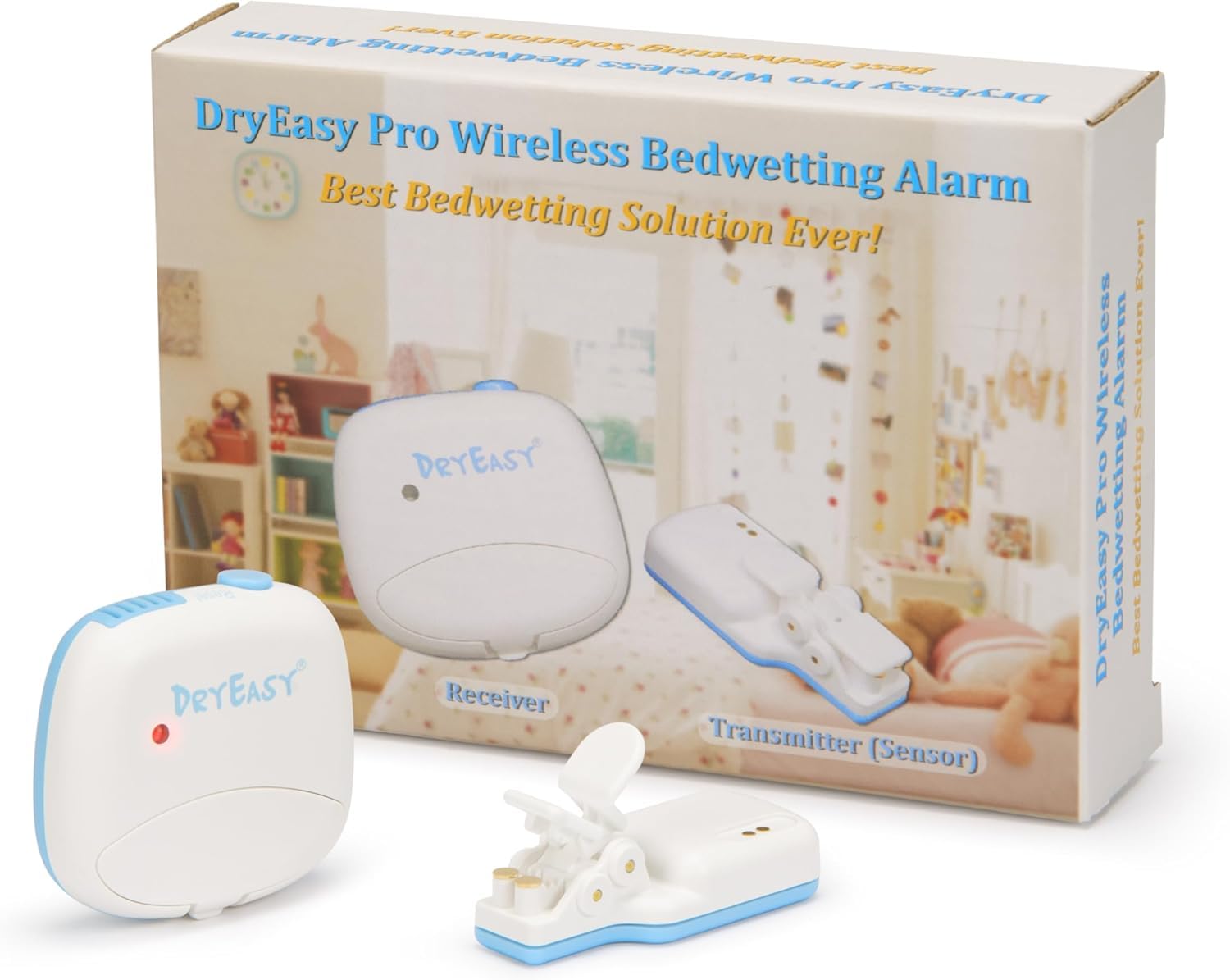
The DryEasy Pro eliminates the tripping hazard of wires while keeping the price accessible. Its new toggle clamp secures the transmitter to the underwear band more reliably than earlier versions, and the receiver can sit on the bedside table rather than requiring a body-worn unit. This design is especially useful for children who feel claustrophobic with a box clipped to their collar.
Six selectable sounds rotate randomly to prevent the child from sleeping through a familiar tone, and the six-level volume control lets parents find the threshold that wakes the child without frightening siblings. The three operation modes — sound only, vibration only, or combined — accommodate children with sensory differences, including those on the autism spectrum.
Battery life exceeds one month on a full charge, and the company replaces lost charging cords free of charge. Some users misplace the small transmitter because it stays in the underwear when doing laundry, and a few report that the alarm fails to trigger if the sensor isn’t positioned directly at the urine stream. Overall, the wireless freedom and customizable alert make this a strong entry-level upgrade from basic wired units.
Why it’s great
- True wireless design with no body cord
- Six-level volume control is rare at this tier
- Vibration-only mode for sensitive children
- Excellent battery life exceeding one month
Good to know
- Small transmitter can get lost in laundry
- Sensor positioning is critical for triggering
- Some users report missed detections in pull-ups
- No replaceable batteries — rechargeable only
3. Wet-Stop3 Kit with Waterproof Bed Pad

The Wet-Stop3 Kit pairs the proven alarm with a reusable waterproof mattress pad, eliminating the need to layer plastic sheets under the fitted sheet. The cotton-poly blend pad is machine washable and stays in place without shifting, so one accidental wetting doesn’t ruin the entire bedding setup. For families who want a single purchase that includes both training tool and mattress protection, this kit removes a major source of nightly friction.
The alarm itself shares the same 80-decibel output and six-tone selection as the standalone Wet-Stop 3, with the same two-step shut-off and clip-on sensor design. Parents report that having the pad simplifies cleanup to a single sheet swap rather than a full bed stripping, which reduces the stress of middle-of-the-night accidents. The star reward chart and downloadable guide are also included.
The wired design still risks tangling for very active sleepers, and the alarm’s single-volume nature means no fine-tuning for different sleep environments. A few users report that the sensor can unclip during the night, requiring the child to reattach it. For the added convenience of an included bed protector, this kit represents the smartest value for families just starting the training process.
Why it’s great
- Includes reusable waterproof mattress pad
- Same reliable alarm as standalone Wet-Stop 3
- Simplifies overnight cleanup
- Cotton-poly pad is machine washable
Good to know
- Wired sensor cord can tangle
- No volume control on alarm unit
- Sensor may unclip during active sleep
- Pad dimensions may not fit deep mattresses
4. ovevve Wireless Bedwetting Alarm
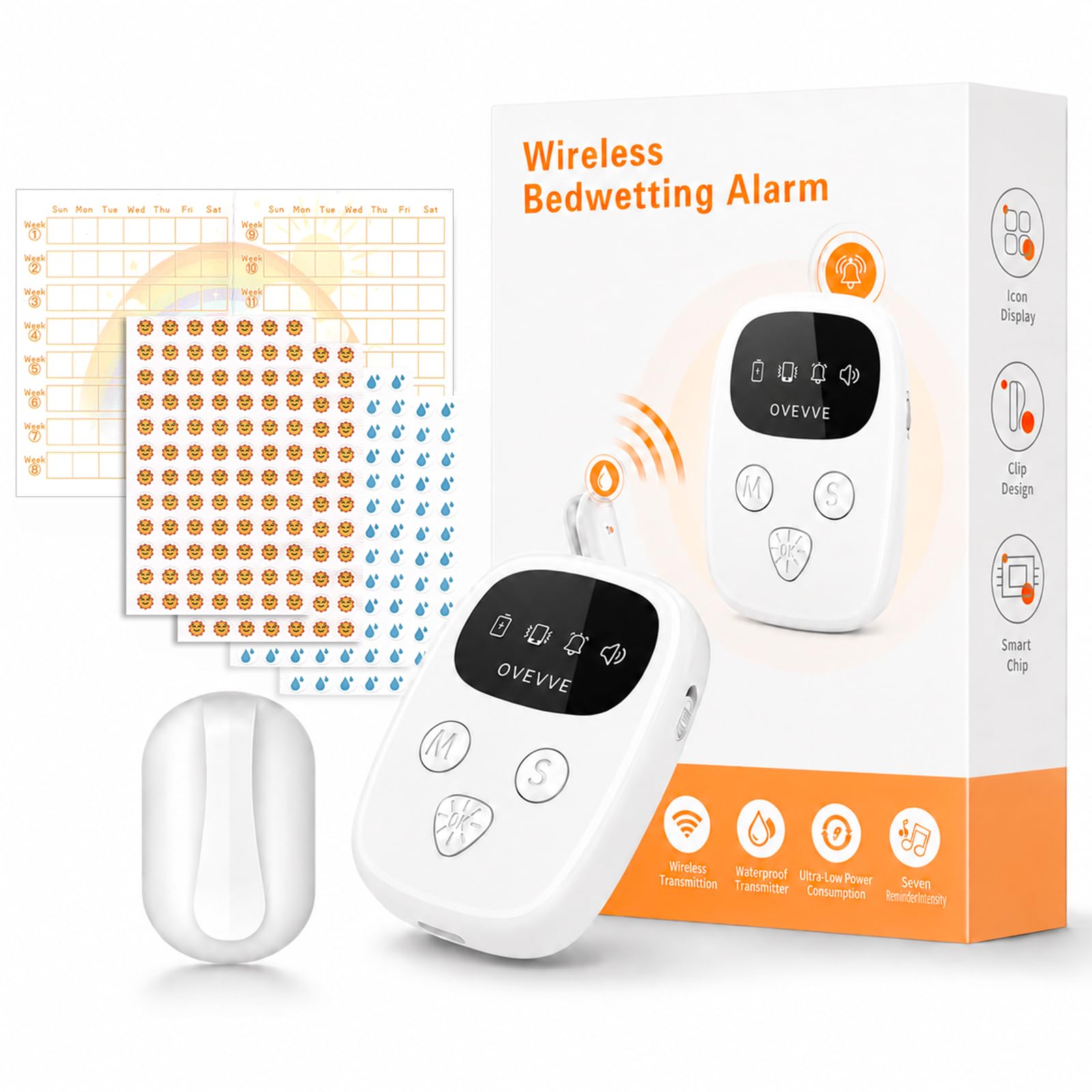
The ovevve alarm introduces modern convenience with USB-C charging for both the receiver and the magnetically attached transmitter. With seven different melodies and three alarm modes, it offers the widest variety of alerts in the mid-range category. The transmitter is fully waterproof and compact enough to be worn discreetly during travel or summer camp without drawing attention.
The receiver does not need to be worn on the body — it can sit on the nightstand or near the pillow, which is especially useful for children who reject wearing any device. The progress card and sun-and-water-drop stickers provide a structured reward system that builds motivation. The magnetic charging dock on the back of the receiver keeps the transmitter stored and topped up at all times.
Some users report false alarms even when the sensor is clean and dry, and a few note that the connection can drop if the transmitter shifts out of position during the night. The built-in battery eliminates the need for disposable cells, but the unit cannot operate while charging. For families who prioritize easy charging and travel-friendly size, this is the most convenient option in its range.
Why it’s great
- USB-C and magnetic charging for convenience
- Seven melodies prevent desensitization
- Waterproof, compact transmitter for travel
- Includes progress card and stickers
Good to know
- Some units experience false alarms
- Transmitter can lose connection if shifted
- Cannot operate while charging
- Replacement parts may not be available
5. Malem Ultimate Selectable Camouflage

The Malem Ultimate is the most recommended alarm among pediatric enuresis specialists for children who sleep through everything. It combines light, sound, and vibration from a 1-ounce box that sits on the pajama top, and the eight variable alarm tones include options specifically designed to penetrate deep sleep. The FDA registration and CE Marking confirm it meets medical-device standards.
The Secure Grip sensor clips firmly to the underwear and uses Quick Detect technology that senses one drop of urine, then triggers all three alert modes simultaneously. The included smartphone app provides instructional videos and FAQ access directly on a parent’s phone, reducing the learning curve. Parents of severe bedwetters, including children aged 7–12 who have never had a dry night, report success within three to eight weeks.
The wired design remains a minor inconvenience for active sleepers, and the higher cost puts it out of reach for budget-focused families. Some children find the combined vibration-plus-sound alarming on the first night, but most adapt within a few uses. For the child who has already failed with cheaper alarms, the Malem Ultimate offers the highest likelihood of breaking the cycle.
Why it’s great
- Combines light, sound, and vibration alerts
- FDA registered with medical-device standards
- Smartphone app for support and FAQ
- Secure Grip sensor stays in place
Good to know
- Higher price point than entry-level units
- Wired cord can still cause tangling
- First-night intensity may frighten sensitive kids
- Some units have finicky shut-off mechanism
6. Eclipse Wireless Bedwetting Alarm

The Eclipse Wireless differentiates itself with a 40-foot transmission range that lets the receiver sit in the parent’s bedroom while the child wears only a small, plastic-coated sensor. This setup ensures the parent hears the alarm even if the child sleeps through it, which is critical for very deep sleepers who cannot self-arouse. The sensor is thin and coated to avoid skin irritation, making it suitable for children with eczema or sensory sensitivities.
The wireless receiver runs on two included lithium metal batteries and can sit on a nightstand or clip to a belt loop. Parents of older children, including those aged 12 with lifelong nightly enuresis, report complete dryness within five to ten days of consistent use. The plastic sensor eliminates the risk of cord strangulation, giving peace of mind for younger children who move around during sleep.
The alarm sound is intentionally jarring to penetrate deep sleep, which some families find too harsh for sensitive children. Frequent false alarms from sweat are the most common complaint, and the sensor can be easily lost if it detaches inside the bedding. A reverse-alarm locating feature would help but is not included. For parents who need to hear the alarm from another room, the Eclipse remains the top choice.
Why it’s great
- 40-foot range for parent-room monitoring
- Plastic-coated sensor prevents skin irritation
- No wires for child to tangle or remove
- Proven quick results with older children
Good to know
- Sweat can cause frequent false alarms
- Jarring sound may upset sensitive children
- Small sensor can be lost in bedding
- No volume control or tone selection
7. Rodger Wireless Bedwetting Alarm Kit

The Rodger kit is the most complete system on the market, integrating two pairs of cotton boxer briefs with moisture-sensing threads sewn into the fabric, a rechargeable transmitter that snaps onto the briefs, and a wall-plug receiver that forces the child to get out of bed to turn it off. This requirement to fully stand up and walk reinforces the bladder–wake connection more effectively than a bedside button.
The included Dry Defender bed pad adds a 34×36-inch waterproof layer, and the Seven Steps to Nighttime Dryness book provides a pediatrician-approved framework for the entire process. The receiver offers eight different sounds and variable volume settings, all controlled via a single button. Parents report that children aged 6–8 achieve dryness within two to four weeks with consistent use.
The system is significantly more expensive than any other alarm on this list, and the integrated briefs are not available as standalone replacements — if a brief wears out, the entire kit may need replacement. Some users report connectivity issues between the transmitter and receiver after several months of use. For families who want a premium, all-inclusive solution with professional support materials, the Rodger delivers the most structured approach available.
Why it’s great
- Sensor briefs eliminate clip-on discomfort
- Wall-plug receiver forces out-of-bed turn-off
- Includes bed pad and professional guidebook
- Pediatrician-recommended framework
Good to know
- High upfront cost compared to other alarms
- Briefs not sold separately for replacement
- Connectivity issues reported after extended use
- Briefs run slightly small; consider sizing up
FAQ
What is the typical success rate of a bedwetting alarm?
How do I stop false alarms caused by sweat?
Should I choose a wired or wireless alarm for my child?
What age is appropriate to start using a bedwetting alarm?
Final Thoughts: The Verdict
For most users, the best bedwetting alarm winner is the Wet-Stop 3 Blue because it combines proven clinical effectiveness with a price that makes it accessible to any family, and the six-tone selection prevents the desensitization that ruins results with single-tone alarms. If you want wireless freedom without the high cost, grab the DryEasy Pro Wireless. And for a stubborn deep sleeper who has tried everything else, nothing beats the multi-alarm power of the Malem Ultimate.

Mo Maruf
I created WellFizz to bridge the gap between vague wellness advice and actionable solutions. My mission is simple: to decode the research and give you practical tools you can actually use.
Beyond the data, I am a passionate traveler. I believe that stepping away from the screen to explore new environments is essential for mental clarity and physical vitality.