Our readers keep the lights on and my smoothie glass nicely filled. As an Amazon Associate, I earn from qualifying purchases.
Pulling a dull blade through a ripe tomato only to crush it is a kitchen failure that repeats weekly. The root cause isn’t your knife’s steel — it’s the absence of a reliable, repeatable angle that only an automatic system can deliver.
I’m Mohammad Maruf — the founder and writer behind WellFizz. After spending dozens of hours analyzing wheel composition, motor stability, and abrasive longevity across the current market, this guide separates machines that restore edges from those that grind them down.
Whether you maintain a set of German stainless or a collection of Japanese carbon steel, finding the best automatic knife sharpener means understanding the real difference between diamond plating and generic corundum wheels.
How To Choose The Best Automatic Knife Sharpener
Choosing an electric sharpener is less about brand loyalty and more about matching the abrasive material, stage architecture, and angle guidance system to the steel you own. The wrong combination removes too much metal or fails to set a durable edge.
Abrasive Material: Diamond vs. Sapphirite vs. Corundum
Diamond abrasives are the hardest natural substance and cut through high-carbon and stainless alloy steels with minimal heat buildup. Sapphirite, used by Presto, is a synthetic ceramic that works well for routine maintenance but wears faster on very hard steel. Avoid corundum-based wheels if you own blades with a Rockwell hardness above 56.
Stage Count and Edge Progression
A 2-stage system combines coarse grinding and fine honing — sufficient for weekly touch-ups. A 3-stage system adds a dedicated polishing or stropping slot that removes the microscopic burr left by the diamond wheels, producing a smoother cutting edge that lasts longer between sharpenings.
Guide Mechanism: Fixed vs. Spring-Loaded
Fixed guides lock the blade into a preset angle but can leave a burr if the blade tapers. Spring-loaded guides, found on premium units like Chef’sChoice, flex to maintain constant contact with both sides of the edge, significantly reducing the risk of uneven material removal and accidental rounding of the tip.
Quick Comparison
On smaller screens, swipe sideways to see the full table.
| Model | Category | Best For | Key Spec | Amazon |
|---|---|---|---|---|
| Chef’sChoice 15XV | Premium | Reprofiling hard steel | 3-stage, 15° edge, metal housing | Amazon |
| Chef’sChoice UltraHone | Mid-Range | Daily home use | 2-stage, diamond abrasives | Amazon |
| Homly 3-Stage | Mid-Range | Versatile multi-blade sets | 3-stage, diamond, spring guides | Amazon |
| Enutogo 2-Stage | Mid-Range | Budget upgrade from manual | 2-stage, diamond, 20° edge | Amazon |
| Presto EverSharp | Value | Light kitchen maintenance | 2-stage, Sapphirite wheels | Amazon |
| Chef Pro 2-Stage | Budget | Occasional sharpening | 2-stage, compact design | Amazon |
| Dawnstar S865 | Budget | Entry-level automation | 2-stage, diamond, 100-240V | Amazon |
In‑Depth Reviews
1. Chef’sChoice 15XV Professional Electric Knife Sharpener

The Chef’sChoice 15XV is built around a 3-stage EdgeSelect system that reprofiles standard 20-degree factory edges into a 15-degree Trizor XV geometry. The brushed metal housing houses a motor that runs between 65 and 75 dB — noticeable but not intrusive — and the 5-pound weight provides stability during repeated passes. Stage 1 and 2 use 100-percent diamond plating for coarse and fine grinding, while Stage 3 employs a patented flexible abrasive system to polish and remove the burr without scratching.
Real-world tests show that a heavily dulled 4-year-old chef’s knife restores to a paper-cutting edge in about 5 minutes. The spring-loaded guides automatically adjust to blade thickness, which prevents rounding of the tip that plagues fixed-guide sharpeners. Users report the unit lasting 5+ years under weekly use with no degradation in wheel performance.
The 15-degree edge is sharper than the standard 20-degree angle but also more delicate — not ideal for heavy chopping or bone contact. This unit is designed for cooks who prioritize slicing precision and are comfortable maintaining a thinner edge geometry. It also handles serrated blades effectively through the Stage 3 slot.
Why it’s great
- Three-stage diamond system produces a polished, burr-free edge
- Spring-loaded guides prevent tip rounding and uneven wear
- Reprofiles to 15 degrees for noticeably better slicing performance
Good to know
- 15-degree edge requires more careful handling for heavy tasks
- Unit ships in a plain box without retail packaging
2. Chef’sChoice Professional UltraHone 2-Stage

The UltraHone pairs 100-percent diamond abrasives in Stage 1 with advanced micron-size diamond plating in Stage 2, allowing it to handle both straight-edge and serrated knives. The 2-stage design is straightforward — insert, pull through, repeat — and the precision angle guides eliminate guesswork for achieving a consistent 20-degree edge. Weighing just 16 ounces, it’s significantly lighter than the 15XV but remains stable on countertops thanks to integrated rubber feet.
Users with Wusthof and Henckels German stainless steels report the UltraHone restores edges to a smooth, glass-like finish that outperforms factory sharpness. The compact form factor (under 5 inches tall) makes it easy to store in drawers or small cabinets. It’s also capable of sharpening serrated knives by running the blade through the same slots, though results on deeply scalloped edges are less consistent than on straight blades.
The trade-off for the lighter weight and simpler operation is slower material removal on very dull blades. Users needing to reprofile a heavily nicked blade may require 8-10 passes per slot rather than the standard 3-4. The unit works best as a maintenance sharpener for knives that are still reasonably sharp.
Why it’s great
- Micron-size diamonds produce a smooth, polished cutting edge
- Lightweight and compact for easy storage
- Effortless operation with precision angle guides
Good to know
- Slower material removal on heavily dulled blades
- Not designed for reprofiling edge angles
3. Homly Professional 3-Stage Electric Knife Sharpener

The Homly 3-stage sharpener uses 100-percent diamond abrasives in its first two stages and a dedicated polishing stage for final edge refinement. The flexible spring guide rod maintains consistent contact across the entire blade length, which is critical for achieving a uniform arch edge rather than a flat grind that weakens toward the tip. The motor runs noticeably quieter than many competitors in its class, with users describing the noise level as unobtrusive during operation.
Stage 1 removes nicks and reshapes the edge, Stage 2 hones, and Stage 3 polishes — a progression that mirrors the workflow of the Chef’sChoice 15XV but at a lower price tier. Users with 60 years of sharpening experience reported that the Homly holds the blade firmly enough to avoid the side-to-side wobble that leaves scratch patterns on the blade face. It handles straight-edge knives across a wide range of steel types, including ceramic, though ceramic blades should only be run through the diamond stages sparingly.
The downsides include a learning curve around pull speed. Moving too slowly through Stage 1 can create a visible indent on the blade, and the instructions recommend practicing on an old knife first. The unit lacks a metal debris collection box — shavings collect inside the housing and require periodic cleaning by removing the base.
Why it’s great
- Three-stage system with dedicated polishing slot
- Spring guide rod reduces uneven edge wear
- Quieter motor than most mid-range units
Good to know
- Slow pull speed can leave blade indentations
- No external metal debris collection system
4. Enutogo 2-Stage Diamond Knife Sharpener

The Enutogo applies a traditional 20-degree edge and uses 100-percent diamond abrasives that are harder and longer-lasting than standard corundum grinding wheels. The 2-stage system separates coarse sharpening from polishing, and the angle guide function ensures consistent contact through the entire blade length. The unit stands upright at 10.4 inches tall with a compact 4.2 x 3.7-inch footprint, making it one of the more space-efficient options on this list.
Users transitioning from manual sharpening report that the Enutogo dramatically reduces the effort required to restore dull kitchen knives. The oblique insertion method — insert the blade at a slight angle and pull from outside to inside — produces sharp edges in 3-6 passes per slot. The diamond wheels leave a fine finish on straight-edge blades, though some users note very fine grooves on the blade face that disappear after a few honing sessions.
The unit works best with standard German and Japanese kitchen knives. It handles ceramic blades gently, but repeated sharpening will wear the thin ceramic edge faster than diamond wheels would on steel. The lack of a serrated-specific slot means scalloped edges must be sharpened manually on the coarse wheel, which can be imprecise.
Why it’s great
- True diamond abrasives at a mid-range price point
- Compact vertical design saves counter space
- Consistent 20-degree angle guide for repeatable results
Good to know
- Fine grooves may appear on blade face after sharpening
- No dedicated serrated knife slot
5. Presto EverSharp Electric Knife Sharpener

The Presto 08800 uses Sapphirite sharpening wheels — an ultra-hard ceramic material originally developed for professional sharpening shops — rather than diamond abrasives. The 2-stage system uses Stage 1 for precision grinding to create the initial edge angle and Stage 2 for fine honing and polishing. The built-in precision blade guides lock the knife at the correct angle automatically, eliminating the need for manual angle estimation.
Users report that a single pass through both stages transforms a very dull knife into one that easily cuts through cardboard, paper, and carrots. The unit sharpens most non-serrated blades at 20 degrees and takes roughly 1 minute for a full sharpening cycle. The lightweight plastic construction (under 3 pounds) and suction cup feet keep it stable during operation, though the motor produces a noticeable grinding noise that is louder than mid-range diamond units.
The Sapphirite wheels wear faster than diamond when used on high-hardness steels like those in Wusthof or Shun. For knives with a Rockwell hardness above 58, the Presto works best as a maintenance sharpener rather than for reprofiling. It is not recommended for ceramic knives or blades with acute 15-degree edges.
Why it’s great
- Fast sharpening — 1 minute for a full cycle
- Sapphirite wheels deliver professional-grade material removal
- Built-in guides eliminate guesswork for beginners
Good to know
- Wheels wear faster on very hard steel
- Louder motor than diamond-based competitors
6. Chef Pro Electric Kitchen Knife Sharpener

The Chef Pro uses a 2-stage sharpening system with coarse and fine wheels housed in a compact 8 x 4.75 x 3.5-inch body. Three suction cups on the base provide solid countertop adhesion during operation, reducing the risk of the unit sliding when pressure is applied. Built-in guides accommodate kitchen knives, sports knives, and scissors — the scissor sharpening slot is a useful addition not found on many entry-level electric sharpeners.
Users report that the machine revives very dull knives after 6-8 passes per slot, with noticeable improvement after the first pass. The mess-free receptacles with removable plugs collect metal shavings and are easy to empty simply by pulling out the plug and rinsing. The simple on/off front switch and lightweight design make it easy to store in a drawer or on a shelf when not in use.
The motor lacks the power of larger units, meaning heavily nicked blades take longer to restore. The coarse wheel removes material slowly, which reduces the risk of over-grinding but extends the sharpening session. Some users note that the suction cups lose grip on textured or uneven countertops, requiring a smooth surface for reliable operation.
Why it’s great
- Includes a dedicated scissor sharpening slot
- Suction cup base provides stable operation on smooth surfaces
- Easy-to-clean metal shard receptacles
Good to know
- Slower material removal on heavily dulled blades
- Suction cups may struggle on textured countertops
7. Dawnstar S865 Electric Knife Sharpener
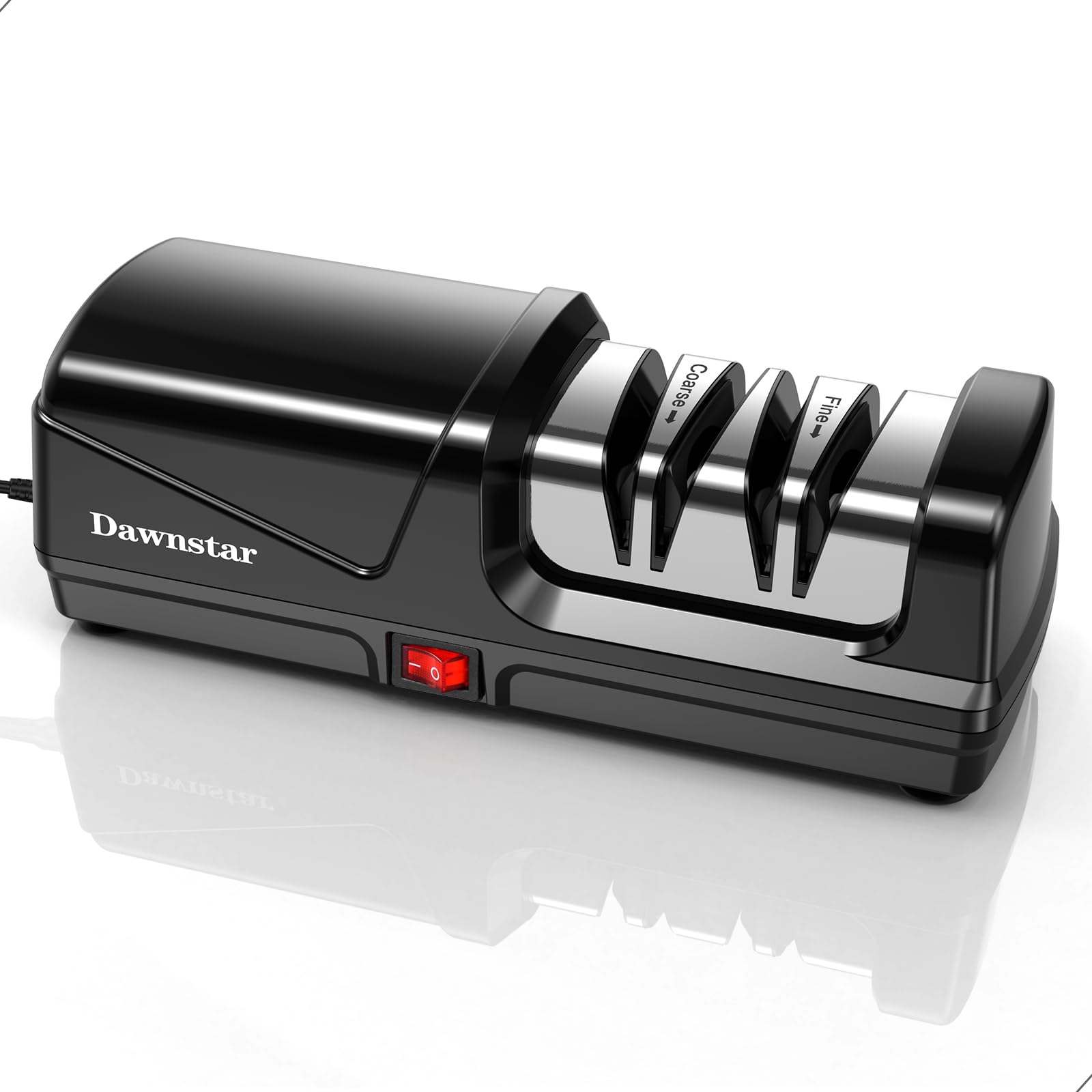
The Dawnstar S865 features a dual sharpening system with diamond abrasives — a notable inclusion at its price point. The crude stage handles quick edge restoration while the fine stage polishes for a smoother, burr-free finish. A direction guide piece in each slot automatically positions the blade at the correct angle, removing the learning curve associated with manual sharpening. Four anti-slip foot pads and an ergonomic handle reduce vibration during use, making the sharpening process more controlled.
Users report that the unit sharpens knives in approximately 2 seconds per pass, with the ability to bring old knife sets back to life quickly. The universal voltage design (100-240V) makes it suitable for international use, a unique feature among budget sharpeners. The included metal dust collection box catches shavings and is easy to empty after each session.
The diamond wheels are less coarse than those on premium units, so heavily nicked or damaged blades may require more passes to fully restore. Some users caution that improper hold technique can cause the back end of the knife to round if the blade is not pulled straight through. The plastic housing feels less rigid than the metal-bodied Chef’sChoice models, though it holds up well under normal home use.
Why it’s great
- Diamond abrasive wheels at an entry-level price point
- Universal voltage for international use
- Anti-vibration design with collection box for metal shavings
Good to know
- Less aggressive material removal on heavily damaged edges
- Tip rounding risk if pull technique is inconsistent
FAQ
Can an automatic sharpener handle ceramic knives?
How many passes should I make per slot?
Will an electric sharpener damage my expensive German or Japanese knives?
How often should I clean out the metal shavings collection box?
Final Thoughts: The Verdict
For most users, the best automatic knife sharpener winner is the Chef’sChoice 15XV because its 3-stage diamond system and spring-loaded guides deliver professional edges without the guesswork. If you want a quieter, more affordable 3-stage alternative, grab the Homly Professional. And for budget-conscious buyers who own standard stainless steel kitchen knives, the Presto EverSharp provides fast, reliable sharpening without breaking the bank.

Mo Maruf
I created WellFizz to bridge the gap between vague wellness advice and actionable solutions. My mission is simple: to decode the research and give you practical tools you can actually use.
Beyond the data, I am a passionate traveler. I believe that stepping away from the screen to explore new environments is essential for mental clarity and physical vitality.