Our readers keep the lights on and my smoothie glass nicely filled. As an Amazon Associate, I earn from qualifying purchases.
A home speaker should blend into your living space, not dominate it, until you hit play and the room transforms. The best ones disappear visually while delivering a soundstage that makes you forget the size of the box they came in. Whether you are setting up a dedicated listening corner, upgrading your desktop audio, or filling an open-concept living area with consistent sound, the choice comes down to driver architecture, amplification philosophy, and the connectivity ecosystem you already own.
I’m Mohammad Maruf — the founder and writer behind WellFizz. This guide is the result of hundreds of hours spent cross-referencing frequency response curves, amplifier topologies, driver materials, and real-world user feedback across the entire at home speaker landscape.
You need a speaker that matches your room’s acoustics, your source equipment, and your tolerance for wires. This review of the best at home speaker options breaks down exactly which models justify their place on your shelf, desk, or floor.
How To Choose The Best At Home Speaker
The home speaker market splits into three distinct camps: passive speakers that require a separate amplifier, powered (active) speakers with amplifiers built into the cabinet, and all-in-one wireless speakers that stream directly from your network. Your choice dictates everything from placement flexibility to future upgrade options. Before browsing models, decide whether you want a system you can build piece by piece or a self-contained unit that delivers sound out of the box.
Driver Configuration and Cabinet Design
A two-way speaker uses one tweeter and one woofer, while a three-way adds a dedicated midrange driver for cleaner vocals. The cabinet material — MDF versus plastic versus natural wood veneer — affects resonance damping. Ported (bass reflex) cabinets extend low-frequency output by venting air from inside the enclosure, but require careful placement away from walls to avoid boomy bass. Sealed cabinets produce tighter, more accurate bass at the cost of deeper extension. For a home listening environment, a front-ported design gives you the most placement flexibility without sacrificing low-end response.
Amplification and Connectivity Ecosystem
Powered speakers eliminate the need for a separate receiver, simplifying setup and reducing cable clutter. Look for RMS wattage rather than peak power — continuous RMS tells you how cleanly the speaker plays at moderate volumes. For wireless speakers, the protocol matters more than the number: Wi-Fi streaming supports higher bitrates than Bluetooth, and codecs like LDAC (on Android) and AirPlay 2 (on Apple devices) preserve near-lossless quality. If you own a turntable, verify that the speaker includes a built-in phono preamp or a line-level RCA input.
Quick Comparison
On smaller screens, swipe sideways to see the full table.
| Model | Category | Best For | Key Spec | Amazon |
|---|---|---|---|---|
| MEVOSTO DS19 | Powered Bookshelf | Desktop & TV audio | 36W RMS, 5″ woofer | Amazon |
| Sony SS-CS5M2 | Passive Bookshelf | Hi-Fi system building | 3-way, 5.12″ woofer | Amazon |
| Sonos Era 100 SL | Wireless Smart | Whole-home audio | Dual angled tweeters | Amazon |
| Denon Home 150 | Wireless Smart | HEOS multi-room | 1″ tweeter, 3.5″ woofer | Amazon |
| Marshall Stanmore III | Wireless Smart | Style-first listening | Bluetooth 5.2, RCA/Aux | Amazon |
| Bose Lifestyle Ultra | Wireless Smart | Immersive single-room | TrueSpatial Audio | Amazon |
| Klipsch R-40PM | Powered Bookshelf | Critical music listening | 90° Tractrix Horn, 4″ woofer | Amazon |
| Edifier S880DB MKII | Powered Bookshelf | Audiophile desktop | 88W RMS, LDAC, 24-bit/192kHz | Amazon |
| Sony SS-CS3 | Passive Floor-Standing | Full-range home theater | 3-way, 4-driver tower | Amazon |
In‑Depth Reviews
1. Klipsch Reference R-40PM Powered Bookshelf Speakers
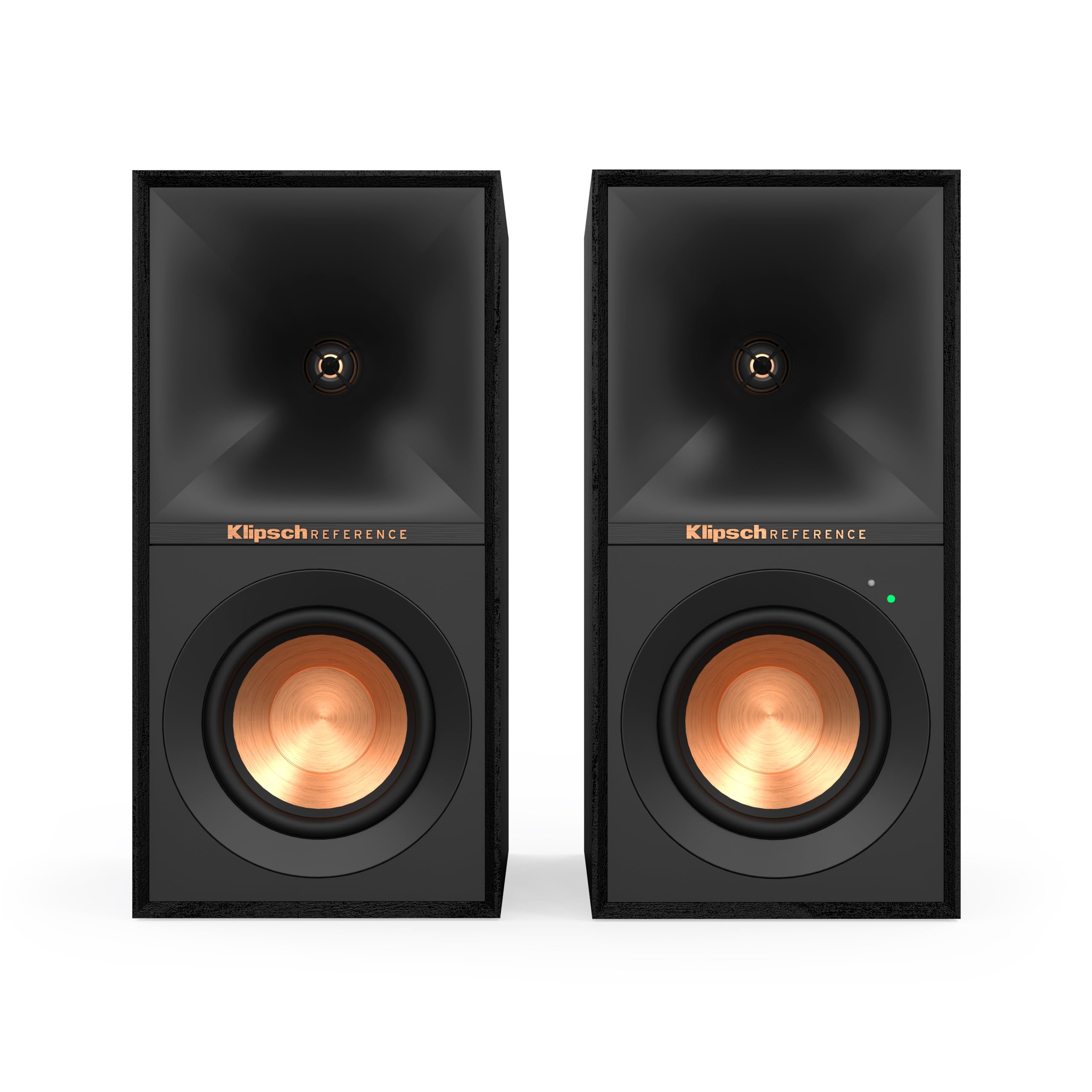
The Klipsch R-40PM brings the brand’s signature horn-loaded tweeter technology to a powered bookshelf format, eliminating the need for a separate amplifier while retaining the dynamic, live-sound character that Klipsch is known for. The 90-degree by 90-degree Tractrix horn controls high-frequency dispersion, creating a wide, precise soundstage that feels larger than the cabinet dimensions suggest. The 4-inch spun-copper TCP woofers use trickle-down driver tech from the Reference Premiere line, delivering punchy, articulate bass that stays tight at moderate volumes.
Connectivity covers the essentials: Bluetooth for wireless streaming, a phono input with a ground screw terminal for turntables, plus digital optical and analog RCA inputs. The built-in amplifier is tuned specifically to the drivers, so you get a coherent, optimized sound without the guesswork of matching a separate amp. Users consistently report clear, warm sound with outstanding detail retrieval, even at higher volumes where lesser powered speakers begin to distort.
The main trade-off is bass depth — the 4-inch woofers produce excellent mid-bass punch but don’t reach the sub-50 Hz region. For listeners who want full-range sound without a subwoofer, a larger driver or a floor-standing model may be more satisfying. The remote control feels basic compared to the speaker’s otherwise premium build.
Why it’s great
- Horn-loaded tweeter delivers exceptional clarity and soundstage width for a compact cabinet
- Built-in phono preamp lets you connect a turntable directly without extra gear
- Powered design simplifies setup while delivering perfectly matched amplification
Good to know
- 4-inch woofers limit deep bass extension below 50 Hz
- Some units exhibit an auto-on behavior that keeps the speaker powered after manual shutoff
2. Edifier S880DB MKII Hi-Fi Bookshelf Speakers
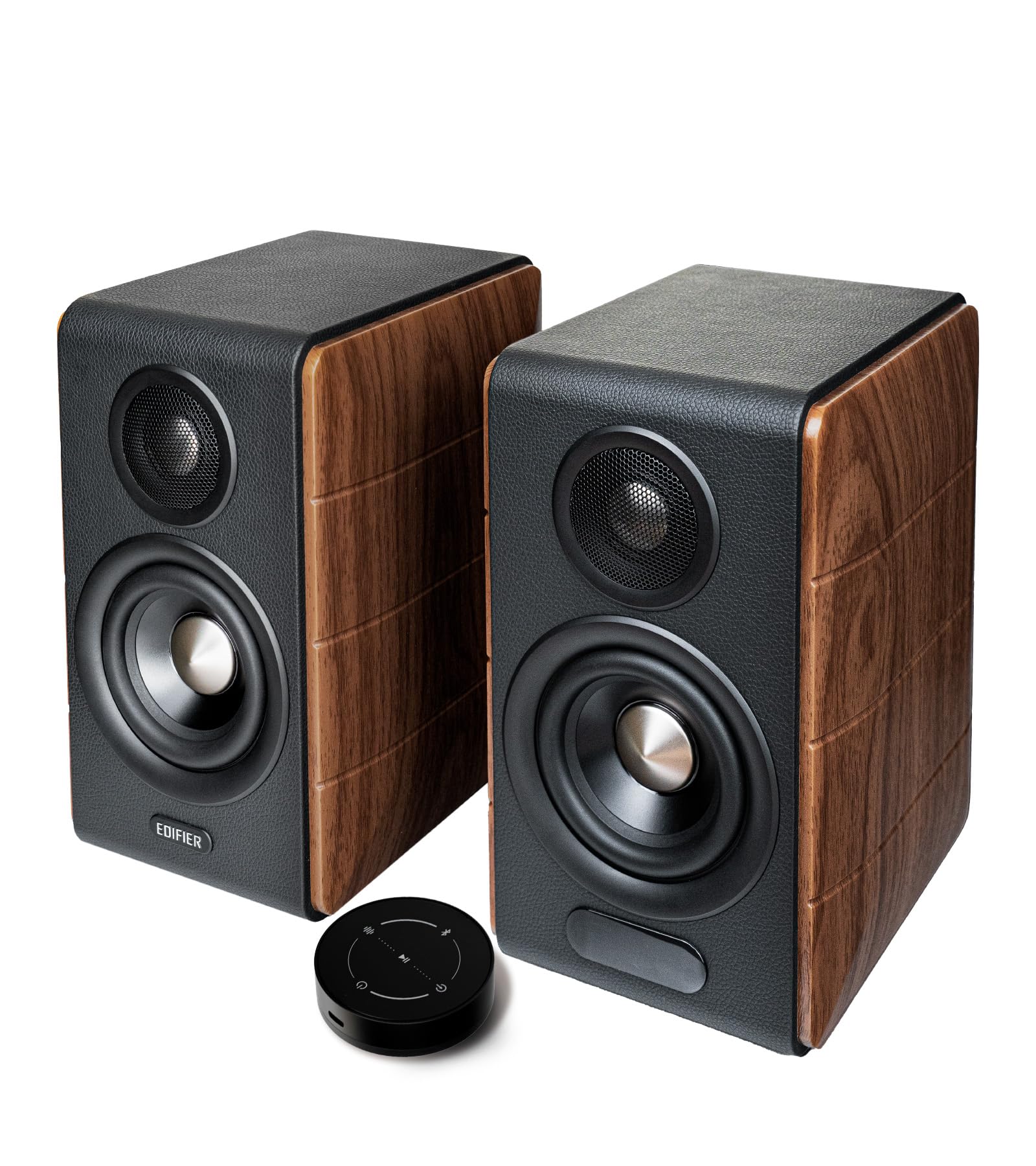
Edifier’s S880DB MKII is a precision-engineered active speaker system built for listeners who demand reference-grade clarity from a compact desktop footprint. The dual Class-D amplification delivers 12 watts per tweeter and 32 watts per woofer — 88 watts RMS total — with independent crossover control handled by a 16-core XMOS DSP processor that runs at 2,000 MIPS. This processing muscle ensures real-time speaker compensation and dynamic range control, eliminating the muddy crossover artifacts common in lower-tier powered speakers.
The driver complement pairs 1.25-inch titanium-dome tweeters with 3.75-inch aluminum mid-woofers, covering a frequency range of 20 Hz to 40 kHz. The titanium dome delivers airy, extended highs without the metallic harshness that plagues lesser metal tweeters. Wireless streaming supports LDAC at up to 990 kbps, giving Android users near-lossless Bluetooth performance that rivals wired connections. Wired inputs include USB-C, optical, coaxial, and RCA, with 24-bit/192 kHz playback on the digital inputs.
The cabinet uses MDF with internal damping to suppress resonance, and the dark wood veneer finish looks substantially more expensive than the price suggests. The remote control is small and can feel flimsy, but rear-panel controls and a keyboard volume knob provide reliable alternatives. For desktop audiophiles who want a single-box solution that out-resolves most passive setups at twice the price, this is a compelling option.
Why it’s great
- 16-core XMOS DSP enables precise crossover tuning and dynamic range control
- LDAC Bluetooth streaming preserves near-lossless quality wirelessly
- Titanium-dome tweeters deliver extended, fatigue-free high-frequency detail
Good to know
- Remote control feels cheap compared to the speaker build quality
- 3.75-inch woofers benefit from the subwoofer output for full-range listening
3. Bose Lifestyle Ultra Speaker
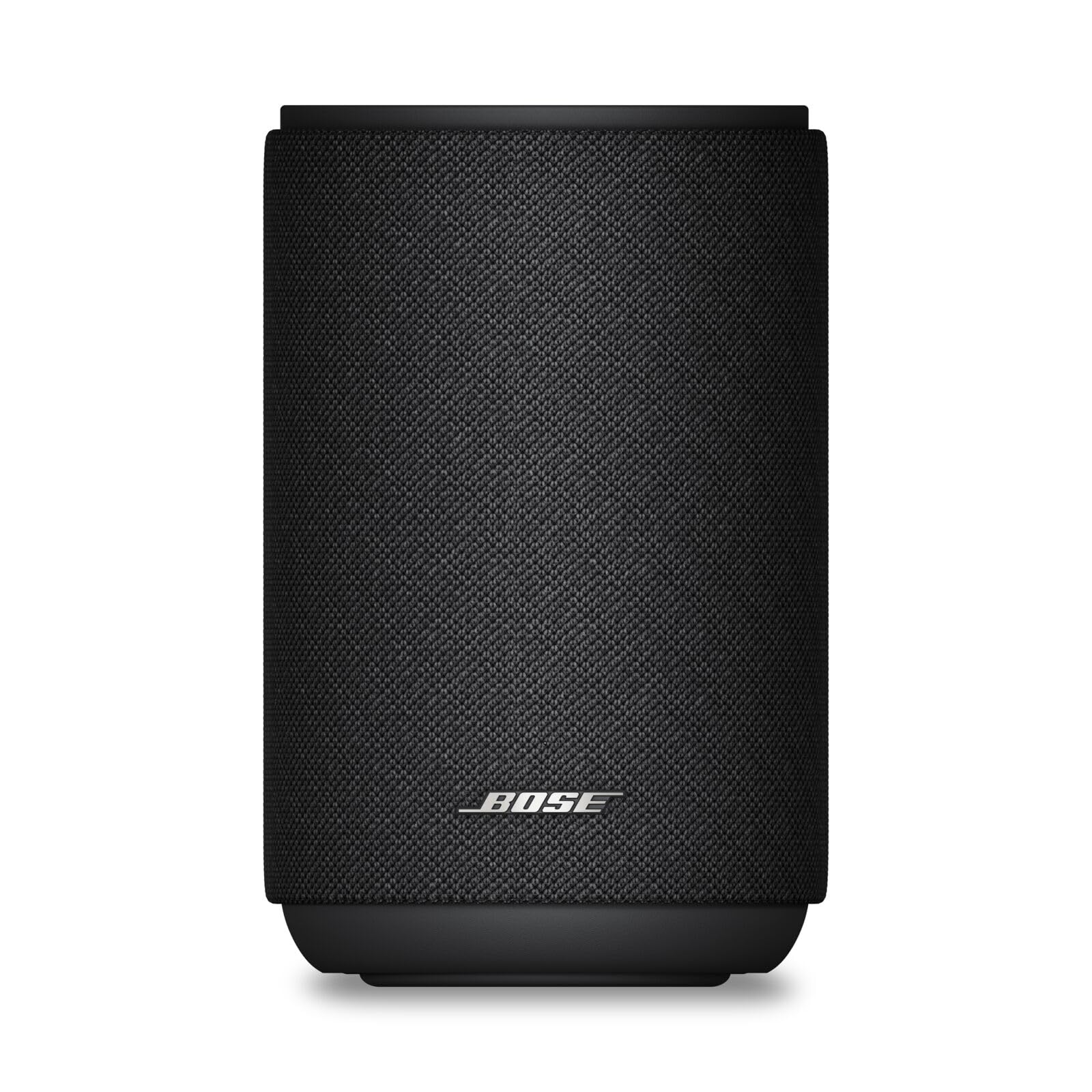
The Bose Lifestyle Ultra is a versatile wireless speaker that aims to be the single audio hub for an entire room. Its TrueSpatial Audio processing creates a wide, immersive sound field from a compact cabinet, making it feel like the music is coming from beyond the physical speaker boundaries. The CleanBass technology keeps low frequencies tight and distortion-free even when you push the volume, avoiding the muddy, one-note thump that plagues many single-driver wireless speakers.
Setup is streamlined through the Bose app, which handles Wi-Fi configuration, EQ adjustment, and multi-room grouping. The speaker supports Wi-Fi, Bluetooth, AirPlay 2, Spotify Connect, and Google Cast, giving you maximum flexibility regardless of your streaming platform. A 3.5 mm AUX input allows connection to legacy sources like CD players or turntables with an external preamp, and the compact footprint — 7.27 inches tall — fits easily on a kitchen counter, bookshelf, or nightstand.
The most common criticism centers on the Bose app’s reliability. Some users report occasional connection drops or failure to detect the speaker on the first try. Once connected, however, playback is stable and device switching happens seamlessly. If you want a single speaker that fills a medium-sized room with rich, balanced sound and offers every modern streaming protocol, this is the most complete wireless package available.
Why it’s great
- TrueSpatial Audio creates an expansive soundstage that exceeds the cabinet size
- CleanBass delivers distortion-free low frequencies at high volumes
- Supports Wi-Fi, AirPlay 2, Google Cast, and AUX for universal compatibility
Good to know
- Bose app can be unreliable for initial setup and device discovery
- No built-in phono preamp for direct turntable connection
4. Denon Home 150 Wireless Smart Speaker

The Denon Home 150 is engineered for the HEOS multi-room ecosystem, offering seamless synchronization across multiple speakers, soundbars, and AV receivers without the premium markup of competing platforms. Inside the compact chassis, a 1-inch tweeter and a 3.5-inch woofer are powered by two Class-D amplifiers, delivering surprisingly authoritative sound that outperforms similarly sized smart speakers from Amazon and Sonos in clarity and dynamic range.
Streaming works over Wi-Fi, AirPlay 2, Bluetooth, or via the USB port for local music libraries. The speaker supports hi-res audio formats including WAV, FLAC, and ALAC up to 24-bit/192 kHz, making it a rare smart speaker that can satisfy an audiophile’s library playback needs. The built-in Alexa allows voice control of music, smart home devices, and routines, and you can pair two Home 150 units as rear surrounds with the Denon Home Soundbar 550 for a 5.1-channel setup.
The HEOS app has historically been the weak point, with some users reporting setup difficulties when switching between 2.4 GHz and 5 GHz Wi-Fi bands. The speaker is AC-powered only — there is no battery for portable use, and moving it to a new location requires a full power cycle. For Denon ecosystem owners or anyone building a multi-room system that prioritizes sound quality over platform simplicity, the Home 150 is a strong value.
Why it’s great
- HEOS multi-room syncs playback across Denon devices with minimal audio lag
- Hi-res audio support up to 24-bit/192 kHz via USB and network streaming
- Built-in Alexa enables hands-free control without extra hardware
Good to know
- HEOS app setup can be finicky with dual-band Wi-Fi networks
- AC-only design requires a power cycle when moving between locations
5. Marshall Stanmore III Bluetooth Home Speaker
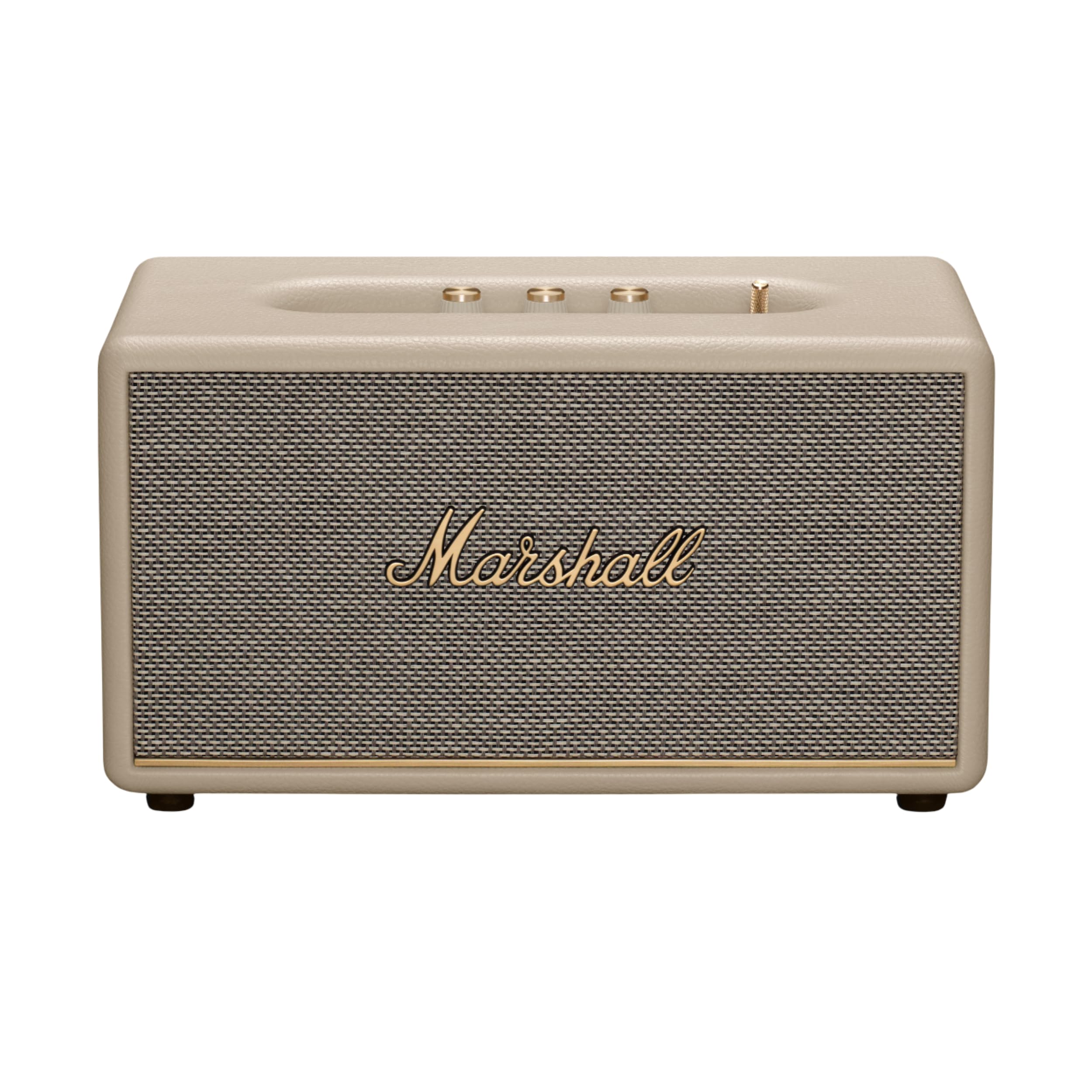
The Marshall Stanmore III is a statement piece first and a speaker second — but its sound quality matches its visual ambition. The third-generation model widens the soundstage compared to its predecessor, delivering the brand’s signature rock-voiced tuning with noticeable improvements in imaging and clarity. The front-facing tweeter and dual rear ports create a stereo-like presence that fills medium to large rooms without sounding congested.
Physical controls are a highlight: analog knobs for bass, treble, and volume give you immediate, tactile EQ adjustments without diving into an app. The Bluetooth 5.2 implementation supports next-gen features and provides reliable streaming up to 33 feet through walls. Wired connections include RCA and 3.5 mm auxiliary inputs, making it compatible with turntables (through an external phono preamp) and computers.
The Stanmore III is strictly plugin-powered, so it stays where you put it. The cream leather-like finish and gold-accented hardware look stunning but show smudges and dust easily. It also lacks Wi-Fi streaming — there is no AirPlay, Spotify Connect, or multi-room grouping. For listeners who prioritize aesthetic cohesion and want a straightforward, great-sounding speaker without app complexity, the Stanmore III delivers.
Why it’s great
- Analog bass and treble knobs allow instant tone shaping without software
- Wider soundstage than previous generation with improved instrument separation
- Iconic retro design with sustainable PVC-free, 70% recycled plastic build
Good to know
- No Wi-Fi streaming, AirPlay, or multi-room support
- Light-colored finish requires regular cleaning to stay looking fresh
6. Sonos Era 100 SL
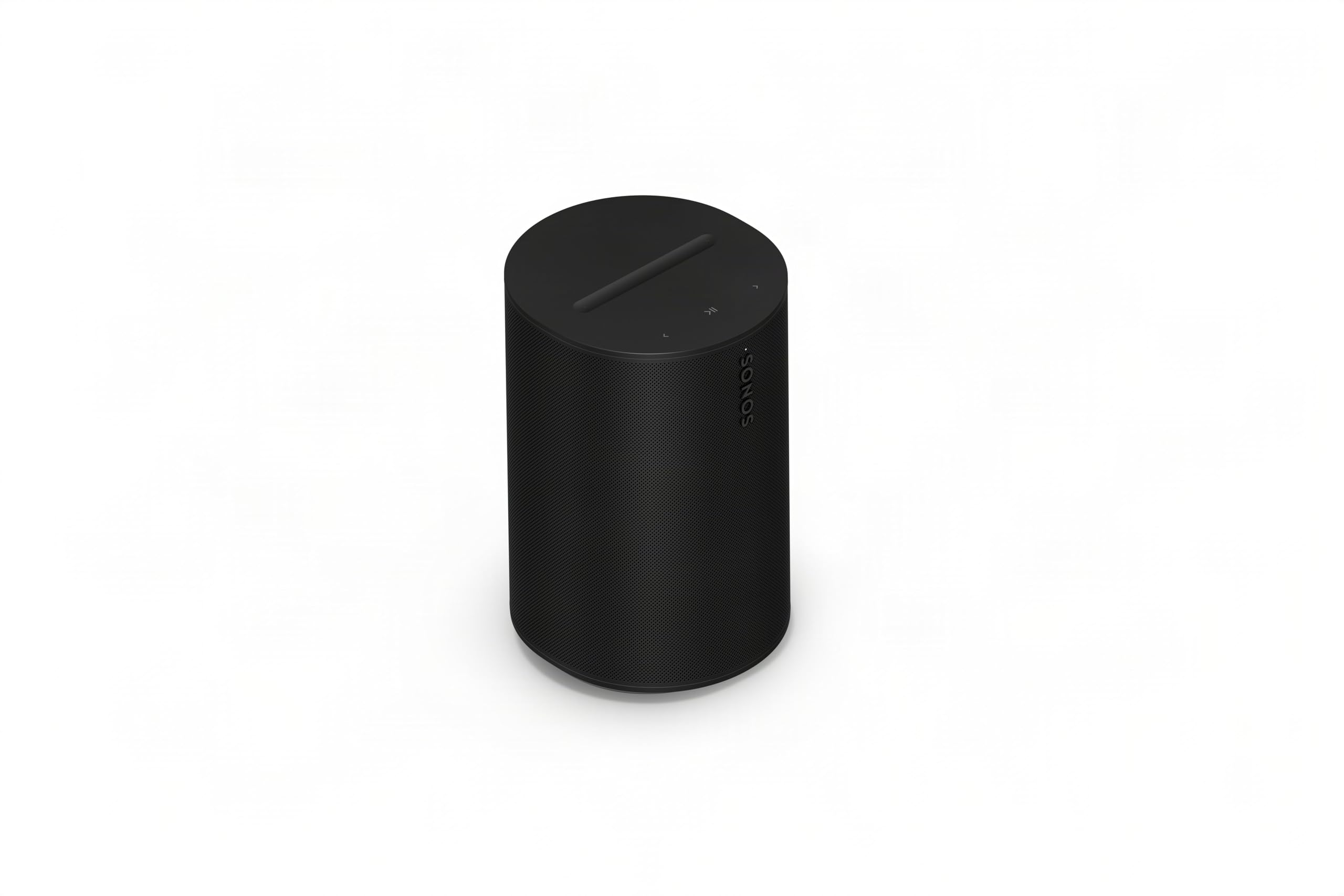
The Sonos Era 100 SL is the microphone-free version of the Era 100, stripping voice control in exchange for a slightly lower entry point into the Sonos ecosystem. The acoustic architecture uses dual angled tweeters to create a stereo image from a single cabinet, paired with a powerful midwoofer that delivers deeper bass than the previous Sonos One. The result is a balanced, room-filling sound that handles everything from podcasts to orchestral music with composure.
Setup is the fastest in the category: plug in, open the Sonos app, and the speaker is streaming within minutes. Trueplay tuning uses your iPhone’s microphone to measure room acoustics and adjust the EQ in real time, compensating for odd room shapes, reflective surfaces, and placement near walls. The Era 100 SL streams over Wi-Fi, pairs via Bluetooth for direct device playback, and includes a USB-C line-in adapter for turntables or other analog sources.
The downside is Sonos’s walled-garden approach — the speaker works best within the Sonos app ecosystem, and while it supports AirPlay 2, it lacks native Google Cast support. The lack of a physical AUX input on the speaker itself (the adapter is sold separately) can be frustrating for users who want quick wired connections. For anyone already in the Sonos ecosystem or building a simple, reliable multi-room system, this is the most polished option.
Why it’s great
- Trueplay automatically tunes the speaker to your specific room acoustics
- Dual angled tweeters create genuine stereo separation from a single box
- Fast, app-driven setup with seamless integration into existing Sonos systems
Good to know
- No physical AUX input without purchasing a separate USB-C adapter
- Google Cast is not natively supported; AirPlay 2 is required for Android users
7. MEVOSTO DS19 Active Bookshelf Speakers

The MEVOSTO DS19 brings a compelling feature set to the entry-level powered speaker segment, including Bluetooth 5.4, a USB digital audio input, and dedicated bass and treble knobs with 10 adjustment levels. The driver complement pairs 1-inch silk dome tweeters with 5-inch woofers, delivering 36 watts RMS of clean power. The silk dome design smooths out high-frequency harshness, making extended listening sessions less fatiguing than metal-dome alternatives in this price range.
The USB digital audio input is a rare find at this level — it bypasses the computer’s internal DAC for lower latency and cleaner signal path compared to a standard 3.5 mm jack. Multiple users report that USB connection solves Bluetooth audio delay issues during gaming and video playback. The wood veneer cabinet adds thermal and acoustic damping that plastic enclosures cannot match, and the included remote control adds convenience for adjusting volume from across the room.
Bass depth is decent for the woofer size but won’t satisfy listeners seeking subwoofer-level extension. The Bluetooth latency, while improved with BT 5.4, can still introduce a slight delay with video content, making the USB connection the preferred option for TV or gaming use. The front-firing port design allows relatively close wall placement without excessive boominess, a practical advantage for smaller desks or shelves.
Why it’s great
- USB digital audio input bypasses computer DAC for lower latency and cleaner sound
- Bass and treble knobs with 10 adjustment levels give precise tonal control
- Silk dome tweeters deliver smooth highs without listener fatigue
Good to know
- Bluetooth latency may still be noticeable during video content
- Deep bass extension is limited; a subwoofer output is not included
8. Sony SS-CS5M2 3-Way Bookshelf Speakers

The Sony SS-CS5M2 is a passive 3-way speaker that punches well above its price point when paired with a quality amplifier. The three-driver configuration — a 5.12-inch woofer, a high-precision tweeter, and a wide-dispersion super tweeter — covers a frequency range of 53 Hz to 50 kHz, extending into the ultrasonic range required for Hi-Res Audio certification. The bass reflex enclosure uses a reinforced cellular cone woofer that minimizes distortion while producing clean, stable low frequencies.
Soundstage width is the standout characteristic here. The super tweeter widens dispersion vertically and horizontally, creating a spacious presentation that makes small listening rooms feel larger. Vocals are clear and present without being pushed forward, and the overall tonal balance leans slightly bright — detailed in the highs, with a slight dip in the upper mids that some listeners perceive as recessed. Pairing these with a subwoofer fills the lower octaves and balances the presentation.
These are passive speakers, so you need a separate amplifier or AV receiver to drive them. The 6-ohm impedance is relatively easy to drive, but a quality amp makes a noticeable difference in bass control and dynamic range. The cabinets are lightweight and benefit from isolation feet or blu-tack to prevent vibration transfer to shelves. For budget-conscious buyers building a serious stereo system, these deliver a level of clarity that challenges speakers at three times the price.
Why it’s great
- 3-way design with dedicated super tweeter creates an exceptionally wide soundstage
- Hi-Res Audio certified with frequency response extending to 50 kHz
- Reinforced cellular cone woofer minimizes distortion at moderate volumes
Good to know
- Passive design requires a separate amplifier or AV receiver
- Bright voicing can sound fatiguing with poor recordings or bright electronics
9. Sony SS-CS3 3-Way Floor-Standing Speaker Pair

The Sony SS-CS3 is a 3-way, 4-driver floor-standing speaker that brings true full-range performance to a home audio system without requiring the investment of high-end audiophile brands. The driver array includes a 1-inch polyester main tweeter, a ¾-inch super tweeter, and dual woofers in a bass reflex cabinet, covering frequencies up to 50 kHz with Hi-Res Audio certification. The 6-ohm impedance and 145-watt peak power handling make these compatible with a wide range of amplifiers and AV receivers.
The addition of both a tweeter and a super tweeter extends the high-frequency response beyond human hearing range, but the practical benefit is improved airiness and detail retrieval in the upper registers. The dual-woofer configuration moves more air than a single-driver bookshelf, delivering bass that fills a room without the need for a separate subwoofer for music listening. Reviewers consistently note that these speakers reveal details in familiar recordings that were previously inaudible, a sign of well-executed driver integration.
The cabinets show some plastic trim elements that look less premium than all-wood competitors, and the supplied speaker wire is basic. Deep sub-40 Hz bass still benefits from a dedicated subwoofer, especially for home theater use with action movies. At the entry-level floor-standing price point, the SS-CS3 offers a rare combination of high-resolution capability and full-range output that makes it the smart foundation for a long-term system build.
Why it’s great
- Floor-standing design delivers full-range output without requiring a subwoofer for music
- Dual tweeter arrangement produces exceptional high-frequency air and detail
- Capable of revealing subtle mix details that bookshelf speakers mask
Good to know
- Cabinet uses some plastic trim that reduces the premium aesthetic
- Deep bass extension below 40 Hz still requires a separate subwoofer
FAQ
Do I need an amplifier for powered or active speakers?
What is the difference between Bluetooth and Wi-Fi streaming for home speakers?
How much bass can I expect from a bookshelf speaker?
Can I use a home speaker outdoors or on a covered patio?
Final Thoughts: The Verdict
For most users, the best at home speaker winner is the Klipsch R-40PM because it combines horn-loaded clarity, a built-in phono preamp, and powered convenience in a compact bookshelf format that works as a standalone system without an amplifier. If you want reference-grade detail and LDAC wireless streaming, grab the Edifier S880DB MKII. And for room-filling wireless sound with the most streaming protocol support, nothing beats the Bose Lifestyle Ultra.

Mo Maruf
I created WellFizz to bridge the gap between vague wellness advice and actionable solutions. My mission is simple: to decode the research and give you practical tools you can actually use.
Beyond the data, I am a passionate traveler. I believe that stepping away from the screen to explore new environments is essential for mental clarity and physical vitality.