Our readers keep the lights on and my smoothie glass nicely filled. As an Amazon Associate, I earn from qualifying purchases.
Streaming your phone’s music library through a vintage stereo receiver shouldn’t flatten the soundstage or introduce audible lag. The problem is that most budget Bluetooth adapters use generic DAC chips and skip high-bitrate codecs, turning your carefully curated playlist into a thin, compressed mess that lacks body and spatial depth.
I’m Mohammad Maruf — the founder and writer behind WellFizz. I’ve spent countless hours analyzing the internal architecture, Bluetooth chip generations, and DAC implementations of the most popular receivers to separate the units that actually preserve dynamic range from the ones that just add wireless convenience with a noise floor penalty.
This guide compares seven distinct models that bridge the gap between modern wireless streaming and classic analog amplification, helping you identify the best bluetooth receiver for home stereo based on codec support, output flexibility, and real-world signal stability.
How To Choose The Best Bluetooth Receiver For Home Stereo
Buying a Bluetooth receiver for your home stereo means deciding how far you want to push wireless fidelity. The DAC architecture, supported codecs, and output connectors determine whether your vintage amplifier sounds new or simply noisy.
Look at the DAC Chip First
A receiver with an ESS Sabre ES9018K2M or AKM AK4396 DAC will reproduce micro-details and low-noise floor compared to generic chips integrated into the Bluetooth module itself. The DAC is the component that converts the digital signal back to analog — cheap chips introduce a metallic edge and smear the stereo image.
Codec Support Determines Bitrate
LDAC (up to 990 kbps) and aptX HD (up to 576 kbps) deliver near-lossless wireless audio. If your phone supports LDAC and the receiver lacks it, you are stuck with SBC or AAC — adequate for casual listening but noticeably less dynamic during complex orchestral passages or bass-heavy electronic music.
Output Connector Versatility
RCA is the universal standard for home integrated amplifiers and powered speakers. Optical (Toslink) and coaxial outputs let you bypass the receiver’s internal DAC entirely and use your amplifier’s higher-quality DAC. Balanced XLR outputs matter only if you use professional studio monitors or high-end gear with true balanced inputs.
Quick Comparison
On smaller screens, swipe sideways to see the full table.
| Model | Category | Best For | Key Spec | Amazon |
|---|---|---|---|---|
| FiiO BR13 | Receiver + DAC | Full codec support with EQ | ESS ES9018K2M DAC | Amazon |
| Fosi Audio BT20A | Amplifier + Receiver | Powering passive speakers directly | 100W x 2 Class D amp | Amazon |
| 1Mii DS500 | Audiophile DAC | High-res streaming with OLED info | 32-bit/384kHz ESS DAC | Amazon |
| B3 Professional XLR | Pro Studio Receiver | XLR balanced output for mixers | ESS ES9018K2M + QCC5125 | Amazon |
| Pyle PLMRA430BT | Marine Amplifier | Outdoor / boat speaker systems | 1000W max / 4-channel bridgeable | Amazon |
| Pyle PDA77BU | All-in-One Receiver | Karaoke & multi-source home audio | 800W peak / dual mic inputs | Amazon |
| Audioengine B1 | Premium Receiver | Sonic purity with optical output | AKM AK4396 24-bit DAC | Amazon |
In‑Depth Reviews
1. FiiO BR13 HiFi Bluetooth 5.1 Receiver

The FiiO BR13 pairs the ESS ES9018K2M reference DAC with Qualcomm’s QCC5125 Bluetooth chip, covering LDAC, aptX HD, aptX Low Latency, AAC, and SBC. The OLED display shows active codec and sample rate, while the accompanying app lets you switch between seven preset EQ curves or build two custom 10-band profiles. The metal chassis reduces RF interference compared to plastic enclosures commonly found at this tier.
Optical and coaxial outputs allow you to bypass the internal DAC entirely and feed a digital signal directly to your amplifier’s converter — a feature rarely seen below the premium price bracket. The BR13 also acts as a USB DAC for a PC, supporting up to 24-bit/96kHz over USB. Dual-device pairing means you can switch from a phone call to a tablet stream without manually disconnecting.
Reviewers note the sound signature is clean with tight bass and detailed mids, outperforming receivers that cost three times more. A small minority reported power button failure after extended use, but the overall reliability rate remains high for the price. The only cable in the box is USB; you will need to supply your own RCA, optical, or coaxial cable.
Why it’s great
- LDAC streaming at 990 kbps for near-lossless audio
- Dual-device Bluetooth with seamless auto-switch
- App-based 10-band custom EQ for genre-specific tuning
Good to know
- No power adapter or analog cable included in the box
- App can crash before firmware update via Windows/Mac
2. Fosi Audio BT20A Bluetooth Stereo Amplifier

The BT20A is not a standalone receiver — it is a full Class D amplifier with built-in Bluetooth 5.0 reception, delivering 100 watts per channel into 4-ohm loads. This makes it the right choice if your setup lacks a separate amplifier and you want to drive passive bookshelf speakers directly from a single box. The compact aluminum chassis fits on a desk shelf or behind a TV stand without blocking ventilation.
Bass and treble knobs let you tilt the frequency response without an app, and the RCA input provides a fallback for non-Bluetooth sources. The Bluetooth connection remains stable at distances around 30 feet through one wall, according to user reports. The amp powers on automatically when it detects signal from a TV’s auxiliary output, making it convenient for living-room installations.
Some users note a slight midrange bias in the voicing, and Bluetooth overrides the AUX input — you cannot run a wired source while a phone is connected wirelessly. The included 24V/4.5A power supply is adequate for moderate listening levels, but pairing with low-sensitivity speakers may push the amp toward its thermal limits during extended high-volume sessions.
Why it’s great
- Combines amplifier and Bluetooth receiver in one chassis
- Physical bass and treble controls for quick tonal adjustment
- Auto power-on from TV aux signal
Good to know
- Bluetooth overrides AUX input — no simultaneous wired streaming
- Midrange bias may sound forward with neutral speakers
3. 1Mii DS500 Hi-Res Bluetooth 5.3 Receiver

The DS500 uses Bluetooth 5.3 with an external high-gain RP-SMA antenna, rated for stable connections up to 100 feet. The ESS Sabre ES9018K2M DAC supports 32-bit/384kHz decoding, and the OLED screen displays live sampling rate, codec, and volume. Built-in EQ presets (Rock, Pop, Jazz) let you tweak the sound without a phone app, though a companion app is available for finer control.
RCA, optical, and coaxial outputs give you flexibility to connect to any integrated amplifier or powered speaker. The unit also functions as a USB DAC for a computer — reviewers report cleaner sound from a PC’s USB output compared to Bluetooth streaming from the same computer’s built-in radio. The LDAC implementation achieves 990 kbps with compatible Android phones, while iPhones max out at AAC.
Users consistently report fatigue-free highs and a wide soundstage that rivals entry-level wired DACs. The included USB-C cable is only one meter long, which may be inconvenient depending on your stereo rack layout. Some users recommend purchasing the Luculent Systems LDAC driver for Windows to achieve the full 990 kbps bitrate over USB.
Why it’s great
- 32-bit/384kHz ESS Sabre DAC for high-resolution decoding
- External antenna for 100-foot range through walls
- Optical and coaxial outputs for bypassing internal DAC
Good to know
- Short USB cable; may require extension for rack placement
- Mac and iOS users limited to AAC/SBC via Bluetooth
4. B3 Professional XLR Bluetooth 5.1 Receiver (Blafili)

The B3 is the only receiver in this lineup with balanced XLR outputs, making it the natural fit for DJ mixers, PA systems, and studio monitors with true balanced inputs. Inside, it pairs Qualcomm’s QCC5125 with the ESS ES9018K2M DAC, supporting LDAC, aptX HD, aptX Low Latency, AAC, and SBC. All four output types (XLR, RCA, optical, coaxial) are active simultaneously, so you can feed a studio desk and a consumer amp at the same time.
The 1.3-inch display shows Bluetooth codec and status behind a trapezoid acrylic window. Silent pairing means no beeps or voice prompts interrupt your listening session or live set. The RP-SMA antenna is removable for replacement with a higher-gain unit if your rack sits far from the source device. It also works as a USB DAC with up to 16-bit/48kHz resolution — sufficient for most streaming but not full 24-bit.
Users praise the noise-free sound floor and solid Bluetooth lock at 25 feet through walls. The unit auto-powers on with USB voltage, so it wakes up when your mixer or amplifier turns on. No RCA cable is included, and the optical cable in the box is short. Custom Bluetooth names and passcodes require contacting support for a reprogramming tool.
Why it’s great
- Balanced XLR output for professional audio gear
- Simultaneous XLR, RCA, optical, and coaxial output
- Silent pairing — no beeps or voice prompts
Good to know
- USB DAC limited to 16-bit/48kHz
- Custom Bluetooth name requires contacting support for tool
5. Pyle PLMRA430BT Marine Amplifier Receiver
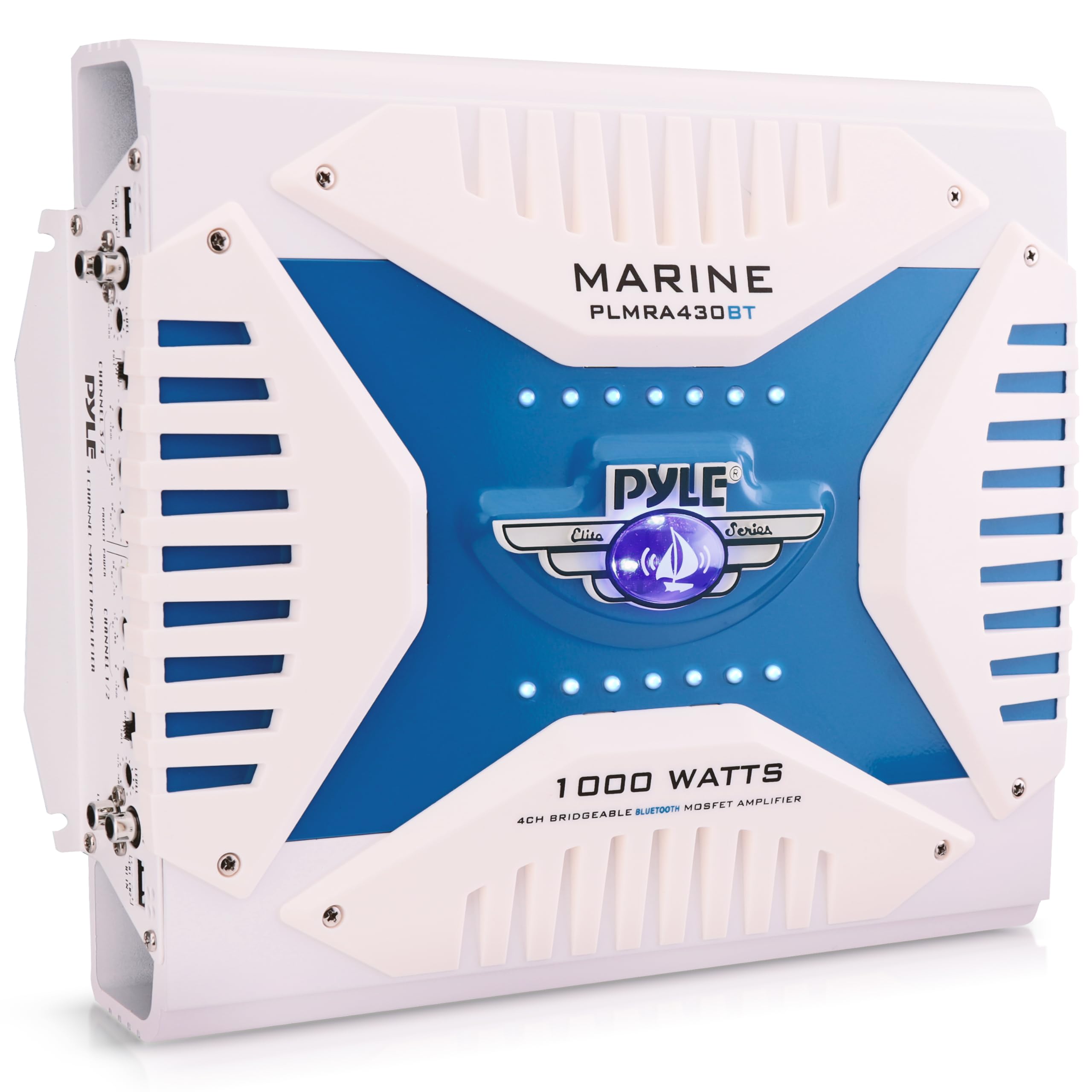
The PLMRA430BT is a 4-channel marine amplifier with Bluetooth streaming designed for boats, side-by-sides, and outdoor speaker systems. It delivers 1000 watts peak power with dual MOSFET power supply and features bridgeable channels — you can combine two channels into one for a subwoofer while the remaining pair drives mid-range speakers. The IP-01 moisture rating provides basic splash protection, and silver-plated terminal connectors resist corrosion better than bare copper.
Bluetooth range is rated at 25+ feet, and the unit remembers paired devices for automatic reconnection. The aluminum heatsink and thermal overload protection prevent shutdown during sustained high-volume playback in direct sunlight. Gain level controls for each input allow you to match the sensitivity of your source device, reducing noise floor.
Users report excellent sound output for trail riding and classic car installations where space is tight. However, the IP-01 rating is minimal — terminals can corrode in humid environments, and the internal dials are not sealed. Several reviews mention Bluetooth volume control issues with specific apps like Pandora, where the phone cannot adjust the amplifier’s output level. This unit is best suited for dry, covered outdoor use rather than full marine submersion situations.
Why it’s great
- Bridgeable channels for flexible subwoofer + speaker configurations
- Rugged aluminum heatsink for outdoor thermal management
- Auto-connect remembers paired devices
Good to know
- IP-01 rating provides minimal moisture protection
- Bluetooth volume may not sync with some streaming apps
6. Pyle PDA77BU Home Stereo Receiver with Bluetooth

The PDA77BU is a full-function home stereo receiver with Bluetooth 5.0, 800 watts peak output, dual 1/4-inch microphone jacks with independent volume and reverb controls, USB/SD card playback, and an FM radio tuner. It is designed for users who want a single hub for karaoke nights, TV audio, and background music in a garage, office, or living room. The front panel LED display and included remote give you quick access to input selection and EQ presets.
Audio inputs include RCA, 3.5mm auxiliary, and Bluetooth — you can connect a turntable, game console, and phone simultaneously. The Bluetooth range is rated at 30+ feet, and the receiver supports stereo output for four speakers (two pairs) with independent left/right channels. The dual mic inputs with reverb control make this one of the few receivers in the lineup that doubles as a PA system for small gatherings.
Users note that the Bluetooth reconnection can occasionally cause audio skipping with smart TVs, requiring a manual unpair/repair cycle. The 800-watt peak rating assumes low-impedance loads and short bursts; continuous output is lower. For a dedicated home theater setup, a separate Bluetooth receiver feeding an existing amplifier may yield better fidelity, but for multi-source karaoke and casual listening, the PDA77BU offers exceptional convenience.
Why it’s great
- Dual mic inputs with independent reverb for karaoke
- Integrates Bluetooth, USB, SD, FM, and RCA sources
- Remote control for distance operation
Good to know
- Bluetooth may skip on reconnection with some smart TVs
- Peak 800W rating does not reflect sustained clean output
7. Audioengine B1 Bluetooth Receiver

The Audioengine B1 is a premium Bluetooth receiver that prioritizes sound quality and build craftsmanship over feature quantity. It uses an AKM AK4396 24-bit DAC — a chip known for its natural, non-fatiguing treble and wide dynamic range — paired with Bluetooth 5.3 Adaptive for stable, low-latency streaming. The anodized aluminum enclosure feels substantial and helps dissipate heat without a fan.
Output options include RCA and optical (Toslink), so you can either use the internal DAC or pass a digital signal to a better external converter. The B1 works as both a receiver and a transmitter, letting you send audio from a non-Bluetooth TV to wireless headphones. The included RCA and optical cables reduce the need for separate purchases, unlike most competitors. Audioengine claims a 100-foot line-of-sight range, and real-world users confirm reliable signals through two interior walls.
Reviewers consistently report that the B1 sounds indistinguishable from a wired connection when using aptX with a compatible phone, though some note that the wireless signal still falls short of a high-end wired USB DAC in micro-detail retrieval. The bright blue power LED may be distracting in a dark room, and the unit occasionally loses the analog output after a power outage, requiring a quick reboot. For listeners who value simplicity and a proven DAC implementation over codec swappability, the B1 remains a reference design.
Why it’s great
- AKM AK4396 DAC delivers natural, fatigue-free highs
- Transmitter and receiver dual-mode functionality
- Included RCA and optical cables simplify setup
Good to know
- No LDAC support — limited to aptX and AAC
- Bright power LED may be distracting in dark rooms
FAQ
Do I need a receiver with LDAC if I use an iPhone?
Can I use a Bluetooth receiver with an amplifier that has no RCA input?
Why does my Bluetooth receiver have a slight audio delay during movies?
Final Thoughts: The Verdict
For most users, the best bluetooth receiver for home stereo winner is the FiiO BR13 because it combines LDAC support, a discrete ESS Sabre DAC, versatile digital outputs, and app-based EQ all at a mid-range price that undercuts premium audiophile receivers by a wide margin. If you need to drive passive speakers directly without a separate amplifier, grab the Fosi Audio BT20A. And for professional studios or live sound setups requiring balanced XLR outputs, nothing beats the B3 Professional XLR.

Mo Maruf
I created WellFizz to bridge the gap between vague wellness advice and actionable solutions. My mission is simple: to decode the research and give you practical tools you can actually use.
Beyond the data, I am a passionate traveler. I believe that stepping away from the screen to explore new environments is essential for mental clarity and physical vitality.