Our readers keep the lights on and my smoothie glass nicely filled. As an Amazon Associate, I earn from qualifying purchases.
Window blinds sit in a weird spot between decor and utility—too many options, too many measurement mistakes, and too many products that claim blackout but deliver “dim.” The real frustration isn’t choosing a color; it’s fighting light leaks at the edges, slats that won’t stay put, and cords that turn a window into a hazard zone.
I’m Mohammad Maruf — the founder and writer behind WellFizz. My research process for this guide involved cross-referencing customer reports of light leakage percentages, cordless mechanism durability, and installation failure rates across dozens of window-blind SKUs to separate genuine performers from over-marketed misses.
The challenge here is narrowing the field to options that actually seal light, survive daily raising and lowering, and fit without a carpenter’s intervention. This is the best blinds for windows guide built from real-world feedback, not brochure specs.
How To Choose The Best Blinds For Windows
Three specs separate a great blind from a frustrating one: light-blocking architecture, mounting precision tolerance, and cordless mechanism type. Ignore the marketing adjectives and focus on these three measurable elements.
Blackout vs. Room Darkening vs. Light Filtering
Blackout means zero light passes through the fabric itself. Room darkening means significant reduction but not total blackness. Light filtering means daytime privacy with soft glow. No blind can fix side leakage if the width deduction is wrong—account for a ½-inch total deduction on inside-mount widths to minimize edge gaps.
Material: Faux Wood vs. Cellular vs. Polyester Roller
Faux wood (PVC or engineered wood) resists humidity and warping, making it ideal for kitchens and bathrooms. Cellular honeycomb shades trap air in pockets for real insulation value—measured in R-value. Polyester roller shades are the lightest and most compact but offer the least insulation unless backed with a thermal coating. Choose by room function, not just appearance.
Cordless Mechanism Type
Free-stop systems allow you to pull the bottom rail to any height and release to lock. Spring-loaded continuous-loop systems raise and lower with a chain or wand. Free-stop is safer for homes with children and pets, but the spring tension degrades over time. Look for metal internal springs rather than plastic ones if longevity matters to you.
Quick Comparison
On smaller screens, swipe sideways to see the full table.
| Model | Category | Best For | Key Spec | Amazon |
|---|---|---|---|---|
| Calyx Interiors Faux Wood Blinds | Faux Wood | Best Overall Quality & Safety | 2″ slats, cordless lift + wand tilt | Amazon |
| LOTUS & WINDOWARE Cordless Faux Wood | Faux Wood | Premium Build & Privacy | 2″ slats, 4.06 kg weight, tight closure | Amazon |
| AOSKY Cordless Zebra Blinds | Zebra Dual-Layer | Light Control Flexibility | Sheer + solid dual-layer fabric | Amazon |
| LazBlinds Cordless Cellular Blackout | Honeycomb | No-Drill Rental Solution | 33 3/5″ actual width, spring rod | Amazon |
| Persilux Cordless Blackout Roller Shades | Roller | Full Blackout on a Budget | Thermal coating, free-stop system | Amazon |
| LazBlinds 2-inch Faux Wood Cordless | Faux Wood | Value Faux Wood Option | 2″ slats, royal valance included | Amazon |
| Arlo Blinds Single Cell Cellular Shades | Honeycomb | Entry-Level Light Filtering | True-to-size, no width deduction | Amazon |
In‑Depth Reviews
1. Calyx Interiors Faux Wood Blinds

This blind delivers precisely what the faux wood category should: 2-inch slats made from durable PVC that resists warping, a cordless lift mechanism that holds position without sagging, and a wand tilt system that rotates slats 180 degrees for total privacy or full open. The absence of dangling cords eliminates the primary safety hazard for homes with toddlers or pets, and the WCMA “Best for Kids” certification is a concrete third-party verification, not a marketing slogan. At nearly 5 kilograms, the weight of this unit reflects the density of the PVC material—it feels substantial in hand and stays rigid inside the window frame.
The classic valance measures 2.5 inches and covers the headrail completely, which is a detail many budget faux wood blinds overlook—exposed headrails create an unfinished look that cheapens the entire room. Inside mount requires a window depth of at least 1.5 inches for a flush fit, and the included hardware supports both inside and outside mounting equally. Customer reports consistently note that the cordless lift operates smoothly with no binding, even on the 60-inch height variant, which is a common failure point in cheaper spring-loaded mechanisms.
One review mentioned a slight gap at the windowsill on one of two identical blinds, which points to window frame irregularity rather than a manufacturing defect—real windows are rarely perfectly square, and inside-mount blinds will reveal those imperfections. The light blocking is described as “good but not blackout,” meaning some glow will seep around the edges in direct afternoon sun. For bedrooms requiring complete darkness, pair these with blackout curtains or choose a roller shade with a dedicated blackout coating instead.
Why it’s great
- WCMA certified child-safe with no exposed cords
- Heavy-duty PVC slats resist warping and clean easily
- Smooth cordless lift and independent wand tilt
Good to know
- Not fully blackout—edge light leakage possible
- Must order exact width; no deduction built in
2. LOTUS & WINDOWARE Cordless Faux Wood Blinds

This blind stands out for its construction density—the slats are noticeably heavier than typical entry-level faux wood blinds, which results in a more rigid closure and less light seepage between slats when fully shut. The cordless mechanism uses a magnetic tension system that provides smooth resistance when raising and lowering, and multiple customer reports confirm the blind stays at the set height without creeping up or down—a common frustration in cheaper spring-based systems. The PVC headrail matches the slat color perfectly, maintaining a uniform appearance from every angle.
The included 3.25-inch classic beaded valance adds a decorative touch that mimics real wood plantation shutters, and the valance attaches securely to the headrail without visible clips. For inside mount, the blind arrives exactly 0.5 inches narrower than the stated width—the 35-inch version measures 34.5 inches—which is the standard deduction for a proper inside fit. A minimum frame depth of 1.5 inches is required for a flush mount, and the included hardware is sufficient for both drywall and wood frames. Outside mount requires adding 3 inches to the window width for adequate overlap.
Customer reviews consistently describe the light-blocking capability as “excellent for privacy” while noting it is not blackout—the slats close tightly, but some ambient light wraps around the edges in bright conditions. One buyer with children and pets confirmed the blinds survived daily abuse without damage, which speaks to the PVC material’s impact resistance. The only installation catch is that the top bracket requires a longer screwdriver for tight spaces inside deep window frames—a minor tooling consideration, not a design flaw.
Why it’s great
- Heavy slats provide tight closure for maximum privacy
- Cordless magnetic lift holds position reliably
- Durable PVC construction resists pet and child damage
Good to know
- Not blackout—edge light visible in direct sun
- Long screwdriver needed for deep-frame top bracket
3. AOSKY Cordless Zebra Blinds

Zebra blinds solve a specific problem: wanting to see outside while preventing outsiders from seeing in. The dual-layer construction alternates sheer horizontal bands with opaque solid bands—by adjusting the overlap, you can transition from full privacy (opaque bands aligned) to filtered daylight (sheer bands open) without raising the blind at all. AOSKY uses 100% imported polyester fabric with a waterproof and anti-static finish, which means dust doesn’t cling as aggressively as it does on cotton or linen blinds. The free-stop system replaces the traditional pull string with an upgraded bottom rod—pull down to lower, lift slightly to release and raise—eliminating cord hazards entirely.
The aluminum square valance and fish-style bottom rod have a metallic sheen that pairs well with modern and industrial interiors, and the color-matched hardware keeps the look clean. For inside mount, measure the width at the top, middle, and bottom of the window frame—the narrowest measurement determines the size you order. Outside mount requires the blind to be 2 to 4 inches wider than the window opening for proper coverage. One customer with a glass door used the no-drill hook-and-loop method for outside mounting and reported total privacy both day and night, though a minor fraying issue appeared after 18 months that was resolved by trimming loose threads.
The limitation is clear: these are not blackout blinds. The dual-layer opaque bands block direct sunlight effectively, but the sheer bands are translucent by design, so nighttime privacy is only achieved when the bands are fully aligned. For bedrooms requiring pitch-black conditions, a dedicated blackout roller shade or cellular blackout shade is a better fit. For living rooms, home offices, or any space where you want natural light with privacy control, the zebra design is genuinely functional rather than purely decorative.
Why it’s great
- Adjustable light control without raising the blind
- Cordless free-stop system eliminates cord hazards
- Waterproof, anti-static polyester resists dust
Good to know
- Not blackout—sheer bands allow light through
- Limited nighttime privacy unless bands fully aligned
4. LazBlinds Cordless Cellular Blackout Shades
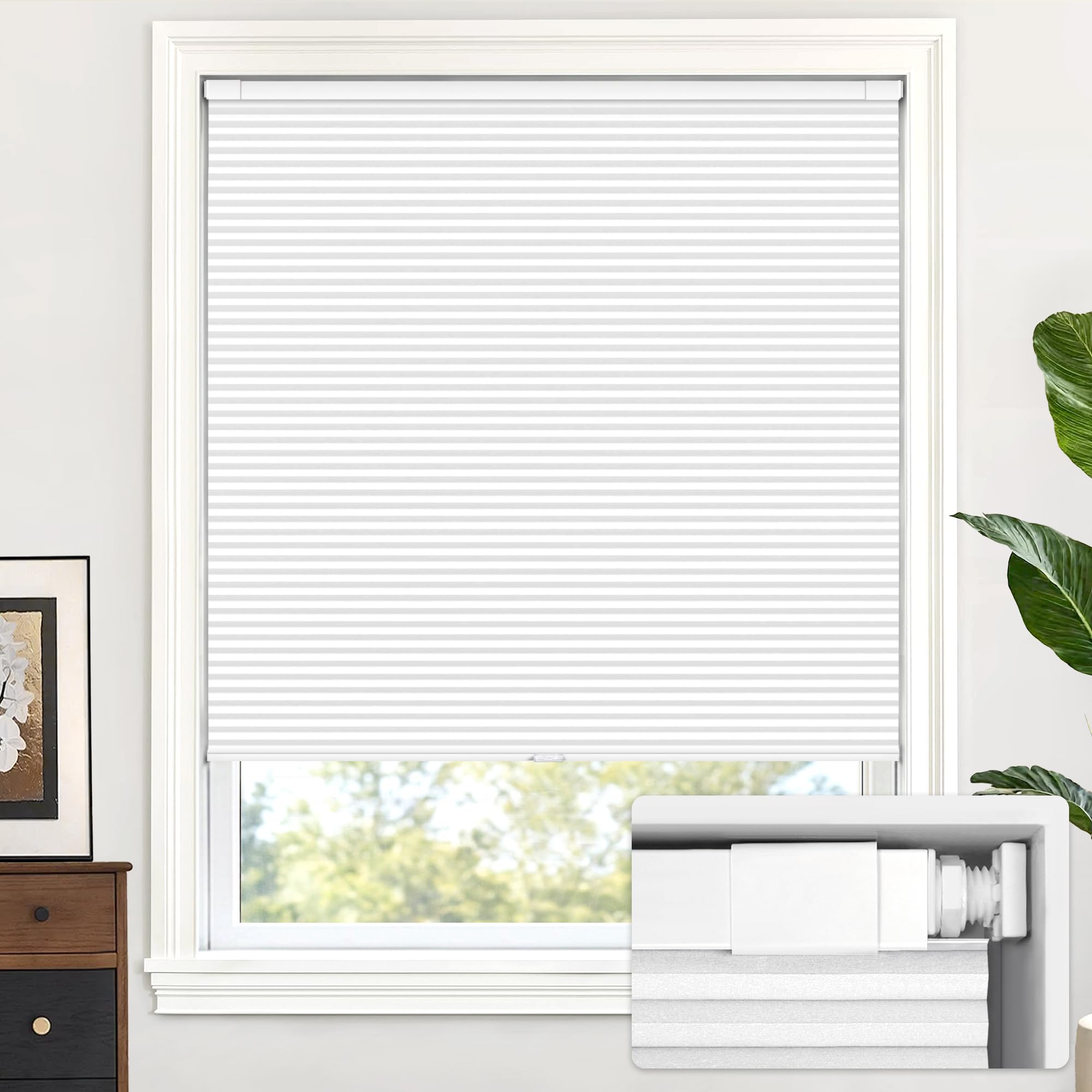
The headline feature here is the No Tools-No Drill system—a patented spring-loaded rod that expands inside the window frame to hold the shade in place without screws, brackets, or any permanent modification. This is a genuine solution for renters who cannot drill into window frames, for tile and marble surfaces where drilling is impractical, and for anyone who wants a 30-second installation that reverses just as quickly. The cellular honeycomb construction uses a silver-plated inner layer that reflects light back out, achieving true blackout rather than the “room darkening” label many shades settle for. The 3/5-inch cell structure traps air for insulation value—noticeably cooler in summer, slightly warmer in winter.
The width deduction is 2/5 inch from the stated size, so the 34-inch version measures 33.6 inches wide. The spring rod extends 1 inch total, allowing it to fit window widths from 33.7 to 34.6 inches. A minimum frame depth of 1.2 inches is required for the inside mount spring pressure to hold. Customer reviews confirm the blackout performance is genuine—multiple users reported complete darkness during daytime naps, and one described it as “really dark, not just darker.” The fabric-wrapped bottom rail gives a finished appearance, and the cordless operation uses a simple pull-down-to-lower, slight tug-to-release mechanism that is intuitive for all ages.
The biggest caveat involves grip on vinyl window frames—the rubbery end pieces on the spring rod do not always get sufficient friction on slick vinyl surfaces, and there is a risk of the shade falling. One review mentioned this concern explicitly, noting that the plastic tightening parts stripped when over-tightened with the metal wrench. For vinyl frames, consider using the included adhesive strips or switching to a drill-mount installation. The “no-drill” claim is valid for many surfaces but not all—test the grip on your specific frame before committing to installation.
Why it’s great
- True blackout with silver-plated cell liner
- No-drill spring rod installs in 30 seconds
- Cellular honeycomb adds real insulation value
Good to know
- Spring grip may fail on vinyl window frames
- Plastic tightening parts can strip if over-tightened
5. Persilux Cordless Blackout Roller Shades

For the price point, Persilux delivers something that many mid-priced roller shades fail at: genuine 100 percent blackout fabric with a built-in thermal coating. The fabric itself blocks all light transmission—the distinction between blackout and “very dark” is critical here, and customer photos in reviews confirm zero light passes through the rolled material itself. The square frosted aluminum valance has a matte finish that looks more expensive than the price suggests, and the fabric-wrapped bottom rail eliminates the hollow plastic look that cheap roller shades suffer from. The free-stop mechanism allows you to pull the shade to any position and release to lock—no ratcheting, no continuous loop, just smooth friction hold.
The width deduction is 0.8 inches—the fabric width is cut 0.8 inches narrower than the valance width to allow for hardware clearance during inside mount. The aluminum valance and side screws match the fabric color, which is a rare detail at this tier—many budget roller shades use silver or white hardware regardless of fabric color. Installation hardware and a clear guide are included, and Persilux offers a custom size option through the Amazon “Customize Now” button for non-standard windows. The thermal coating also provides a measurable reduction in solar heat gain—one customer noted a “considerable” temperature drop on their back porch after installation.
The main complaint is consistency: one reviewer reported significant light leakage around the edges despite following the mounting instructions for both inside and outside mount. This suggests that while the fabric is 100 percent blackout, the fit tolerance can produce gaps, particularly on windows that are not perfectly square. If you order the exact window width without accounting for frame irregularities, you may get side gaps that the fabric alone cannot seal. Measure carefully, and if your window frame is more than 1/4 inch out of square, order slightly wider than your narrowest measurement to allow overlap.
Why it’s great
- Genuine 100% blackout fabric with thermal coating
- Frosted aluminum valance looks premium
- Free-stop system holds at any height
Good to know
- Side light leakage possible on uneven frames
- Width deduction of 0.8″ must be accounted for
6. LazBlinds 2-inch Cordless Faux Wood Blinds

This blind brings the classic plantation-shutter look to a budget price point by using engineered wood (MDF with a PVC coating) instead of solid PVC. The material is moisture-resistant enough for bathrooms and kitchens—it won’t warp or peel like unfinished wood in humidity—and the smooth surface wipes clean with a damp cloth. The 2-inch slats provide a substantial visual weight that narrow 1-inch slats cannot match, and the royal valance (3.25 inches tall) covers the headrail for a built-in custom look. The cordless operation is simple: lift or lower the bottom rail directly, with no wand required for raising—a separate twisting wand controls slat tilt independently.
The width deduction for inside mount is 0.5 inches, so the 34.625-inch version measures 34.125 inches wide. A minimum frame depth of 2 inches is required for standard flat mounting, and a depth of 3 inches is needed for a flush fit where the blind sits completely inside the frame without protruding. Customer reviews consistently praise the difficulty-to-value ratio—the blind looks “more expensive than it is” and the cordless mechanism operates smoothly without catching. One reviewer with a houseboat reported that the blinds withstood direct sun and humidity exposure without degradation, which is a strong real-world test for the engineered wood construction.
The trade-off at this price is that the slats are not as rigid as solid PVC—they can hang slightly askew when fully raised, and the valance can be difficult to snap into place on wider sizes. One reviewer noted that the installation required different screws than the ones provided for their specific window frame material, which is a common compatibility issue rather than a defect. The light control is room-darkening, not blackout—the slats close tightly but the material itself is not opaque enough to block all ambient light. For bedrooms that need total darkness, these will let in some glow around the slat edges and through the fabric itself.
Why it’s great
- Classic plantation style at a budget-friendly price
- Moisture-resistant engineered wood for humid rooms
- Cordless lift is safe and smooth
Good to know
- Room darkening only—not true blackout
- Valance can be difficult to snap on wide sizes
7. Arlo Blinds Single Cell Light Filtering Cellular Shades

Arlo Blinds takes an unusual approach: the shade ships at the exact stated width with no deduction. That means the 34-inch shade is 34 inches wide, and your window must measure between 34.25 and 35 inches for a proper inside fit. This eliminates the standard deduction confusion that trips up many first-time buyers, but it also means you cannot order a shade that exactly matches your window width—you need that quarter-inch to half-inch gap for the blind to fit without jamming. The single-cell honeycomb construction is made from a translucent polyester fabric that diffuses sunlight into a soft glow while providing daytime privacy—passersby cannot see inside, but the room is not darkened.
Installation is genuinely simple: two brackets screw into the top of the window frame, and the shade clips into the brackets with a latch mechanism that one reviewer described as “15 minutes, no stress.” The PVC headrail and bottom rail are color-matched to the fabric, and the package includes hardware for inside mount, ceiling mount, and outside mount. For height, the 60-inch shade works on windows from 48 to 60 inches tall—shorter windows will work, but the cells will bunch more at the bottom when fully raised. The cordless operation uses a standard spring-loaded lift that raises and lowers smoothly, with a locking button to hold position—some users noted that the Arlo mechanism feels smoother than the locking-button systems from big-box brands.
The biggest limitation is in the name: “light filtering” is not blackout, not room darkening, not even close. These shades let in enough light to read by without turning on a lamp during the day, and at night, interior lights will be visible from outside—total privacy requires pairing with curtains. The cell structure provides minimal insulation compared to double-cell or triple-cell honeycomb shades, and the single layer of translucent fabric offers no thermal reflection. For a bedroom, home theater, or nursery, these are the wrong choice. For a living room, dining room, or office where soft natural light is desired, they perform exactly as intended at a very low entry price.
Why it’s great
- True-to-size width eliminates deduction math
- Diffuses harsh sunlight into soft ambient glow
- 15-minute installation with simple clip-in brackets
Good to know
- Light filtering only—no blackout or privacy at night
- Single-cell construction offers minimal insulation
FAQ
What width deduction should I expect for inside mount blinds?
Can faux wood blinds go in bathrooms and kitchens?
How do I fix light leakage around the edges of my blinds?
Final Thoughts: The Verdict
For most users, the blinds for windows winner is the Calyx Interiors Faux Wood Blinds because it combines certified child safety, durable PVC construction, and a dual cordless lift-and-tilt system that delivers genuine privacy control without looking cheap. If you want true blackout in a no-drill rental-friendly package, grab the LazBlinds Cordless Cellular Blackout Shades. And for flexible daylight management with a modern aesthetic, nothing beats the AOSKY Cordless Zebra Blinds.

Mo Maruf
I created WellFizz to bridge the gap between vague wellness advice and actionable solutions. My mission is simple: to decode the research and give you practical tools you can actually use.
Beyond the data, I am a passionate traveler. I believe that stepping away from the screen to explore new environments is essential for mental clarity and physical vitality.