Our readers keep the lights on and my smoothie glass nicely filled. As an Amazon Associate, I earn from qualifying purchases.
You cannot see, smell, or taste carbon dioxide, but when indoor levels drift above 1,000 ppm your focus drops, your head aches, and your sleep suffers. A dedicated CO2 detector transforms that invisible problem into clear, actionable data—showing you exactly when to crack a window or turn on a ventilator.
I’m Mohammad Maruf — the founder and writer behind WellFizz. I’ve spent countless hours comparing sensor technologies, reading environmental chamber test reports, and cross-referencing hundreds of verified buyer experiences to separate the accurate monitors from the noise.
After examining photoacoustic NDIR sensors, electrochemical cells, alarm threshold logic, and battery backup configurations across seven leading models, the best carbon dioxide detectors deliver a balance of precision, real-time feedback, and smart alerts that protect both your health and your peace of mind.
How To Choose The Best Carbon Dioxide Detectors
Not every alarm or monitor labeled “CO2” works the same way. Some measure carbon monoxide and skip CO2 entirely; others use slow sensors that lag behind real-time conditions. Understanding sensor type, power source, and display readout helps you pick the right unit for your home, office, or grow space.
Sensor Technology: NDIR vs Electrochemical
Non-dispersive infrared (NDIR) sensors and photoacoustic NDIR sensors are the gold standard for CO2 detection because they measure gas concentration by how much infrared light CO2 molecules absorb. Electrochemical sensors, common in carbon monoxide detectors, react differently to CO and CO2—most cannot accurately measure the 400–5,000 ppm range that matters for indoor air quality. If you see a detector that claims CO2 monitoring but uses an electrochemical cell without an NDIR element, it likely cannot deliver reliable readings above 1,000 ppm.
Alarm Thresholds and Visual Feedback
A basic detector screams at 1,500 or 2,000 ppm, but by that point your cognitive performance has already dropped by 15–20 percent. Look for units with programmable alarms so you can set a threshold at 1,000 ppm or lower, and choose a model with a color-coded display (green/yellow/red) that gives you a glanceable readout before the buzzer sounds. Models that also track temperature and humidity help you distinguish a stale-air problem from a humidity imbalance.
Power Source: Plug-In, Battery, or Both
Plug-in monitors with a battery backup ensure round-the-clock protection even during outages, which matters for gas-heated homes where CO could accumulate silently. Battery-powered portable units let you test air quality in different rooms, RVs, or tents, but they rely on you keeping fresh batteries installed. Hybrid designs—hardwired with AA backup or USB-powered with an internal cell—offer the best of both worlds for stationary use.
Quick Comparison
On smaller screens, swipe sideways to see the full table.
| Model | Category | Best For | Key Spec | Amazon |
|---|---|---|---|---|
| GoveeLife Smart Air Quality Monitor | Smart Monitor | Real-time CO2 with app alerts | Photoacoustic NDIR ±40 ppm accuracy | Amazon |
| KDWKD Indoor Air Quality Monitor | Multi-Sensor Monitor | CO2 + PM2.5 + VOC detection | 9-hour rechargeable battery | Amazon |
| Kidde Plug In CO Detector (2-Pack) | Plug-In Alarm | CO monitoring with digital readout | 85 dB alarm, 9V battery backup | Amazon |
| Kidde Hardwired Smoke & CO Detector (2-Pack) | Hardwired Combo | Smoke + CO hardwired protection | Interconnectable, AA battery backup | Amazon |
| Newentor CO2 Monitor | Desktop Monitor | CO2 + temp/humidity with clock | Swiss Sensirion PASens sensor, 5000 ppm range | Amazon |
| First Alert SMCO100 Combo Alarm | Battery Combo | Smoke + CO battery-operated alarm | Precision Detection, 10-year warranty | Amazon |
| TOPTES CT-580 Portable CO Detector | Portable Tester | Handheld CO leak detection | 0.3 sec response, 0–1000 ppm range | Amazon |
In‑Depth Reviews
1. GoveeLife Smart Air Quality Monitor
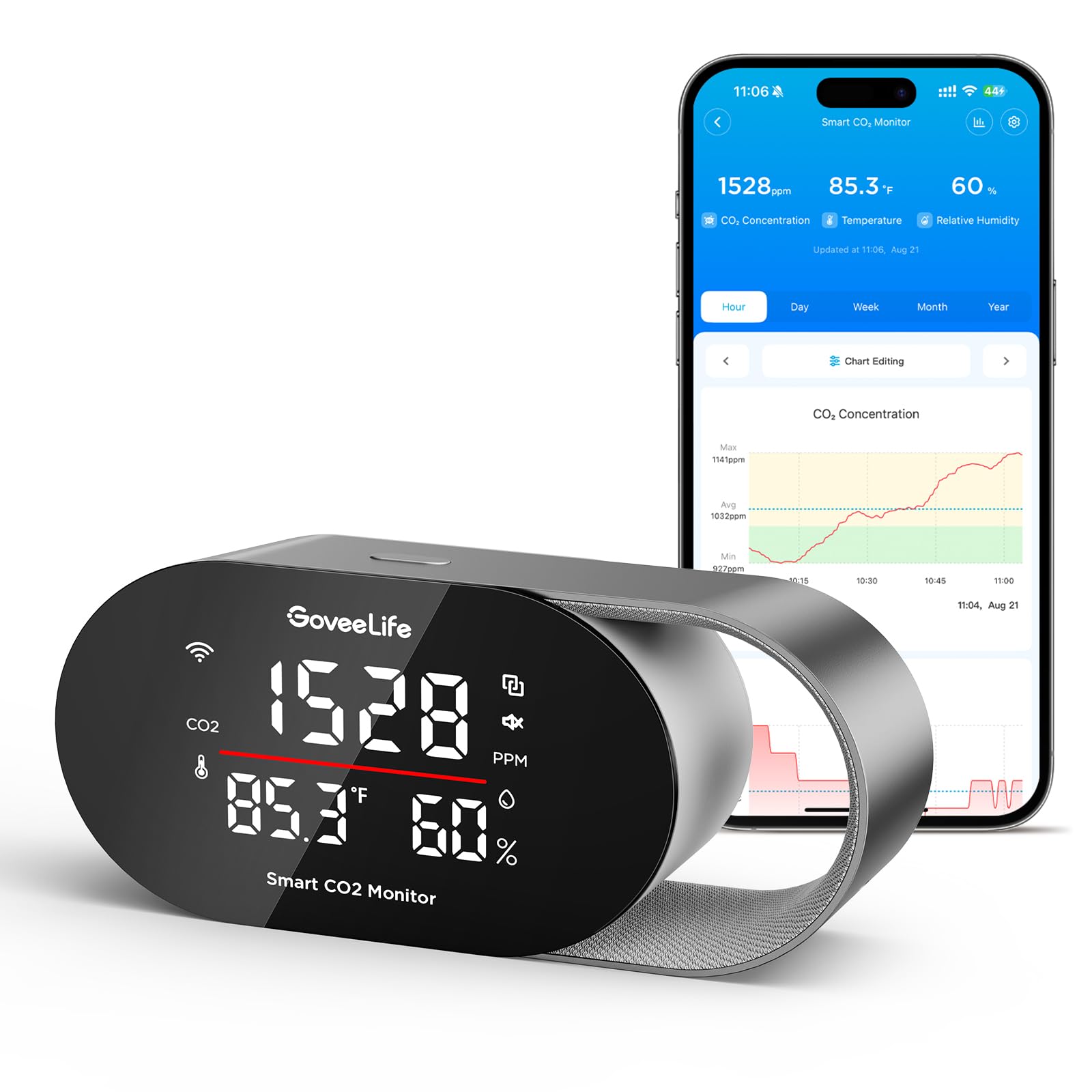
The GoveeLife H5140 uses a photoacoustic NDIR sensor from the SCD4x family, delivering ±40 ppm accuracy with a 5-second refresh rate. That speed matters when you’re watching CO2 climb during a meeting or family gathering—you see the rise in real time, not after a five-minute lag. Its tri-color light bar and programmable screen automatically dim at night, so the monitor stays informative without becoming a light nuisance.
Beyond the hardware, the Govee Home app logs two years of historical data and exports CSV reports for medical or energy-efficiency reviews. You can set custom alarms for CO2, temperature, and humidity, and the unit integrates with Alexa and Google Assistant to voice-query readings. Unlike purifiers that cannot remove CO2, the monitor can trigger smart fans or humidifiers through the app for active ventilation control.
AC-powered with no batteries required, the GoveeLife runs 24/7 without interruption. Multiple verified buyers reported CO2 spikes above 1,400 ppm during parties and confirmed that opening windows dropped levels back to baseline—exactly the feedback loop this monitor enables. The only gap is the lack of particulate or VOC sensors, but for pure CO2 tracking with smart home integration, this is the most capable unit tested.
Why it’s great
- Photoacoustic NDIR sensor with 5-second refresh and ±40 ppm accuracy
- App-based data logging, CSV export, and smart home voice integration
- Customizable LED display with automatic day/night brightness adjustment
Good to know
- Requires AC power — no battery backup option
- Wi-Fi connectivity may drop if placed far from the router
2. KDWKD Indoor Air Quality Monitor
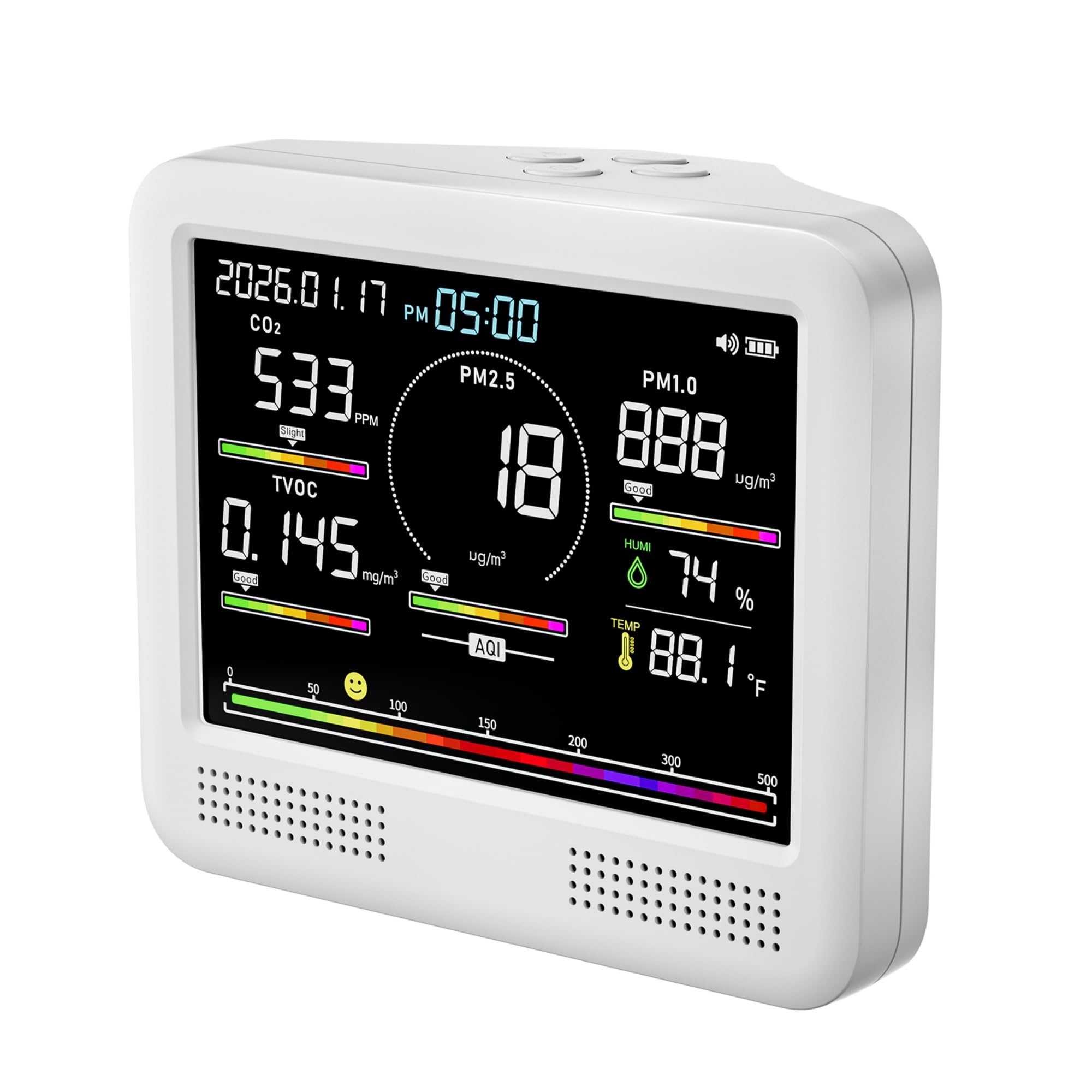
If you need CO2 tracking alongside particulate matter (PM0.3 through PM10), formaldehyde (HCHO), and total volatile organic compounds (TVOC), the KDWKD AK23CA packs all those sensors into a portable, battery-powered chassis. Its built-in rechargeable battery lasts up to 9 hours, letting you move room-to-room or take it into an RV, hotel, or newly renovated space to check for off-gassing from paint or furniture.
The display cycles through CO2, PM2.5, HCHO, TVOC, temperature, and humidity in a single glance. Verified buyers noted the unit detects VOCs quickly—one reviewer confirmed an alcohol wipe test triggered the sensor immediately. For new construction or after a remodel, this monitor gives you confidence that formaldehyde levels are dropping to safe concentrations before you move furniture back in.
Portability comes with a trade-off: you have to remember to recharge it, and the audible alarm, while helpful, is not as loud as a dedicated plug-in alarm. Still, for anyone concerned about both CO2 buildup and chemical pollutants in a single device, the KDWKD delivers the broadest sensor suite at a price that undercuts most multi-sensor competitors.
Why it’s great
- Monitors CO2, PM2.5/PM10, HCHO, TVOC, temp, and humidity
- 9-hour rechargeable battery for portable room-to-room testing
- Sleek, compact design with bright color display
Good to know
- Audible alarm is moderate — not as loud as dedicated safety alarms
- Requires periodic recharging for portable use
3. Kidde Carbon Monoxide Detector Plug In Wall with Battery Backup (2-Pack)

Kidde’s KN-COPP-3 is a dedicated carbon monoxide detector—not a CO2 monitor—but it remains one of the most trusted plug-in CO alarms on the market. Its digital LED display shows real-time CO levels in ppm, so you know whether the reading is 0 ppm (safe) or climbing toward the 85 dB alarm threshold. The 9-volt battery backup keeps the alarm active during power outages, a critical feature for homes with gas appliances or attached garages.
Peak Level Memory records the highest CO concentration detected since the last test, giving you a snapshot of any overnight leak. Verified buyers reported readings of 463 ppm in bedrooms and 268 ppm downstairs, which triggered immediate evacuation and boiler inspection. The alarm is loud and unmistakable, and the two-pack covers multiple rooms without needing hardwired installation.
This unit does not measure CO2 or indoor air quality beyond carbon monoxide, so it is not a substitute for a CO2 monitor. But for basic CO safety compliance and peace of mind, especially on bedroom levels, the Kidde plug-in is a reliable, code-friendly choice that has saved lives in real-world scenarios.
Why it’s great
- Digital LED display shows real-time CO ppm readings
- 9V battery backup provides protection during power outages
- Peak Level Memory logs the highest CO concentration detected
Good to know
- Does not measure CO2 or overall indoor air quality
- Requires a 9V battery even when plugged into AC
4. Kidde Hardwired Smoke & Carbon Monoxide Detector (2-Pack)

The Kidde 30CUAR combines smoke and carbon monoxide detection in a single hardwired unit with two AA alkaline batteries for backup. It meets UL 217 9th Edition and UL 2034 4th Edition standards, with enhanced sensing technology that reduces false alarms from cooking while still providing early fire warning. The interconnect feature links multiple alarms so when one unit detects smoke or CO, every alarm in the chain sounds.
Three LED indicators communicate status at a glance: green for normal operation, amber for an error, and red for smoke or CO detected. The Test & Hush button silences nuisance false alarms without disabling the detector permanently. Verified buyers found installation straightforward, though some noted that swapping older hardwired bases may require updating the connector style.
This unit is not a CO2 monitor—it detects carbon monoxide only—but for homeowners who need combined smoke/CO protection with hardwired reliability, the Kidde 30CUAR is a strong, code-compliant option. The 10-year limited warranty from power-on adds long-term value, but at least one reviewer reported a faulty sensor within the first year, so test weekly as recommended.
Why it’s great
- Combines smoke and CO detection in one hardwired unit
- Interconnectable — when one alarm sounds, all alarms sound
- Meets latest UL standards with reduced cooking nuisance alarms
Good to know
- Does not measure CO2 levels
- Some users reported early sensor failure in isolated units
5. Newentor CO2 Monitor

The Newentor C1 is built around a Swiss Sensirion PASens photoacoustic sensor, which delivers reliable CO2 readings from 0 to 5,000 ppm without the drift issues that plague cheaper NDIR sensors over time. Its color display shows CO2 concentration, temperature, humidity, time, and date simultaneously, and you can set a custom alarm threshold so the unit beeps or speaks a voice alert before CO2 negatively affects your focus.
Packed with a clock and calendar, the Newentor works well as a desktop or nightstand device. Verified buyers confirmed that readings baseline around 400 ppm outdoors and climb to 1,500 ppm in occupied rooms without ventilation—matching the expected rise from human respiration. The voice alarm is a nice differentiator for sleepers or anyone who misses a simple beep.
One caveat: the unit runs on USB power or three AAA batteries, but battery life is short if the display stays on, so most users leave it plugged in. A small number of units failed under high humidity (70–95%), though the manufacturer replaced them quickly. For a mid-range CO2 monitor with a premium sensor chip, the Newentor delivers strong value.
Why it’s great
- Swiss Sensirion PASens sensor for accurate CO2 readings up to 5,000 ppm
- Voice alarm and customizable CO2 alert threshold
- Multi-function display includes clock, temp, and humidity
Good to know
- Battery life is short with display on — best used plugged in
- Some units showed humidity-related sensor failure in high-moisture environments
6. First Alert SMCO100 Combination Smoke & Carbon Monoxide Alarm

First Alert’s Precision Detection technology in the SMCO100 is designed to reduce nuisance alarms from cooking while still providing early warning for real fires and CO emergencies. This battery-operated 2-in-1 alarm uses two AA batteries that power both smoke and CO sensors, making installation as simple as twisting the base onto the ceiling. The end-of-life warning chirps when the unit reaches its 10-year replacement mark.
Verified buyers, many of whom have used First Alert for decades, praise the SMCO100’s easy setup and reliable performance. The test/silence button works intuitively, and the compact 5.6-inch diameter fits standard mounting plates. Because it is entirely battery-powered, there is no hardwiring required, which makes it ideal for apartments, basements, or rooms without existing AC wiring.
This alarm does not display CO2 ppm or CO concentration numerically—it simply triggers an 85 dB siren when either hazard is detected. For someone who wants a no-fuss, code-friendly safety device that covers both smoke and CO without monthly battery swaps, the SMCO100 is a dependable entry point. Just do not expect real-time air quality data from this unit.
Why it’s great
- Combines smoke and CO detection in a battery-operated form factor
- Precision Detection reduces cooking nuisance alarms
- 10-year limited warranty and end-of-life warning chirp
Good to know
- No digital display — no real-time CO or CO2 ppm readout
- Requires periodic battery replacement even with long-life cells
7. TOPTES CT-580 Portable Carbon Monoxide Detector

The TOPTES CT-580 is a handheld, rechargeable CO detector designed for pinpointing gas leaks rather than monitoring ambient air in a fixed location. Its electrochemical DDS sensor responds within 0.3 seconds and reads CO concentrations from 0 to 1,000 ppm with two alarm thresholds. Three alarm modes—indicator light, audible buzzer, and vibration—ensure you cannot miss an alert even in noisy environments like a garage or workshop.
Verified buyers have used the CT-580 to find CO leaks from boat engines, propane water heaters in RVs, and car exhaust systems. The included protective case and USB-C charging make it portable, and the TFT color display shows the CO reading in large, clear numbers. The built-in flashlight is a useful addition for inspecting dim engine bays or crawl spaces.
As a spot-check tool, the CT-580 is excellent, but it is not designed for 24/7 wall-mount monitoring. The electrochemical sensor has a shorter lifespan than NDIR or photoacoustic sensors, and it does not measure CO2 at all. If your primary concern is hunting down a specific CO leak, this is your tool. If you need ongoing indoor air quality tracking, choose a dedicated CO2 monitor instead.
Why it’s great
- 0.3-second response time for fast CO leak detection
- Three alarm modes: light, buzzer, and vibration
- Rechargeable via USB-C with built-in flashlight
Good to know
- Electrochemical sensor has limited lifespan compared to NDIR
- Does not measure CO2 concentration
FAQ
What is a safe CO2 level in my home?
Can a carbon monoxide detector measure CO2?
Where should I place a CO2 detector in my home?
Do I need a plug-in or battery-powered CO2 monitor?
Final Thoughts: The Verdict
For most users, the best carbon dioxide detectors winner is the GoveeLife Smart Air Quality Monitor because its photoacoustic NDIR sensor, app-based historical tracking, and smart home integration provide the most actionable air quality feedback available. If you want portable multi-sensor coverage that includes PM2.5 and VOCs, grab the KDWKD Indoor Air Quality Monitor. And for reliable fixed CO safety with battery backup, nothing beats the Kidde Plug In CO Detector.

Mo Maruf
I created WellFizz to bridge the gap between vague wellness advice and actionable solutions. My mission is simple: to decode the research and give you practical tools you can actually use.
Beyond the data, I am a passionate traveler. I believe that stepping away from the screen to explore new environments is essential for mental clarity and physical vitality.