Our readers keep the lights on and my smoothie glass nicely filled. As an Amazon Associate, I earn from qualifying purchases.
Whether you need crisp black-and-white documents for client proposals or vibrant color handouts for presentations, the print engine under the hood determines your long-term satisfaction more than any brand name or app-store rating ever could.
I’m Mohammad Maruf — the founder and writer behind WellFizz. I’ve spent hundreds of hours analyzing print-engine specifications, yield-per-dollar ratios, duplex mechanisms, and real-world software reliability across dozens of all-in-one models to identify which designs actually serve a home office instead of creating new headaches.
The best option for your desk ultimately depends on whether you prioritize minimal per-page costs, color capability, or ultra-fast monochrome throughput — but every model in this aio printer for home office guide was selected because it excels in at least one measurable category that directly impacts daily workflow.
How To Choose The Best AIO Printer For Home Office
Selecting an all-in-one printer for a home office means balancing upfront cost against long-term consumable expenses and matching the print engine type to your typical workload. The wrong choice leads to either overpaying for speed you never use or being trapped by cartridge refill costs that exceed the machine’s value within a year.
Print Engine Type: Laser vs. Inkjet vs. Ink-Tank
Black-and-white laser printers deliver the lowest cost-per-page for text-heavy documents — typically under two cents per page with high-yield toner cartridges. Color laser printers produce sharp graphics and resist smudging on standard office paper, but the upfront investment is higher. Inkjet models offer the best photo quality and the lowest entry price, but standard cartridge-based inkjets often cost more per page than laser alternatives. Ink-tank (supertank) printers like the Epson EcoTank line split the difference: higher upfront cost, dramatically lower per-page costs, and the ability to print thousands of color pages before refilling.
Automatic Duplex and Document Feeder
Automatic duplex printing (two-sided output) is non-negotiable for any home office producing multi-page reports, contracts, or manuals — it cuts paper usage in half and makes bound documents look professional. An automatic document feeder (ADF) is equally critical if you regularly scan or copy stacks of receipts, signed forms, or multi-page agreements. ADF capacities typically range from 35 to 50 sheets; models without an ADF require you to place each page manually on the flatbed scanner, which becomes tedious after a few pages.
Connectivity and Mobile Support
Home offices often mix Windows laptops, MacBooks, iPhones, and Android tablets. A printer with dual-band Wi-Fi (2.4 GHz and 5 GHz) avoids interference from other household devices and maintains a stable connection. Support for Apple AirPrint, Mopria Print Service, and a manufacturer’s mobile app ensures you can print from any device without installing full driver suites. Ethernet connectivity matters if your printer sits in a corner where Wi-Fi signal is inconsistent.
Yield and Running Costs
The purchase price is only the first number to check. Calculate the total cost of ownership by dividing the cartridge or toner price by its page yield. A printer that costs less upfront but uses cartridges yielding only 200 pages may become more expensive than a premium model with high-yield toner after 12 months. Ink-tank printers list their yield per bottle set — for example, the Epson EcoTank ET-4950 ships with enough ink for up to 6,600 black pages. Always verify whether the included starter cartridge is full-yield or a starter (low-yield) unit.
Quick Comparison
On smaller screens, swipe sideways to see the full table.
| Model | Category | Best For | Key Spec | Amazon |
|---|---|---|---|---|
| Brother MFC-L3720CDW | Color Laser | Vibrant docs with low per-page color cost | 19 ppm color / 3.5″ touchscreen | Amazon |
| Brother MFC-L2820DW | Mono Laser | Compact high-volume B&W printing | 36 ppm / 50-sheet ADF | Amazon |
| HP LaserJet Pro MFP 3101sdw | Mono Laser | Small-team B&W with smart Wi-Fi | 40 ppm / 250-sheet tray | Amazon |
| Canon imageCLASS MF275dw | Mono Laser | Fast text output with 6-line touchscreen | 30 ppm / 35-sheet ADF | Amazon |
| HP LaserJet Pro MFP 3101fdw | Mono Laser | Multi-user B&W with fax and security | 35 ppm / HP Wolf Pro Security | Amazon |
| Xerox C235dni | Color Laser | Affordable entry into color laser | 24 ppm color / 500-page starter toner | Amazon |
| Epson EcoTank ET-4950 | Ink Tank | Ultra-low cost color printing | 6,600-page black ink yield / ADF | Amazon |
| Epson EcoTank ET-2803 | Ink Tank | Budget color with low running costs | 4,500-page black yield / 10 ppm | Amazon |
| Canon PIXMA TS7720 | Inkjet | Compact home photo printing | 15 ppm black / 2.7″ touchscreen | Amazon |
In‑Depth Reviews
1. Brother MFC-L3720CDW

The Brother MFC-L3720CDW delivers the most balanced feature set for a home office that needs color documents without sacrificing mono speed. Its 19 ppm color output is consistent across text and graphics, and the 3.5-inch color touchscreen with 48 customizable shortcuts lets you bypass menus for frequent tasks like scan-to-email or duplex copy. The 50-sheet auto document feeder handles multi-page contracts efficiently, while dual-band Wi-Fi (2.4 GHz / 5 GHz) maintains stable connections even when other household devices crowd the network.
Toner yield is a genuine highlight — the high-yield TN229XXL black cartridge prints up to 5,000 pages, and the color cartridges are similarly generous, keeping cost-per-page well below what most color laser competitors demand. Wireless setup via the Brother Mobile Connect app is straightforward on both iOS and Android, and the printer supports Apple AirPrint, Mopria, and direct cloud access to Google Drive and Dropbox. Automatic duplex printing and the 250-sheet adjustable paper tray cover the majority of home-office volumes without frequent reloads.
The main trade-off is that color laser cannot match an inkjet’s photo quality — glossy photo paper yields acceptable but not gallery-level results. A few users note that the paper feed can occasionally double-feed, and Brother’s toner-stop behavior (locking the printer when toner reaches its rated page count rather than true emptiness) may require carrying a spare cartridge. For daily document work, however, this is the most capable all-rounder in the color laser category.
Why it’s great
- Fast 19 ppm color and mono with consistent quality
- High-yield toner keeps cost-per-page very low
- 3.5-inch touchscreen with 48 shortcut keys saves time
Good to know
- Photo quality on glossy paper is inferior to inkjet
- Paper feed may double-feed occasionally under full load
2. Brother MFC-L2820DW

The Brother MFC-L2820DW proves that a compact monochrome laser can still deliver serious throughput — 36 pages per minute with a first-page-out time of around 8.5 seconds. Its footprint is notably smaller than many competitors with similar speeds, making it a strong candidate for crowded desks. The 50-sheet auto document feeder and automatic duplex printing mean you can feed a 40-page contract and receive collated, two-sided copies without standing at the machine.
Connectivity is flexible: dual-band Wi-Fi, Ethernet, and USB let you place it anywhere, and the Brother Mobile Connect app provides remote printing, scanning, and toner monitoring. The 2.7-inch touchscreen is responsive and supports scanning directly to cloud services like Google Drive and Dropbox. The TN830 high-yield toner cartridge delivers roughly 3,000 pages, keeping the cost-per-page in the sub-two-cent range typical of well-engineered mono lasers.
The main drawback is the setup process — several users report that the sparse printed instructions make initial Wi-Fi configuration confusing, requiring a manual connection to the network through the printer’s menu. The mobile printing app is functional but somewhat clunky compared to AirPrint. Additionally, Brother’s firmware prompts about third-party toner can be aggressive, though the hardware itself remains highly reliable. If you only print black-and-white documents and need a compact form factor, this is a top-tier choice.
Why it’s great
- Very compact footprint for a 36 ppm laser
- 50-sheet ADF and duplex save time on multi-page jobs
- Sub-two-cent cost-per-page with high-yield toner
Good to know
- Setup instructions are sparse and may require manual Wi-Fi entry
- Firmware aggressively warns about third-party toner
3. HP LaserJet Pro MFP 3101sdw
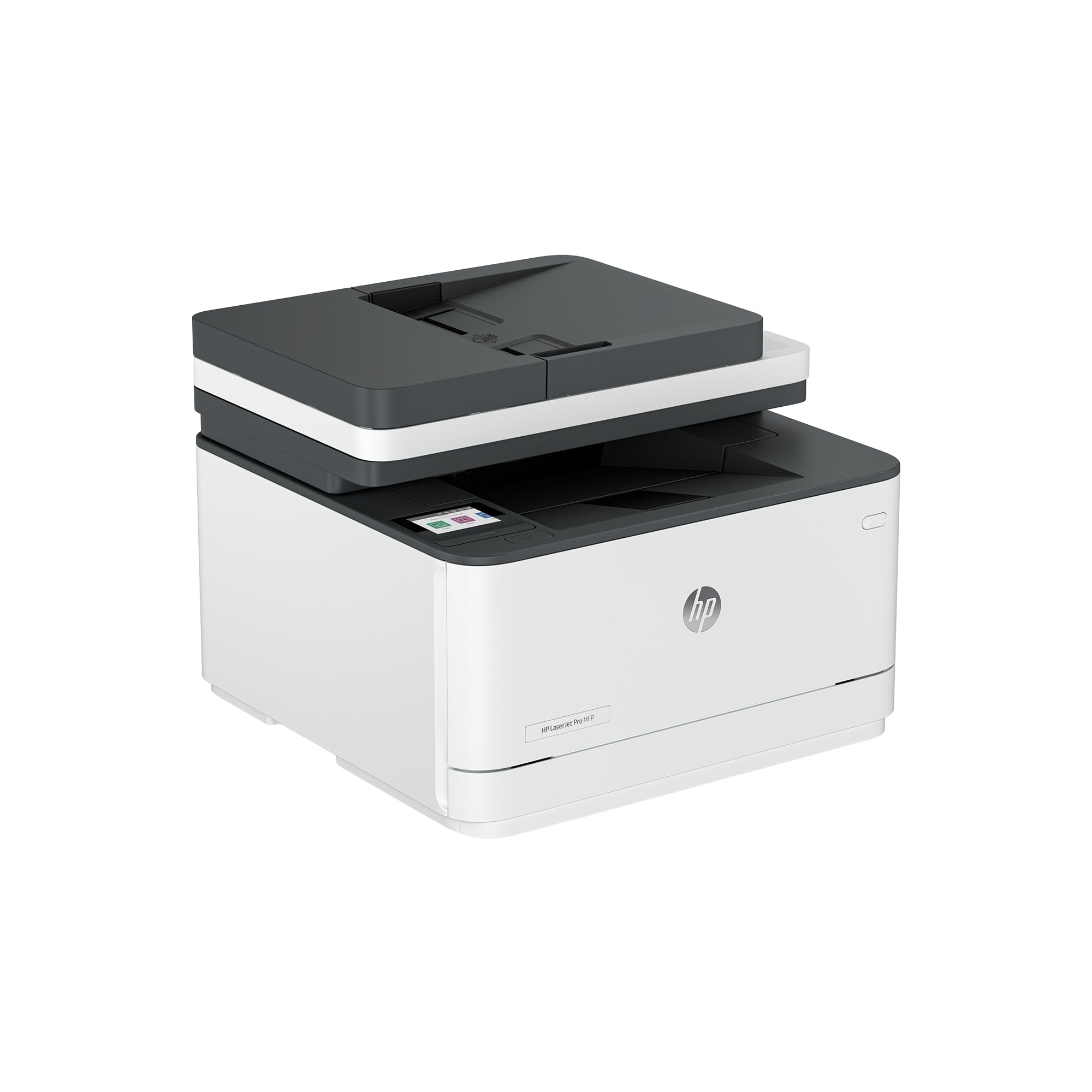
The HP LaserJet Pro MFP 3101sdw is built for small teams who need professional black-and-white output at the highest speed in this guide — up to 40 pages per minute with a 7-second first-page-out time. The 250-sheet input tray and 50-sheet auto document feeder support sustained workflows without constant paper refills, and automatic duplex printing is standard. HP’s “intelligent Wi-Fi” actively seeks the strongest connection band, which reduces the drop-off issues common with standard 2.4 GHz-only printers.
Print quality is sharp and consistent thanks to HP’s toner formulation, which produces deep blacks and clean edges on standard copy paper. The included introductory toner cartridge yields roughly 1,000 pages; replacing it with a high-yield HP 151A toner (approximately 3,000 pages) brings the per-page cost down to a competitive level for a mono laser. The machine also includes HP Wolf Pro Security, a firmware-level security suite that protects against network-based attacks — relevant if your home office handles sensitive client data.
The biggest frustration is HP’s cartridge-blocking firmware: the printer is designed to reject cartridges without original HP chips or circuitry. Third-party replacements will be blocked, forcing you to buy OEM toner at a premium. A minority of users report that the device can be picky about paper weight — light 20-lb bond paper may cause subtle feed inconsistencies. For teams printing 1,000+ pages per month who prioritize speed and security above all, the 3101sdw delivers.
Why it’s great
- Blazing 40 ppm speed with fast first-page-out
- Intelligent Wi-Fi maintains stable connections
- HP Wolf Pro Security for data-sensitive environments
Good to know
- Firmware blocks all non-HP cartridges
- Light 20-lb paper may cause feed inconsistencies
4. Canon imageCLASS MF275dw

Canon’s imageCLASS MF275dw offers a rare combination for a mono laser in its tier: a 6-line adjustable touchscreen that tilts for sit-stand desks, plus a 35-sheet auto document feeder and automatic duplex printing. Print speed is a reliable 30 pages per minute with a 5.3-second first-page-out time, which makes it competitive for home offices that handle sporadic bursts of multi-page printing rather than continuous high-volume runs. The 150-sheet paper cassette is lower capacity than some competitors, but adequate for light to moderate use.
Wireless setup through the Canon PRINT Business app is generally smooth, and the printer supports Apple AirPrint, Mopria, and direct Wi-Fi connection without a computer. Print quality is crisp with deep black text — exactly what you want for contracts, invoices, and correspondence. The Canon 071 starter toner yields roughly 700 pages; the standard-yield 071 cartridge delivers 1,200 pages, and the high-yield 071H pushes to 3,000 pages, keeping the running costs low for a mono laser.
One limitation is that the scanner only supports auto-duplex scanning on the ADF for the document feeder — the flatbed scanner itself cannot scan both sides of a page simultaneously. A few users also note that the network setup can be finicky if you’re connecting through a complex router configuration. The paper tray, while smaller, is also a bit stiff to open initially. For a small office that values a user-adjustable screen and quick text output, this remains a strong mid-range mono laser option.
Why it’s great
- 6-line adjustable touchscreen for sit-stand use
- Fast 30 ppm with 5.3-second first-page-out
- Low running costs with high-yield 071H toner
Good to know
- Flatbed scanner does not support auto-duplex
- 150-sheet cassette may need frequent refills for high volume
5. HP LaserJet Pro MFP 3101fdw
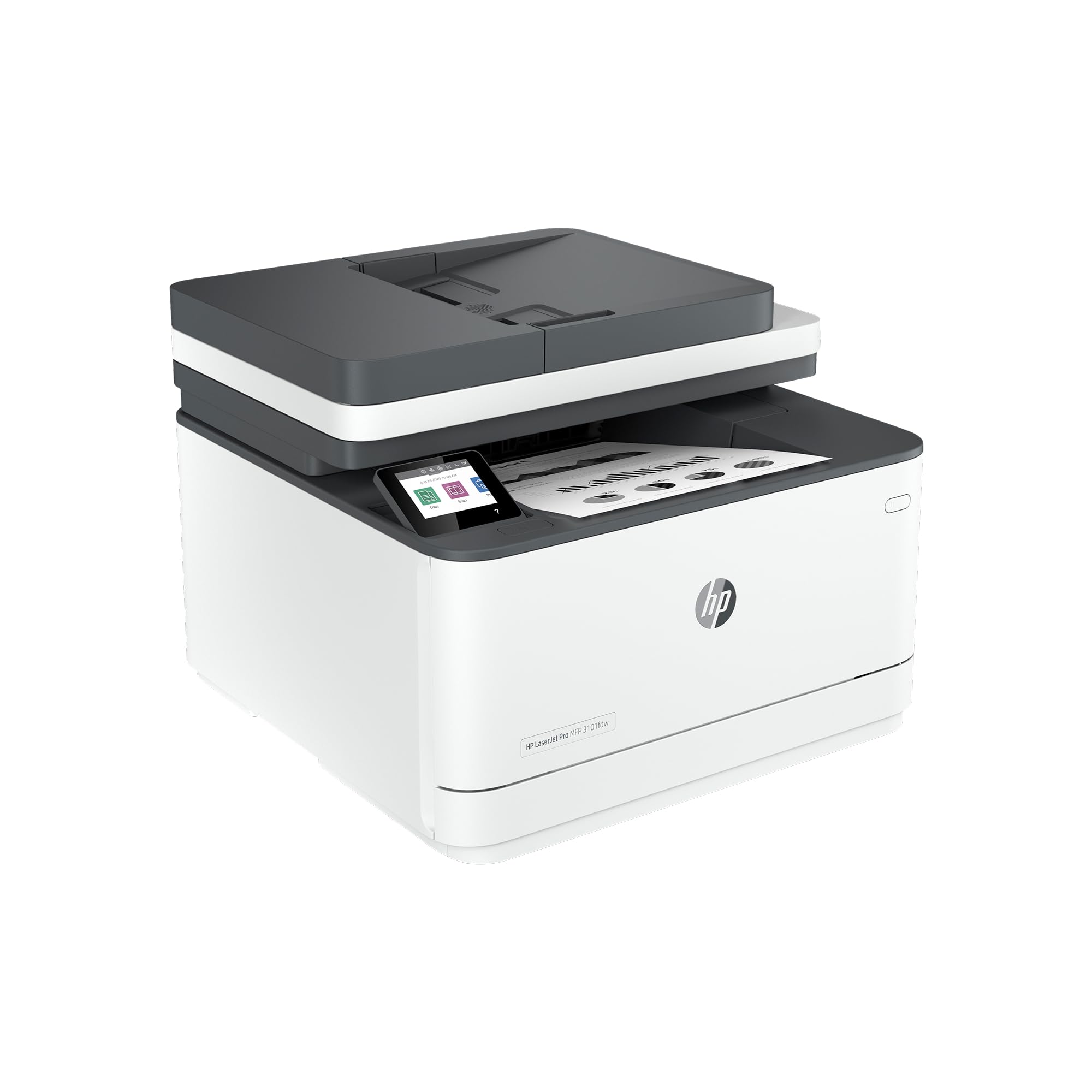
The HP LaserJet Pro MFP 3101fdw is essentially a fax-enhanced version of the 3101sdw, adding a built-in fax modem while retaining the 35 ppm print speed, 50-sheet ADF, and intelligent dual-band Wi-Fi. The inclusion of HP Wolf Pro Security is a differentiator for home offices that handle confidential documents — the firmware can enforce user-level permissions and automatically block unauthorized access to the printer’s hard drive or network ports.
Print quality is consistent and sharp, and the automatic duplex printing works reliably without adding noticeable delay. The 250-sheet paper tray handles standard letter and legal sizes, and the ADF supports duplex scanning for multi-page copy and fax jobs. The introductory toner cartridge yields around 1,000 pages; the high-yield HP 151X toner extends to about 3,800 pages, keeping the per-page cost in a competitive zone for a mono laser in this speed class.
As with the 3101sdw, HP’s cartridge-blocking firmware prevents use of third-party toner — a significant long-term cost consideration. A small number of users report that the wireless setup can be unreliable if the printer is not placed within good range of the router, and the initial driver installation may require downloading HP’s Smart app rather than using a traditional driver. The price sits higher than other mono lasers in this guide, but for teams needing fax capability and enterprise-grade security, the 3101fdw justifies the premium.
Why it’s great
- Built-in fax for offices that still need it
- HP Wolf Pro Security protects sensitive data
- 35 ppm speed with reliable duplex and ADF
Good to know
- Blocks all non-HP cartridges via firmware
- Wireless setup can be unreliable at range
6. Xerox C235dni
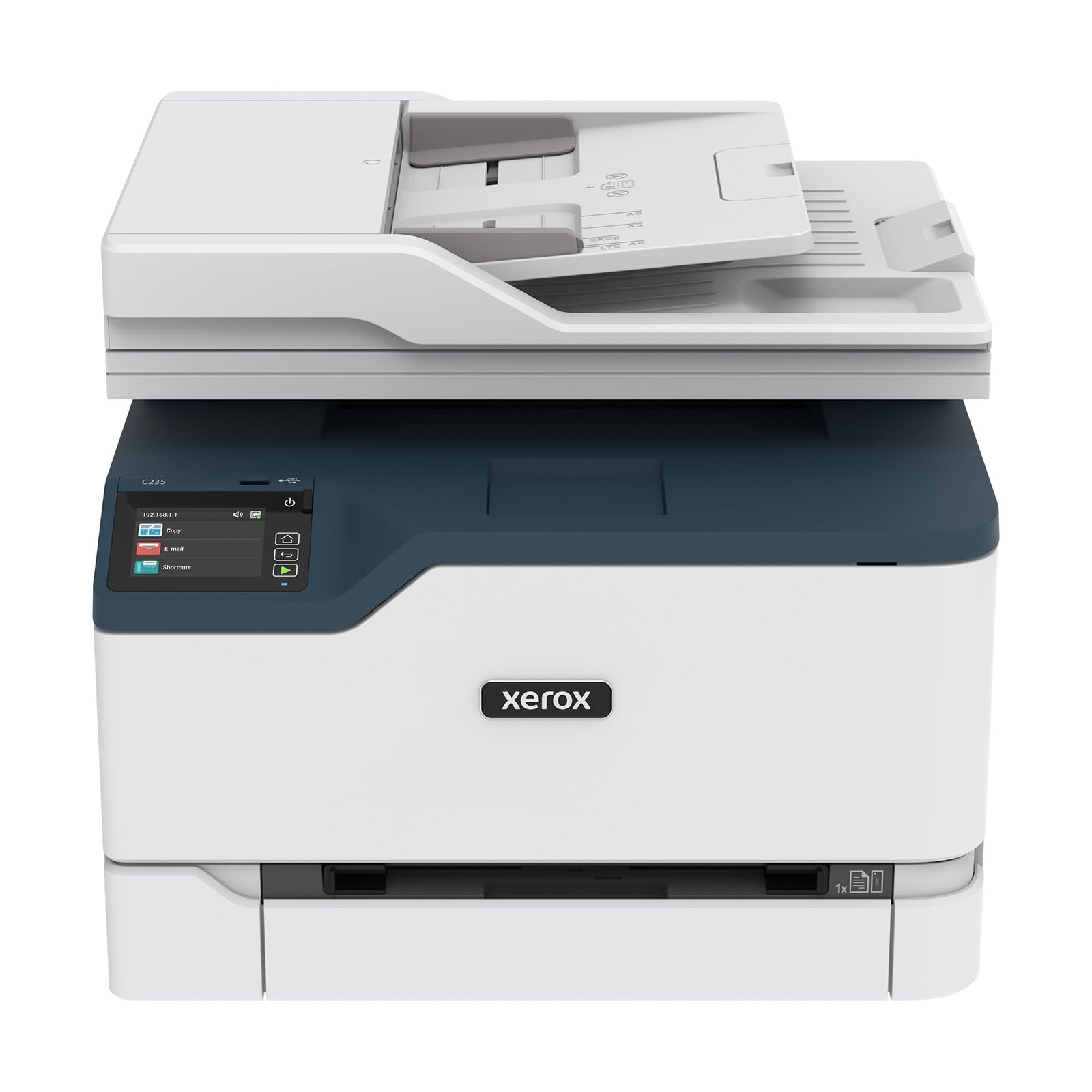
The Xerox C235dni is one of the most affordable ways to get a color laser all-in-one for a home office that needs professional-quality graphics in presentations, proposals, or marketing materials. Print speed is a respectable 24 ppm in both color and black-and-white, with a first-page-out time of roughly 10 seconds. The 250-sheet paper tray and manual feed slot accommodate a variety of media types, and automatic duplex printing is standard.
Color output is vibrant and consistent on standard office paper, with sharp text and rich graphics that make slide decks and one-pagers look polished. The Xerox Easy Assist App simplifies initial setup by guiding you through the network connection, though several users found that using the front panel directly was more reliable than the app. The included starter toner yields roughly 500 pages per cartridge — noticeably lower than the final high-yield cartridges — so you’ll need to budget for replacements within the first month of moderate use.
The scanner performance is a known weak point: a handful of users report that scanned documents come out extremely light or blank, which makes the scanner function unreliable for critical work. The Windows driver installation process can be finicky on Windows 11 — some users had to manually enter the printer’s IP address to get the driver to detect it. If you primarily need color document printing rather than scanning, this model offers strong value for the price, but the scanner issue makes it less suitable as a do-everything machine.
Why it’s great
- Lowest entry price for a color laser all-in-one
- 24 ppm color speed is fast enough for most workloads
- Print quality is sharp and vibrant on standard paper
Good to know
- Scanner quality may be unreliable (light/blank outputs reported)
- Windows driver setup can require manual IP configuration
7. Epson EcoTank ET-4950
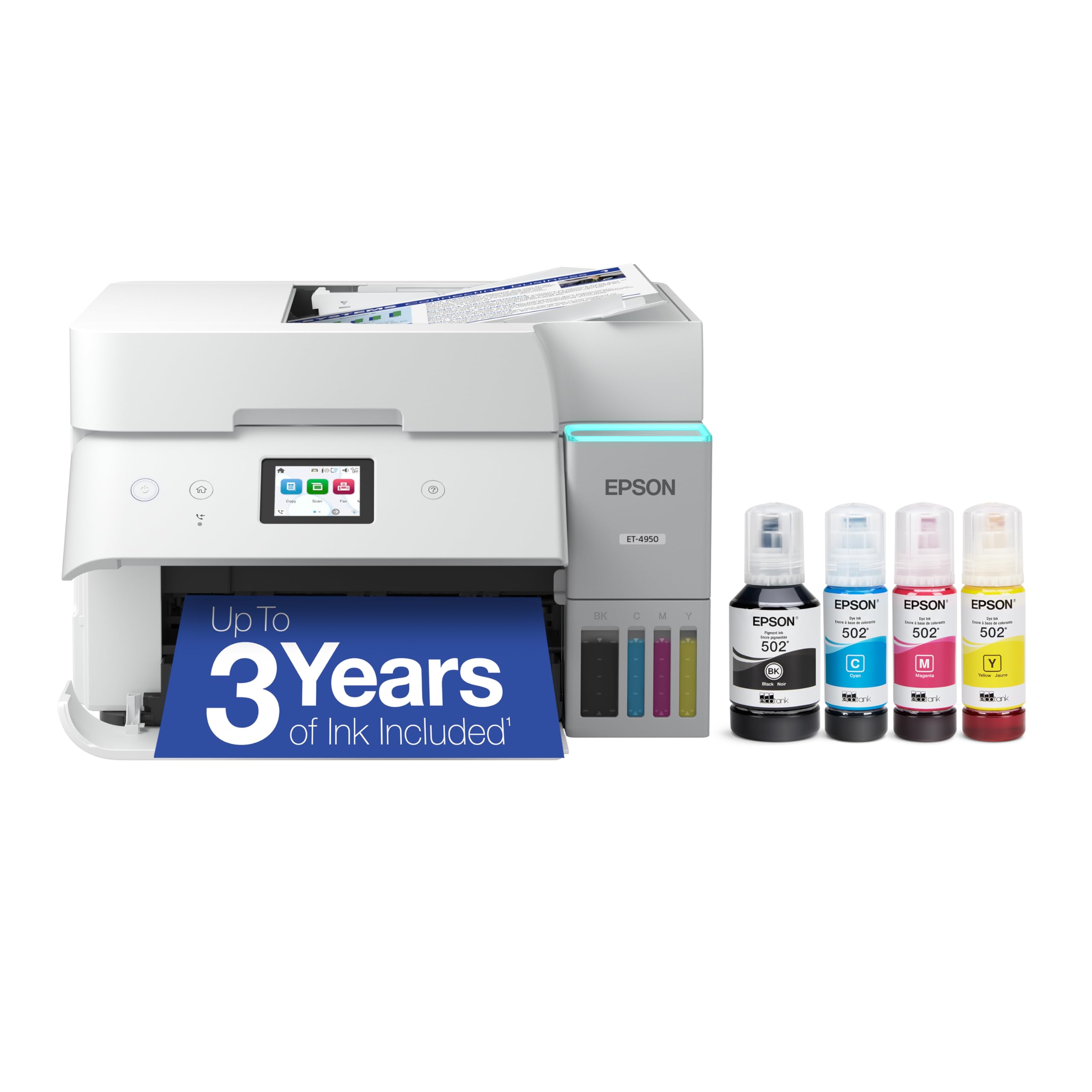
The Epson EcoTank ET-4950 represents the ink-tank approach at its most capable: it ships with enough ink to print up to 6,600 black pages and 5,500 color pages, completely eliminating cartridge anxiety for the first year or more. Print speeds are 18 ppm black and 9 ppm color — slower than a laser but competitive for an ink tank. The 2.4-inch color touchscreen, auto document feeder, 250-sheet paper tray, and automatic duplex printing make this a fully-featured office machine rather than a basic home unit.
Print quality is strong for an inkjet: text is crisp enough for business documents, and color photos and graphics are vibrant and smudge-resistant on Epson’s own paper. The EcoFit ink bottles are keyed to each color tank, preventing accidental mis-fills, and the refill process is clean and straightforward. Wi-Fi connectivity is robust, with the printer maintaining its connection through router resets and brief power outages. The Epson Smart Panel app provides remote printing and scanning without issues.
The build quality feels slightly less substantial than a laser — some plastic panels make a snapping sound when flexed. The auto duplex speed is noticeably slower than single-sided printing (as is typical with inkjets), and the initial setup took about 45 minutes for some users due to a paper jam during the ink-charging process. Copying quality is occasionally reported as off-center or slightly cropped. For anyone printing more than 500 color pages per year, the ET-4950’s running costs (roughly a penny per color page) are unmatched.
Why it’s great
- Extremely low cost-per-page with 6,600-page black ink yield
- Keyed EcoFit bottles prevent messy refill mistakes
- Full office features: ADF, duplex, fax, touchscreen
Good to know
- Duplex printing is slower than single-sided mode
- Build quality feels plasticky compared to laser machines
8. Epson EcoTank ET-2803

The Epson EcoTank ET-2803 strips the feature set back to essentials — no auto document feeder, no fax, no duplex — but keeps the core ink-tank advantage at the lowest entry price in this category. The included ink bottles yield up to 4,500 black pages and 7,500 color pages, which is enough for several years of moderate home-office use. Print speeds are modest at 10 ppm black and 5 ppm color, but the machine has zero warmup time, so the first page comes out quickly.
Setup is straightforward: the ink bottles are keyed to prevent mis-fills, and the tank fills are visible through translucent windows. Print quality is good for the price — text is crisp enough for most documents, and color graphics are vibrant on standard paper. The printer sits compactly on a desk and is relatively lightweight. The Epson Smart Panel app supports remote printing, though some users find the app-based setup more cumbersome than a traditional driver installation.
Where the ET-2803 falls short is software reliability. Multiple users report persistent “printer not available” errors, paper mismatch messages, and connection drops that require restarting the printer or router. The lack of duplex means you’ll manually flip pages for two-sided documents. For a home office that prints mostly in color with low-to-moderate volume and can tolerate occasional software hiccups, the long-term ink savings are compelling enough to recommend this model.
Why it’s great
- Very low running costs with 4,500-page black ink yield
- Keyed EcoFit bottles make refilling clean and foolproof
- Compact and lightweight for small desks
Good to know
- Frequent software connection errors reported
- No duplex, no ADF, and small hard-to-read screen
9. Canon PIXMA TS7720

The Canon PIXMA TS7720 is the only standard inkjet in this guide, and it earns its place for home offices that require genuine photo-quality output without moving to a larger format printer. The 2.7-inch color touchscreen makes menu navigation intuitive, and automatic duplex printing is included — an unusual feature at this tier. Print speeds are 15 ppm black and 10 ppm color, which is adequate for light document work but slower than any laser on this list.
Photo print quality is the TS7720’s standout feature — color photos on Canon’s glossy photo paper produce smooth gradients, accurate skin tones, and no visible banding. The printer handles a wide range of media sizes, from 4×6 inch snapshots to 8×10 inch prints, via the rear paper tray. The included PG-285 black and CL-286 color cartridges are reasonably priced for standard inkjet, and Canon’s app integration provides easy mobile printing from social media and cloud photo libraries.
The limitations are significant for a home office primarily handling text documents. The ink cartridges yield only about 180 black pages and 180 color pages, so running costs quickly exceed those of an ink-tank or laser printer. The flatbed scanner lacks an auto document feeder, so multi-page scanning requires manual page placement. Several users report that the trial ink cartridges run out within a few days of moderate printing, and wireless setup can be finicky, particularly on older Windows versions. For a home that prints a mix of documents and photos, this printer works well — but for primarily text-based office work, a laser or ink-tank model will prove more economical.
Why it’s great
- Excellent photo print quality with smooth color gradients
- 2.7-inch touchscreen is intuitive and responsive
- Auto duplex printing at a very low entry price
Good to know
- Very high cost-per-page with standard-yield cartridges
- No auto document feeder for multi-page scanning
FAQ
Should I pick a laser or ink-tank printer for a home office that prints about 300 pages per month?
Why do some printers block third-party toner cartridges and how can I avoid the issue?
Is a color laser printer worth it if I only print color occasionally?
Final Thoughts: The Verdict
For most users, the aio printer for home office winner is the Brother MFC-L3720CDW because it blends color capability, fast 19 ppm speed, and genuinely low cost-per-page through high-yield toner, wrapped in a feature set that includes a 50-sheet ADF, duplex, and cloud connectivity. If you want purely black-and-white printing at the lowest long-term cost, grab the Brother MFC-L2820DW — its compact size and sub-two-cent per-page cost are hard to beat for text-focused home offices. And for heavy color workloads without cartridge anxiety, nothing beats the Epson EcoTank ET-4950, which ships with enough ink to last the average home office a full year or more.

Mo Maruf
I created WellFizz to bridge the gap between vague wellness advice and actionable solutions. My mission is simple: to decode the research and give you practical tools you can actually use.
Beyond the data, I am a passionate traveler. I believe that stepping away from the screen to explore new environments is essential for mental clarity and physical vitality.