Our readers keep the lights on and my smoothie glass nicely filled. As an Amazon Associate, I earn from qualifying purchases.
Every hardwired smoke detector without battery backup leaves you exposed during a power outage, and every battery model that eats AAs every six months adds a recurring chore you are bound to forget. The solution is a sealed, long-life sensor that stays silent for a decade and only speaks when it matters.
I’m Mohammad Maruf — the founder and writer behind WellFizz. I spent dozens of hours cross-referencing UL 217 listings, decibel ratings, sensor types, and real-world false-alarm performance to separate the detectors worth ceiling space from the ones that will drive you crazy with nuisance trips.
This analysis of the five best battery-powered smoke alarms on the market covers photoelectric and dual-sensor units, sealed 10-year lithium models, and affordable AA-powered options so you can match the right detector to your home layout and budget. Read on to find your best option from the best battery-powered smoke detector list.
How To Choose The Best Battery-Powered Smoke Detector
Every smoke detector sold in the U.S. must meet minimum safety standards, but the real-world performance — false alarm frequency, installation ease, and long-term reliability — varies widely. Focus on the sensor type, power source, and nuisance-alarm features before making a selection.
Sensor Technology: Photoelectric vs. Ionization
Photoelectric sensors are more responsive to smoldering fires — the type that produces thick smoke before bursting into flames. Ionization sensors react faster to fast-flaming fires. For residential use, a photoelectric-only unit is the standard recommendation because slow smoldering fires are more common in homes. Some premium models combine both, but a quality photoelectric sensor with a good algorithm beats a cheap dual-sensor unit with frequent false trips.
Power Source: Sealed 10-Year Lithium vs. Replaceable AA
A sealed 10-year lithium battery removes the chore of biannual battery swaps and eliminates the danger of a dead battery going unnoticed. Replaceable AA batteries are cheaper upfront and let you keep the unit after the batteries die, but they require discipline. If you want a set-and-forget solution, invest in a sealed 10-year model.
False Alarm Reduction
Steam from a hot shower, smoke from a toaster, or fumes from cooking can trigger a cheap sensor. Look for detectors that advertise nuisance-alarm reduction technology — typically a photoelectric algorithm that distinguishes between cooking particles and actual combustion particles. This feature makes the difference between a unit you ignore and one that stays installed on the ceiling.
Quick Comparison
On smaller screens, swipe sideways to see the full table.
| Model | Category | Best For | Key Spec | Amazon |
|---|---|---|---|---|
| First Alert SMCO100 (AA) | 2-in-1 Smoke & CO | Dual hazard protection | Precision Detection; AA batteries | Amazon |
| Kidde p3010b | Sealed 10-Year | Set-and-forget reliability | Photoelectric; 10-year lithium | Amazon |
| Kidde 20SDR | AA Powered | Affordable code compliance | 25% faster detection; 85 dB | Amazon |
| First Alert SMICO100 (9V) | 2-in-1 Smoke & CO | Dual protection with 9V | Precision Detection; 9V battery | Amazon |
| SITERWELL GS525A | Budget-Friendly | Low-cost 10-year sealed | Photoelectric; 10-year lithium | Amazon |
In‑Depth Reviews
1. First Alert SMCO100 (AA Powered)

First Alert’s SMCO100 delivers a rare combination the market under-serves: a battery-operated 2-in-1 smoke and carbon monoxide alarm that uses Precision Detection technology to slash nuisance trips from cooking and steam. The unit runs on standard AA batteries (included), which keeps the upfront cost lower than sealed lithium models while still offering a 10-year limited warranty on the device. The audio alarm hits the standard 85-decibel threshold, and the test/silence button allows quick silencing of false alarms without removing the detector from its base.
The photoelectric smoke sensor is optimized for smoldering fires — the slow-burning type that generates heavy smoke before flames appear. Pairing that with a carbon monoxide electrochemical sensor means this single unit covers the two most common household hazards. The end-of-life warning chirps when it is time to replace the entire alarm, so you are never guessing about its operational status. The base plate uses multiple hole patterns, making it compatible with most existing ceiling or wall screw layouts.
Real-world feedback highlights the easy installation and trust in the First Alert brand after decades in the safety market. A few users note the included AA batteries are basic and recommend replacing them with premium lithium AAs for maximum life, but the alarm functions reliably out of the box. For anyone who wants both smoke and CO protection in a single battery-powered device, this is the most practical choice.
Why it’s great
- Dual smoke and CO detection in one unit saves ceiling space
- Precision Detection reduces false alarms from cooking and steam
- Universal mounting plate fits most existing screw patterns
Good to know
- Uses replaceable AA batteries — not a sealed 10-year lithium pack
- Included AA batteries are entry-level; upgrading to lithium lasts longer
2. Kidde p3010b 10-Year Battery

The Kidde p3010b is the definition of set-and-forget safety. A sealed 10-year lithium battery powers the photoelectric sensor for the entire life of the unit, meaning zero battery swaps and zero risk of a dead battery leaving you unprotected. The alarm activates automatically when you twist it onto the mounting bracket — no pull tabs or battery doors to fumble with. The test/hush button lets you silence nuisance alarms caused by cooking or shower steam without removing the detector from the ceiling.
Photoelectric technology makes this unit especially sensitive to slow smoldering fires, which is the primary fire risk in residential bedrooms and living areas. The end-of-life chirp activates after a decade, telling you the alarm needs full replacement — not a battery swap. The 5.22-inch diameter footprint is compact enough to blend into ceilings without looking bulky, and the tamper-resistant design deters removal. UL 217 certification ensures it meets current safety standards.
Some users report that the 10-year battery claim does not always hold the full decade in practice — chirping can begin as early as year seven or eight. Also, the mounting bracket design changed compared to older Kidde models, which can require new screw holes if you are replacing an older unit from the same brand. Despite these quirks, the reliability of a sealed lithium-powered photoelectric sensor makes this a top contender for anyone who wants to install it and forget it.
Why it’s great
- Sealed 10-year lithium battery eliminates annual battery changes
- Photoelectric sensor excels for smoldering fire detection
- Auto-activates when mounted — no separate power switch
Good to know
- Battery may chirp before 10 years in some units
- Mounting plate changed from older Kidde models — may need new holes
3. Kidde 20SDR AA Battery Powered

Kidde’s 20SDR is the no-nonsense workhorse for homeowners who want reliable smoke detection without paying for a sealed lithium or CO-combo feature they may not need. Powered by two AA batteries (included), it claims detection speed that is 25 percent faster than the minimum UL 217 standard. The 85-decibel alarm pairs with a red LED strobe that provides a visual warning for the hearing-impaired or noisy environments. The test/hush button silences false alarms from cooking or steam without disabling the detector.
The advanced sensing technology focuses on differentiating between actual smoke particles and everyday cooking aerosols, which dramatically cuts down nuisance trips compared to older ionization units. The 5-inch diameter body fits standard ceiling layouts, and the included mounting hardware makes installation a 2-minute job. Kidde backs this with a 10-year limited warranty starting from the purchase date, which covers defects in the alarm itself. The unit also operates in humidity up to 95 percent non-condensing, so bathrooms and kitchens are not off-limits if the mounting location is appropriate.
Users consistently praise the easy setup and the reliable brand reputation. One frequent note is that the mounting bracket is designed for Kidde’s current holster pattern — if you are replacing an older Kidde Firex unit, confirm the bracket compatibility first. For an AA-powered detector that balances low-running cost with strong performance, this is the pick of the middle tier.
Why it’s great
- Detects smoke 25% faster than minimum UL 217 requirements
- AA batteries are cheap and easy to replace
- Red LED adds visual alarm cue alongside the 85 dB siren
Good to know
- Mounting bracket may not fit older Kidde Firex holsters
- AA batteries need replacing every 6–12 months
4. First Alert SMICO100 (9V Powered)

The First Alert SMICO100 offers the same Precision Detection technology found in the AA-powered SMCO100, but runs on a single 9-volt battery. This is a critical distinction for users who already stock 9V batteries for existing detectors or who prefer the standardized power source found in millions of homes. The 2-in-1 design combines a photoelectric smoke sensor with an electrochemical carbon monoxide sensor, providing dual-hazard protection in a single ceiling-mounted unit that is roughly 5.6 inches in diameter.
Precision Detection is First Alert’s proprietary algorithm that reduces nuisance alarms by analyzing the rate and pattern of particle detection rather than just raw particle count. In practice, this means the alarm is less likely to scream at you for toasting bread or taking a steamy shower, while still reacting quickly to real combustion. The test/silence button allows you to hush false triggers temporarily, and the end-of-life warning signals when the entire unit must be replaced — not just the battery. The base plate uses multiple mounting hole patterns, including compatibility with some older First Alert screw layouts.
The 9-volt battery does not last as long as lithium AA packs — expect roughly one year of life under normal conditions, less if the alarm activates frequently. Users also note that the included 9V battery sometimes arrives with no printed date or Chinese text only, which raises minor quality-control questions. For those who want a 2-in-1 alarm and already standardize on 9V batteries, this is a strong option, but the AA-powered SMCO100 offers a more modern and longer-lasting power solution.
Why it’s great
- Reliable 2-in-1 smoke and CO detection from a trusted brand
- Precision Detection reduces cooking and steam false alarms
- Universal base plate fits multiple ceiling screw patterns
Good to know
- 9V battery lasts only about one year — needs annual replacement
- Included battery may be unbranded with no date code
5. SITERWELL GS525A 10-Year Battery
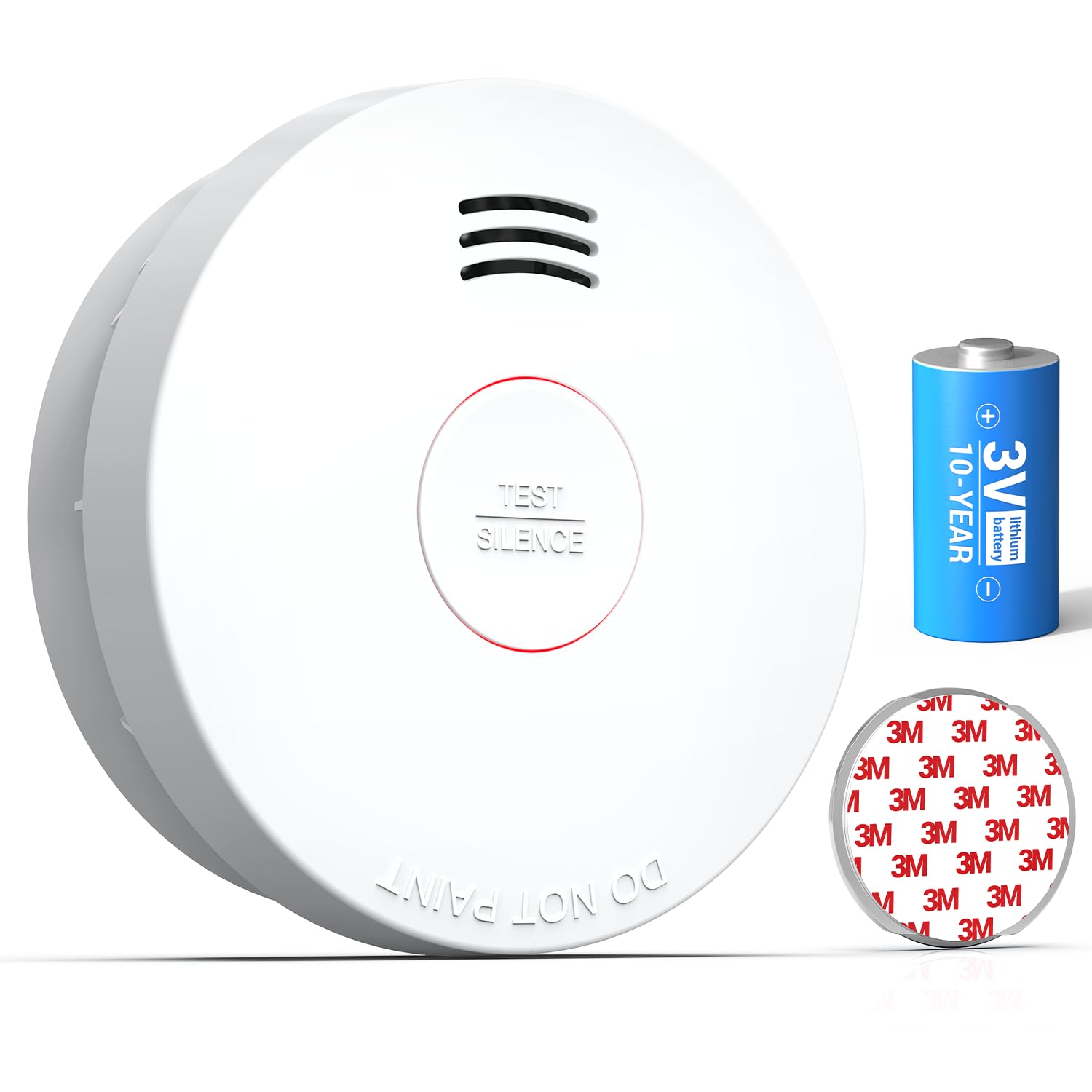
For entry-level buyers who want sealed 10-year lithium convenience without paying a premium, the SITERWELL GS525A delivers surprising value. The built-in 3V lithium battery powers a photoelectric sensor for the full decade — no battery swaps, no annual reminders. The 85-decibel alarm is loud enough to penetrate closed doors, and the test/mute button allows quick silencing of false alarms without removing the unit. UL 217 listing confirms the unit meets recognized safety standards.
One standout feature for the price is the magnetic mounting kit. The base includes a magnetic plate that sticks to the included adhesive pad or screws, making installation a 30-second job on metal surfaces or drywall. This is especially convenient for renters who cannot drill holes or who want to temporarily place a detector in a workshop or garage. The optimized sensing algorithm is designed to filter out steam and cooking smoke, reducing false trips from daily household activity.
The main trade-off is long-term reliability. User feedback is positive for the first few months, with praise for the small 3.93-inch footprint and easy install, but quality control over the full 10-year lifespan is unproven compared to established brands like Kidde and First Alert. Some users note the alarm triggers on shower steam occasionally despite the advertised algorithm. For a secondary bedroom, basement, or rental property where budget is the primary concern, this is a capable choice that punches above its price tier.
Why it’s great
- Sealed 10-year lithium battery — set and forget for a decade
- Magnetic mounting kit makes installation quick and drill-free
- Compact 3.93-inch footprint fits tight ceiling spaces
Good to know
- Long-term reliability over 10 years is unverified
- False alarms on steam may occur despite the filter algorithm
FAQ
How often should I test a battery-powered smoke detector?
Can a sealed 10-year lithium detector really last a decade?
Why does my smoke detector go off when I cook or shower?
Final Thoughts: The Verdict
For most users, the best battery-powered smoke detector winner is the First Alert SMCO100 because it combines dual smoke and carbon monoxide protection with Precision Detection technology that cuts false alarms, all powered by easy-to-find AA batteries. If you want a sealed 10-year lithium unit for true set-and-forget peace of mind, grab the Kidde p3010b. And for a budget-friendly secondary-floor or workshop detector, the SITERWELL GS525A delivers a magnetic mount and a decade battery for cents on the dollar.

Mo Maruf
I created WellFizz to bridge the gap between vague wellness advice and actionable solutions. My mission is simple: to decode the research and give you practical tools you can actually use.
Beyond the data, I am a passionate traveler. I believe that stepping away from the screen to explore new environments is essential for mental clarity and physical vitality.