Our readers keep the lights on and my smoothie glass nicely filled. As an Amazon Associate, I earn from qualifying purchases.
Buying a cane for knee pain is different from buying one for general balance. The wrong handle angle or base configuration can actually increase joint strain with every step. Most people grab the cheapest stick without realizing an offset handle centers your weight directly over the shaft, reducing torque on an already sore knee. A quad base, on the other hand, provides lateral stability when the knee feels like it might buckle on uneven ground. This guide compares seven models purpose-built to offload pressure from the knee joint while keeping you upright and confident.
I’m Mohammad Maruf — the founder and writer behind WellFizz. I’ve spent hundreds of hours analyzing mobility aid specifications, comparing weight capacities, handle geometries, and base designs to identify which canes actually reduce knee joint stress versus which ones simply look the part.
After diving into real customer experiences and technical data, I’ve narrowed the field to the seven canes that genuinely make a difference for knee pain sufferers. This guide to the best cane for knee pain covers everything from offset ergonomics to quad stability so you can walk with less discomfort and more confidence.
How To Choose The Best Cane For Knee Pain
Choosing a cane for knee pain is not about grabbing the cheapest stick. It’s about understanding how handle angle, base width, and weight distribution affect the joint you’re trying to offload. Knee pain changes the way you load your leg through the gait cycle — the wrong cane can amplify that load instead of relieving it.
Offset vs. Crook Handle: Why Geometry Matters
A standard crook cane places your hand behind the shaft’s centerline, forcing your weight slightly off-axis. For knee pain, this misalignment can torque the joint as you step through. An offset handle positions your hand directly over the shaft, channeling body weight straight down through the cane’s tip. This neutral alignment reduces rotational stress on the knee, making offset models the preferred choice for knee-specific support.
Quad Base vs. Single Point: Stability vs. Portability
Single-point canes are lighter and easier to maneuver, but they offer zero lateral stability. If your knee pain includes episodes of instability or a feeling of the knee “giving out,” a quad base with four contact points provides a much wider support footprint. Quad canes are heavier and bulkier, but the added base width can prevent sideways falls that a single tip cannot catch. For persistent knee buckling, the quad configuration is safer.
Handle Material and Foam Density
A cane transfers the load from your arm to the ground. The handle is the interface. Thin or hard grips cause hand fatigue, which makes you compensate by gripping harder and shifting your posture — both of which can increase knee load. A high-density foam handle or gel-filled grip cushions the palm and reduces the need to clamp down. Thicker foam also absorbs micro-vibrations that travel up into the knee joint with each footstrike.
Quick Comparison
On smaller screens, swipe sideways to see the full table.
| Model | Category | Best For | Key Spec | Amazon |
|---|---|---|---|---|
| Vive Offset Walking Cane | Offset Single-Point | Knee pain with good balance | 12 oz, 300 lb capacity, offset handle | Amazon |
| YOKABOZE Floral Quad Cane | Quad Base | Knee instability + travel | 3-in-1 interchangeable base, folds to 16” | Amazon |
| PELEGON Quad Cane | Quad Base | Maximum stability for buckling knees | 2.1 lb, 300 lb capacity, 4-prong base | Amazon |
| Royal RC Canes Offset Cane | Offset Single-Point | Style + gel comfort for daily use | Gel grip handle, 250 lb capacity | Amazon |
| PCP Offset Cane (Butterfly) | Offset Single-Point | Tall users + joint stress relief | Adjusts 32”–41”, 300 lb capacity | Amazon |
| Medline Aluminum Quad Cane | Quad Base | Large base for post-surgery recovery | 3.6 lb with wide 4-prong base | Amazon |
| DMI Deluxe Adjustable Cane | Offset Single-Point | Budget-friendly entry-level pick | 5.12 oz, 250 lb capacity, foam grip | Amazon |
In‑Depth Reviews
1. Vive Offset Walking Cane
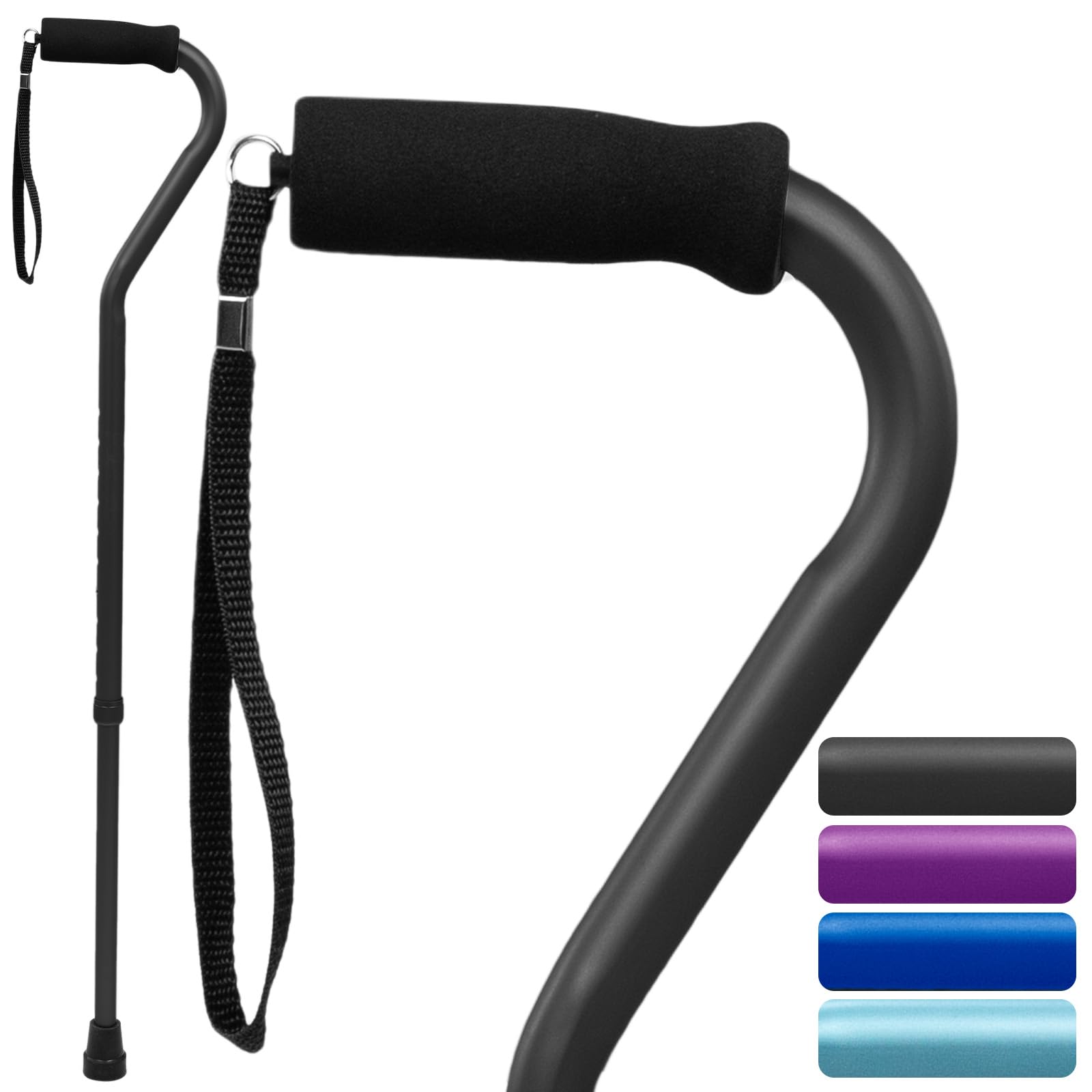
The Vive Offset Walking Cane gets the top spot because it nails the single most important factor for knee pain: the offset handle design that centers body weight directly over the shaft. At just 12 ounces, it’s light enough to carry without fatigue, yet the anodized aluminum shaft supports up to 300 pounds. The push-button height adjustment with a locking ring prevents the rattling that cheaper canes develop after a few weeks of use.
What sets this cane apart for knee pain specifically is the thick foam handle. Multiple users recovering from total knee replacement reported that the cushioned grip eliminated hand pain and allowed them to put more pressure through the cane during the critical offloading phase of walking. The wider base at the bottom also lets the cane stand upright on its own, which is a small convenience that matters when you are one-handed.
The non-slip rubber tip delivers steady traction on tile, hardwood, and concrete without scuffing. Vive backs this with a lifetime guarantee, which is unusual at this price point. If you need a single-point cane that prioritizes knee joint unloading without frills, this is the one.
Why it’s great
- Offset handle reduces knee torque by centering weight over the shaft
- Thick foam grip prevents hand fatigue during extended weight bearing
- Push-button lock with silencer ring eliminates annoying rattle
Good to know
- Single-point base offers no lateral stability for buckling knees
- Some users found the initial push-button mechanism stiff on first use
2. YOKABOZE Floral Quad Cane
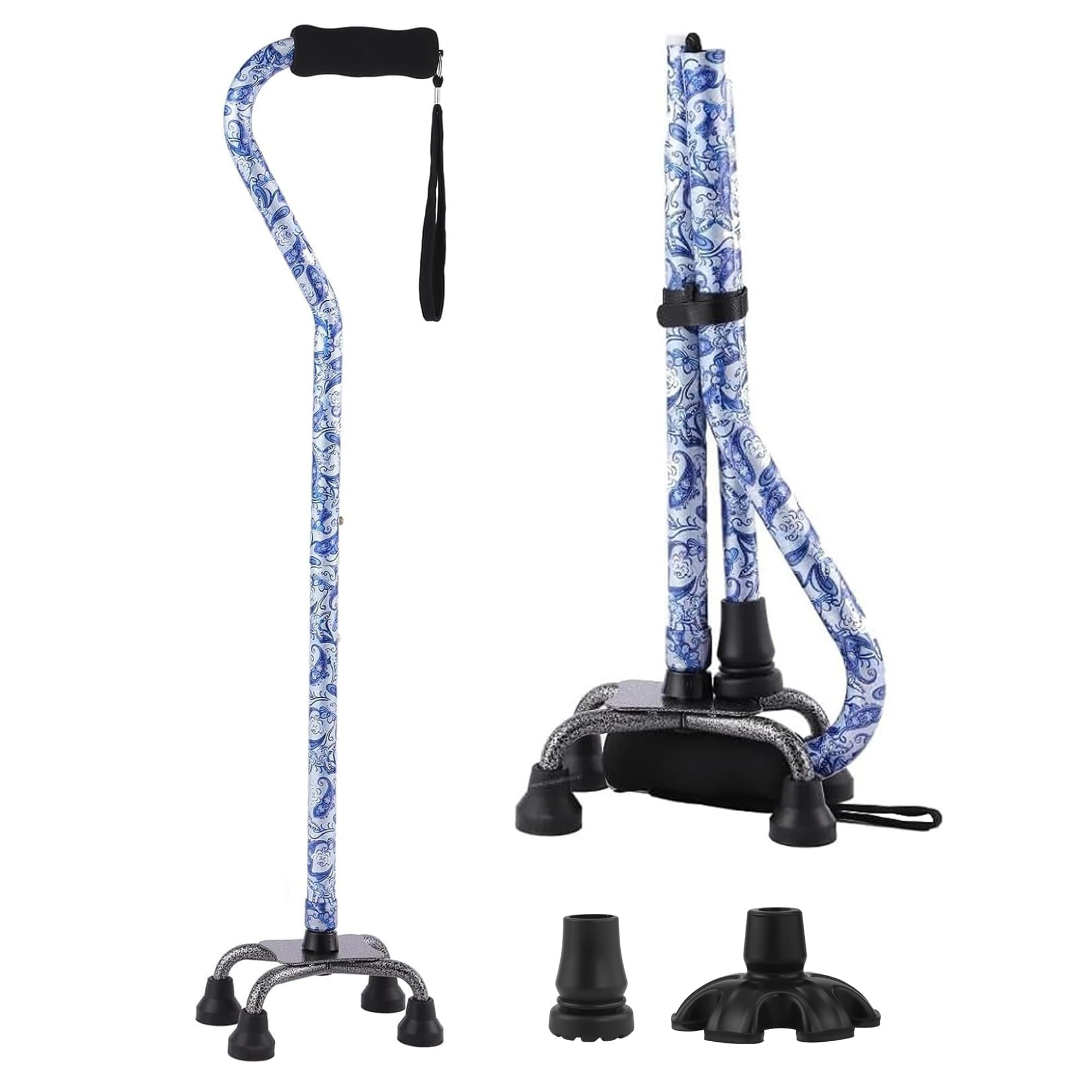
The YOKABOZE Floral Quad Cane solves a unique problem for knee pain sufferers: it comes with three interchangeable bases — a standard four-prong, a hexagon six-prong, and a large four-prong — so you can match the support footprint to your current stage of recovery. When your knee feels unstable, the six-prong base provides massive lateral catch. As you heal, swapping to a smaller base reduces weight and bulk.
It folds down to 16 inches in about three seconds, which makes it the best travel option for knee pain. You can stash it in a backpack or car door pocket without the quad prongs catching on fabric. The aircraft-grade aluminum frame supports up to 380 pounds, the highest in this comparison, yet the cane remains manageable at 1.7 pounds.
The offset foam handle is ergonomically shaped to reduce wrist strain during the push-off phase of walking. Users recovering from ankle surgery noted the hex base stood up independently, eliminating the frustration of a fallen cane that requires bending down — a motion that aggravates many knee conditions.
Why it’s great
- Three interchangeable bases let you dial in stability as recovery progresses
- Folds to 16 inches for easy travel and storage
- Highest weight capacity in this guide at 380 pounds
Good to know
- Heavier than single-point canes at 1.7 pounds
- One user reported it was too heavy for weaker arms
3. PELEGON Quad Cane

The PELEGON Quad Cane is built for one thing: unwavering stability for knees that feel like they could collapse mid-step. The four-pronged base is medium-sized — large enough to offer a wide support footprint but not so oversized that it catches on door frames or furniture. Each prong is fitted with an anti-slip rubber tip that grips tile, hardwood, and outdoor concrete equally well.
At 2.1 pounds, this cane is heavier than aluminum single-point models, but the weight is a trade-off users with buckling knees consistently accept. Real users report that the added heft creates a grounded, planted feeling that builds confidence. One customer specifically mentioned it helped relieve sciatica-related knee pain by keeping pressure off the affected leg during the full gait cycle.
The height adjustment range of 29.5 to 38.4 inches covers nearly all adult heights. PELEGON includes a booklet with proper walking technique for first-time users, which is a thoughtful addition because using a cane on the wrong side can increase knee pain rather than reduce it. The rubber handle is less cushioned than foam, but it provides a slip-resistant grip even with sweaty palms.
Why it’s great
- Quad base provides wide lateral support for buckling knees
- Height range fits very tall users up to 38.4 inches
- Includes technique booklet for correct cane usage
Good to know
- Not foldable; takes up trunk space during travel
- Rubber handle lacks the cushion of foam grips
4. Royal RC Canes Offset Walking Cane
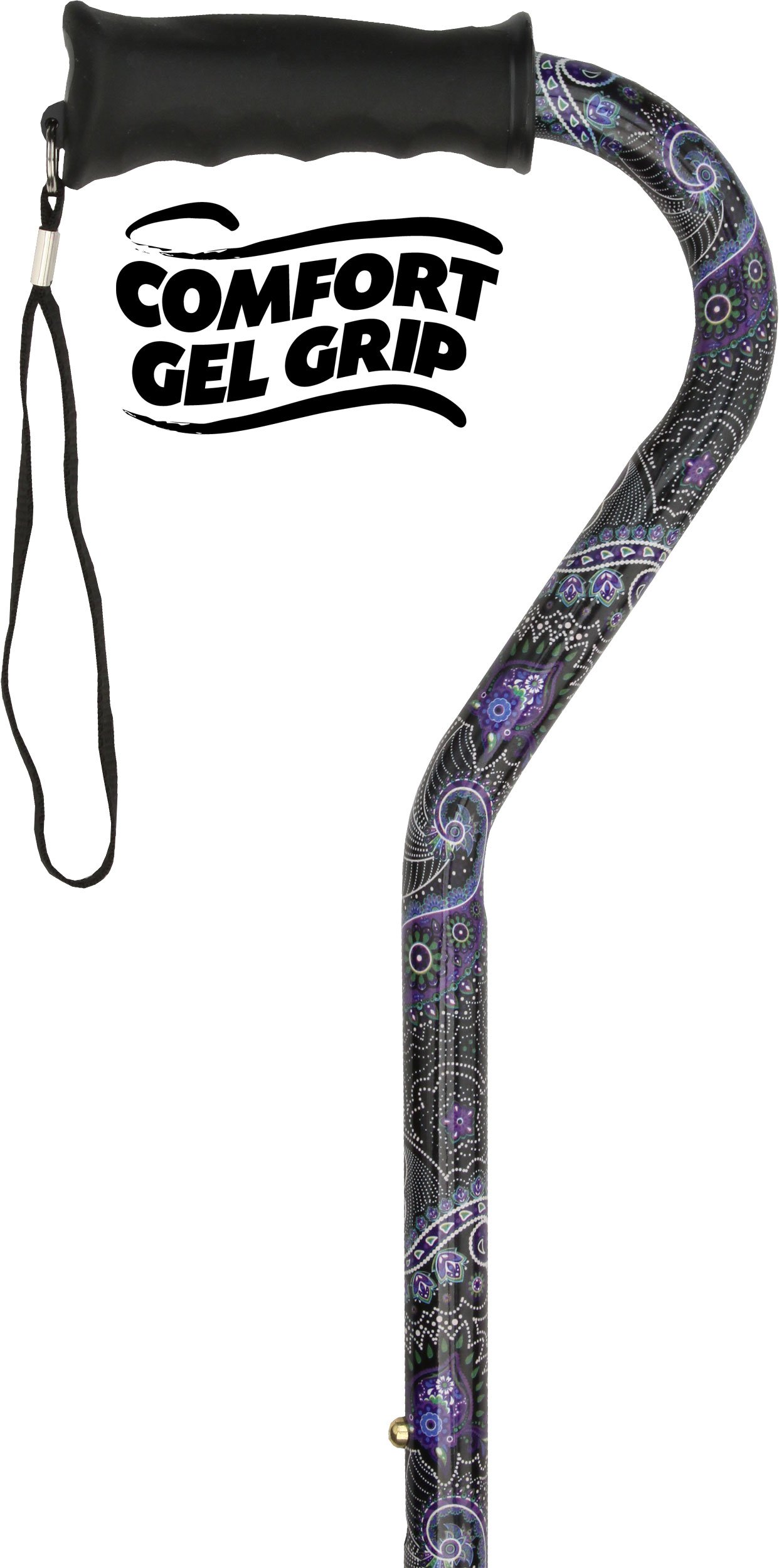
The Royal RC Canes Offset Walking Cane proves that a knee pain cane does not have to look like medical equipment. The Purple Majesty pattern features a subtle, elegant floral design that draws compliments rather than stares, which matters when you use a cane full-time and want to feel dignified, not disabled. But the real story is the gel grip handle — a thick, padded layer of comfort gel that distributes weight across the palm more evenly than standard foam.
The offset geometry is identical in function to the Vive cane; it centers body weight directly over the 18mm tip to reduce knee torque. The aluminum shaft keeps the overall weight at 12.8 ounces, making it as light as the Vive but with a significantly more comfortable grip surface. Users report being able to lean heavily through the cane during long walks without developing the hand cramps typical of hard plastic handles.
The 250-pound weight capacity is lower than some competitors, so heavier users should look at the Vive or YOKABOZE. The rubber tip is harder than some replacement tips, producing a slight clicking sound on smooth floors. But for style + comfort with genuine knee-unloading geometry, this cane delivers.
Why it’s great
- Gel-filled grip provides superior palm cushioning for heavy pressure
- Stylish floral pattern reduces clinical appearance
- Offset handle properly channels weight to reduce knee torque
Good to know
- 250-pound capacity lower than competing models
- Harder tip can click audibly on tile and hardwood
5. PCP Offset Handle Foam Grip Adjustable Cane (Butterfly)

The PCP Offset Cane stands apart because of its height range: it adjusts from 32 to 41 inches, making it the only cane in this lineup tall enough for users over 6 feet. For a tall person with knee pain, using a cane that is too short forces you to lean sideways with each step, which torques the knee joint. This cane eliminates that problem and also supports up to 300 pounds.
The offset foam grip is comfortable and distributes weight evenly across the palm. The locking ring prevents the rattling that plagues many adjustable canes, and the lanyard strap lets you dangle the cane from your wrist when you need both hands. The butterfly pattern adds a touch of personality without being overwhelming.
One user who suffered from rapid joint degenerative pain due to chronic Lyme disease noted the cane reduced knee pain significantly when climbing stairs in a three-story house. The single-point base is inherently less stable than a quad, but for users with good balance who just need to offload the knee, this is a solid tall-friendly option. Some users swapped the tip for a quad base adapter to improve stability.
Why it’s great
- 41-inch max height fits tall users without forcing a lean
- Foam offset handle cushions the palm during weight bearing
- Rattle-free locking ring stays tight during use
Good to know
- Single-point base offers minimal lateral stability
- Some users felt the tip required swapping for a quad adapter
6. Medline Aluminum Quad Cane

The Medline Aluminum Quad Cane is built for immediate post-surgery or injury recovery when knee stability is at its lowest. The large four-pronged base provides a support footprint wide enough that the cane stands up on its own, eliminating the need to bend down and pick it up — a motion that is painful after knee surgery. At 3.6 pounds, it is the heaviest cane in this comparison, but that weight is a direct consequence of the extra-wide base.
The foam handle is comfortable and provides a secure grip even when hands are sweaty or unsteady. The flip-lock adjustment system is tool-free and allows height changes between 29 and 38 inches. Users as tall as 6’3″ reported excellent stability around the house, with one customer noting the cane was so reliable they spray-painted it yellow for visibility in dim light.
The trade-off is portability. This cane does not fold, and the wide base makes it awkward to stow in a car or carry on public transit. One experienced user preferred the small quad base version of the same cane, noting that the large base introduced more wobble and shudder during the push-off phase. For short-term recovery at home, this is a great tool. For long-term daily carry, consider a more compact option.
Why it’s great
- Extra-wide quad base offers maximum stability for post-op recovery
- Stands upright on its own to avoid painful bending
- Flip-lock adjustment is fast and tool-free
Good to know
- Heavy and awkward to travel with at 3.6 pounds
- Some users found the large base introduced more wobble than a smaller quad
7. DMI Deluxe Adjustable Cane

The DMI Deluxe Adjustable Cane is a budget-friendly entry point for someone testing whether a cane helps their knee pain before committing to a premium model. The anodized aluminum shaft is lightweight at just 5.12 ounces and supports up to 250 pounds. The padded foam grip handle is comfortable enough for moderate daily use, and the classic curved handle design is familiar and easy to hold.
Height adjusts from 29 to 38 inches with a locking ring that stays tight. The slip-resistant rubber tip provides adequate traction on most indoor surfaces. The included wrist strap adds security for times when you need both hands briefly. Multiple long-term users reported buying this cane repeatedly as a backup or second cane to keep in the car.
The trade-offs become apparent with heavy use. Some long-time buyers of this cane noted that recent manufacturing changes have made the foam grip thinner and less comfortable than earlier versions. At this price point, the foam density is lower than the Vive or PCP canes. For someone who needs a cane for occasional knee flare-ups or as a spare, this is a solid value. For daily heavy use with significant weight bearing, the extra investment in a thicker grip is worth it.
Why it’s great
- Very lightweight at 5.12 ounces for easy carrying
- Price makes it accessible as a backup or travel cane
- Wrist strap adds security when hands are needed
Good to know
- Foam grip has been made thinner in recent versions
- Classic crook handle geometry, not offset — less ideal for knee torque
FAQ
Should I use the cane on the same side as my painful knee or the opposite side?
How do I know if I need a quad base or a single-point cane for my knee pain?
Can a cane actually make my knee pain worse?
Final Thoughts: The Verdict
For most users, the best cane for knee pain winner is the Vive Offset Walking Cane because it combines the offset handle geometry that properly unloads the knee with a thick foam grip and a 300-pound weight capacity at a competitive price. If your knee pain includes significant instability or buckling, grab the YOKABOZE Floral Quad Cane for its interchangeable bases that let you match support to your recovery stage. And for a budget-friendly entry point to test whether a cane helps your knee pain, nothing beats the DMI Deluxe Adjustable Cane.

Mo Maruf
I created WellFizz to bridge the gap between vague wellness advice and actionable solutions. My mission is simple: to decode the research and give you practical tools you can actually use.
Beyond the data, I am a passionate traveler. I believe that stepping away from the screen to explore new environments is essential for mental clarity and physical vitality.