Our readers keep the lights on and my smoothie glass nicely filled. As an Amazon Associate, I earn from qualifying purchases.
That sudden, sharp twist during a step-off-the-curb stride or a quick pivot on the court is the unmistakable sound of an ankle giving way. For anyone with a history of sprains, chronic instability, or recovering from an injury, the fear of that moment rules daily movement. The right brace doesn’t just wrap the joint—it re-teaches your nervous system to trust the ground beneath you.
I’m Mohammad Maruf — the founder and writer behind WellFizz. I’ve spent the last several years analyzing hardware specifications, customer durability reports, and biomechanical feedback across hundreds of recovery and support products to separate what actually stabilizes from what just squeezes. This guide is built from that deep dive into real-world material performance and fit data.
Whether you are returning to the volleyball court or just need confident footing on uneven sidewalks, finding the right gear starts with a close look at the specific features that matter. This research-led breakdown of the best ankle support for weak ankles focuses on the stabilizers, compression straps, and material densities that truly prevent re-injury and keep you moving.
How To Choose The Best Ankle Support For Weak Ankles
Selecting an ankle brace for chronic weakness isn’t about picking the tightest wrap. The wrong brace can restrict circulation, create pressure points, or fail to lock the talus bone during lateral movement. Focus on the mechanics of stabilization rather than marketing buzzwords like “maximum compression.”
Stabilizer Type and Rigidity
Not all braces prevent the ankle from rolling inward—the most common failure pattern. Look for removable lateral splints made from rigid nylon or polypropylene. These create a mechanical stop against inversion. If you need flexibility for daily walking, splints that can be removed offer two modes in one brace. Braces relying solely on fabric tension rarely prevent sprains in active settings.
Strapping Architecture
The difference between a figure-8 strap and a simple top wrap is significant. A figure-8 configuration crosses the talocrural joint and mimics athletic taping by locking the ankle from two directions. Lace-up systems offer graduated tension along the full length of the foot but require more time to adjust. For quick changes during games, hook-and-loop closure systems with pre-tensioned laces save time without sacrificing hold.
Fit Profile and Material Breathability
A support that doesn’t fit inside your sneaker is useless. Measure the volume of your ankle, not just shoe size. Neoprene retains heat and aids blood flow for recovery but adds bulk that crowds cleats and dress shoes. Nylon Oxford fabric with honeycomb venting zones reduces sweating during long wear. Always check if the brace accommodates swelling—adjustable Velcro straps are non-negotiable for post-injury days when the joint changes size.
Quick Comparison
On smaller screens, swipe sideways to see the full table.
| Model | Category | Best For | Key Spec | Amazon |
|---|---|---|---|---|
| McDavid Ankle Brace Ultralight | Premium | High-intensity sports and prevention | Figure-6 strapping pattern | Amazon |
| AGPTEK Ankle Brace | Mid-Range | Post-surgery recovery and all-day wear | Quick-lace with 1-second fastening | Amazon |
| Fitomo Ankle Brace | Mid-Range | Customizable support with removable stabilizers | Triple-lock with figure-8 strap | Amazon |
| Neo-G Ankle Brace | Entry-Level | Arthritis pain and moderate daily support | Thermal neoprene material | Amazon |
In‑Depth Reviews
1. McDavid Ankle Brace Ultralight
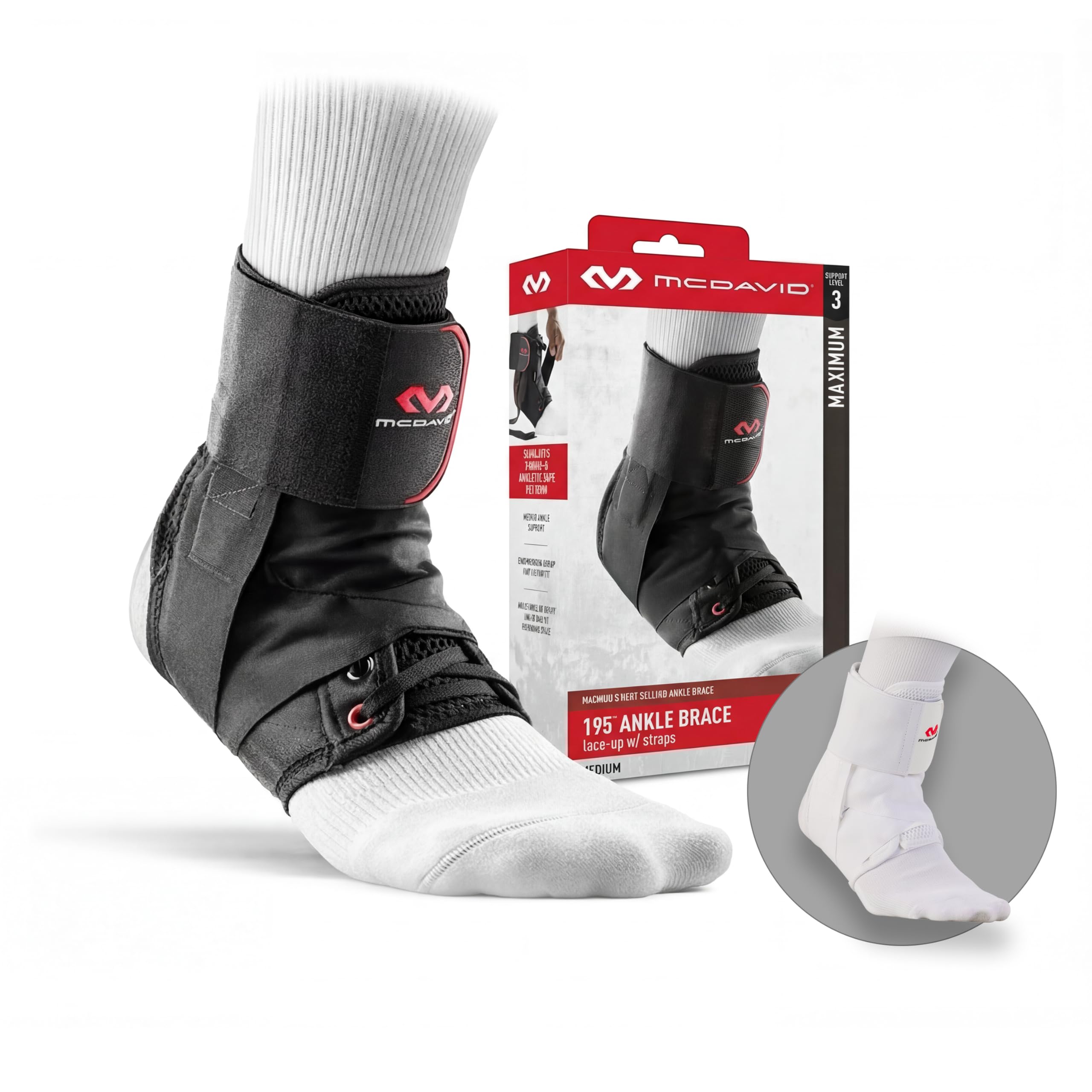
McDavid’s design directly mimics athletic taping with a figure-6 strapping pattern that locks the subtalar joint against inversion. The lace-up chassis allows you to dial in tension across the entire foot arch before securing the top compression strap—without needing to unlace your shoes for mid-game adjustments. The ventilated tongue keeps air moving around the dorsum, cutting down on sweat buildup during long sessions on the hardwood or turf.
Users recovering from moderate sprains consistently praise the way this brace isolates the painful area while still permitting a normal gait. The medium size accommodates shoe sizes 8.5 to 10 snugly, and the durable lace material holds up against repeated cinching without fraying. Because the support comes primarily from the strapping geometry rather than bulky side splints, the McDavid Ultralight slides into most sneakers and even dress shoes without looking or feeling cumbersome.
The figure-6 configuration does take a few wears to break in—the fabric stiffness softens after about three sessions. Some wearers with very narrow feet report that the tongue can bunch slightly, which is easily solved by wearing a crew sock underneath. For the athlete who needs reliable proprioceptive feedback without sacrificing speed, this remains the gold standard in the mid-weight category.
Why it’s great
- Figure-6 pattern replicates professional taping for lateral stability
- Top strap adjusts without unlacing the shoe
- Breathable tongue design prevents heat buildup during play
Good to know
- Initial stiffness requires a brief break-in period
- Rubber logo on strap may peel after several months of heavy use
2. AGPTEK Ankle Brace
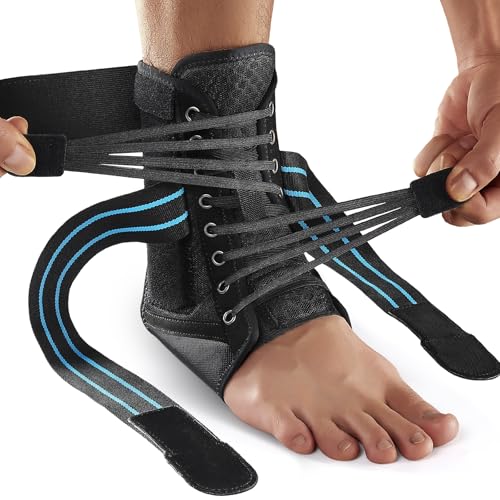
The AGPTEK brace tackles the biggest friction point for anyone recovering from foot surgery or a bad sprain: putting the brace on without pain. Its quick-lace system uses elastic laces that stretch over a swollen joint, and the dual-direction hook-and-loop fasteners lock everything in about one second. The honeycomb ventilation panels on the nylon Oxford fabric keep the joint from stewing during all-day wear, a common complaint with neoprene-heavy designs.
Reinforced side stabilizers on both the medial and lateral sides provide the rigid mechanical stop that prevents the ankle from rolling during early rehab. Several users recovering from fractured ankles report that this brace outperformed the one their orthopedic surgeon provided, specifically noting the Velcro strap placement that avoids digging into the malleoli. The medium size fits a women’s 10W comfortably, though those with very narrow feet might find the heel pocket slightly roomy.
The X-cross compression straps add a second layer of hold over the top of the foot, which helps reduce the sagging that often happens with single-strap braces after a few hours of walking. For the price point, the material quality and longevity after two months of daily use are impressive. The trade-off is that the quick-lace mechanism does not allow the fine-grained tension adjustment that a full lace-up system offers.
Why it’s great
- One-second fastening ideal for post-surgery swelling and limited mobility
- Honeycomb ventilation prevents moisture buildup during extended wear
- Removable splints allow transition from rigid protection to flexible daily use
Good to know
- Quick-lace system offers less granular tension control than traditional laces
- Heel pocket may feel loose for very narrow foot shapes
3. Fitomo Ankle Brace
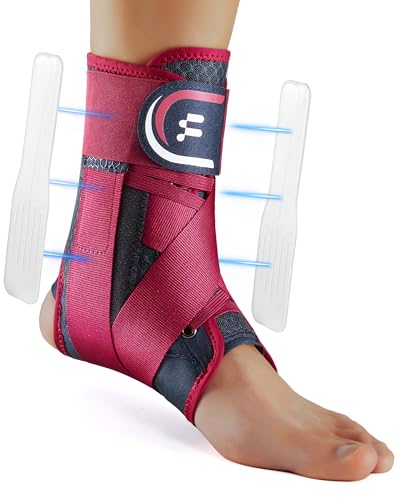
Fitomo’s brace addresses the feedback gap between “too loose” and “too tight” with a figure-8 strap that lets you target compression exactly where your ankle needs it. The Triple-Lock system stacks a top strap over dual removable side stabilizers and cross straps, creating three distinct vectors of hold. For anyone with ligament laxity who still wants to play volleyball or run, this layered approach reduces the slipping and re-tightening that plagues many figure-8 designs.
Post-stroke patients and those with foot drop have successfully used this brace to replace bulky AFOs, noting that the low-profile fit slides into real shoes instead of requiring orthopedic footwear. The removable stabilizers are a practical touch—keep them locked in for basketball practice, pop them out for a day of walking through the office. Many users report that the brace stays secure without readjusting for hours, which is a direct result of the cross-strap geometry distributing load across the dorsal arch rather than pulling on the Achilles.
The 69% polyester and 17% nylon blend fabric provides a good balance between stiffness and breathability, though the large size can feel slightly baggy on slender ankles. Several reviews mention that the product is FSA and HSA eligible, making it an easier purchase for those with flexible spending accounts focused on injury recovery.
Why it’s great
- Triple-lock configuration minimizes the need for mid-day readjustment
- Removable stabilizers offer two distinct support levels from one brace
- Low enough profile to fit inside standard athletic and casual shoes
Good to know
- Single-pack purchase may feel underwhelming for the price per brace
- Large size may not cinch tightly enough for very slender or petite ankles
4. Neo-G Ankle Brace with Figure of 8 Strap

Neo-G focuses on a different priority: thermotherapy. The neoprene body traps body heat to increase blood flow around arthritic joints and chronic tendonitis, reducing morning stiffness without relying on rigid plastic supports. The integrated figure-8 strap adds compression across the ankle complex, limiting excessive plantarflexion and inversion without the bulk of side splints. It is registered as a Class 1 Medical Device and is officially partnered with the Chartered Society of Physiotherapy, giving it a clinical credibility that many generic sleeves lack.
For users with peroneal tendon issues who find traditional braces dig into the area around the malleolus tip, the soft neoprene construction avoids creating new pressure points. The one-size-fits-most design works for a wide range of foot volumes, though wearers with very small or very large feet report the cuff feeling either loose or tight. Several customers trying this as a replacement for stiffer lace-up models appreciate that it is easier to put on and take off, especially when dealing with post-activity soreness.
The primary limitation is that neoprene does not breathe like mesh or nylon Oxford fabric. In warm conditions or during high-cardio sports, the trapped heat can become uncomfortable quickly. The brace also struggles to fit inside tight cleats—soccer players have reported blisters from the added bulk. This is a recovery-first brace best suited for walking, daily chores, and mild activity rather than competitive cutting and jumping.
Why it’s great
- Neoprene heat retention aids circulation for arthritis and chronic tendon pain
- Soft material profile avoids aggravating sensitive bony prominences
- Physiotherapy-endorsed brand with medical device classification
Good to know
- Neoprene traps heat and moisture, making it less ideal for sports or hot weather
- One-size design may fit poorly at the extremes of foot circumference
FAQ
Can I wear an ankle brace with removable splints during basketball or volleyball?
How do I know if a brace fits my ankle correctly without trying it on?
Why does my neoprene ankle brace cause blisters during soccer but not during walking?
Final Thoughts: The Verdict
For most users, the best ankle support for weak ankles winner is the McDavid Ankle Brace Ultralight because its figure-6 strapping pattern delivers proven lateral stability without the bulk of metal splints. If you want a quick-apply brace for post-surgery recovery, grab the AGPTEK Ankle Brace with its one-second fastening system. And for chronic arthritis pain where heat therapy is the priority, nothing beats the Neo-G Ankle Brace thermal neoprene design.

Mo Maruf
I created WellFizz to bridge the gap between vague wellness advice and actionable solutions. My mission is simple: to decode the research and give you practical tools you can actually use.
Beyond the data, I am a passionate traveler. I believe that stepping away from the screen to explore new environments is essential for mental clarity and physical vitality.