Our readers keep the lights on and my smoothie glass nicely filled. As an Amazon Associate, I earn from qualifying purchases.
A carbon monoxide and gas detector is the single most critical safety device most homes still lack in the right configuration. You need one that sniffs out both the invisible, odorless CO from a malfunctioning furnace and the explosive methane or propane from a cracked stove line — and every model in this class balances that dual-threat detection against battery life, audible loudness, and certification rigor.
I’m Mohammad Maruf — the founder and writer behind WellFizz. I have spent years analyzing home safety hardware specifications, cross-referencing UL certification standards, and reviewing thousands of consumer reports on gas and CO detector performance to separate the truly protective units from the noisy duds.
After comparing the sensor types, decibel output, power sources, and real-world false-alarm rates of seven leading units, this guide will help you confidently select the best carbon monoxide and gas detector for your home or workshop.
How To Choose The Best Carbon Monoxide And Gas Detector
Selecting the right combination detector means looking past the brand name and understanding three core pillars: the types of gases it can sense, its power architecture, and the certification that backs its claims. A unit that misses explosive gas or relies on a battery that fails during a cold snap is no safety device at all.
Sensor Technology: Electrochemical vs. Semiconductor
Carbon monoxide detection is best handled by an electrochemical sensor, which measures CO concentration in parts per million (PPM) with high precision. Combustible gas detection (methane, propane, natural gas) typically uses a semiconductor sensor that reacts to the gas molecules. The best dual detectors pair both technologies in one housing. Cheap units sometimes omit the combustible gas sensor entirely, leaving you blind to gas leaks from your stove, water heater, or grill.
Power Source and Battery Life
Plug-in units with a 9V battery backup offer the most reliable uptime — they stay online during a power outage. Battery-only units with sealed 10-year lithium batteries eliminate the hassle of annual battery swaps but require the entire alarm to be replaced once the battery depletes. Units powered by standard AA batteries are the most economical to maintain but demand biannual replacement vigilance. Check the decibel rating too: a true safety alarm should hit at least 85 dB to wake a sleeping household.
Certifications and Standards Compliance
Never trust a detector that does not carry UL 2034 (for CO) and UL 217 (for smoke) certifications if it is a combo unit. For dedicated gas detectors, look for compliance with ANSI/UL 1484 for combustible gas detectors. Third-party certification ensures the sensor responds at the correct thresholds and does not generate dangerous false negatives. Units marketed as “natural gas detectors” without a clear UL mark are simply alarms, not certified safety tools.
Quick Comparison
On smaller screens, swipe sideways to see the full table.
| Model | Category | Best For | Key Spec | Amazon |
|---|---|---|---|---|
| X-Sense XP0H-SN | Combo Detector | Smoke & CO detection | 10-Year Sealed Lithium Battery | Amazon |
| First Alert SMICO100 | Combo Detector | Precision Detection | 9V Battery Powered | Amazon |
| First Alert SMCO100 | Combo Detector | Budget-friendly reliability | AA Battery Powered | Amazon |
| X-Sense SC01-W | Combo Detector | Wireless interconnection | RF Interconnected Model | Amazon |
| TopTes PT520A+ | Gas Leak Detector | Spot-checking gas lines | 17-inch Gooseneck Probe | Amazon |
| Kidde KN-COEG-3 | CO & Gas Detector | Plug-in with display | Digital LED Display | Amazon |
| Kidde 30CUDR | Combo Detector | Two-pack value | AA Battery Powered | Amazon |
In‑Depth Reviews
1. TopTes PT520A+
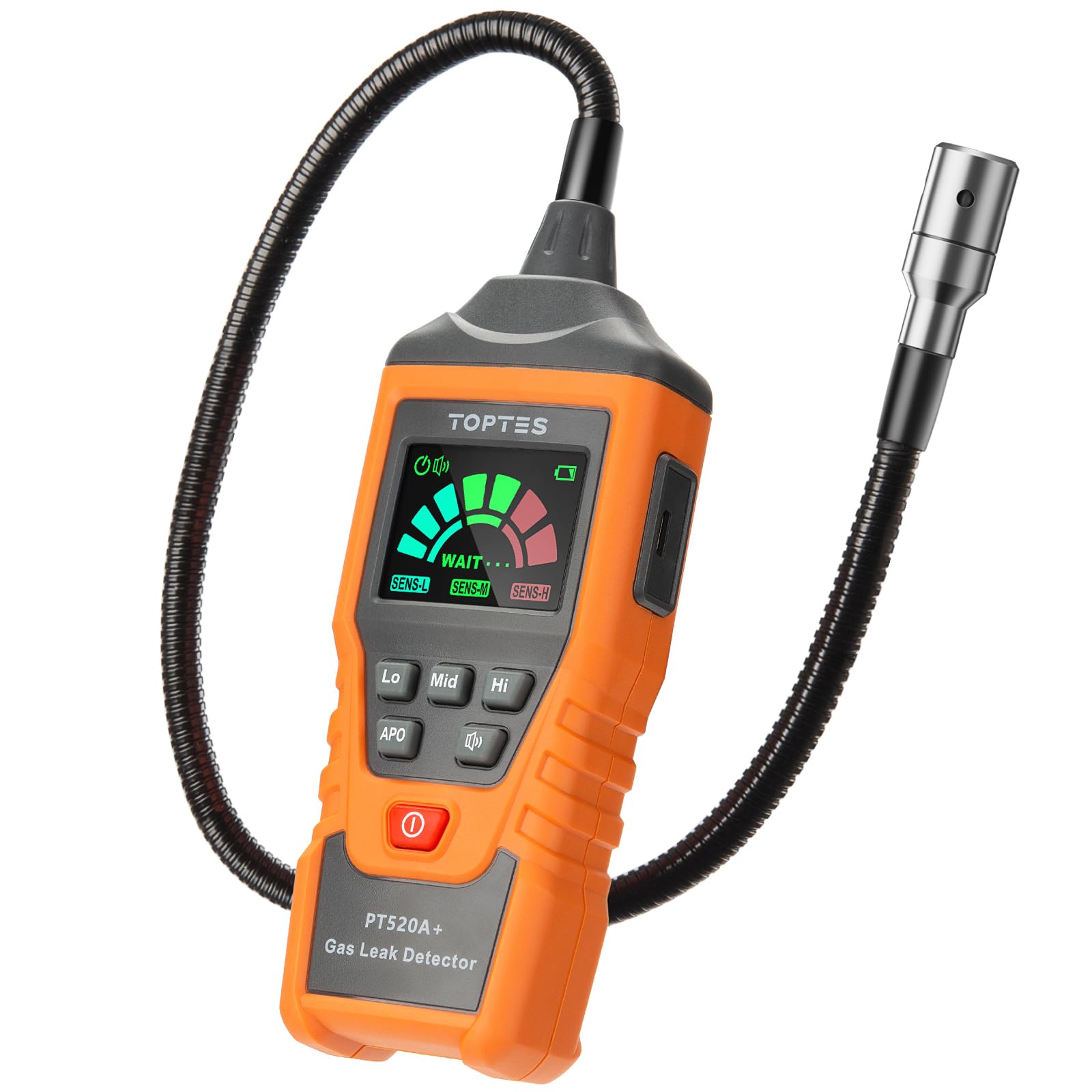
The TopTes PT520A+ is a dedicated handheld gas sniffer, not a wall-mounted monitor. It uses a semiconductor sensor with a 17-inch bendable gooseneck probe to reach behind water heaters, stoves, and RV propane lines. The sensor heats up for about 30 seconds, then reacts to combustible gas concentrations between 50 and 10,000 PPM with both a 75 dB buzzer and a seven-segment LED bar that climbs as the leak gets worse.
Its rechargeable battery is rated for over 3,000 cycles, making it the only unit in this roundup that never requires battery disposal. The auto-shutoff kicks in after 10 minutes of inactivity to preserve charge, and a mute button lets you silence the alarm while continuing to inspect. The bright orange body and nonslip grip make it hard to misplace in a toolbox.
This is not a continuous CO guardian — it has no electrochemical CO sensor. It is the best tool for annual inspections of gas connections, after-installation checks on new appliances, and RV safety walkthroughs. For periodic leak detection rather than 24/7 wall-mounted monitoring, the PT520A+ is the clear specialist.
Why it’s great
- Bendable probe reaches tight spaces behind appliances
- Rechargeable battery eliminates disposable cell waste
- Fast half-second response to gas concentration changes
Good to know
- Does not detect carbon monoxide — only combustible gases
- Requires 30-second warm-up before each use
- Not designed for permanent wall or ceiling mounting
2. Kidde KN-COEG-3

The Kidde KN-COEG-3 is a plug-in combination detector that monitors for carbon monoxide, natural gas, and propane simultaneously — a rare triple-threat capability in a single compact unit. Its digital LED display shows real-time CO levels in PPM and switches to display “GAS” when a combustible leak is detected. An 85 dB alarm provides the volume needed to wake a household from deep sleep.
Power comes from a standard 120V outlet, backed by a 9V battery that keeps the sensor active during a blackout. The Peak Level Memory records the highest CO concentration since the last reset, which is useful for diagnosing intermittent furnace issues or water heater backdrafts. The unit is only 2.48 inches deep, so it protrudes minimally from the wall.
It does not detect smoke, so you still need separate smoke alarms. But for a dedicated CO and explosive gas sentry that plugs in at nightstand height, the KN-COEG-3 offers the most informative display and the widest gas detection range in this class.
Why it’s great
- Detects CO plus both natural gas and propane
- Bright digital display shows real-time PPM levels
- Battery backup keeps it running during power outages
Good to know
- Plug-in format can obstruct a lower wall outlet
- Does not include smoke or fire detection
- Battery compartment is stiff to open initially
3. X-Sense XP0H-SN
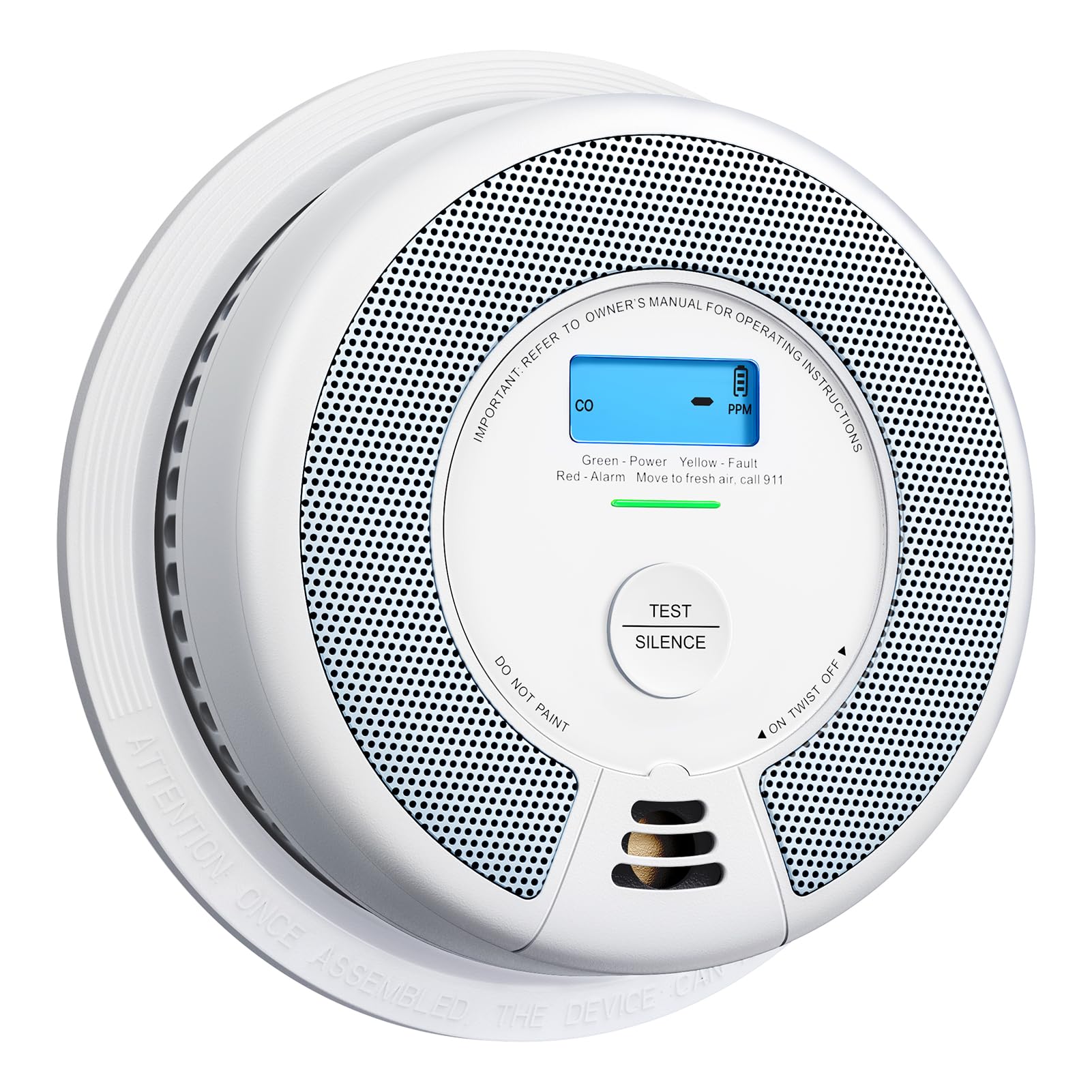
The X-Sense XP0H-SN is a 2-in-1 smoke and carbon monoxide alarm powered by a sealed 10-year lithium battery, meaning zero battery swaps for the entire life of the device. It uses a photoelectric sensor for smoke and an electrochemical sensor for CO, both certified to UL 217 and UL 2034 standards. The LCD screen stays dark during standby to avoid light pollution in bedrooms but lights up to show real-time CO levels and remaining battery life when tested or during an alarm.
Its 5.7-inch mounting bracket is deliberately oversized to cover old screw holes and ceiling stains left by previous alarms, making replacement jobs much cleaner — no patching required. The built-in self-test runs every 60 seconds to check sensor integrity, electronics, and battery health automatically. The unit is a basic standalone detector with no wireless interconnection or Wi-Fi, but that simplicity keeps it reliable and affordable.
For any owner who wants a set-it-and-forget-it combo alarm with a decade of power and a clear digital readout, the XP0H-SN is the most maintenance-free option on this list. Install it near bedrooms and the garage for comprehensive CO and smoke coverage.
Why it’s great
- Sealed 10-year lithium battery eliminates annual battery changes
- Large mounting bracket hides old screw holes during replacement
- Automatic self-test every 60 seconds for continuous peace of mind
Good to know
- No wireless interconnectivity between multiple units
- Basic standalone — no Wi-Fi or smart home integration
- Not a combustible gas detector — smoke and CO only
4. X-Sense SC01-W
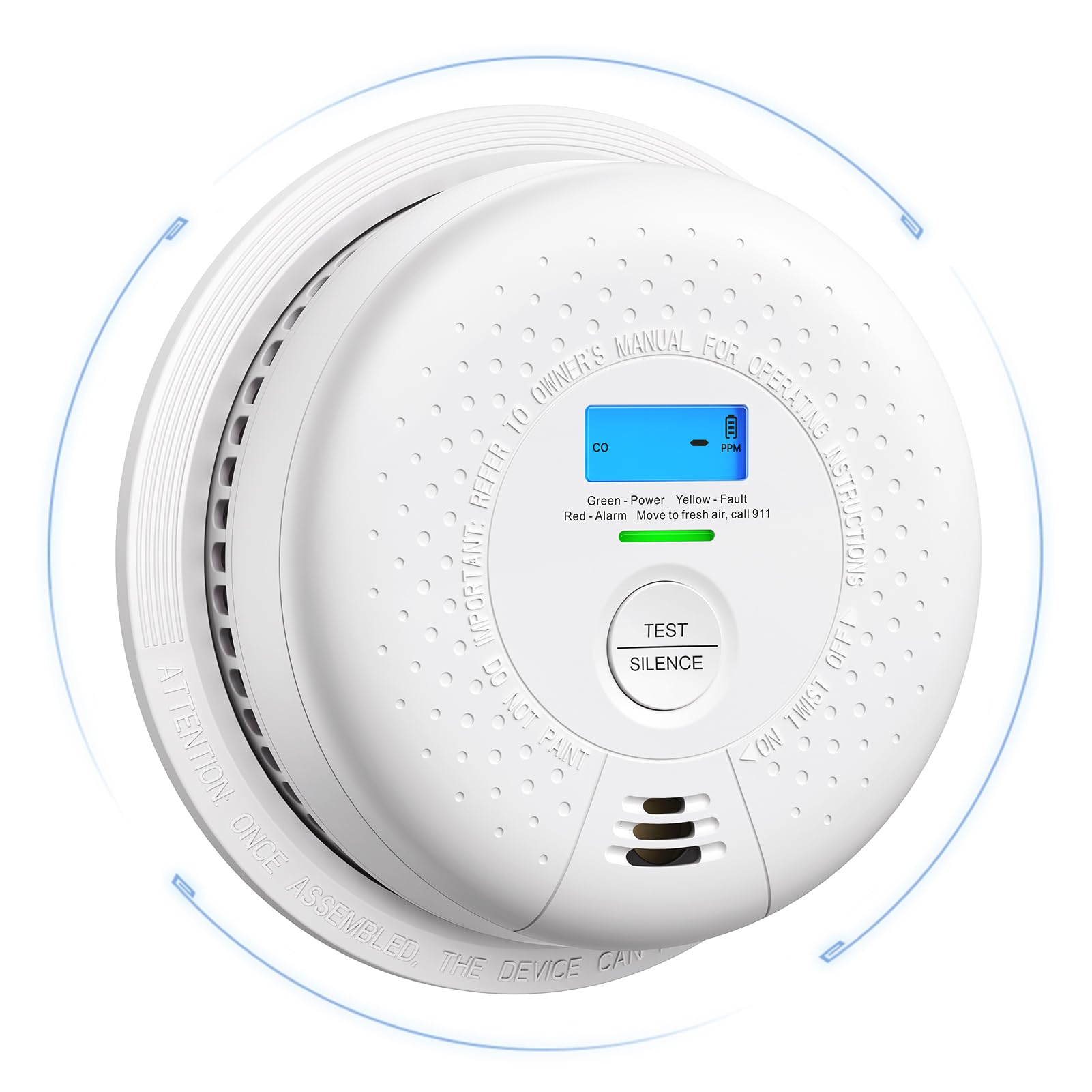
The X-Sense SC01-W brings wireless RF interconnection to a sealed 10-year lithium battery combo detector — if one unit in your home detects smoke or CO, all up to 18 linked alarms will sound simultaneously. This makes it the best choice for multi-story homes where a basement leak might go unnoticed by someone sleeping on the second floor.
The 85 dB alarm is paired with a digital LCD that shows real-time CO readings and battery status. The enclosure is made from heat-resistant PC plastic, which adds an extra layer of safety in high-temperature environments near kitchens or utility rooms. Like the XP0H-SN, it uses a photoelectric smoke sensor and an electrochemical CO sensor, both meeting UL 217 and UL 2034.
One installation caveat: the mounting plate is smaller than a standard round electrical box, which may require a 5-inch round electrical cover as an adapter plate for clean installation on old-work boxes. For new construction or blank ceilings, the included mounting hardware works fine. This is the best pick for whole-home synchronized protection without a hardwired system.
Why it’s great
- RF interconnection triggers all linked alarms simultaneously
- Heat-resistant PC enclosure for safer operation near heat sources
- Sealed 10-year lithium battery with zero maintenance
Good to know
- Mounting plate is too small for some round electrical boxes
- No Wi-Fi or app connectivity — RF only
- Interconnection requires all units to be the same Link+ series
5. First Alert SMICO100

First Alert’s SMICO100 uses the brand’s Precision Detection technology, which is engineered to comply with new industry standards aimed at reducing the cooking nuisance alarms that plague many photoelectric sensors. The unit provides 2-in-1 smoke and CO protection, powered by a standard 9V battery that is included in the box for immediate installation.
The test/silence button is large and responsive, and the end-of-life warning chirps when the entire unit needs replacement after roughly 10 years. It is easy to mount to a ceiling or wall with the included screws, though some users noted the bracket’s hole pattern differs from older First Alert models, so a small adapter block may be needed for direct replacement of legacy units.
It operates in 10-95% relative humidity, making it suitable for bathrooms or laundry rooms where moisture is present. The 9V battery is a replaceable consumable, so you will swap it annually — a minor tradeoff for a unit that otherwise matches the features of premium sealed-battery models. Great for renters or anyone who wants a no-fuss, trusted brand at a reasonable cost.
Why it’s great
- Precision Detection reduces false alarms from cooking
- 9V battery is simple to replace yearly
- Trusted brand with high user satisfaction ratings
Good to know
- Bracket hole pattern differs from previous First Alert models
- No digital display for real-time CO levels
- Battery life is roughly 1 year, not 10
6. First Alert SMCO100

The First Alert SMCO100 is a compact, entry-level 2-in-1 smoke and carbon monoxide alarm that runs on two AA batteries (included). It is essentially the same Precision Detection platform as the SMICO100 but with AA batteries instead of a 9V, which many users find easier to keep stocked in the pantry for quick swaps.
The unit is only 1.9 inches tall, giving it a low-profile appearance on the ceiling. It also includes an end-of-life warning and a test/silence button. The user feedback is almost universally positive, with long-time First Alert customers noting the brand’s consistency over decades of use. There is no digital display or wireless interconnectivity, keeping the design simple and the cost low.
For tight budgets or for outfitting a vacation home where smoke and CO detection is required by insurance but the building is rarely occupied, the SMCO100 offers reliable dual sensing with no frills. Just mark your calendar for a battery change every six months to avoid the low-battery chirp at 2 a.m.
Why it’s great
- Low profile at only 1.9 inches tall
- AA batteries are easy to replace and widely available
- Proven brand reputation with decades of trust
Good to know
- No digital readout of CO levels
- No wireless interconnection between units
- AA batteries need replacement every 6 months
7. Kidde 30CUDR 2-Pack

The Kidde 30CUDR 2-Pack offers two battery-powered smoke and CO alarms in one box, making it the most cost-effective way to cover the main floor and upstairs simultaneously. Each unit runs on two AA alkaline batteries and uses Enhanced Sensing Technology to reduce false alarms from cooking while still meeting UL 217 9th Edition and UL 2034 4th Edition.
Three LED indicators provide at-a-glance status: green for normal operation, amber for an operating error, and red for smoke or CO detection paired with an 85 dB alarm. The test and hush button allows silencing of nuisance alarms, and the self-testing circuit checks internal electronics continuously. The twist-and-click mounting bracket installs quickly with the included screws.
Some users reported a fault code after extended use, though this is not uncommon across any brand of battery-powered detectors. For the price of two units, the Kidde twin pack delivers solid certification and a loud alarm — perfect for outfitting a new home or replacing outdated detectors across multiple rooms without breaking your budget.
Why it’s great
- Two detectors in one box for whole-home coverage
- Enhanced Sensing Technology cuts cooking false alarms
- Three-color LED status system is intuitive to read
Good to know
- AA batteries require replacement every 6 months
- Some units reported a fault code after 16 months
- No digital display for CO concentration readout
FAQ
What is the difference between a carbon monoxide detector and a combustible gas detector?
Where should I mount a combination carbon monoxide and gas detector?
How often should I replace a carbon monoxide and gas detector?
Can a carbon monoxide detector also detect a natural gas leak?
Final Thoughts: The Verdict
For most users, the best carbon monoxide and gas detector winner is the X-Sense XP0H-SN because it combines reliable photoelectric smoke detection with electrochemical CO sensing, a sealed 10-year battery that eliminates nuisance battery changes, and a thoughtful oversized bracket for clean retrofits. If you need real-time gas and CO readouts on a digital display, grab the Kidde KN-COEG-3. And for whole-home synchronized alerts without hardwiring, nothing beats the X-Sense SC01-W with its RF interconnection and decade-long battery life.

Mo Maruf
I created WellFizz to bridge the gap between vague wellness advice and actionable solutions. My mission is simple: to decode the research and give you practical tools you can actually use.
Beyond the data, I am a passionate traveler. I believe that stepping away from the screen to explore new environments is essential for mental clarity and physical vitality.