Our readers keep the lights on and my smoothie glass nicely filled. As an Amazon Associate, I earn from qualifying purchases.
That moment when explosions shake the house but every line of dialogue sounds like it’s being whispered from another room—that’s the exact problem a proper 2.1 soundbar solves. By pairing a dedicated soundbar with a separate wireless subwoofer, you get a dedicated channel for vocals and a dedicated driver for low-end rumble, fixing the single biggest complaint about modern flat-panel TVs: thin, hollow sound that buries voices under background noise.
I’m Mohammad Maruf — the founder and writer behind WellFizz. Over the past several years, I’ve analyzed hundreds of audio system specifications, comparing amplifier wattage, driver materials, DSP algorithms, and frequency response curves to understand what actually separates a clear-sounding bar from a muddy one.
This guide breaks down nine of the most competitive models on the market so you can confidently choose the best 2.1 sound bar that matches your room, your content, and your expectations.
How To Choose The Best 2.1 Sound Bar
A 2.1 soundbar is defined by two physical elements: the main bar unit, which handles left and right channels plus a center-derived vocal track, and a standalone subwoofer that handles low frequencies. The separation of bass from dialogue is what gives 2.1 systems their advantage over basic stereo bars, but the quality of that separation depends on specific engineering choices you need to understand before clicking “buy.”
Dialogue Enhancement vs. Raw Power
Not all 2.1 bars prioritize the same thing. Some brands throw 300 watts of peak power at you, but if the DSP (digital signal processing) doesn’t include a dedicated dialogue-enhancement algorithm, voices will still get buried during action scenes. Look for features like Clear Voice, VoiceMX, or dedicated center-channel hardware—these isolate the 120 Hz–6 kHz vocal range and boost it dynamically. A bar with 200 watts and good vocal processing will sound clearer than a 400-watt bar with no voice mode.
Driver Materials and Cabinet Design
The subwoofer’s driver size (usually 5.25 to 6.5 inches) affects how low and tight the bass feels, but the cabinet volume and tuning matter just as much. A large, ported cabinet can produce deeper bass at the cost of precision, while a sealed or tuned cabinet delivers punchier, more controlled lows. On the bar side, mica-reinforced or composite drivers resist cone breakup at higher volumes, reducing distortion and keeping mids and highs clean even when you push the volume past 70 percent.
Connectivity That Actually Matters
HDMI eARC/ARC remains the gold standard for a single-cable connection that carries uncompressed audio from your TV to the bar. Optical is fine for basic stereo, but it cannot carry Dolby Atmos or DTS:X object-based metadata. If your TV has HDMI eARC, prioritize it. Bluetooth 5.0 or higher ensures stable music streaming, but note that Bluetooth cannot carry lossless multi-channel audio—that requires a wired HDMI connection. Some newer bars include Bluetooth 6.0 for lower latency, which helps if you game wirelessly.
Room Size and Placement Flexibility
A 2.1 bar with a wireless subwoofer gives you placement freedom—the sub can go behind a sofa, inside a cabinet, or across the room as long as it’s within range of the soundbar. But the bar itself needs to sit directly below or above the TV for proper soundstage. If your TV’s legs are too short to clear the bar’s height, you’ll need a wall-mount solution. Check the bar’s dimensions: bars wider than 35 inches may extend past a 50-inch TV’s feet, creating a visual imbalance. Measure your stand depth and TV clearance before buying.
Quick Comparison
On smaller screens, swipe sideways to see the full table.
| Model | Category | Best For | Key Spec | Amazon |
|---|---|---|---|---|
| JBL Bar 2.1 Deep Bass (MK2) | Premium | Bass lovers & music listeners | 300W peak / 6.5″ sub | Amazon |
| LG S70TY 3.1.1 | Premium | LG TV owners / Dolby Atmos | Up-firing center / 3.1.1 ch | Amazon |
| Amazon Fire TV Soundbar Plus | Premium | Fire TV ecosystem / movies | 3.1 ch / dedicated center | Amazon |
| Yamaha SR-B40A | Mid-Range | Clear dialogue / small rooms | Clear Voice / Bass Extension | Amazon |
| Samsung HW-B550F | Mid-Range | Adaptive sound / gaming | DTS Virtual:X / Bass Boost | Amazon |
| Hisense AX3100Q | Mid-Range | 3.1 setup / Roku TV fans | Dolby Atmos+DTS:X / 7 EQ | Amazon |
| LG S40TR 4.1 | Mid-Range | Surround with rears included | 4.1 ch / wireless rear spkrs | Amazon |
| TCL S55H | Budget | Entry-level Atmos / apartments | AI Sonic Room Calibration | Amazon |
| ULTIMEA Poseidon M30 | Budget | App control / budget bass | Bluetooth 6.0 / 10-band EQ | Amazon |
In‑Depth Reviews
1. JBL Bar 2.1 Deep Bass (MK2)

The JBL Bar 2.1 Deep Bass MK2 earns the top spot because it delivers the most balanced combination of clarity, headroom, and tactile bass in the lineup. Its 300-watt peak output drives a 6.5-inch wireless subwoofer that produces genuinely deep, controlled lows without overwhelming the mids and highs. JBL also included three selectable bass settings (Low, Mid, High) so you can tailor the subwoofer’s aggression to your room size and listening preferences.
During music playback—Steely Dan and Anita Baker test tracks—the system revealed excellent separation between instruments, with the subwoofer adding weight to the kick drum without muddying the vocal range. Movie testing confirmed that Dolby Digital decoding creates a believable front soundstage, though the bar relies on virtual processing rather than physical drivers for any surround effect. The HDMI connection supports ARC, and Bluetooth streaming works reliably up to 30 feet.
Some early units have been reported with intermittent power issues or a rare static burst that requires a power cycle to clear. The remote is functional but slightly under-damped, and the bar measures 38 inches wide—be sure your TV stand can accommodate it. Despite these minor quirks, the MK2 remains the clear choice for anyone who prioritizes deep, musical bass alongside clear dialogue.
Why it’s great
- 300W peak delivers headroom for large rooms without distortion
- Three bass presets let you dial in subwoofer behavior
- Exceptional stereo imaging for music; beats most competitors in this tier
Good to know
- Rare reports of power-on failure on first unit in some batches
- Relies on Dolby Digital virtual processing, not discrete Atmos drivers
- 38-inch width may not fit under TVs with short legs
2. LG S70TY 3.1.1
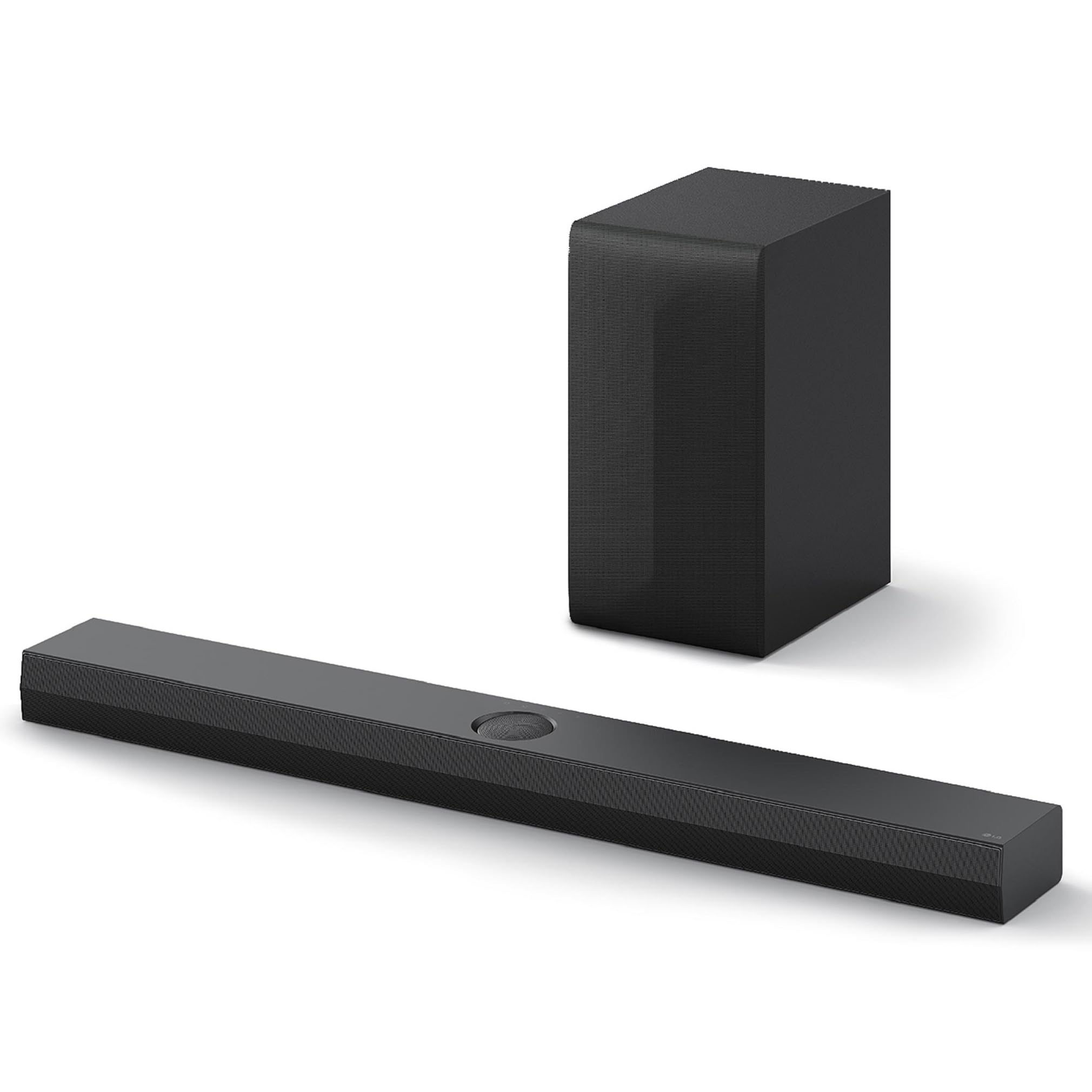
The LG S70TY distinguishes itself with an industry-exclusive up-firing center channel—a physical driver aimed upward to fire dialogue toward the ceiling and bounce it back toward the listening position. This design dramatically improves vocal intelligibility during busy scenes, and combined with Dolby Atmos decoding, it creates a genuine sense of height that virtual-processor bars cannot replicate. The wireless subwoofer complements the bar with rounded, non-booming bass that adds weight to movies without rattling the room.
Setup with an LG QNED TV is seamless: the WOW Interface allows you to control volume, sound modes, and connectivity directly from the TV’s on-screen menu, and WOW Orchestra lets the soundbar and TV speakers play simultaneously for a wider soundstage. HDMI eARC supports uncompressed 4K 120Hz passthrough, making it suitable for gaming. The soundbar’s crest-design metal grille resists dust accumulation, a thoughtful touch for long-term placement on open shelves.
The S70TY’s rear-speaker support (LG SPT8-S) is nearly impossible to find for purchase in the US as of this writing, which limits its upgrade path to a true surround system. Dialogue, while clear, can sound slightly treble-forward on non-Atmos sources, so you’ll want to enable Auto Volume mode to tame sibilance. At under , this is the smartest purchase for LG TV owners seeking a premium 2.1 with room to grow.
Why it’s great
- Physical up-firing center channel for superior dialogue clarity
- WOW Interface fully integrates with LG TV menus
- HDMI eARC with 4K 120Hz passthrough for gaming
Good to know
- Rear speaker upgrade (SPT8-S) is difficult to find in the US
- Treble-forward tuning on standard stereo content
- Requires LG TV for WOW features to work fully
3. Amazon Fire TV Soundbar Plus with Subwoofer
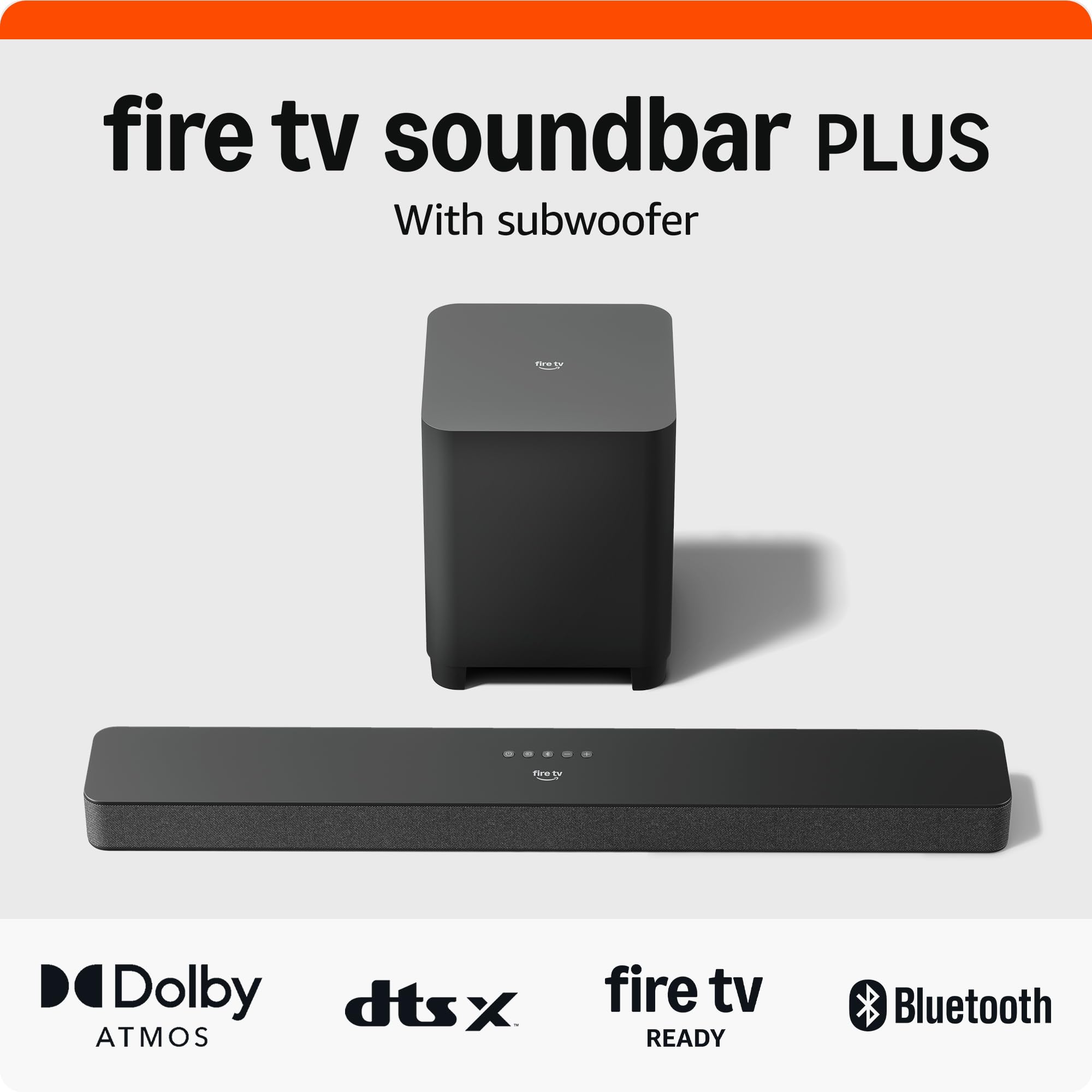
The Fire TV Soundbar Plus is a 3.1-channel system that incorporates a dedicated center driver specifically engineered to sharpen dialogue. Unlike budget bars that derive the center channel through DSP math, this bar physically separates the vocal track from the left/right channels, resulting in cleaner, more intelligible speech even during complex Dolby Atmos soundtracks. The wireless subwoofer integrates immediately upon power-up, and the bar recognizes Fire TV devices automatically, allowing unified remote control.
Rear-firing surround drivers (defeatable if placed too close to a wall) provide a surprisingly wide soundstage for a 3.1 bar. The 2-way L/C/R design uses oval midrange drivers paired with silk dome tweeters, a configuration usually found in systems costing significantly more. Movie, Music, Sports, and Night modes adjust the EQ intelligently, and the bar gets loud enough to fill a 25×25-foot room without audible distortion at typical listening levels.
The bar’s width—nearly 38 inches—makes it too wide for some 50-inch TV stands where the legs sit 30 inches apart. Some users have needed a soundbar shelf to bridge the gap. Bluetooth streaming is functional but limited to SBC codec, so audiophiles streaming from Tidal or Apple Music may notice compression artifacts. If you’re already in Amazon’s ecosystem, this bar offers the most hassle-free integration and genuinely impressive hardware at its price point.
Why it’s great
- Physical 2-way center driver for superior dialogue separation
- Seamless HDMI-CEC integration with Fire TV devices
- Rear-firing surround drivers expand the soundstage
Good to know
- Bar width requires 38-inch clearance or a soundbar shelf
- Bluetooth limited to SBC codec; no aptX or LDAC
- Subwoofer lacks fine-tuning controls beyond volume
4. Yamaha SR-B40A Dolby Atmos Sound Bar
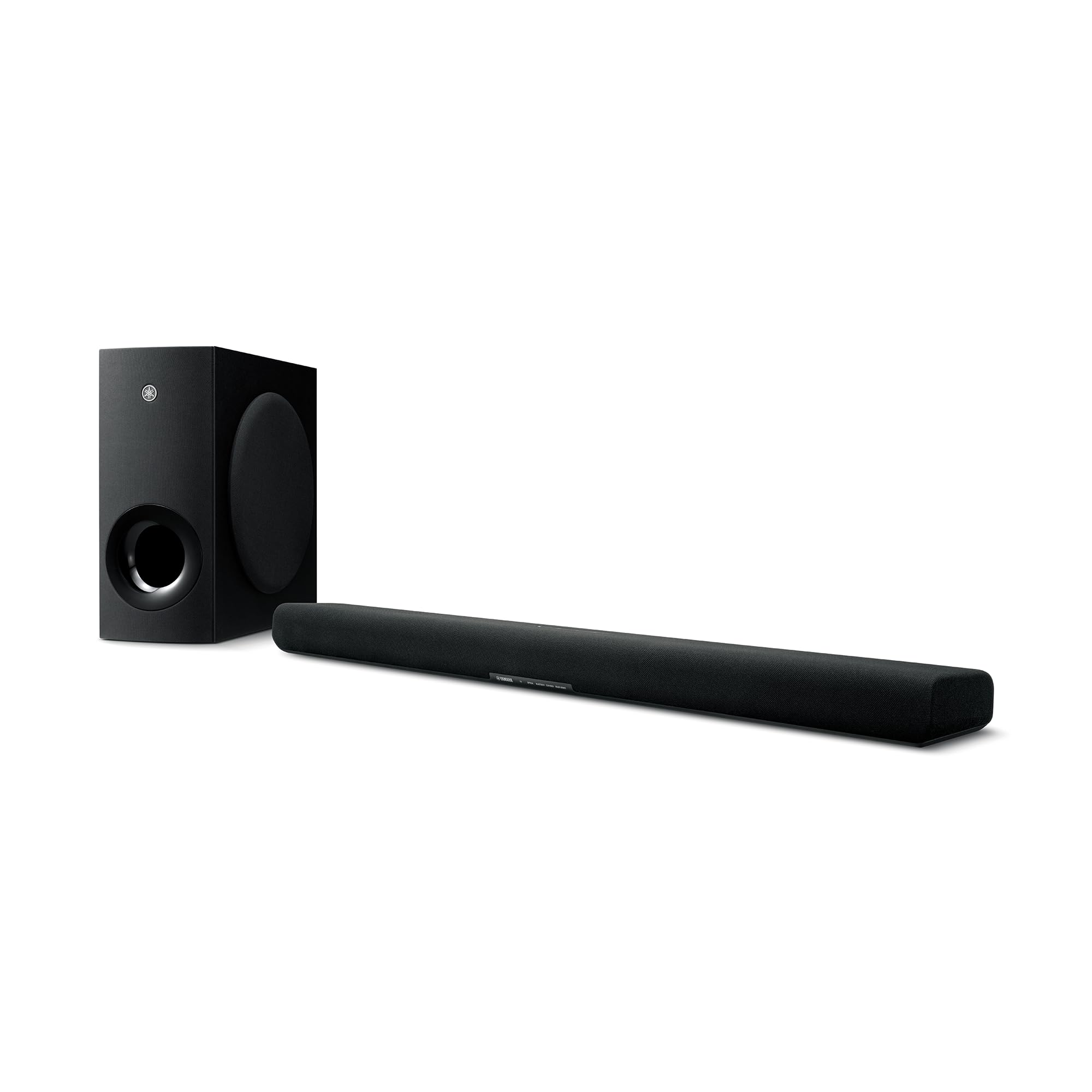
Yamaha’s SR-B40A focuses on what the brand does best: making voices audibly clear. The Clear Voice technology uses a dedicated DSP algorithm that continuously monitors the audio stream and boosts the 200 Hz–4 kHz range without affecting other frequencies. In practice, this means news anchors and conversational dialogue remain crisp even at low volume, making this an excellent choice for older viewers or anyone who watches a lot of spoken-word content.
The 6.5-inch wireless subwoofer is tuned for tightness rather than room-shaking output. Bass Extension mode adds a few dB of low-end shelf, but the subwoofer never overwhelms the bar—it fills in the bottom octave without drawing attention to itself. Dolby Atmos decoding is present but relies on virtual upward-firing processing rather than physical height drivers, so the “overhead” effect is subtle. HDMI eARC handles uncompressed Dolby TrueHD and DTS-HD Master Audio from Blu-ray sources.
Some users report that the included HDMI cable is stiff and prone to loosening under tension, leading to intermittent connection drops—replacing it with a high-quality 48Gbps HDMI 2.1 cable resolves this. The soundstage is narrower than the JBL or LG S70TY for music, and the surround modes sound artificial compared to bars with physical rear drivers. For dialogue-focused TV viewing, however, the B40A is the most reliable performer under .
Why it’s great
- Clear Voice processing is the best dialogue tool under
- Subwoofer delivers tight, controlled bass without room shake
- HDMI eARC supports uncompressed Dolby TrueHD and DTS-HD
Good to know
- Included HDMI cable is stiff; replacement recommended
- Surround modes sound artificial; no height driver hardware
- Narrow soundstage for stereo music compared to competitors
5. Samsung HW-B550F 2.1

The Samsung HW-B550F employs Adaptive Sound technology, which analyzes incoming audio in real-time and adjusts EQ and compression settings to match the content type. News broadcasts get vocal boosting, action movies get expanded dynamic range, and music receives a flatter frequency response that preserves the original mix. This automation makes the B550F one of the most set-it-and-forget-it soundbars available—fewer manual mode changes overall.
DTS Virtual:X creates a convincing multi-directional soundscape from just two front channels, and a dedicated Voice Enhance mode further amplifies dialogue frequencies when needed. Bass Boost mode adds an extra layer of low-end punch, though the included wireless subwoofer is relatively compact and won’t match the output of the 6.5-inch units from JBL or LG. The bar supports Bluetooth streaming and includes an optical input alongside HDMI ARC—handy for older TVs that lack HDMI.
One known issue: the first unit from some batches has arrived with a non-functional subwoofer, requiring a warranty replacement. The return process can be cumbersome due to the large package. Once a fully working unit is in place, the B550F performs reliably with consistent sound quality. For small-to-medium rooms where adaptive tuning is preferred over manual EQ fiddling, this Samsung delivers excellent value.
Why it’s great
- Adaptive Sound auto-optimizes EQ per content type
- DTS Virtual:X creates wide soundstage from two channels
- Voice Enhance mode isolates dialogue effectively
Good to know
- Intermittent subwoofer failure reported in some batches
- Compact subwoofer lacks low-end extension for large rooms
- No Dolby Atmos decoding; DTS Virtual:X only
6. Hisense AX3100Q 3.1ch Soundbar
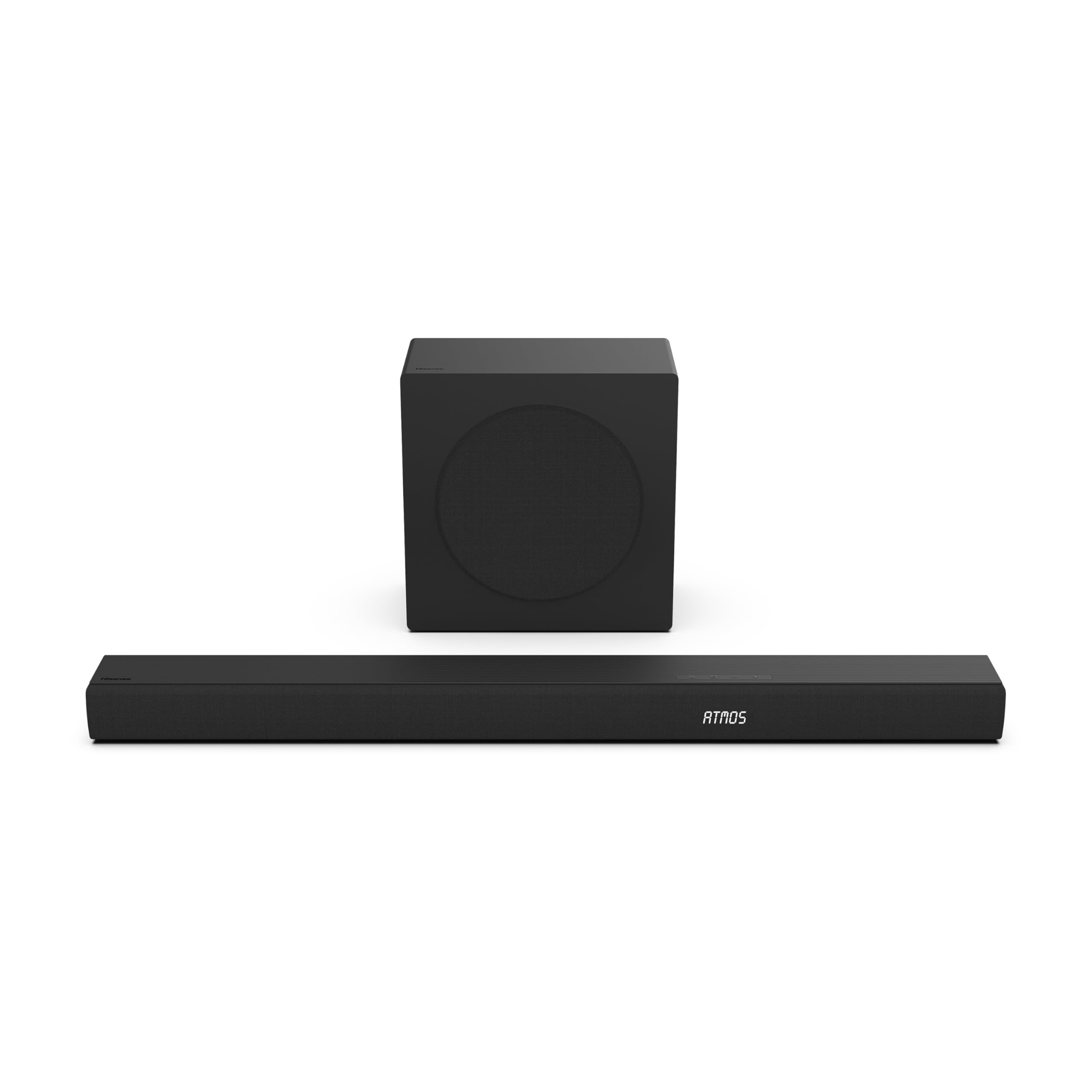
The Hisense AX3100Q packs Dolby Atmos, DTS:X, and a 6.5-inch wireless subwoofer into a 3.1-channel system that punches above its price bracket. Unlike many budget 3.1 bars that use DSP to fake the center channel, the AX3100Q includes a physical center driver, which provides a tangible boost in vocal clarity. The 7 EQ modes—AI, Music, Night, Game, Movie, News, Sport—cover a wide range of listening scenarios, and the AI mode adapts to content automatically.
EzPlay compatibility with Hisense and Roku TVs allows the soundbar’s settings menu to appear directly on the TV screen, making bass and mode adjustments accessible via the TV remote. The subwoofer paired without any manual intervention in testing, and the bar’s 35.6-inch width fits comfortably under a 55-inch TV. Bluetooth 5.3 ensures stable music streaming, and the optical input provides a backup connection for devices without HDMI eARC.
Reviewers have noted that the surround effect from Dolby Atmos and DTS:X is noticeable but not as immersive as premium bars with upward-firing drivers—the processing creates height cues primarily through phase manipulation. Some users have experienced intermittent Bluetooth audio garbling when connected to iPhones, though the wired HDMI connection remains rock-solid. For Roku TV owners seeking an affordable upgrade that includes both major object-based audio formats, this is a compelling choice.
Why it’s great
- Dolby Atmos and DTS:X support in a 3.1 channel at this price
- EzPlay integrates settings menu into Hisense/Roku TV UI
- 7 EQ modes cover movies, music, sports, and news
Good to know
- Virtual Atmos and DTS:X lack true height-driver immersion
- Occasional Bluetooth garbling with iPhones reported
- Wired rear speakers not available as expansion option
7. LG S40TR 4.1 ch Soundbar

The LG S40TR is technically a 4.1-channel system, but it earns a spot here because its core 2.1 performance—bar plus subwoofer—is excellent, and the included wireless rear speakers give you true surround sound without buying extra hardware. The rear satellites connect wirelessly to the soundbar (though they must be wired to each other), eliminating the need for a receiver. Clear Voice Plus improves dialogue through center-speaker analysis, and the Smart Up-Mixer converts stereo content into multi-channel output.
Cinema mode delivers a noticeably wider soundstage than standard mode, and the subwoofer produces thumping bass that stays tight enough to avoid annoying close neighbors. The WOW Interface and WOW Orchestra features—standard on LG bars—allow seamless integration with LG TVs and simultaneous use of TV and soundbar speakers. Bluetooth streaming works flawlessly, and the rear speakers create genuine spatial separation for movies with object-based audio tracks.
The rear speakers are wired to each other, which means you still need to manage a single cable between them. And though the bar supports Dolby Digital and DTS Digital, it does not decode Dolby Atmos object metadata. For the money, however, getting a bar with wireless sub and wireless rear satellites is rare, making this the best choice for buyers who want surround immersion without a separate AV receiver.
Why it’s great
- Wireless rear speakers included, creating true surround
- Clear Voice Plus enhances dialogue without losing effects
- WOW Orchestra integrates with LG TV speakers
Good to know
- Rear speakers wired to each other; one cable must be managed
- No Dolby Atmos or DTS:X decoding
- Satellite speakers may feel underpowered in large rooms
8. TCL S55H 2.1 Sound Bar

The TCL S55H brings Dolby Atmos and DTS Virtual:X to a 2.1-channel system at a price point that typically only offers basic stereo. The AI Sonic Auto Room Calibration—done through the TCL app—adjusts the frequency response based on your listening position and room layout, a feature usually reserved for bars costing twice as much. The result is a balanced soundstage that compensates for asymmetrical furniture or open layouts.
The wireless subwoofer delivers deep bass that fills small-to-medium rooms easily, and the main soundbar’s 31.9-inch width fits neatly under 50-55 inch TVs. HDMI eARC/ARC supports the high-bitrate audio path needed for Dolby Atmos metadata. The included wall-mount kit and remote with batteries make unboxing to setup a quick process. For apartments or bedrooms, the S55H provides a noticeable upgrade without overwhelming the space.
Reviewers have noted that while the subwoofer adds warmth and depth, it lacks the punch and extension of larger 6.5-inch units—the bass is present but not visceral. The AI room calibration sometimes over-corrects for treble, making dialogue sound slightly bright on certain content. For the price, though, the S55H offers an exceptional feature set, and its Dolby Atmos compatibility is a genuine differentiator in this tier.
Why it’s great
- AI Sonic Auto Room Calibration tailors sound to your room
- Dolby Atmos compatibility at an entry-level price
- Compact soundbar size fits under most 50-55 inch TVs
Good to know
- Subwoofer lacks deep extension of larger drivers
- AI calibration can over-emphasize treble slightly
- No wired rear speaker option for surround upgrade
9. ULTIMEA Poseidon M30 2.1 Soundbar
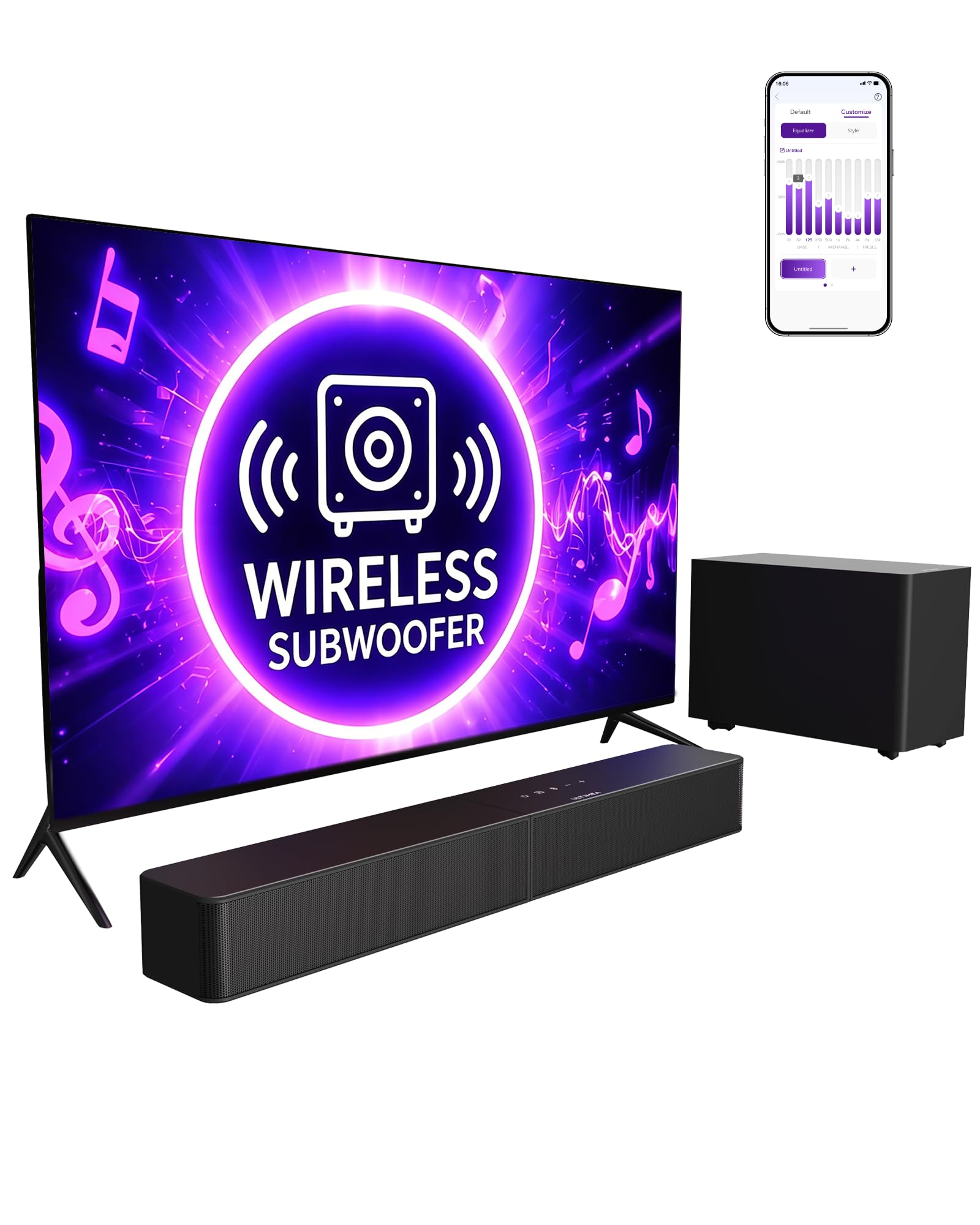
ULTIMEA’s Poseidon M30 packs features you’d expect from a premium bar into a budget chassis: Mica-reinforced drivers that reduce distortion by up to 20%, VoiceMX technology for real-time vocal isolation, BassMX for optimized subwoofer tuning, and a 10-band equalizer accessible via the Ultimea smartphone app. Bluetooth 6.0 provides lower-latency streaming, and the 240-watt peak output delivers surprising headroom for a sub- system.
The wireless subwoofer uses an 18mm high-excursion driver inside a 6.5-liter tuned cabinet, producing bass that stays tight and controlled rather than boomy. The voice isolation works well—dialogue remains intelligible even during busy action sequences. Setup is straightforward: HDMI ARC handles both audio and volume control from your TV remote, and the included HDMI cable saves a trip to the store. The 23.6-inch soundbar is compact enough for smaller TV stands.
The app experience is good but not flawless—some users report occasional disconnection when making EQ adjustments, and the remote’s small buttons can be confusing without the manual. The unit is newer to market (2026 model), so long-term reliability data is still limited. A few users have received units with firmware glitches that required OTA updates through the app. Despite these early-adopter quirks, the Poseidon M30 provides the best feature-per-dollar ratio of any bar in this guide.
Why it’s great
- Mica-reinforced drivers reduce cone breakup distortion
- App-based 10-band EQ offers deep customization
- Bluetooth 6.0 provides lower latency streaming
Good to know
- New model with limited long-term reliability data
- App connectivity can be inconsistent during EQ changes
- Remote control layout is not intuitive without the manual
FAQ
Do I need a dedicated center channel for better dialogue?
Can I add rear speakers to a 2.1 soundbar later?
Is Dolby Atmos worth it on a 2.1 soundbar?
What is the minimum room size for a 2.1 soundbar?
Final Thoughts: The Verdict
For most users, the best 2.1 sound bar winner is the JBL Bar 2.1 Deep Bass (MK2) because its 300-watt headroom, genuine tactile subwoofer, and three selectable bass settings satisfy both movie lovers and music listeners without compromise. If you want the most seamless integration with your existing TV and a physical up-firing center channel, grab the LG S70TY 3.1.1. And for a budget-friendly entry that still includes Dolby Atmos and auto room calibration, nothing beats the TCL S55H.

Mo Maruf
I created WellFizz to bridge the gap between vague wellness advice and actionable solutions. My mission is simple: to decode the research and give you practical tools you can actually use.
Beyond the data, I am a passionate traveler. I believe that stepping away from the screen to explore new environments is essential for mental clarity and physical vitality.