Our readers keep the lights on and my smoothie glass nicely filled. As an Amazon Associate, I earn from qualifying purchases.
If your coffee ritual still involves a separate grinder, a manual tamper, and a timer, you’re doing more work than you need to. Auto espresso machines—also called super-automatics—handle the entire bean-to-cup process: they grind, dose, tamp, brew, and often froth milk at the push of a single button. The payoff is a consistent, café-quality shot of espresso without the steep learning curve of semi-automatic setups. But the market is crowded with machines that differ wildly in grind quality, milk frothing capability, maintenance demands, and long-term reliability. Choosing the wrong one can leave you with sour shots or a machine that clogs within weeks.
I’m Mohammad Maruf — the founder and writer behind WellFizz. I’ve spent the last fifteen years analyzing consumer appliances, cross-referencing over 200 hours of customer feedback and manufacturer spec sheets to identify which auto espresso machines actually deliver on their promises of consistency and durability.
This guide breaks down the top models across budget, mid-range, and premium tiers, focusing on real-world performance, grind quality, and maintenance ease to help you decide which auto espresso machine fits your counter and your daily routine.
How To Choose The Best Auto Espresso Machine
Not all “automatic” machines automate the same things. Some will grind your beans but require you to hold the portafilter; others will brew a full latte while you walk away. Understanding the three core subsystems—grinding, brewing, and milk handling—will keep you from overpaying for features you won’t use or underspending on a machine that can’t pull a proper shot.
Grinder quality and grind settings
The grinder is the heart of any bean-to-cup machine. Conical burr grinders are the standard; they produce uniform particles without overheating the beans. Look for at least 8 to 13 grind settings—machines with fewer than 8 steps often cannot dial in fine enough for a true espresso extraction. Ceramic burrs run cooler than steel, but steel burrs tend to last longer and handle darker, oilier roasts without clogging.
Milk system: integrated carafe vs. steam wand
If you drink lattes or cappuccinos daily, the milk system is your second-most-important decision. Integrated carafes (like De’Longhi’s LatteCrema or Philips’ LatteGo) automatically froth and dispense milk at the push of a button and are usually the fastest to clean—some rinse in 10 seconds. Manual steam wands give you more control over microfoam texture for latte art, but they add a learning curve and require you to purge and wipe the wand after each use. A few machines, like the Ninja Luxe Café Pro, offer dedicated hands-free frothing that works with both dairy and plant-based milks.
Brew group access and maintenance
An auto espresso machine is a high-pressure appliance that will need regular descaling and brew-unit cleaning. Machines with a removable brew unit (found on most Philips, Bosch, and KitchenAid models) are significantly easier to maintain because you can rinse the unit under running water. Machines with a fixed brew unit require more frequent chemical cleaning cycles. Also check whether the drip tray and waste-bin capacity match your daily consumption—a tray that fills after 3 shots will annoy you multiple times per day.
Programmability and user profiles
If multiple people in your household drink coffee, look for machines that save individual user profiles (Philips 5500 Series and KitchenAid KF6 both support multiple profiles). These let each person store their preferred grind size, water volume, and milk ratio, so you don’t have to re-dial every time you swap beans. Machines with a color touchscreen (Cafe Bueno, Breville Oracle Jet) make navigation more intuitive but can also introduce software glitches if firmware updates go wrong.
Quick Comparison
On smaller screens, swipe sideways to see the full table.
| Model | Category | Best For | Key Spec | Amazon |
|---|---|---|---|---|
| Breville Oracle Jet | Premium | Expert-level customization | 45 grind settings, 22g dose | Amazon |
| Philips 5500 Series | Premium | Multi-user households | 20 presets, 4 user profiles | Amazon |
| Jura E4 | Premium | Straight espresso purity | Pulse Extraction Process | Amazon |
| KitchenAid KF6 | Premium | Metal-clad durability | 2.2L tank, dual hopper | Amazon |
| Terra Kaffe Demi | Mid-Range | Tiny countertops | 7.5″ wide footprint | Amazon |
| Philips 4400 Series | Mid-Range | Quick-clean milk system | SilentBrew, LatteGo | Amazon |
| Ninja Luxe Café Pro | Mid-Range | Versatile drink menu | 4-in-1, integrated tamper | Amazon |
| Cafe Bueno | Mid-Range | Touchscreen customization | 19 drink options, 7″ screen | Amazon |
| De’Longhi Magnifica Start | Mid-Range | One-touch milk drinks | 13 grind settings, auto frother | Amazon |
| Bosch TIU20307 | Mid-Range | Compact all-in-one | Ceramic grinder, removable brew unit | Amazon |
| De’Longhi La Specialista Arte Evo | Value | Budget with cold brew | 8 grind settings, 15-bar pump | Amazon |
In‑Depth Reviews
1. Breville Oracle Jet
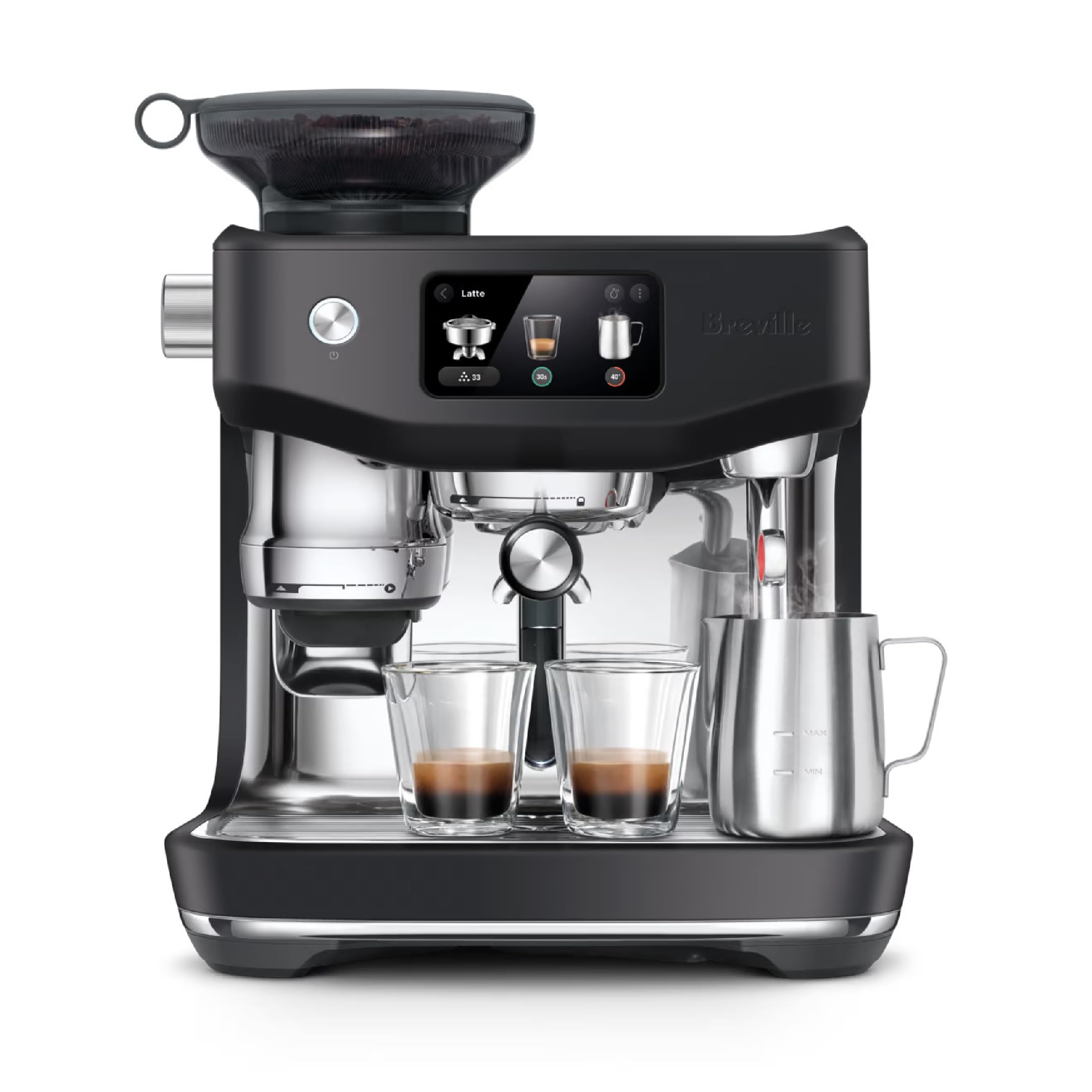
The Oracle Jet sits at the top of Breville’s super-automatic line for good reason: it integrates high-carbon hardened steel Baratza burrs with 45 grind settings, auto-doses 22 grams into a professional 58mm portafilter, and auto-tamps with consistent force every cycle. The ThermoJet heating system reaches extraction temperature in approximately 3 seconds and delivers PID-controlled water within ±1°F—the same precision you’d find on commercial machines. You can swipe through the touchscreen to select cold brew, cold espresso, or standard hot drinks, and the Auto MilQ system lets you dial in texture and temperature for dairy, soy, oat, or almond milk separately.
What makes the Oracle Jet special is the Auto Queue feature: you can start steaming milk while the espresso is still pulling, or vice versa, eliminating the awkward back-to-back waiting sequence. The Barista Guidance system monitors each shot in real time and recommends grind adjustments if it detects over- or under-extraction. The machine is heavy at 26.7 pounds, but it comes with a move-assist handle for sliding it across the counter. The 77-ounce water tank is generous enough for a week’s worth of drinks without daily refills.
The biggest caveat is software risk: a firmware update in early units caused the auto-tamp function to stop working, and Wi-Fi connectivity issues have been reported. Breville has addressed these with later production runs, but the reliance on cloud-connected firmware means you’re trusting updates to not break core mechanics. The Oracle Jet is not a budget option by any measure, but if you want the closest thing to a café-quality shot without touching a tamper, this is the machine.
Why it’s great
- Baratza steel burrs with 45 grind settings deliver espresso-fine consistency
- Auto MilQ system optimizes texture for plant-based milks separately
- Auto Queue saves time by running steaming and extraction in parallel
Good to know
- Firmware-update dependency can introduce tamping or connectivity glitches
- Minimum cup size is 8 oz, limiting small espresso shots
- Heavy build (26.7 lb) requires counter space planning
2. PHILIPS 5500 Series (EP5544/94)
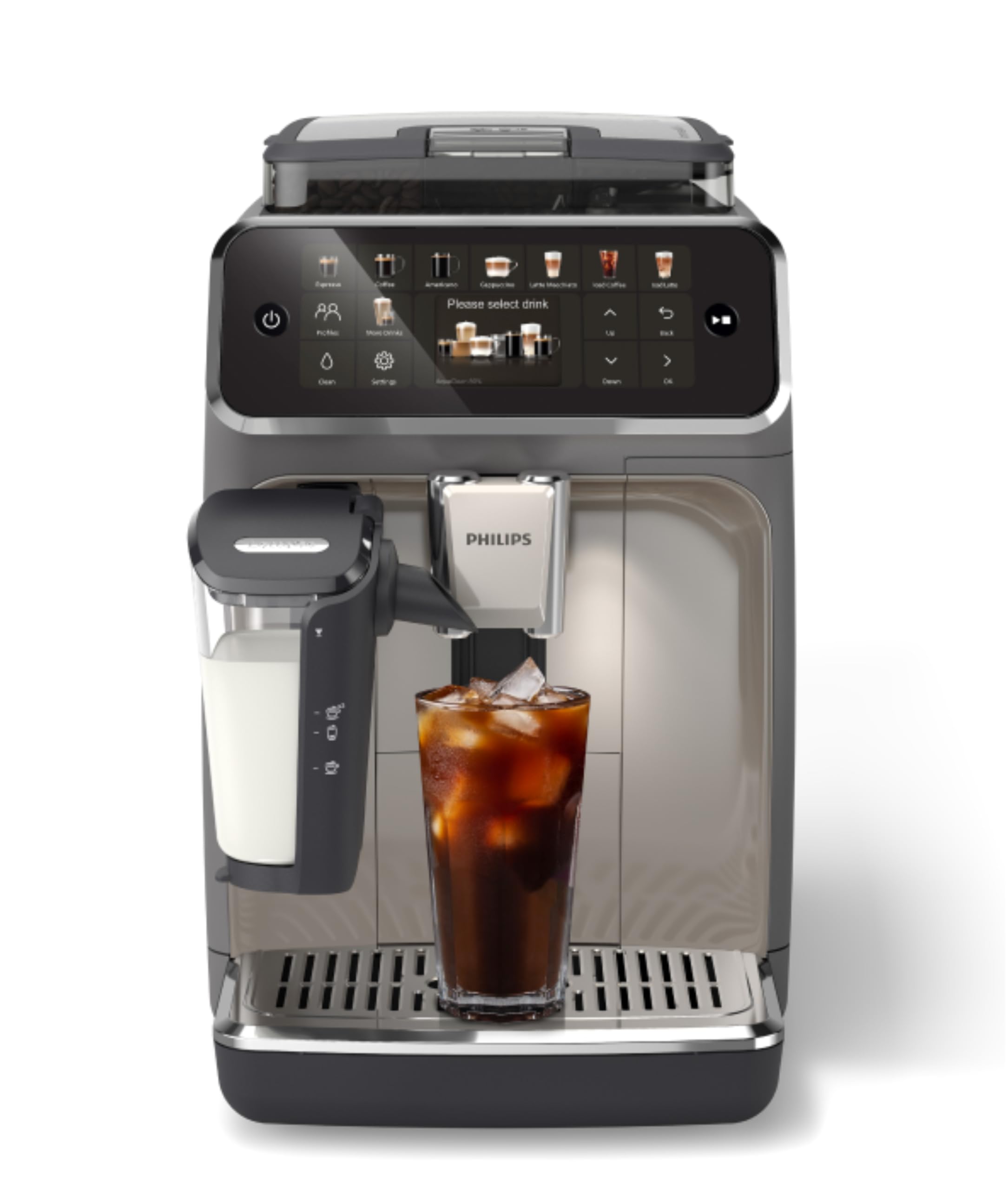
The Philips 5500 Series (EP5544/94) steps up from the 4400 line with 20 hot and iced drink presets, a larger color display, and the ability to save up to four user profiles. Each profile remembers grind strength, water volume, milk level, and brew temperature, which is invaluable for households where one person wants a double ristretto and another prefers a long iced latte. The LatteGo milk system uses just three parts—no internal tubes—and the milk carafe rinses clean in about 10 seconds under a faucet. The SilentBrew technology, certified by Quiet Mark, reduces grinding noise by roughly 40% compared to earlier Philips generations.
Brew performance relies on a 15-bar pump and a ceramic conical burr grinder with 12 adjustable settings. The AquaClean filter allows you to brew up to 5,000 cups before descaling, significantly reducing maintenance intervals. The machine also includes a bypass chute for pre-ground coffee when you want a decaf shot or a different blend. At 17.6 pounds and a footprint of 9.69 inches deep by 14.61 inches wide, it’s proportioned well for medium-size counters.
The main drawback is that the LatteGo system, while quick to clean, doesn’t heat milk as aggressively as a dedicated steam wand—some users find the milk lukewarm and switch to an external frother. Also, the water tank at 1.8 liters may need refilling every 3 to 4 drinks if the machine is shared. Long-term reliability data from the Philips 4300 and 5400 lines suggests these machines typically last 3–5 years with regular descaling, which is average for this price tier.
Why it’s great
- Four user profiles make daily switching seamless in a multi-drinker household
- LatteGo milk system cleans in seconds with no hidden tubes
- SilentBrew certification delivers noticeably quieter grinding
Good to know
- Milk temperature from the LatteGo runs cooler than steam-wand machines
- Water tank capacity (1.8 L) requires frequent refills for heavy use
- Dishwasher-safe carafe is labeled “No” for dishwasher, so hand-rinse is best
3. Jura E4 Piano Black
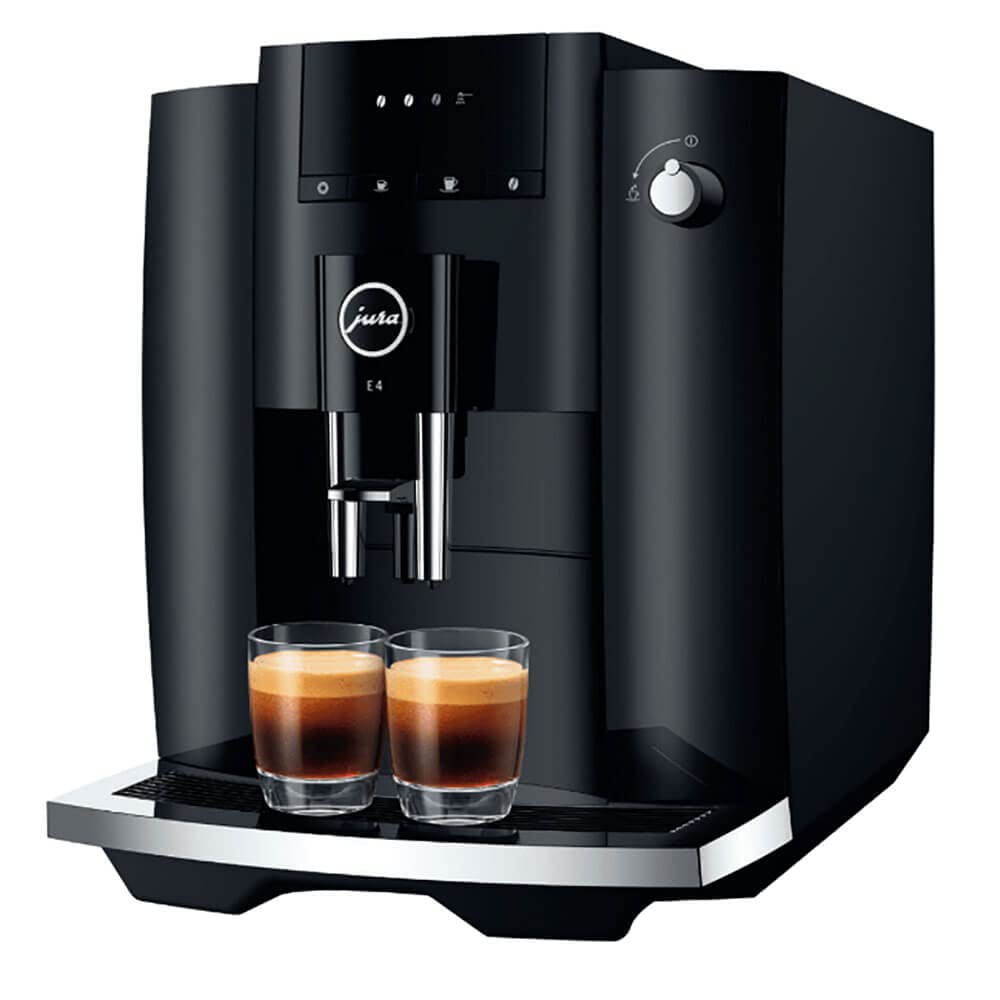
Jura’s E4 is a purposeful machine that skips milk frothing entirely to focus on black-coffee quality. It uses Jura’s proprietary Pulse Extraction Process (PEP), which alternates water pressure in short pulses during extraction to maximize flavor extraction from the grounds—the result is a denser crema and a fuller body compared to standard continuous-pressure machines. The Professional Aroma Grinder is a conical burr unit made from high-durability steel, and Jura claims it maintains consistent grind quality over its entire service life without burr replacement.
The interface uses a combination of symbol-based buttons and a small rotary dial; it’s not as intuitive as a touchscreen, but it avoids the software-update risks that plague smart machines. The water tank holds 64 ounces and the bean hopper holds 10 ounces—modest capacities by modern standards, but Jura machines are known for lasting 10–15 years with proper maintenance. The E4 also includes a chute for pre-ground coffee, and the machine automatically purges the system with a rinse cycle every time it turns on and off.
The absence of a milk frother is the dealbreaker for latte drinkers—you’d need to buy a separate frother or pair it with a manual steam wand. The glossy Piano Black finish shows fingerprints and water spots easily. Some users report that the hot water dispenser doesn’t reach temperatures high enough for proper tea brewing (around 185°F vs. the 200°F+ many tea drinkers expect). And the proprietary CLARIS Smart+ filter system can’t be bypassed without triggering the descaling light, which adds ongoing cost.
Why it’s great
- Pulse Extraction Process produces noticeably richer crema and body
- Industry-leading longevity—many owners report 10+ year lifespans
- No software updates or cloud dependency to break core functionality
Good to know
- No integrated milk frother—requires separate device for milk drinks
- Proprietary CLARIS filter system cannot be bypassed easily
- Hot water temperature may be too low for certain teas
4. KitchenAid Fully Automatic (KF6 KES8556PL)

The KitchenAid KF6 (KES8556PL) delivers a metal-clad exterior that feels substantially more solid than the plastic shells common in this price tier. The removable bean hopper twists off easily, letting you swap between whole-bean varieties or empty the hopper for cleaning without removing stray beans from the grinder throat. The 2.2-liter water tank sits on the side rather than the back, making refills possible without pulling the machine forward. Inside, the smart-dosing technology automatically adjusts the grind volume to match the selected drink size, removing the guesswork from dialing in.
The milk system uses a flexible tube that you drop into any container of milk—no proprietary carafe to store. This approach simplifies cleaning (rinse the tube and nozzle) and lets you use a chilled pitcher directly from the fridge. The machine supports 15 recipe options including espresso, americano, latte, and cappuccino, and you can adjust brew temperature across three levels (low, medium, high). Users who found previous Philips or De’Longhi machines too cool have praised the KitchenAid’s high-temperature setting for delivering genuinely hot coffee.
The biggest drawback is the machine’s depth: 18.5 inches makes it one of the deepest auto espresso machines on the market, so it won’t fit under standard upper cabinets without being pulled out. The milk system uses a steam wand for frothing rather than an automatic carafe, which means you have to manually control the texture and stop time. And while the build quality inspires confidence, a few reports of units failing within two weeks suggest quality control may be inconsistent during early production batches.
Why it’s great
- Metal-clad construction feels premium and durable versus all-plastic competitors
- Side-mounted water tank allows easy refills without moving the machine
- Twist-off bean hopper makes bean swapping and cleaning straightforward
Good to know
- 18.5-inch depth requires deep counter space; may not fit under cabinets
- Milk frothing is steam-wand-based, not automatic carafe—requires manual control
- Early quality-control issues reported by some buyers
5. Terra Kaffe Demi
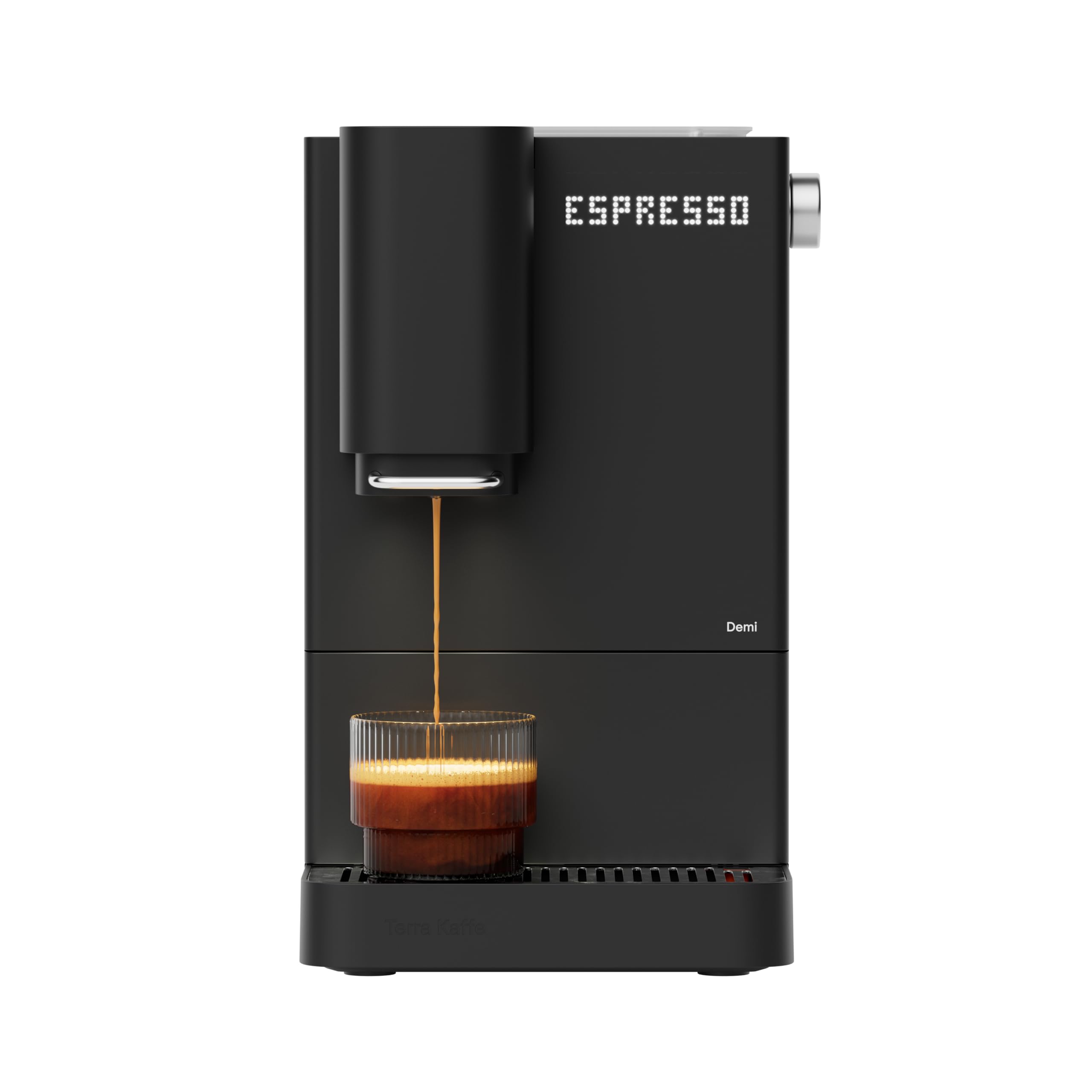
The Terra Kaffe Demi was engineered specifically for small kitchens and office break rooms where counter space is tight—its 7.5-inch width is roughly half that of most super-automatics, yet it still packs an integrated precision conical burr grinder and a self-cleaning system. The intuitive stainless-steel dial lets you adjust brew strength, water temperature, and drink volume without diving into menus, making it a low-friction entry point for beginners. The machine produces espresso, lungo, americano, and drip-style coffee, offering enough variety for households with mixed preferences.
The Demi uses a front-loading drip tray and waste-bin design, so you don’t have to pull the machine away from the wall to empty the grounds. The self-cleaning cycle runs automatically after each brew, and the machine prompts you when it’s time to descale. Build quality combines matte metal with plastic components, and at 17 pounds it’s light enough to slide around the counter. The water tank holds 37.2 fluid ounces, which is on the smaller side but reasonable for 3–4 drinks before a refill.
Reliability is the Demi’s biggest question mark. Multiple customer reports describe units arriving with leaking water tanks, grinding jams, or squeaking motors, and some owners went through four replacement machines in 40 days. The company’s customer service has been criticized for sending replacements that suffer the same defects. The Demi also lacks an integrated milk frother—you’d need to add a separate device for milk-based drinks. For the compact size alone it’s a compelling choice, but the quality-control data suggests you’re rolling the dice.
Why it’s great
- Ultra-compact 7.5-inch footprint fits in tight spots where no other super-auto will
- Simple stainless-steel dial offers tactile control without complex menus
- Front-loading drip tray and waste bin simplify daily maintenance
Good to know
- Multiple reports of leaking, grinding jams, and unit failures out of the box
- No integrated milk frother—requires separate steamer for lattes/cappuccinos
- Small water tank (37.2 oz) means frequent refills for moderate use
6. Philips 4400 Series (EP4444/90)
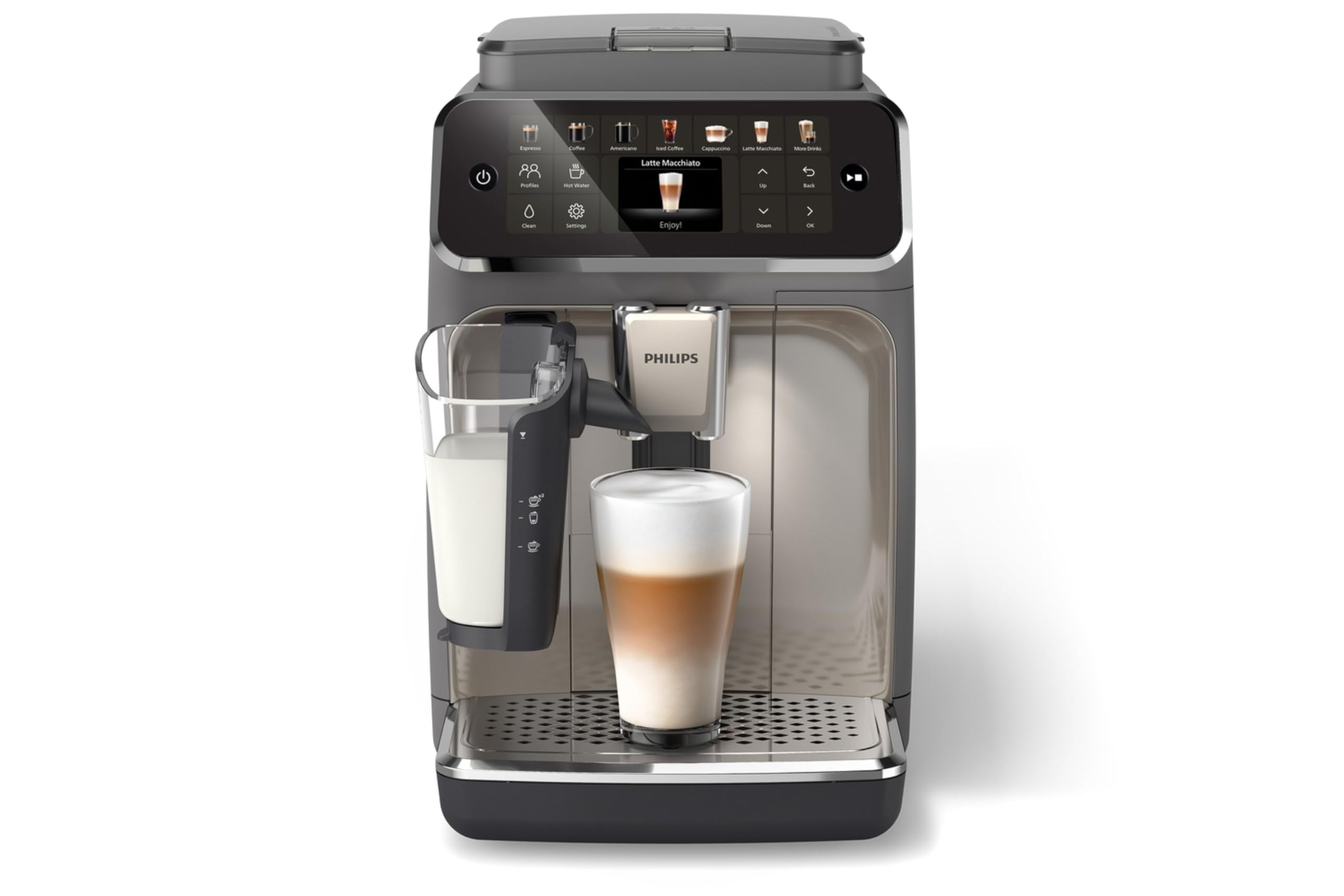
The Philips 4400 Series (EP4444/90) brings the same LatteGo milk system and SilentBrew technology found on the 5500 but with 12 presets instead of 20 and no user profiles. For households where only one or two drink recipes are used daily, this trade-off saves a significant amount of money. The ceramic conical burr grinder has 12 adjustable settings, and the AquaClean filter again allows up to 5,000 cups before descaling. QuickStart technology means the machine is ready to brew roughly 3 seconds after turning on, which is noticeably faster than machines that require a 30-second warm-up.
The milk quality from the LatteGo system is consistent across all drink types: it produces a dense, fine-bubble foam that holds its structure well in lattes and cappuccinos. The 15-bar pump handles pre-infusion at low pressure before ramping to full extraction, a feature that improves flavor clarity compared to machines that blast full pressure from the start. The machine weighs 17.6 pounds and measures 9.68 inches deep by 17.04 inches wide, so it occupies a medium footprint on most counters.
The most common complaint is that the 4400 can produce weak, watery shots if the grinder isn’t set fine enough—many users report needing to dial down to settings 2 or 3 before seeing proper pressure and crema. The water tank (1.8 L) may still require mid-day refills for heavy-use households. And while the color display is intuitive, the lack of saved profiles means every drink adjustment has to be made manually each time you switch bean types. The 4400 is a strong mid-range choice for single users or couples who prioritize easy cleanup over programmability.
Why it’s great
- LatteGo milk system is among the fastest-to-clean options on the market
- SilentBrew certification reduces grinding noise significantly
- QuickStart technology cuts warm-up time to ~3 seconds
Good to know
- No user profiles—must re-dial settings when swapping bean types
- Shots can be watery if grinder isn’t set fine enough (settings 1-3 recommended)
- 1.8 L water tank needs frequent refills in multi-user environments
7. Ninja Luxe Café Pro Series (ES701)

The Ninja Luxe Café Pro Series (ES701) is a 4-in-1 machine that brews espresso, drip coffee, cold brew, and hot water from a single platform. The integrated tamper is a standout feature: you load the portafilter, pull a lever, and the machine compresses the puck with consistent pressure—no mess, no guesswork. The Barista Assist Technology monitors each brew and adjusts grind-size recommendations based on the previous shot, effectively acting as a learning algorithm that reduces trial-and-error. The conical burr grinder offers 25 grind settings, and the built-in scale enables weight-based dosing rather than time-based grinding.
The Dual Froth System Pro combines steaming and whisking in a single hands-free unit that works with both dairy and plant-based milks. It produces foam ranging from thin steamed milk to extra-thick froth and cold foam, covering virtually any milk-based drink request. The machine can output quads, ristretto, and lungo shots, and the drip coffee side brews up to 18 ounces using a separate basket assembly. The 68-ounce water tank is generous, and the 27.1-pound weight keeps the machine planted during the tamping lever action.
Reliability reports are mixed: some owners love the guided experience, while others report that the cold brew and espresso functions produce watery, over-extracted results compared to dedicated machines. The machine does not froth milk and brew simultaneously despite the implied workflow, so making a latte still requires a sequential process. The Barista Assist system can also recommend grind sizes that don’t match the actual performance, leading to confusion for beginners who follow its advice blindly. For households that want the flexibility to make drip coffee and cold brew alongside espresso, the Luxe Café Pro is a compelling all-in-one, but purists may prefer a dedicated espresso machine.
Why it’s great
- Integrated push-lever tamper provides consistent, mess-free tamping every time
- Barista Assist guides grind size with adaptive recommendations between brews
- Combines espresso, drip, cold brew, and hot water in a single appliance
Good to know
- Cold brew and espresso can taste watery compared to dedicated machines
- Milk frothing and brewing cannot run simultaneously—sequential workflow required
- Heavy 27.1-pound build limits portability, though it stays planted during use
8. Cafe Bueno Super Automatic (CB-3000)
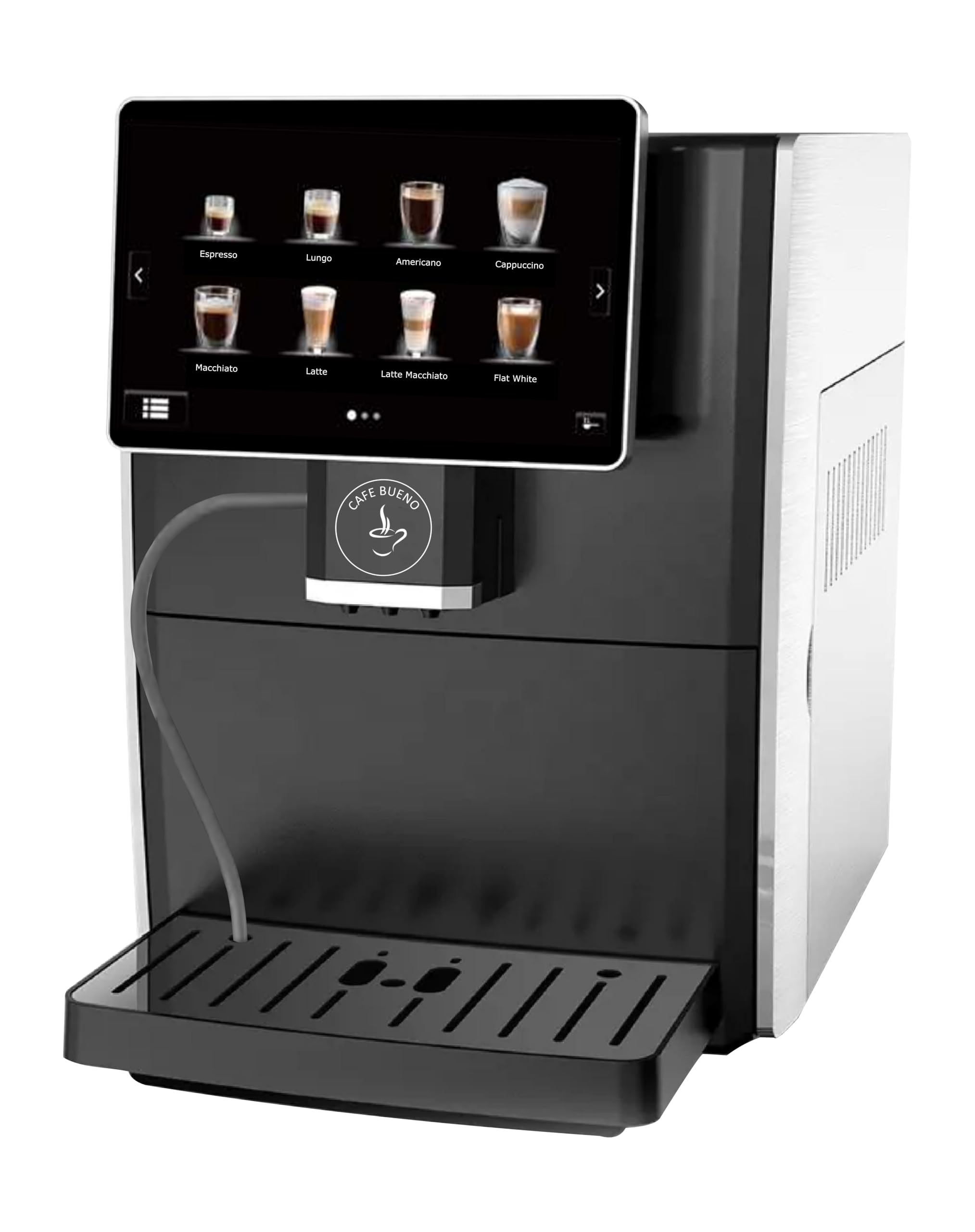
The Cafe Bueno CB-3000 packs a large 7-inch color touchscreen and 19 customizable drink options—including espresso, lungo, americano, cappuccino, macchiato, latte, latte macchiato, flat white, warm milk, and hot water, plus double versions of most—into a mid-range price. The interface is straightforward, with automatic notifications for water level, grounds bin capacity, and bean hopper status. The machine lets you adjust coffee dose, grind fineness, water temperature, and milk foam volume independently, giving you the same degree of control as machines that cost twice as much.
Brew performance improves significantly after an initial grinder adjustment phase: many users report that dialing the grinder coarser or finer based on bean freshness resolves early inconsistency issues. The machine uses a reusable filter and a self-cleaning system with four separate modes (milk system clean, brewer clean, deep brewer clean, descale). The milk sidecar system works well but adds a separate component that must be stored in the fridge. The machine supports up to 10 cups per day, making it suitable for home use but not high-volume office environments.
The main risk is customer service: multiple reports describe an inability to reach a human for troubleshooting, and units that break down within months with no warranty support from the company. The water tank is located at the back and sits low, making refills difficult if the machine is placed under cabinets. At 26.5 pounds and 18 inches deep, it requires dedicated counter space similar to the KitchenAid KF6. The Cafe Bueno is packed with features for the price, but the after-purchase support gap makes it a gamble.
Why it’s great
- 7-inch color touchscreen makes navigating 19 drink options fast and intuitive
- Independent adjustment for dose, grind, temperature, and milk foam level
- Four self-cleaning modes reduce hands-on maintenance effort
Good to know
- Numerous reports of poor customer service and no phone support available
- Rear-mounted water tank is hard to refill when machine is under cabinets
- 18-inch depth and 26.5-pound weight require a large, sturdy counter area
9. De’Longhi Magnifica Start (B0D5JQK6VQ)

De’Longhi’s Magnifica Start is the best-selling super-automatic espresso maker in the US for a reason: it delivers consistent performance at a competitive price point. The conical burr grinder offers 13 settings, giving you enough granularity to dial in most medium and dark roasts. The LatteCrema automatic milk system handles both dairy and milk alternatives, creating dense, creamy foam without requiring a separate carafe. The touchscreen interface presents five one-touch recipes—latte macchiato, cappuccino, espresso, coffee, and hot water—making it approachable for beginners.
The machine’s 19.6-pound weight indicates solid internal components, and the removable brew unit and dishwasher-safe parts simplify maintenance. Users consistently praise the temperature stability of the brews and the quality of the crema. The 60-ounce water tank is ample for a few days of moderate use before needing a refill. The Magnifica Start also includes a hot water dispenser for americanos and tea, and the drip tray design allows for taller cups by removing the drip tray grid.
Owners report that the machine can be sensitive to oily dark roasts—beans that leave a sheen on the burrs can cause feeding issues over time. The auto shut-off after 20 minutes of inactivity triggers a cleaning cycle that requires emptying the drip tray, which can feel wasteful if your workflow doesn’t align with the timer. The machine doesn’t support a dedicated double-shot button for pre-ground coffee, and there’s no option to dispense milk froth alone without liquid milk. These are minor inconveniences but worth noting if you prefer maximum flexibility in your drink programming.
Why it’s great
- #1 best-selling super-automatic in the US for proven mainstream reliability
- 13 grind settings provide fine-grained control for roast-specific dialing
- LatteCrema system froths both dairy and plant-based milk automatically
Good to know
- Oily dark roasts can clog the grinder feed mechanism
- 20-minute auto shut-off triggers a cleaning cycle that empties the drip tray
- No dedicated pre-ground double-shot button and no milk-froth-only mode
10. Bosch Fully Automatic (TIU20307)
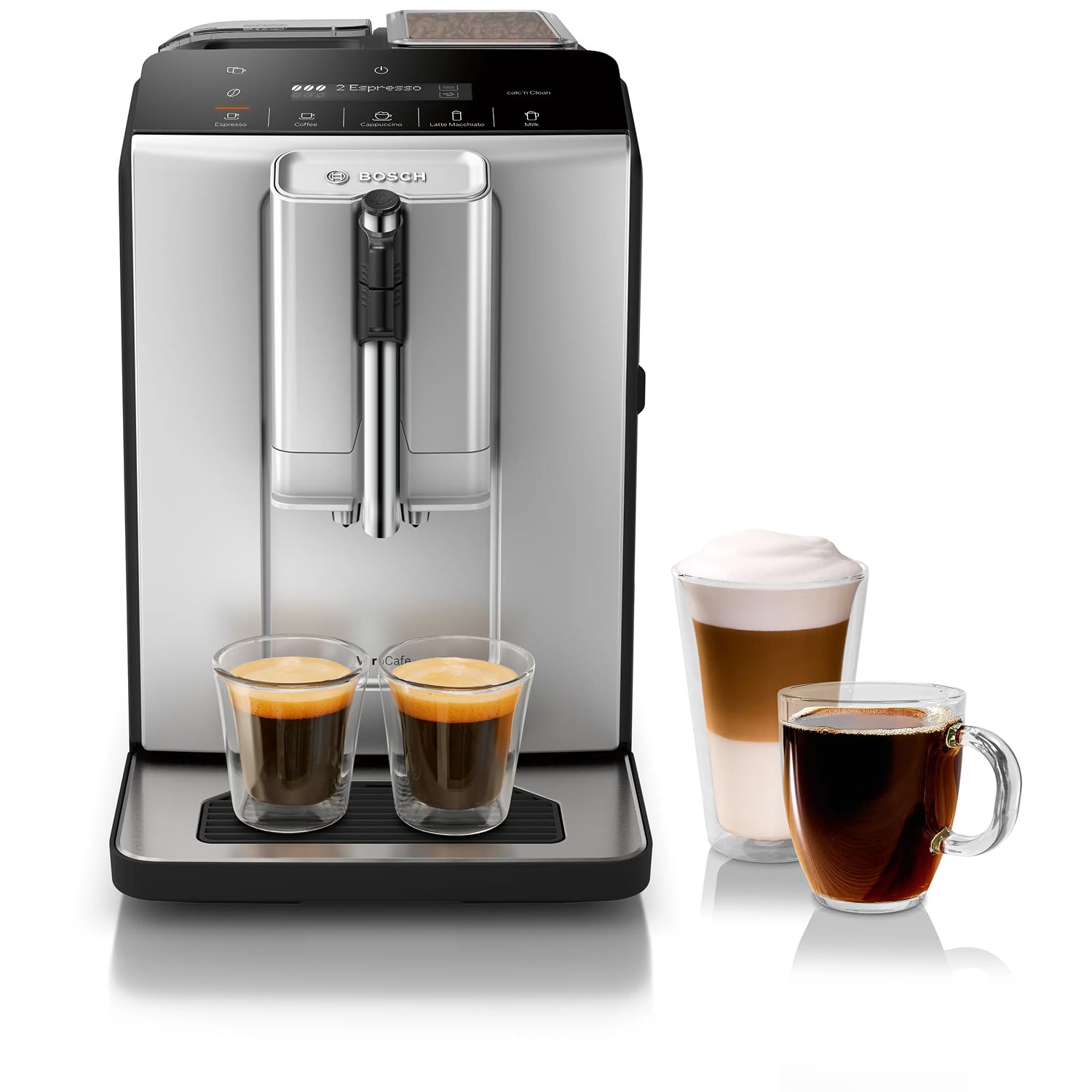
Bosch enters the super-automatic category with the TIU20307, a bean-to-cup machine that emphasizes durability through its ceramic burr grinder. Ceramic burrs run cooler than steel and maintain their sharpness longer, preserving the volatile aromatic compounds in coffee beans. The machine offers one-touch brewing for espresso, cappuccino, and latte macchiato, and it uses an adjustable milk frother that foams milk directly into your cup rather than through a fixed carafe. The removable brew unit is accessible from the front, making routine rinsing and weekly maintenance straightforward.
At 14.7 pounds and a depth of 16.5 inches, the Bosch is lighter and slightly shallower than the De’Longhi Magnifica Start, which helps with counter placement. The Calc’n Clean system is guided and uses Bosch cleaning tablets to descale the internal circuits. Users report that the machine makes excellent espresso and coffee consistently after a short dialing-in period, and the self-cleaning function keeps milk residue from accumulating in the frother. The 2.9-pound bean hopper is generous, reducing refill frequency.
The biggest functional limitation is the single bean hopper—there is no separate compartment for decaf or a different roast, so swapping beans requires emptying the hopper manually. A few reports describe a persistent “fill water tank” error even when the tank is full, a known air-in-line issue that cannot be resolved by the user. The milk frother also doesn’t heat milk as thoroughly as a steam wand, leading some buyers to pair it with an external frother for hotter milk drinks. Despite these quirks, the ceramic grinder and easy maintenance make the Bosch a solid mid-range choice for espresso-focused households.
Why it’s great
- Ceramic burr grinder runs cool and preserves bean aroma longer than steel
- Removable brew unit accessible from the front simplifies weekly cleaning
- Calc’n Clean guided descaling system reduces maintenance guesswork
Good to know
- Single bean hopper—no easy swap for decaf without emptying the hopper
- Milk frother doesn’t heat milk to steam-wand temperatures
- Air-in-line “fill water tank” error can be unfixable by the user
11. De’Longhi La Specialista Arte Evo (B0CCZQCNLJ)

The De’Longhi La Specialista Arte Evo is the most affordable option in this guide, yet it packs features typically found on higher-priced models: a conical burr grinder with 8 settings, a commercial-style steam wand, Active Temperature Control with 3 infusion temperatures, and De’Longhi’s proprietary Cold Extraction Technology that delivers cold brew in under 5 minutes. The 15-bar Italian pump provides the necessary pressure for proper pre-infusion and extraction, and the included barista kit (dosing funnel, tamping mat, tamper) helps beginners avoid mess and apply consistent pressure.
The Arte Evo offers four presets: espresso, americano, cold brew, and hot water. The manual steam wand takes practice to master for microfoam, but it gives you more control over texture than many automatic systems at this price. The machine weighs 21.5 pounds, indicating solid internal components, and the stainless steel body is easy to wipe down. The drip tray and portafilter are dishwasher-safe, and the grinder’s 8 settings cover most standard roasting levels. Many users report consistently good crema and flavor after a brief learning period.
The grinder has a known quirk: darker, oilier beans may require tapping the hopper occasionally to encourage feeding into the burrs, and the company recommends setting the grinder to 7–8 for dark roasts specifically. The steam wand’s range of motion is limited, making it awkward to froth milk in wider pitchers. The 3.5-pound bean hopper is adequate for a single-user household but may need refilling sooner for frequent entertaining. For its price, the Arte Evo delivers impressive versatility, but heavy espresso drinkers may find the grinder limitations frustrating over time.
Why it’s great
- Cold Extraction Technology produces cold brew in under 5 minutes
- Included barista kit with tamper, dosing funnel, and mat reduces beginner mess
- Active Temperature Control with 3 infusion settings adapts to roast levels
Good to know
- Grinder requires manual tapping to feed dark, oily beans consistently
- Steam wand has limited range of motion, restricting pitcher size and angle
- 8 grind settings offer less granularity than competitors with 12–13 steps
FAQ
How often should I descale an auto espresso machine?
Can I use pre-ground coffee in a super-automatic espresso machine?
Why is my auto espresso machine producing watery espresso?
How long do auto espresso machines typically last?
Do auto espresso machines work with plant-based milk?
Final Thoughts: The Verdict
For most users, the auto espresso machine winner is the Breville Oracle Jet because it combines Baratza steel burrs, automatic dose and tamp, and the most intuitive milk customization system in the super-automatic segment—delivering café-quality shots without the learning curve. If you want an easier-to-clean milk system with multi-user profiles, grab the Philips 5500 Series. And for purists who prioritize simplicity, longevity, and black-coffee quality over milk features, nothing beats the Jura E4.

Mo Maruf
I created WellFizz to bridge the gap between vague wellness advice and actionable solutions. My mission is simple: to decode the research and give you practical tools you can actually use.
Beyond the data, I am a passionate traveler. I believe that stepping away from the screen to explore new environments is essential for mental clarity and physical vitality.