Our readers keep the lights on and my smoothie glass nicely filled. As an Amazon Associate, I earn from qualifying purchases.
Choosing an affordable camera with a flip screen used to mean sacrificing image quality for the selfie-friendly form factor. That compromise is no longer necessary. Modern mirrorless and compact systems now pack capable sensors, reliable autofocus, and articulating touchscreens into packages that don’t demand a second mortgage.
I’m Mohammad Maruf — the founder and writer behind WellFizz. I’ve spent years analyzing camera specifications, from sensor size and bit depth to autofocus point layouts and stabilization systems, to identify which models deliver real value in a market full of inflated promises.
After evaluating over a dozen models across price tiers, these seven stand out as the most practical options for anyone searching for the best affordable digital camera with flip screen that balances modern features with real-world usability.
How To Choose The Best Affordable Digital Camera With Flip Screen
Not all flip screens are built the same, and not every affordable camera delivers the autofocus speed needed for vlogging. Before you click buy, here are the three non-negotiable specs to check.
Sensor Size: The Real Low-Light Enabler
Ignore the megapixel war. A 1-inch or APS-C sensor will produce usable images in dim indoor lighting, while smaller 1/2.3-inch sensors common in budget bridge cameras quickly turn noisy. For a flip-screen camera used in variable lighting, an APS-C or Micro Four Thirds sensor is a hard floor for acceptable quality.
Autofocus Architecture: Eye Tracking vs. Contrast Detection
Flip-screen selfies and vlogs demand autofocus that locks onto your face from an arm’s length distance. Phase-detection or hybrid AF systems with eye-tracking deliver consistent sharpness. Older contrast-detection-only systems hunt in video, producing pulsing focus that ruins the shot. Look for models with at least 49 phase-detect points.
Screen Articulation: Tilt vs. Side Flip
A tilt screen flips up 90 degrees for overhead or low-angle shots but blocks a hotshoe mic or external monitor when fully extended. A side-hinged fully articulating screen flips out to the side and rotates 180 degrees, keeping all ports and the accessory shoe accessible. For vloggers, side flip wins every time. For street photographers, a tilt screen is more discreet.
Quick Comparison
On smaller screens, swipe sideways to see the full table.
| Model | Category | Best For | Key Spec | Amazon |
|---|---|---|---|---|
| Sony ZV-1F | Vlog Compact | Vloggers needing wide-angle selfies | 1-inch sensor, 20mm F2 lens | Amazon |
| Panasonic G85 | Mirrorless ILC | Hybrid shooters needing IBIS | 5-axis IBIS, 12-60mm kit lens | Amazon |
| Sony a5000 | Mirrorless ILC | Budget-friendly entry-level stills | 20.1 MP APS-C sensor | Amazon |
| Nikon Z 30 | Mirrorless ILC | Streaming and vlogging hybrid | 209 AF points, 4K 30p | Amazon |
| Panasonic G7 | Mirrorless ILC | 4K video on a tight budget | 4K 30fps, 16MP MFT sensor | Amazon |
| Nikon P950 | Superzoom Bridge | Ultra-long reach wildlife shooting | 83x optical zoom, 2000mm max | Amazon |
| Canon EOS RP | Full-Frame ILC | Entry-level full-frame versatility | 26.2 MP full-frame sensor | Amazon |
In‑Depth Reviews
1. Sony ZV-1F Vlog Camera

The ZV-1F is purpose-built for the vlogger who needs a reliable flip-screen camera without the complexity of interchangeable lenses. Its 20mm ultra-wide lens captures an entire scene at arm’s length, making it ideal for talking-heads and travel vlogs. The 1-inch sensor paired with an F2 aperture delivers solid background defocus even in modest lighting, a feature that usually requires pricier APS-C kits.
Autofocus performance here is exceptional for the tier. Sony’s Eye-AF and real-time tracking keep your face sharply in focus as you move around the frame, and the directional 3-capsule microphone with the included windscreen captures usable audio without an external mic. The side-articulating touchscreen flips out fully, keeping the hotshoe free for a light or microphone — a detail many tilt-screen competitors miss.
The trade-offs are real but manageable. The fixed lens means no optical zoom — you frame with your feet or rely on digital zoom, which degrades quality. Battery life hovers around 45 minutes of continuous recording, so a spare battery is almost mandatory for a full day out. The digital-only stabilization introduces crop and wobble when walking, so handheld motion shots require a steady hand or a gimbal.
Why it’s great
- Ultra-wide 20mm lens captures excellent vlogging selfie shots
- Eye-AF and real-time tracking are reliable and fast
- Built-in directional mic with windscreen saves on accessories
Good to know
- Fixed lens means no optical zoom capability
- Short battery life requires carrying spares
- Digital-only stabilization causes noticeable walking shake
2. Panasonic LUMIX G85

The G85 is the entry-level mirrorless body that refuses to compromise on stabilization. Its 5-axis in-body image stabilization works with any lens you mount, producing clean handheld footage that would require a gimbal on most competitors at this price. The 16-megapixel Micro Four Thirds sensor, which lacks a low-pass filter, resolves fine detail noticeably better than earlier 16MP MFT sensors, making it a strong pick for hybrid shooters who split time between stills and 4K video.
The tilting touchscreen LCD is responsive, though it tilts up rather than flipping out sideways. In practice, this means your hotshoe-mounted microphone will block the screen when it’s flipped up for selfie shooting — a workflow consideration for vloggers. The integrated OLED viewfinder (2360K dots) is sharp and lag-free, a rare inclusion at this price point that benefits traditional photography.
Build quality punches above its class with a magnesium alloy front plate and weather sealing, making the G85 one of the few affordable flip-screen cameras you can use confidently in light rain or dusty environments. The 12-60mm kit lens delivers useful range and optical stabilization that works in tandem with the IBIS. The main limitations are a 49-point contrast-detect AF system that hunts in low-light video and battery life that demands a spare for all-day shoots.
Why it’s great
- 5-axis IBIS delivers gimbal-like stabilization for video
- Weather-sealed magnesium alloy body is durable for outdoor use
- Sharp OLED viewfinder with high refresh rate
Good to know
- Tilt screen is obstructed by hotshoe accessories
- Contrast-detect AF struggles in low-light video
- Battery life is average, not suited for long days
3. Sony Alpha a5000
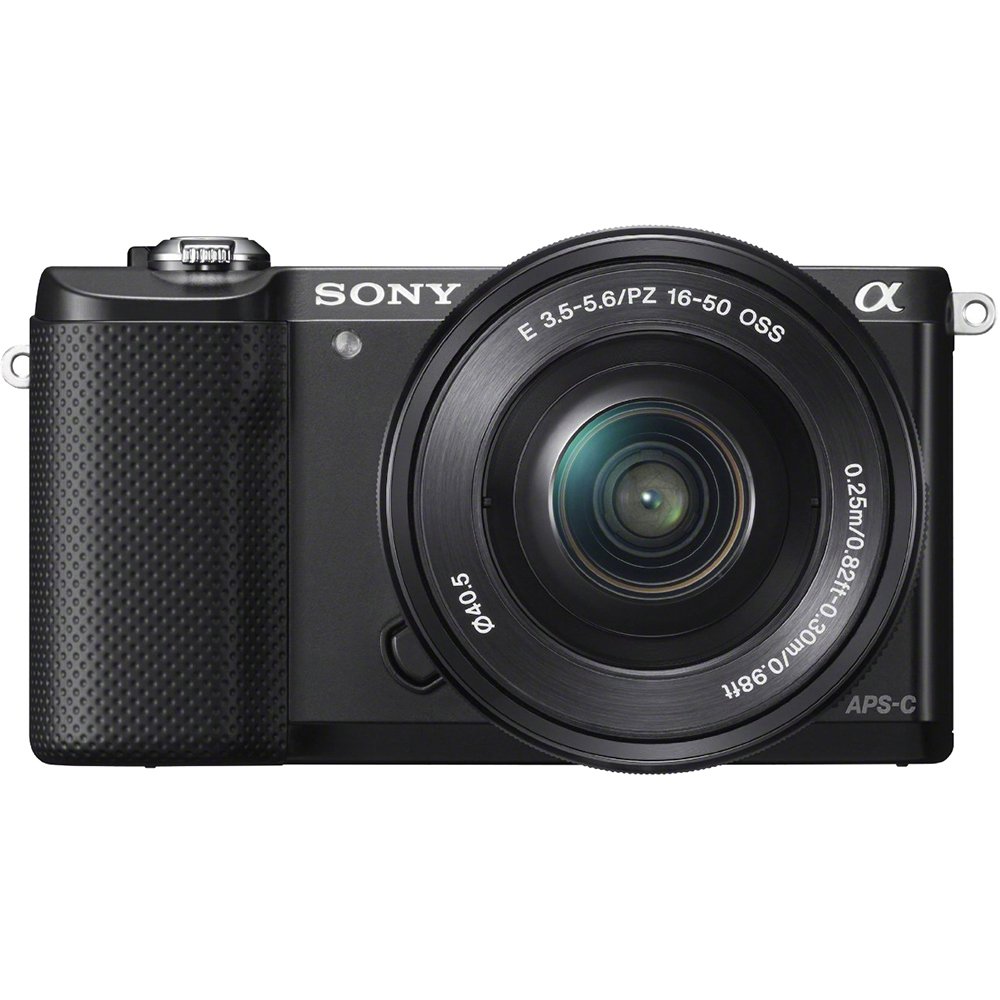
The a5000 is a mirrorless entry point that prioritizes portability and sensor quality over video centric features. Its 20.1-megapixel APS-C sensor is the same size class used in Sony’s pro-level bodies, delivering noticeably richer colors and better dynamic range than any 1-inch or smaller sensor at this price tier. The flip-up screen is a simple 180-degree design that works well for selfies and overhead shots, though it blocks the built-in flash when deployed.
The 16-50mm retractable kit lens is a polarizing inclusion. When collapsed, the camera fits into a large coat pocket, but the power zoom mechanism feels slow and the lens itself is optically soft at the edges. The real value of the a5000 lies in Sony’s E-mount ecosystem — you can mount a Sigma 19mm f/2.8 for sharp wide-angle selfies or a Sony 55-210mm for reach, and the body remains compact enough for daily carry.
Autofocus uses a 25-point contrast-detect system that is reliable in good light but hunts noticeably in dim conditions. There is no phase-detection, so tracking moving subjects is limited. The absence of 4K video and a microphone input confirms this camera is aimed squarely at stills-oriented beginners who want a flip screen for family photos and casual selfies rather than vloggers.
Why it’s great
- Large APS-C sensor produces excellent image quality for the price
- Compact and lightweight body with retractable kit lens
- Access to the extensive Sony E-mount lens ecosystem
Good to know
- Contrast-detect AF is slow in low light
- No 4K video recording or external mic jack
- Kit lens is optically soft at the edges
4. Nikon Z 30

Nikon designed the Z 30 specifically for the creator who needs a camera that doubles as a webcam without fuss. The 209-point hybrid autofocus system with eye tracking for both people and pets locks on reliably and stays locked, even in moderate lighting. The side-articulating flip screen is fully articulated, keeping the hotshoe free for a microphone, and the red REC light on the top plate removes the guesswork of whether you’re rolling.
The 16-50mm kit lens is optically sharp and compact, offering a good general-purpose range for vlogging and streaming. One standout design choice is the unlimited 4K 30p recording — the Z 30 does not overheat like its larger sibling the Z50, making it suitable for long streams or event recording. The USB-C port supports constant power and plug-and-play UVC/UAC streaming, so you can run it as a dedicated webcam for hours without battery anxiety.
The lack of an electronic viewfinder is the most polarizing omission. Anyone accustomed to composing through a viewfinder will need to rely on the rear screen exclusively, which can be challenging in bright sunlight. The battery life is acceptable for a camera this size, but the EN-EL25 battery is small, so a spare is still advisable for all-day outings.
Why it’s great
- Hybrid AF with eye tracking works reliably for people and pets
- Unlimited 4K recording with no overheating issues
- USB-C streaming with constant power is plug-and-play
Good to know
- No electronic viewfinder limits outdoor shooting
- Battery life requires spare for full day use
- Kit lens lacks a wide enough aperture for extreme low light
5. Panasonic LUMIX G7

The G7 remains one of the most affordable ways to get into 4K video with a flip screen and interchangeable lenses. The 16-megapixel Micro Four Thirds sensor, which shares the same no-low-pass-filter design as the G85, produces sharp video and stills with good color science straight out of camera. The 4K Photo mode, which extracts 8-megapixel frames from 30fps video bursts, is a practical tool for capturing split-second moments like a child jumping or a pet mid-air.
The OLED viewfinder (2360K dots) is a premium inclusion at this price, and the dual control dials give you direct access to aperture and shutter without diving into menus. The tilt/swivel LCD is a 3-inch touchscreen that articulates sideways, keeping it clear of accessories on the hotshoe. The body is mostly plastic, lacking the weather sealing of the G85, but it weighs only about 400 grams, making it one of the lightest options for travel.
The absence of in-body stabilization is the headline omission. You rely entirely on the lens’s optical stabilization, which means the 14-42mm kit lens provides modest shake reduction but won’t match the G85’s IBIS performance. Low-light performance is also limited — ISO 1600 shows visible noise, and the contrast-detect autofocus hunts in dimmer conditions. For controlled studio environments and well-lit outdoor shoots, the G7 delivers exceptional value.
Why it’s great
- Affordable 4K recording with useful 4K Photo mode
- Sharp OLED viewfinder and dual control dials
- Lightweight body at 400g for easy travel
Good to know
- No in-body stabilization, relies on lens OIS only
- Plastic body lacks weather sealing
- Low-light performance degrades above ISO 1600
6. Nikon COOLPIX P950

The P950 is the superzoom specialist in this roundup, and its party trick is undeniable — an 83x optical zoom that reaches a 2000mm equivalent focal length. With the rotating vari-angle LCD screen, you can hold the camera low or overhead while composing shots of distant wildlife or the moon, and the optical image stabilization makes handheld telephoto shots usable at full extension. The dedicated Bird and Moon scene modes automate settings for those specific use cases, taking the guesswork out of extreme telephoto photography.
The 16-megapixel 1/2.3-inch sensor is the weakest link for image quality. In good daylight, photos are crisp and detailed, but as light drops, noise becomes aggressive. This is a tool for reach, not for low-light artistry. The 4K UHD video recording is functional but crops the sensor further, and the contrast-detect autofocus is slow to lock on distant, small subjects. The manual focus wheel on the lens barrel is a welcome improvement over the P900’s digital-only manual focus.
Battery life is a strong point — the EN-EL20a pack can manage several hundred shots on a single charge, and the camera offers dual battery charging via the included AC adapter. The downside is the bulk. This is not a pocket camera; it’s a bridge camera that demands a dedicated bag slot. For anyone whose primary subject is birds, planes, or distant landscapes, the P950 offers reach no similarly priced mirrorless kit can match.
Why it’s great
- 83x optical zoom (2000mm equivalent) offers unmatched reach
- Vari-angle LCD works with low and high telephoto shots
- Dedicated Bird and Moon modes simplify extreme telephoto work
Good to know
- Small sensor struggles with noise in low light
- Contrast-detect AF is slow with distant subjects
- Large body is not convenient for everyday carry
7. Canon EOS RP

The EOS RP is the most affordable full-frame mirrorless camera with a flip screen, and that simple fact changes the equation for image quality. Its 26.2-megapixel full-frame sensor delivers the depth, dynamic range, and low-light performance that smaller sensors cannot match. The side-articulating flip screen works cleanly with the RF 24-105mm kit lens, and the Dual Pixel CMOS AF with phase detection is fast and silent for both stills and video.
Body construction is a mix of polycarbonate and metal, keeping weight to a manageable 485 grams for a full-frame body. The kit lens, while optically decent in the center, shows edge softness at wider apertures and the F4-7.1 variable aperture limits low-light capability. The real appeal is the RF lens ecosystem — you can adapt virtually any Canon EF/EF-S lens with the official adapter, gaining access to decades of glass. The 4K video recording has a 1.6x crop factor, which tightens the field of view significantly, but the 1080p output is excellent.
Battery life using the LP-E17 pack is modest, rated at around 250 shots per CIPA standard, which is typical for entry-level full-frame but demands discipline on long shoots. The lack of a built-in flash is offset by the hotshoe, but it is an omission for casual users. For anyone wanting to step into full-frame photography without the financial shock of higher-end models, the RP paired with a decent prime lens is a formidable combination.
Why it’s great
- Full-frame sensor offers superior dynamic range and low-light quality
- Dual Pixel CMOS AF is fast and reliable
- Lightweight body for a full-frame platform
Good to know
- 4K video has a significant 1.6x crop factor
- Kit lens is soft at edges and variable aperture limits low-light use
- Battery life is below average for all-day shoots
FAQ
Is a 180-degree flip-up screen good enough for vlogging?
Will the Canon EOS RP overheat during long 4K recording?
Final Thoughts: The Verdict
For most users, the affordable digital camera with flip screen that hits the best balance is the Sony ZV-1F because it combines intuitive vlogging features, excellent autofocus, and a wide-angle lens that actually works at arm’s length. If you need gimbal-level stabilization for run-and-gun video, grab the Panasonic G85. And for those chasing full-frame depth without the premium price tag, the Canon EOS RP is the entry point that will keep you satisfied for years.

Mo Maruf
I created WellFizz to bridge the gap between vague wellness advice and actionable solutions. My mission is simple: to decode the research and give you practical tools you can actually use.
Beyond the data, I am a passionate traveler. I believe that stepping away from the screen to explore new environments is essential for mental clarity and physical vitality.