Our readers keep the lights on and my smoothie glass nicely filled. As an Amazon Associate, I earn from qualifying purchases.
Planting a sparse, patchy lawn that burns brown by mid-July wastes your weekend and your money. A warm-season Bermuda grass lawn that survives high heat and foot traffic requires a seed blend bred for aggressive lateral spread and deep root penetration — not a generic sun mix engineered for cool-season northern grasses.
I’m Mohammad Maruf — the founder and writer behind WellFizz. I analyze seed germination rates, turf-type cultivar genetics, and formulation science to separate legitimate lawn solutions from overpriced bags of filler.
After evaluating five top-selling blends against drought tolerance, shade adaptability, and real-world germination feedback, this guide breaks down the season’s most reliable choices so you can confidently buy the best bermuda grass seed for your region’s specific light and temperature conditions.
How To Choose The Best Bermuda Grass Seed
Bermuda grass is a warm-season perennial that establishes through stolons and rhizomes. The right seed choice depends on your local climate transition zone, sun exposure windows, and the wear level your lawn receives. Beginners often overlook the difference between coated and raw seed, which directly impacts germination density and watering frequency.
Hulled vs. Unhulled Seed
Hulled seed has the outer husk mechanically removed, which speeds up germination by roughly 5 to 10 days. Unhulled seed retains the husk for longer shelf life but requires consistently moist soil for weeks. For rapid fill-in, hulled varieties perform better in full sun with regular irrigation.
Cold Tolerance Rating
Standard Bermuda goes dormant and turns brown when soil temps drop below 55°F. Improved cold-tolerant cultivars extend your green window into early winter in transition-zone states like Kentucky and Virginia. Check the label for specific cold-tolerance claims if you live north of the typical Bermuda belt.
Wear Resistance and Spreading Habit
Bermuda grass naturally spreads aggressively through above-ground stolons. Blends labeled for high-traffic lawns contain turf-type varieties bred for denser root systems and faster lateral fill. For sports fields or pet areas, prioritize seed that explicitly states wear resistance and deep root architecture.
Quick Comparison
On smaller screens, swipe sideways to see the full table.
| Model | Category | Best For | Key Spec | Amazon |
|---|---|---|---|---|
| Pennington Bermudagrass 5 lb | Warm-Season | Aggressive full-sun coverage | Cold-tolerant; low-growing blend | Amazon |
| Scotts Sun & Shade 5.6 lb | Sun/Shade Mix | Versatile lawn repair | Root-Building Nutrition coating | Amazon |
| Jonathan Green Black Beauty Sun & Shade | Cool-Season | Shade-tolerant patches | Insect/disease resistant | Amazon |
| Jonathan Green Heat & Drought 3 lb | Cool-Season | High-heat transition zones | Waxy leaf coating for moisture retention | Amazon |
| Scotts Sunny Mix 2.4 lb | Sunny Mix | Budget small-patch seeding | Fertilizer + soil improver blended | Amazon |
In‑Depth Reviews
1. Pennington Bermudagrass 5 lb

Pennington’s Bermuda blend stands apart for its cold-tolerant genetics, which keep your lawn green deeper into the shoulder season than standard varieties. The seed is unhulled, meaning it has a natural protective layer that extends shelf life but requires consistent moisture for roughly 14 to 21 days before germination begins. Once established, the deep root system naturally resists drought and spreads aggressively through stolons to fill bare spots without multiple reseeding passes.
The 5-pound bag provides generous coverage — about 1,000 square feet for a new lawn or up to 5,000 square feet for overseeding — making it a strong value for medium-to-large yards. User reports from Florida and the Gulf Coast confirm that this blend handles high humidity and sandy soil without developing fungal patches. The low-growing formulation also reduces mowing frequency, producing fewer clippings than coarser Bermuda varieties.
Some buyers noted that germination can be slower than expected if soil temperatures dip below 70°F. For best results, wait until daily soil temps consistently hit the 75–80°F range, water twice daily in light cycles, and mow at one inch once the grass reaches three inches tall. The cold tolerance makes it a reliable choice for transition-zone lawns that experience mild winter freezes.
Why it’s great
- Cold-tolerant genetics extend green season into early winter.
- Aggressive lateral spread fills bare spots naturally.
- Low-growing habit reduces mowing frequency.
Good to know
- Unhulled seed requires consistent moisture for reliable germination.
- May germinate slowly if soil temps are below 70°F.
- Some users experienced seed that did not sprout with improper watering schedules.
2. Scotts Turf Builder Sun and Shade Mix 5.6 lb

Scotts combines seed, fertilizer, and soil improver into a single bag with their Root-Building Nutrition coating, which provides immediate phosphorus and potassium to support early root development. This mix is engineered for areas that receive full sun in the morning and moderate shade by afternoon, making it a versatile option for yards with trees or fence lines. The 5.6-pound bag covers up to 745 square feet for new lawns and a generous 2,240 square feet for overseeding.
Real-world users reported visible sprouting around day 10 with consistent twice-daily watering, especially when applied over fresh topsoil rather than compacted existing ground. The blend tolerates low mowing heights well, which is beneficial for homeowners aiming for a fairway-style turf appearance. Many long-time users noted that the formulation has held up against summer thunderstorms and heavy wind without significant seed washout.
Some recent batches have drawn complaints about increased weed content, with crabgrass and broadleaf weeds appearing alongside the turf grass. If you apply a pre-emergent herbicide before seeding, you may neutralize the weed seeds while allowing the coated grass seed to establish. For mixed-light conditions and large-area repair, this bag delivers strong coverage density at a practical price point.
Why it’s great
- Root-Building Nutrition coating feeds seedlings immediately.
- Covers up to 2,240 sq. ft. for overseeding projects.
- Handles mixed sun/shade conditions well.
Good to know
- Some batches contain weed seeds that may require pre-emergent treatment.
- Germination is slower than hulled Bermuda varieties.
- Thicker coverage requires multiple seeding passes for bare spots.
3. Jonathan Green Black Beauty Sun & Shade 3 lb

Jonathan Green’s Black Beauty formula uses a proprietary mix of turf-type tall fescue and fine fescues bred specifically for partial shade tolerance. The 3-pound bag seeds up to 2,250 square feet when overseeding, making it an economical choice for patching shady spots under tree canopies where pure Bermuda would thin out. The blend is also naturally insect and disease resistant, reducing the need for chemical treatments during establishment.
Users in shaded northern transition zones consistently report new growth within a week when kept consistently moist. The seed seems to outperform big-box generic brands in terms of weed-free purity — multiple reviewers noted zero weed germination alongside the grass. The black beauty genetics produce a dark green color that blends well with existing turf, minimizing the visual patchwork effect during the transition period.
The main limitation is that this is primarily a cool-season blend, not a warm-season Bermuda. It will go dormant during peak summer heat in southern zones, and it lacks the aggressive spreading habit of true Bermuda varieties. If your lawn is predominantly shaded and you need a grass that stays green through spring and fall, this is a strong pick. For full-sun southern lawns, you will want a dedicated warm-season Bermuda instead.
Why it’s great
- Excellent shade tolerance for tree-lined yards.
- High weed-free purity; no unwanted volunteer grass.
- Dark green color blends with existing turf.
Good to know
- Cool-season blend; goes dormant in intense southern summer heat.
- Lacks the aggressive spreading habit of Bermuda.
- Smaller bag size limits coverage for large new lawns.
4. Jonathan Green Black Beauty Heat & Drought 3 lb

Black Beauty Heat & Drought targets the specific pain point of transition-zone lawns that bake under 100°F afternoons. The blend combines Texas bluegrass with Black Beauty turf-type tall fescues, creating a grass that has a waxy leaf coating — like an apple’s skin — that slows moisture evaporation and reduces water demand. Users who aerated and top-dressed before seeding reported Kentucky bluegrass-quality results in as few as 14 days.
The 3-pound bag covers 750 square feet for new lawns or 1,500 square feet for overseeding. It is designed for full sun to light shade, and the deep root system can penetrate up to 4 feet, which naturally limits the need for frequent irrigation. The waxy leaf coating also provides a natural shield against common fungal diseases that plague Bermuda in humid southern summers.
Some users experienced poor germination when the seed was applied during late spring heat without adequate irrigation. This formula is best planted mid-August through mid-October or mid-March through mid-May, when soil temps are moderate. If you are in a region where summer heat consistently exceeds 95°F and you need a cool-season alternative that survives without constant watering, this is a specialized tool worth considering.
Why it’s great
- Waxy leaf coating reduces water demand and fungal risk.
- Texas bluegrass component adds summer heat tolerance.
- Roots penetrate up to 4 feet for drought survival.
Good to know
- Unhulled seed requires consistent moisture for uniform germination.
- Smaller coverage per bag compared to premium options.
- Some batches show weed content in customer reports.
5. Scotts Turf Builder Sunny Mix 2.4 lb
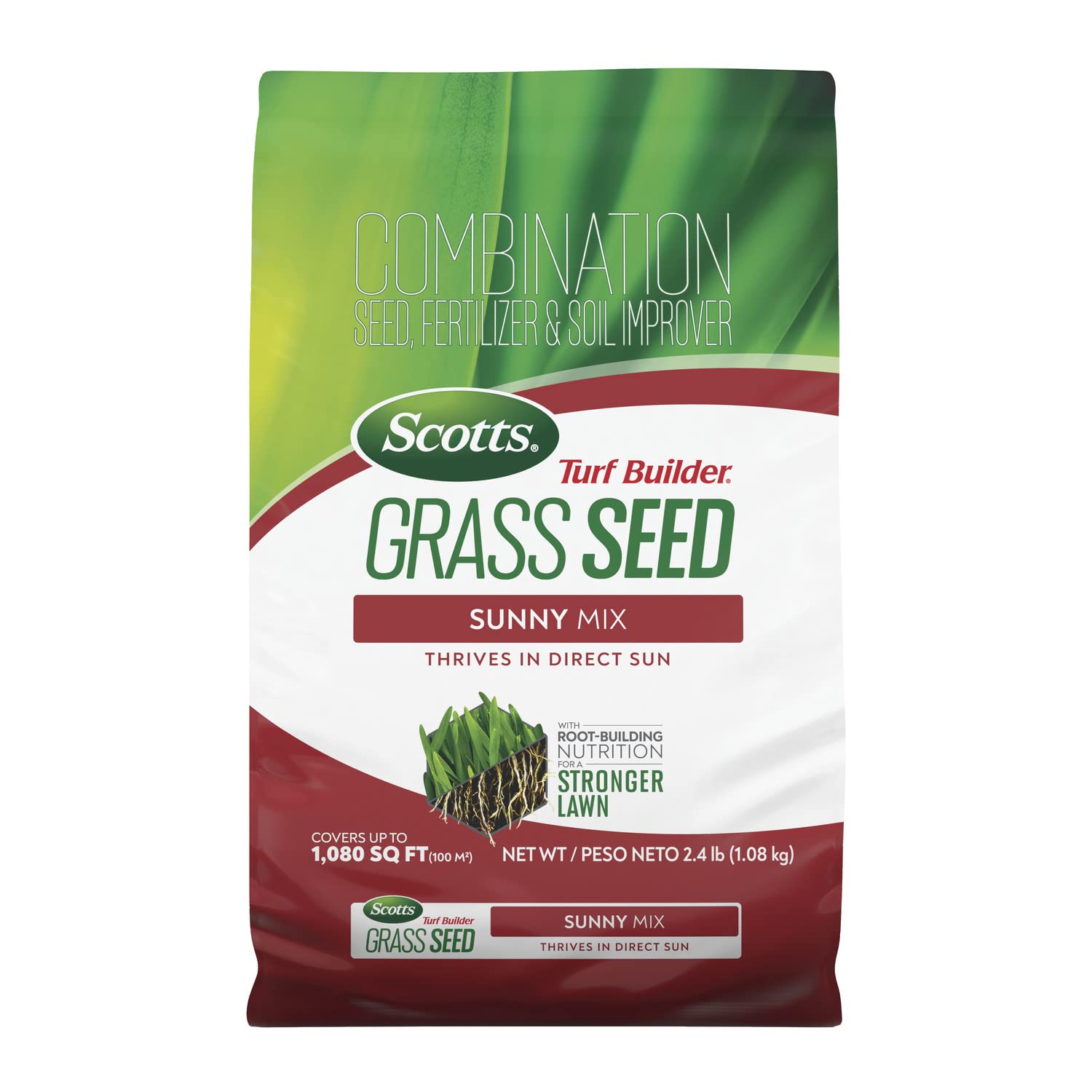
Scotts redesigned their Sunny Mix with a Root-Building Nutrition formula that integrates seed, fertilizer, and soil improver into one application. It is specifically optimized for direct sun and light shade conditions, with medium to high drought resistance and medium to high durability ratings. The 2.4-pound bag covers 360 square feet for new lawns and 1,080 square feet for overseeding, making it a practical entry-level option for small patch repair or starter lawns.
Customer feedback shows that proper soil preparation — scraping the top inch, adding loose topsoil, and watering consistently — yields thick, sturdy grass even on compacted ground. Some users reported that germination took up to three months in challenging conditions, but the end result was a dense turf that spread naturally into adjacent areas. The built-in fertilizer eliminates the need for a separate starter application during the first few weeks.
The main trade-off is the smaller bag size and the medium drought resistance rating compared to premium Bermuda blends. For large new lawns or for areas with extreme summer heat, you will get better density and faster fill from a larger bag of a dedicated Bermuda cultivar. But for fixing a sunny bare patch under 400 square feet, this all-in-one mix saves time and reduces the guesswork of combining separate products.
Why it’s great
- Fertilizer and soil improver built into the seed mix.
- Thrives in full sun with consistent watering.
- Good value for small-area lawn repair.
Good to know
- Smaller bag limits large-scale application.
- Medium drought resistance; requires regular irrigation in hot weather.
- Some users noted slow germination without ideal soil prep.
FAQ
What soil temperature does Bermuda seed need to germinate?
Can I plant Bermuda seed in the shade?
How often should I water new Bermuda seed?
What is the best time of year to plant Bermuda grass?
Final Thoughts: The Verdict
For most users, the best bermuda grass seed winner is the Pennington Bermudagrass 5 lb because its cold-tolerant genetics and aggressive spreading habit deliver reliable full-sun coverage across transition and southern zones. If you need a versatile blend that handles both sun and moderate shade for large-area repair, grab the Scotts Turf Builder Sun and Shade 5.6 lb. And for patchy shaded spots under trees where pure Bermuda cannot survive, nothing beats the Jonathan Green Black Beauty Sun & Shade 3 lb for weed-free dark green fill.

Mo Maruf
I created WellFizz to bridge the gap between vague wellness advice and actionable solutions. My mission is simple: to decode the research and give you practical tools you can actually use.
Beyond the data, I am a passionate traveler. I believe that stepping away from the screen to explore new environments is essential for mental clarity and physical vitality.