Our readers keep the lights on and my smoothie glass nicely filled. As an Amazon Associate, I earn from qualifying purchases.
Cacti are built for survival in lean, brutal soils—they don’t need heavy meals twice a month like a tropical fern. The trouble is, most standard plant food is loaded with nitrogen designed for leafy growth, which turns a hardy barrel cactus into a bloated, rotting mess. Getting the N-P-K ratio and release speed right is the single most important factor in keeping those plump bodies firm and spines sharp.
I’m Mohammad Maruf — the founder and writer behind WellFizz. I’ve spent years analyzing the chemistry behind specialty fertilizers, digging through soil science papers and buyer feedback to separate the formulas that genuinely support slow-growing desert species from the ones that cause spindly, etiolated growth.
This guide walks you through the top-performing options on the market to help you find the best cactus fertilizer that matches your plant type and watering schedule, whether you grow a windowsill collection of lithops or a shelf full of columnar San Pedro.
How To Choose The Best Cactus Fertilizer
Applying the wrong fertilizer to a cactus does more than waste money—it actively harms the plant by triggering unnatural growth spurts or salt-burning the roots. You need to match the NPK ratio, release mechanism, and micronutrient profile to the specific genus in your collection.
NPK Ratio — The Low-Nitrogen Rule
A standard 20-20-20 houseplant feed pushes leafy top growth that cacti simply cannot support. Look for a ratio where the middle (phosphorus) and last (potassium) numbers are higher than the first (nitrogen). Ratios around 2-7-7 or 1-2-2 encourage root strength, spine density, and flower bud formation without forcing weak green tissue that invites rot.
Liquid vs. Slow-Release — Application Style Matters
Liquid concentrates give you fine control—you can adjust dilution strength for different species and stop feeding the moment you see signs of stress. Slow-release granular or powdered organics, especially those with beneficial microbes, build soil structure over months and are forgiving if you occasionally forget to water. The trade-off is that organics often smell earthy or manure-like and require soil warm enough for biological activity to break down.
Micronutrients and Beneficial Microbes
Calcium and magnesium are critical for cell wall strength in thick-skinned cacti, while zinc and iron support chlorophyll function in green stem tissue. Some premium fertilizers also include live microbial inoculants that help break down organic matter in the root zone, which is especially useful for plants in gritty, mineral-heavy potting mixes that lack natural organic decomposition.
Quick Comparison
On smaller screens, swipe sideways to see the full table.
| Model | Category | Best For | Key Spec | Amazon |
|---|---|---|---|---|
| Schultz Cactus Plus 2-7-7 | Concentrated Liquid | Targeted low-nitrogen feeding | NPK 2-7-7 ratio | Amazon |
| Espoma Organic Cactus! | Organic Liquid | Gentle organic maintenance | NPK 1-2-2, OMRI listed | Amazon |
| HiThrive 16oz Liquid | High-Volume Liquid | Large collections on a budget | 32 gallons per bottle | Amazon |
| Grow Queen Organic Powder | Bioactive Powder | Hands-off long-term soil health | 7 packets, up to 8 months | Amazon |
| Gardenera Superfood Spray | Foliar Spray | Quick recovery and transplant aid | Contains Vitamin B-1 & Glucose | Amazon |
In-Depth Reviews
1. Schultz Cactus Plus 2-7-7 Liquid Plant Food
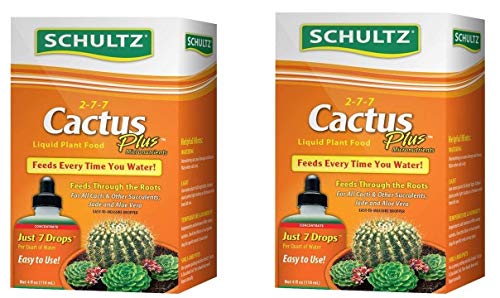
Schultz has been a steady name in specialty plant nutrition for decades, and this 2-7-7 formula remains a top reference point for cactus keepers who want a chemically precise, low-nitrogen feed. The nitrogen content is deliberately kept low to prevent the soft, etiolated growth that standard houseplant fertilizers cause, while the elevated phosphorus and potassium support root anchorage and flower bud formation. Each bottle is highly concentrated—just one teaspoon per gallon of water—so the two-pack lasts a long time even if you have a sizable collection of barrel cacti, opuntias, or mammillarias.
Users report that consistent feeding twice a year in spring and fall, at half-strength for sensitive species, yields noticeably thicker stems and more abundant blooms on Christmas cactus and Easter lily cactus. The liquid formulation makes it easy to stop feeding immediately if a plant shows signs of over-fertilization, such as yellowing at the base or sudden tip growth. Because it is a synthetic mineral salt-based fertilizer, it works best in well-draining cactus soil that doesn’t retain moisture long enough to cause salt buildup.
One limitation is the small bottle volume—four ounces per bottle means you need to measure carefully to make it last across many waterings. The label recommends diluting to one teaspoon per gallon, but several experienced growers halve that for smaller potted specimens or weak-rooted plants like lithops. It is not organic and does not contain beneficial microbes, so it will not improve soil biology the way a powdered organic feed might.
Why it’s great
- NPK 2-7-7 is precisely formulated for cactus-specific low-nitrogen needs, reducing rot risk.
- Extremely concentrated—small bottle stretches further than most liquid competitors.
- Clear mixing instructions and fast-acting results visible within two weeks during active growth.
Good to know
- Small 4-ounce bottle size requires careful measuring for large collections; two-pack helps.
- Synthetic mineral formula does not contribute to long-term soil organic matter.
- Some users prefer to dilute to half-strength for slow-growing species like astrophytum.
2. Espoma Organic Cactus! Plant Food

Espoma has built its reputation on organic plant foods that rely on natural ingredients rather than synthetic salts, and this cactus-specific 1-2-2 liquid is no exception. The low nitrogen number is especially gentle—it will not push soft green growth even if you accidentally apply it more frequently than recommended. The formula is derived from organic sources including composted manure, which gives it a mild earthy scent that some indoor growers find unpleasant, but the trade-off is a fertilizer that feeds the soil microbiome as well as the cactus roots.
Customer feedback highlights how effective this feed is for reviving stressed plants like Christmas cactus that arrive from stores in poor condition, with many reporting new buds within weeks. The recommended dose of half a cap per quart of water is easy to measure, and drenching the soil thoroughly every two to four weeks during the growing season keeps the nutrient supply steady without causing salt crust on the pot rim. It works particularly well for adeniums and other fast-growing succulents that need a bit more phosphorus for flowering.
The main drawback for casual growers is the smell—manure-based organic liquids have a distinct barnyard odor that lingers on the soil surface for a day or two after application. It is not ideal for small, enclosed spaces unless you can ventilate well. Also, because it is organic and relatively mild, it may not produce the dramatic growth spurt that some synthetic fertilizers deliver, especially for columnar cacti that growers want to push for height.
Why it’s great
- OMRI-listed organic formula is safe for pets, kids, and edible plants around the home.
- Low 1-2-2 NPK is nearly impossible to overdo, even for sensitive slow-growing cacti.
- Encourages natural soil biology and root system development over multiple seasons.
Good to know
- Strong manure-like smell can be off-putting in indoor or poorly ventilated spaces.
- Results appear gradually—not suitable for growers seeking a rapid green-up effect.
- Best used during active growth in spring/summer; not needed during winter dormancy.
3. HiThrive 16oz Succulent Fertilizer
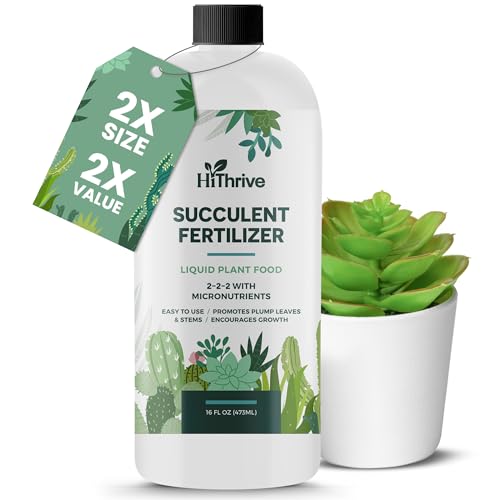
HiThrive positions itself as a high-output liquid option for growers with large collections, and the numbers back that up—the 16-ounce bottle mixes into a full 32 gallons of water, which translates to dozens of watering sessions for a shelf of echeverias, aloes, and jade plants. The formula includes macronutrients alongside calcium, magnesium, and zinc, covering the micronutrient base that many budget liquids skip. A half-cap (quarter teaspoon) per quart of water is the recommended dilution, applied every other watering during the active season.
Buyers consistently note that their succulents show deeper green color and plumper leaf turgor within two weeks of starting the regimen, and the pre-mixed concentrated liquid dissolves instantly with no sediment. The 32-gallon coverage makes this one of the most economical liquid fertilizers on the market per feeding event—ideal for growers who water twenty or more pots per session. It is specifically formulated for succulent growth rather than heavy-feeding tropicals, so the nutrient balance does not encourage the weak stretching that high-nitrogen feeds cause.
The main trade-off for precision feeders is that the NPK ratio is not printed as boldly on the marketing copy as some specialty brands provide, and the numbers lean slightly higher in nitrogen than the Schultz or Espoma options. For extremely sensitive cacti like aztekium or turbinicarpus, you might want to dilute to half the recommended strength to stay safe. The bottle’s flip-cap dispenser also makes it tricky to measure exactly a quarter teaspoon without a separate dropper.
Why it’s great
- Exceptional value—16 ounces makes 32 gallons of ready-to-use feed for large collections.
- Includes calcium, magnesium, and zinc for spine strength and chlorophyll health.
- Easy mix-and-pour routine works well for regular maintenance watering.
Good to know
- Nitrogen content may be slightly high for ultra-sensitive dwarf cacti.
- Measuring the small ¼ teaspoon dose accurately requires an extra dropper tool.
- Not certified organic; relies on synthetic mineral salts for nutrient delivery.
4. Grow Queen Complete Organic Cactus & Succulent Fertilizer
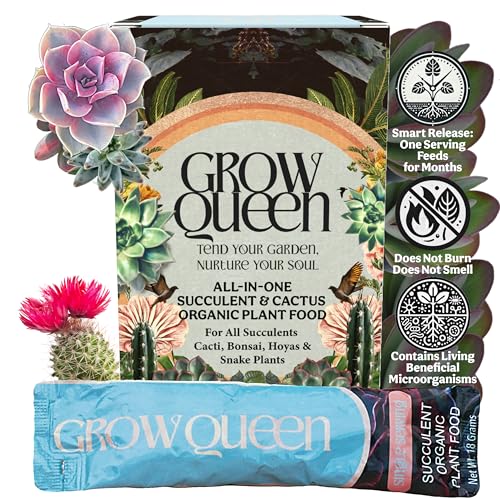
Grow Queen takes a fundamentally different approach from liquid fertilizers: each single-serving packet contains a dry blend of organic nutrients and live beneficial microbes that actively colonize the soil. One packet feeds up to one gallon of soil or six small succulents, and the slow-release action continues feeding for two to eight months depending on watering frequency and soil temperature. For cactus growers who dislike mixing liquids every watering, this set-and-forget system is a compelling alternative.
The organic ingredients are OMRI-listed and vegan, with no synthetic salts, so there is zero risk of fertilizer burn even if you apply a full packet to a small pot. Users report visible new growth on previously stagnant cacti within weeks, and the microbial activity creates healthy white filaments on the soil surface that indicate a thriving rhizosphere. It works particularly well for jade plants, snake plants, and Christmas cactus, and the mess-free pre-portioned packets eliminate measuring errors entirely.
A few caveats: the bioactive nature means you may see what looks like white mold on the soil surface after watering—this is harmless beneficial fungus doing its job, but it can alarm new growers. The packets also require the soil to be warm and slightly moist for the microbes to activate, so if your pots sit in a cool, dark corner, the release may be slower. With only seven packets per box, covering a large collection may require multiple purchases over the year.
Why it’s great
- Single-dose packets eliminate measuring and prevent over-fertilization entirely.
- Live beneficial microbes improve soil structure and immune response in roots.
- Organic, pet-safe, and odorless once mixed—ideal for indoor applications.
Good to know
- Bioactive fungi on the soil surface may be mistaken for mold by first-time users.
- Limited to 7 feedings per box; not the most economical choice for very large collections.
- Slow release depends on warm soil; less effective in cold or dormant periods.
5. Gardenera Plant Superfood Spray for Succulents & Cactus
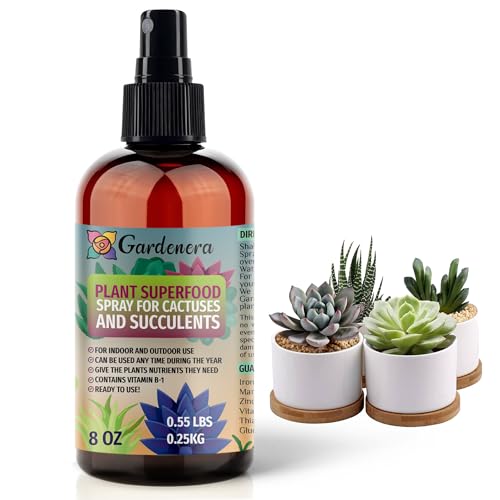
Gardenera offers an 8-ounce ready-to-use spray that delivers a fine mist directly to the stem and leaves rather than through soil drenching. The inclusion of Vitamin B-1 (thiamine) helps reduce transplant shock and encourages root initiation, while added glucose provides a quick energy source for metabolic processes. This approach is particularly useful for cuttings, newly potted offsets, or plants recovering from shipping stress—you can target the stem without soaking already-wet soil.
Users report that a few sprays on the base and leaves every nine to ten days noticeably brightens the green of their plants within a week. The spray format is also practical for treating a large number of small pots quickly, as you can cover multiple specimens in seconds. It is not a complete fertilizer in the traditional sense—the nutrient profile is designed to supplement rather than replace a balanced soil feed—so it works best as a weekly booster alongside a standard cactus fertilizer regimen.
The spray nozzle on some units can deliver an uneven mist or clog if not rinsed after use, and the 8-ounce bottle is small for frequent application across many plants. Since it is a foliar spray rather than a root drench, it does little to improve soil fertility or support the root microbiome. Over-reliance on foliar feeding can also lead to salt residue on the cactus skin, which may mar the appearance of smooth-bodied species like astrophytum.
Why it’s great
- Vitamin B-1 specifically aids root development after repotting or shipping stress.
- Quick foliar absorption shows visible greening within days for struggling plants.
- No mixing required—ready-to-use trigger spray reduces preparation time.
Good to know
- Spray nozzle may clog if not cleaned promptly after each use.
- Not a complete standalone feed; best used as a supplement to soil fertilizer.
- Leaves salt residue on cactus skin if over-applied without wiping.
FAQ
How often should I fertilize my cactus during the growing season?
Can I use regular houseplant fertilizer on my cactus in an emergency?
Why does my cactus look soft after I fertilized it?
Final Thoughts: The Verdict
For most users, the best cactus fertilizer winner is the Schultz Cactus Plus 2-7-7 because its low-nitrogen synthetic formula gives you precise control and fast results without the risk of organic smell or slow release. If you want an organic, pet-safe option that builds long-term soil health, grab the Espoma Organic Cactus! Plant Food. And for a hands-off, set-and-forget feeding system that works for months at a time, nothing beats the Grow Queen Organic Powder Packets.

Mo Maruf
I created WellFizz to bridge the gap between vague wellness advice and actionable solutions. My mission is simple: to decode the research and give you practical tools you can actually use.
Beyond the data, I am a passionate traveler. I believe that stepping away from the screen to explore new environments is essential for mental clarity and physical vitality.