Our readers keep the lights on and my smoothie glass nicely filled. As an Amazon Associate, I earn from qualifying purchases.
Finding a board game that genuinely works for a full table of eight is a different challenge than grabbing any box off the shelf. At this player count, the game needs to keep everyone engaged between turns, avoid long down-time, and offer a ruleset that scales without breaking. The difference between a great game night and a stalled evening often comes down to how well the game handles that eighth player.
I’m Mohammad Maruf — the founder and writer behind WellFizz. I’ve spent years analyzing board game mechanics, player-count scaling, and component quality to determine which games actually deliver when the table is full.
After reviewing dozens of options, I’ve narrowed down the strongest contenders in the board games for 8 players space, focusing on replayability, strategic depth, and the ability to keep a large group locked in from the first round to the final play.
How To Choose The Best Board Games For 8 Players
When the player count hits eight, the margin for error in game design shrinks. A game that works perfectly with four can feel glacial with eight if turn structure, elimination mechanics, or downtime aren’t built for the full group. Here is what to weigh before you buy.
Game Mechanic and Player Interaction
The mechanic dictates whether players are actively engaged during others’ turns. Cooperative games like Castle Panic keep everyone discussing and planning together, which eliminates the boredom of waiting. Traitor or negotiation games such as We’re Doomed! create constant social tension. Pure party games like Telestrations rely on quick, simultaneous action. Avoid games with extended individual turns or player elimination at high counts unless your group tolerates long pauses.
Game Length and Pacing
Eight-player games should rarely exceed 90 minutes on the box. A stated 45-minute playtime often stretches to an hour or more with a full table, especially if rules explanation is needed. Look for estimated playtimes under 60 minutes for party settings. Games like We’re Doomed! advertise 15-minute rounds, which allows multiple plays in a single evening and keeps momentum high.
Component Quality and Player Count Support
Check the included components closely. A game listing “2-8 players” may only include material for four or six, requiring separate purchases for the full experience. For tile-based games like Doreimi Rummy Cube, verify the tile count and rack quantity match eight players. Card-based games should have enough prompt cards to avoid repeat rounds in a single session. Physical item weight and box dimensions also matter — a game like Castle Panic with its 3D towers occupies significant table space.
Replayability and Variety
A game played once with eight becomes a one-night wonder if it lacks variable setups or expansion support. Look for games offering multiple scenarios, card decks with hundreds of prompts, or modular board tiles that change each session. Citadels and No Escape both use tile or card shuffling to ensure no two games play identically, which justifies the investment for regular groups.
Quick Comparison
On smaller screens, swipe sideways to see the full table.
| Model | Category | Best For | Key Spec | Amazon |
|---|---|---|---|---|
| Telestrations 8 Player 2nd Edition | Party Drawing | Hilarious group icebreaker | 2000+ card prompts with dry-erase books | Amazon |
| We’re Doomed! | Cooperative Survival | Fast-paced traitor style | 15-minute rounds for 4-10 players | Amazon |
| Citadels Revised Edition | Strategy Bluffing | Intrigue-laden card play | 27 unique character cards, 84 district cards | Amazon |
| No Escape | Traitor Maze | Dynamic tile-laying sabotage | Fluid board with unique tile-laying each game | Amazon |
| Castle Panic 2nd Edition | Cooperative Defense | Team-based tower defense | 3D towers, 45-minute co-op play for 1-6 | Amazon |
| SongFest! Music Trivia | Music Trivia | Generational music challenge | 1000 questions spanning 5 decades | Amazon |
| Doreimi Non-Transparent Rummy Cube | Tile Strategy | Classic tile-matching for all ages | 214 opaque tiles with 8 wooden racks | Amazon |
In‑Depth Reviews
1. Telestrations 8 Player 2nd Edition
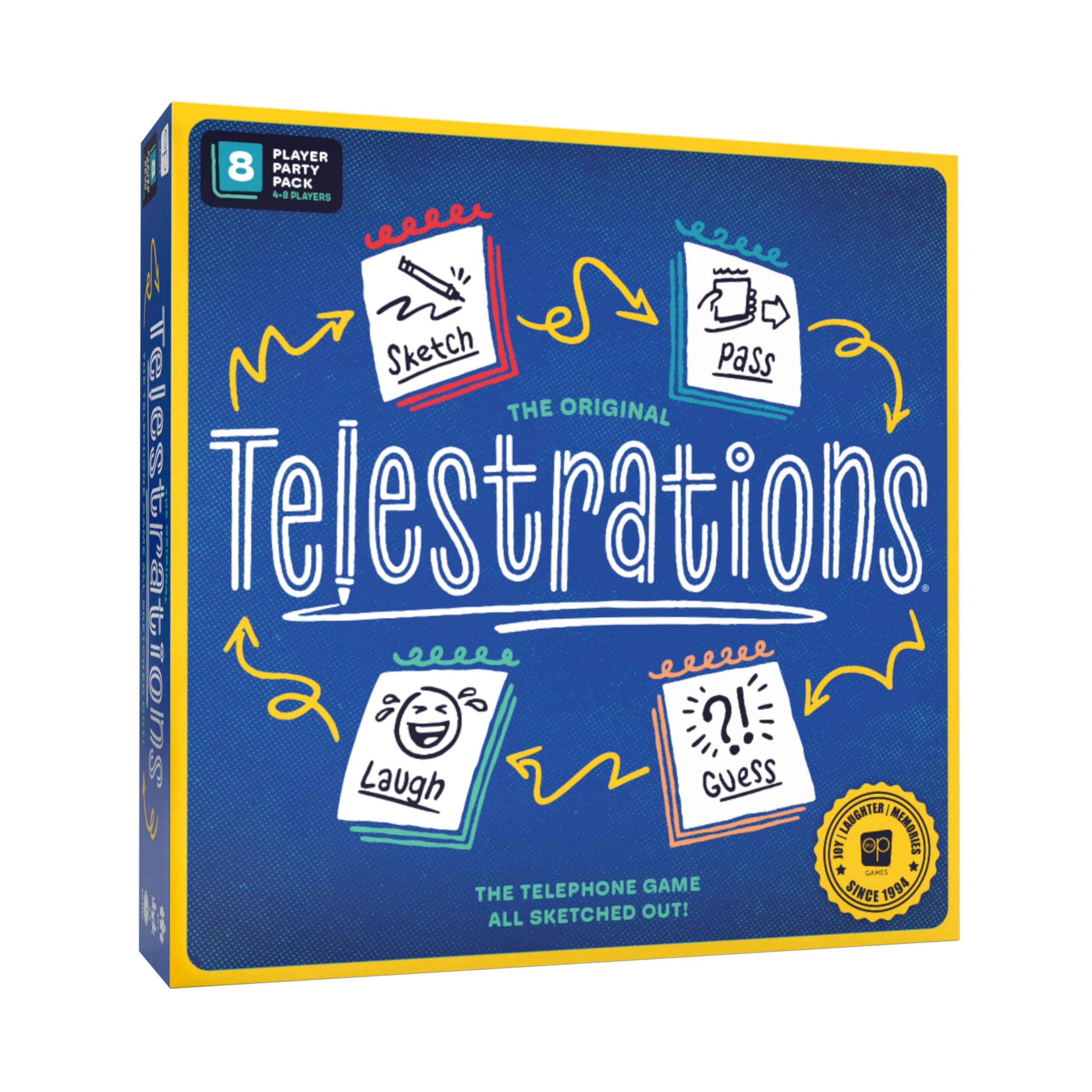
Telestrations is the gold standard for large-group party games because it completely neutralizes the biggest problem at eight players: downtime. Every player draws and guesses simultaneously, meaning no one sits idle waiting for a turn. The 2nd Edition ships with eight dry-erase sketchbooks and markers — one for each seat — plus 130 cards containing over 2,000 prompts, so you can play multiple rounds without repeating a word.
The game combines Pictionary with the childhood game of Telephone. Each player sketches a word, passes their book, and the next player guesses what they saw. That guess then becomes the next drawing instruction. By the fourth pass, the original word has transformed into something completely unrecognizable, and the comparisons at the end produce genuine laughter. The 2025 edition refreshed the prompt deck with contemporary phrases alongside classics, keeping the content relevant for mixed-age groups.
The physical quality holds up well under repeated use. The spiral-bound sketchbooks are thick enough to survive erasing and redrawing across dozens of games, and the dry-erase markers write cleanly without ghosting. The box footprint is a compact 10-inch square, leaving plenty of table room for snacks and drinks. If your group includes people who insist they cannot draw, this is actually the game for them — poor artistic skill is a feature, not a flaw.
Why it’s great
- Simultaneous play keeps all eight players engaged every round
- Over 2,000 prompts ensure high replayability across multiple game nights
- No artistic talent required — bad drawings make the game funnier
Good to know
- Younger children under 8 may struggle with reading prompts quickly
- Some prompts may feel repetitive after very frequent play sessions
2. We’re Doomed! Apocalypse Survival Board Game

We’re Doomed! is built specifically for the 8-player sweet spot — its player range goes up to ten, which means at eight you have exactly the right tension between cooperation and betrayal. The premise is simple: the world is ending, and players must build a rocket together while secretly jockeying for one of the limited escape seats. The 15-minute sand timer creates genuine urgency, forcing quick decisions and fast negotiations.
The core loop revolves around contributing resources to the shared rocket project while also earning personal influence. The higher your influence, the more likely you are to secure a seat when the final launch happens. Event cards introduce chaos — one player might get nuked out of the game, a resource pile may be stolen, or a sudden alliance shifts the balance. The game explicitly rewards social maneuvering over pure strategy, making it ideal for groups that enjoy bluffing and backstabbing.
Setup takes less than two minutes, and the rules fit on a single sheet, so new players can jump in without a lengthy explanation. The box is compact enough to bring to a bar or a friend’s house. The one caveat is that quieter players may be at a disadvantage — the game rewards loud negotiation and active table talk. For a group that loves social deduction with a ticking clock, this is a top-tier pick.
Why it’s great
- Fast 15-minute rounds allow multiple plays in one session
- Traitor and sabotage mechanics keep every round unpredictable
- Easy rules mean eight players can start playing immediately
Good to know
- Quiet or reserved players may feel overshadowed by aggressive negotiators
- The constant timer can feel stressful for groups seeking a relaxed pace
3. Citadels Revised Edition

Citadels is a classic of tabletop strategy that scales elegantly to eight players by using a simultaneous character-selection phase followed by turn-based actions. The Revised Edition condenses the original into a travel-friendly box without cutting content — it includes all 27 character cards from the game’s history, along with 84 district cards, 22 plastic gold coins, and a sculpted plastic crown. The mechanics: each round, players secretly select a character (Assassin, Thief, Architect, etc.) that grants unique abilities and determines turn order. Choosing wisely requires reading the table.
At eight players, the bluffing layer deepens because more characters are in play but not all are revealed. The Assassin targets a character type, the Thief steals gold from another, and the Warlord destroys districts. The combination of hidden roles and resource management creates a tight puzzle where every gold coin matters. The game plays in roughly 30-60 minutes, but with eight new players, expect the first round to take longer as everyone learns the character abilities.
Revised Edition also includes preset scenario cards for quick setup and reference cards that clearly outline each character’s power and turn-order position. The cardstock is sturdy with a linen-finish texture that resists wear, and the gold coins are chunky plastic tokens that feel satisfying to stack. If your group enjoys games like The Resistance or Bang! for their hidden-role tension but wants more economic strategy, Citadels delivers that blend with exceptional polish.
Why it’s great
- Simultaneous character selection reduces downtime even at eight players
- 27 characters and 84 district cards create massive variety between sessions
- Revised Edition includes all previously published content in one box
Good to know
- New players face a moderate learning curve memorizing character abilities
- Game length can stretch past 60 minutes with a full table of newcomers
4. No Escape Board Game

No Escape combines tile-laying, traitor mechanics, and maze navigation into a single game that plays 2-8 players but shines brightest at the upper end. The premise: players are trapped on a space station and must navigate through a shifting tile maze to reach escape pods — but some players may be saboteurs secretly working against the group. The board is built dynamically each game by placing tiles face-down, so the layout is never the same twice.
The strategic depth comes from balancing movement speed against exploration risk. Revealing a tile could open a shortcut to the exit or trigger a trap that sets your character back. The saboteur player has their own win condition — they win if the station collapses with survivors still inside. This dual-win structure forces constant paranoia and table talk. At eight players, the saboteur role is almost always in play, and the tension remains high from the first tile flip to the final escape.
Component quality is solid: tiles are thick cardboard with clear iconography, the dice are standard but responsive, and the meeples are distinct enough to track at a crowded table. The box measures 11.5 x 9 x 3 inches, and the included insert keeps everything organized. Setup is under five minutes, and the ruleset is simple enough that a quick walkthrough gets everyone playing. The one variable is game length — rounds can last anywhere from 15 minutes to 90 minutes depending on player decisions and luck in tile draws.
Why it’s great
- Fluid tile board ensures no two games are ever the same layout
- Saboteur mechanic adds social deduction depth on top of maze strategy
- Plays well across a wide player range with balanced scaling
Good to know
- Game length can vary significantly based on luck and player choices
- Two-player mode is noticeably less engaging than the full group
5. Castle Panic 2nd Edition

Castle Panic is a cooperative tower-defense board game where players work together to defend Castle Bravehold from waves of invading monsters. The official player count is 1-6, but the cooperative nature of the game means you can easily rotate teams or play in pairs, making it a strong candidate for larger gatherings where the focus is on shared strategy rather than head-to-head competition. The 2nd Edition ships with 3D towers, vibrant monster tokens, and an illustrated board that immediately draws attention on the table.
Gameplay revolves around card trading and coordinated defense. Each player holds a hand of cards representing archers, swordsmen, and cavalry positioned in three concentric rings around the castle. Monsters spawn in the outer ring and advance inward each turn. Players must trade cards to get the right attacks in the right zones, then decide collectively whether to focus on a single strong monster or spread damage across multiple threats. Boss monsters, plague cards, and boulders add chaos that forces real-time discussion and planning.
Four game modes (Co-op, Solo, Master Slayer competitive, and Overlord where one player controls the monsters) extend replayability significantly. Each mode shifts the dynamic in ways that feel distinct. The base game plays in about 45 minutes, and the box includes enough cards and tokens for meaningful variety across at least a dozen sessions. If your group prefers collaborative problem-solving over competition and includes younger players, Castle Panic’s simple rules and high engagement make it a reliable choice.
Why it’s great
- Cooperative structure keeps all players actively discussing and planning together
- Four game modes provide excellent replayability beyond the base scenario
- 3D towers and vivid components create strong table presence for game night
Good to know
- Officially supports up to 6 players, so 8-player groups need team play
- More experienced gamers may find the strategic depth limited over time
6. SongFest! Music Trivia Party Game

SongFest! turns game night into a music experience spanning five decades of hits. It supports 2-12 players, meaning a full table of eight is well within its comfort zone, and the 1,000 challenge questions cover the 1970s through today across four distinct categories. The standout feature is the QR code system: when players are stuck on a question, they can scan a code to hear a song hint instantly. This fixes the biggest problem with music trivia games — requiring everyone to know every song by memory alone.
The game includes a physical box with cards sorted by decade, allowing groups to customize which eras they want to play. This is especially useful for multi-generational gatherings where the 70s and 80s crowd may not know recent Top 40 hits, and younger players may not recognize classic rock. The QR hints bridge that gap by playing the actual song clip, which often triggers immediate recognition even if the title or artist escapes you. The phrasing “spontaneous singing may break out” is accurate — multiple rounds inevitably devolve into full-table singalongs.
One pattern noted in repeated play is that certain songs appear across multiple questions, which can reduce variety after several sessions. The song selection also leans slightly country-heavy, with less representation from rock and alternative genres. However, for a game priced in the entry-level tier, the production quality is solid: cards are printed on standard-weight stock with clear text, and the box dimensions (9.75 x 4.8 inches) are compact enough for easy storage. If your group loves music and wants a trivia game that accommodates varying knowledge levels, SongFest! delivers reliable fun.
Why it’s great
- QR code song hints level the playing field between music knowledge levels
- Decade-selectable cards allow customization for multi-generational groups
- Supports up to 12 players, easily accommodating a full table of eight
Good to know
- Some songs repeat across multiple question cards over repeated sessions
- Country-heavy track list may not appeal to rock and alternative fans
7. Doreimi Non-Transparent Rummy Cube Game Set

Doreimi’s Rummy Cube set is the only option in this guide that is explicitly designed and packaged for eight players right out of the box. It includes 208 rummy tiles (plus 4 jokers and 2 spare jokers), 8 wooden racks with anti-slip felt bottoms, a dice, and a booklet-style manual. The tiles are made of non-transparent BPA-free melamine — a critical spec for Rummy Cube, since transparent tiles would allow opponents to read your hand from across the table. The numbers are clearly embossed and printed in sharp contrast for easy readability.
The wooden racks are the standout component here. Each rack has a 3-slot design that keeps tiles organized during play, and the felt-bottomed feet prevent sliding and scratching on wooden tables. At 4.6 pounds, the full set has a satisfying heft that signals quality, and the included carrying case stores both the racks and the tiles for transport. The drawstring bag makes tile collection and randomization fast, which matters when resetting between rounds with eight players eager to start the next game.
Rummy Cube itself is a classic tile-matching game combining strategy and luck — players draw tiles, form runs and sets, and try to empty their rack before opponents. The Doreimi set accommodates 6-8 players comfortably, though at eight players the game pace slows slightly as each player manages a larger hand of tiles. The included guide walks through rules step-by-step, making this accessible for first-timers. If your group prefers a quieter, more methodical game over loud party antics, this set delivers premium feel at a reasonable component count.
Why it’s great
- Eight wooden racks included — no need for separate purchases to play at full count
- Non-transparent tiles prevent opponents from reading your hand during play
- Felt-bottomed racks protect table surfaces and stay stable during gameplay
Good to know
- At 4.6 pounds, the set is heavier than most board games for travel
- Game pace slows noticeably with the maximum eight-player count
FAQ
What type of board game works best for a group of eight people who don’t all know each other?
Can I play a 2-6 player game with eight people?
How important is non-transparent tile quality in Rummy Cube games?
Final Thoughts: The Verdict
For most groups, the board games for 8 players winner is the Telestrations 8 Player 2nd Edition because it eliminates downtime, scales perfectly for eight players without extra purchases, and generates genuine laughter regardless of skill level. If you want a game driven by negotiation and betrayal with fast rounds, grab the We’re Doomed!. And for a classic tile-matching experience that supports eight players out of the box, nothing beats the Doreimi Non-Transparent Rummy Cube Set.

Mo Maruf
I created WellFizz to bridge the gap between vague wellness advice and actionable solutions. My mission is simple: to decode the research and give you practical tools you can actually use.
Beyond the data, I am a passionate traveler. I believe that stepping away from the screen to explore new environments is essential for mental clarity and physical vitality.