Our readers keep the lights on and my smoothie glass nicely filled. As an Amazon Associate, I earn from qualifying purchases.
The leap from smartphone footage to a dedicated camera for YouTube is the single biggest quality jump most creators ever make. You trade computational shortcuts for a larger sensor, interchangeable lenses, and tools like real-time eye-tracking autofocus and mechanical stabilization that no phone can replicate. The challenge isn’t finding a camera—it’s picking the right sensor size, lens mount, and feature set that actually serves your specific content style without wasting budget on specs you won’t use.
I’m Mohammad Maruf — the founder and writer behind WellFizz. Ive spent years analyzing sensor performance, codec support, autofocus systems, and real-world battery life to help creators match hardware to their actual workflow.
Whether you’re filming sit-down tutorials, run-and-gun vlogs, or cinematic B-roll, the right tool eliminates technical friction and lets you focus on storytelling. This guide cuts through the noise to deliver the definitive best cameras for youtube across every budget and use case.
How To Choose The Best Cameras For YouTube
Picking the right YouTube camera means balancing sensor performance, autofocus reliability, audio connectivity, and in-body stabilization against your specific filming style. A sit-down tech reviewer has completely different needs than a travel vlogger or a cinematic filmmaker. Knowing which spec trade-offs to accept—and which are non-negotiable—prevents buyer’s remorse.
Sensor Size and Low-Light Performance
The sensor is the heart of the camera. A larger sensor (full-frame or APS-C) collects more light, producing cleaner footage with less noise in dim interiors or evening street scenes. Full-frame sensors also deliver shallower depth of field, giving you that blurred-background “cinematic” look naturally. However, APS-C sensors (sometimes called Super 35) offer a sweet spot: they’re smaller and cheaper but still vastly outperform the 1-inch sensors found in compact cameras. If you film predominantly in well-lit studios, a 1-inch sensor is perfectly capable. For low-light versatility, prioritize APS-C or larger.
Autofocus System
For a solo creator filming themselves, autofocus reliability is arguably more important than resolution. Phase-detection autofocus (PDAF) with real-time eye tracking keeps you sharp as you move around the frame, gesture, or hold up products. Hybrid systems that combine contrast detection and phase detection are common, but dedicated eye/face/subject tracking—where the camera locks onto a person’s eye and stays there—is what separates consumer from pro-level gear. Sony and Canon lead here, with Nikon and DJI’s ActiveTrack close behind.
Stabilization: IBIS vs Electronic vs Gimbal
Shaky footage is the fastest way to look amateurish. Three stabilization methods exist. In-body image stabilization (IBIS) moves the sensor to counteract your hand movement—it’s the gold standard for handheld walking shots. Electronic stabilization crops the frame and uses software to smooth motion, which works but reduces your field of view and can introduce jello effect in fast pans. A mechanical gimbal (either built-in like DJI’s or third-party) offers the smoothest result but adds bulk and setup time. If you film 80% handheld, prioritize IBIS.
Codec, Bitrate, and Color Depth
The codec determines how your video is compressed. 8-bit 4:2:0 (common in consumer cameras) produces banding in gradients like skies or skin tones. 10-bit 4:2:2 captures far more color information, giving you room to grade in post without artifacts. File formats like Apple ProRes and Blackmagic RAW preserve the most data but require fast storage and powerful editing hardware. If you color grade, 10-bit is critical. If you deliver straight out of camera, 8-bit is fine. Also check bitrate—higher numbers (100+ Mbps for 4K) mean less compression and cleaner detail.
Quick Comparison
On smaller screens, swipe sideways to see the full table.
| Model | Category | Best For | Key Spec | Amazon |
|---|---|---|---|---|
| DJI Osmo Pocket 3 Creator Combo | Compact Gimbal | All-in-one vlogging with smooth tracking | 1″ CMOS, 3-Axis Gimbal | Amazon |
| DJI Osmo Nano Standard Combo | Action Cam | Compact POV and action vlogging | 1/1.3″ Sensor, 200-min Battery | Amazon |
| Nikon Z 30 + 16-50mm | Mirrorless APS-C | Beginner-friendly studio and vlogging | 4K UHD, Eye-AF for Pets | Amazon |
| Canon EOS R50 Kit | Mirrorless APS-C | Entry-level hybrid with social-ready tools | Oversampled 4K, Dual Pixel AF II | Amazon |
| Sony Alpha ZV-E10 | Mirrorless APS-C | Vlogging with product showcase mode | 24.2MP APS-C, 4K from 6K | Amazon |
| Canon EOS RP + 24-105mm | Full-Frame Mirrorless | Travel and hybrid shooting | Full-Frame 26.2MP, 5-Stop IS | Amazon |
| Nikon Z50 II Two-Lens Kit | Mirrorless APS-C | Versatile two-zoom kit for creators | 4K/60p, 31 Built-in Presets | Amazon |
| Canon EOS R7 Body | Mirrorless APS-C | High-speed sports and action content | 32.5MP, 30fps Electronic, IBIS | Amazon |
| Blackmagic Pocket Cinema 4K | Cinema Camera | Professional interview and documentary | 4/3″ Sensor, 13 Stops DR | Amazon |
| Sony FX30 Cinema Line | Cinema Camera | Cinematic 6K oversampled production | Super 35, Dual Base ISO | Amazon |
| Blackmagic Pocket Cinema 6K G2 | Cinema Camera | Professional filmmaking with RAW workflow | Super 35, 6K Native, 13 Stops | Amazon |
In‑Depth Reviews
1. DJI Osmo Pocket 3 Creator Combo

The Osmo Pocket 3 Creator Combo is the single most polished all-in-one vlogging solution available. Its 1-inch CMOS sensor captures 4K footage at 120fps with noticeably better dynamic range than smartphone sensors, while the built-in 3-axis mechanical gimbal delivers genuinely smooth handheld walking shots without any electronic crop. The 2-inch rotatable touchscreen flips out for selfie framing and automatically switches between horizontal and vertical orientation—a killer feature for creators who cross-post to YouTube and Shorts simultaneously.
ActiveTrack 6.0 locks onto your face and keeps you centered even as you move around the frame, making it feel like you have a dedicated camera operator. The included DJI Mic 2 transmitter pairs via OsmoAudio for pristine wireless sound, and the Creator Combo adds a wide-angle lens, battery handle, mini tripod, and carrying bag—everything you need out of the box. Stereo recording also captures quality ambient audio for B-roll scenes.
The compact form factor disappears into a jacket pocket, meaning you’ll actually carry it daily instead of leaving a mirrorless body at home. The moving gimbal head is more fragile than a solid-body action cam, so you need to handle it with care. Battery life sits around 166 minutes with the handle, though intensive 4K/120fps recording pulls it down faster.
Why it’s great
- Built-in 3-axis mechanical gimbal for smooth handheld footage without crop.
- Rotatable 2-inch touchscreen switches between horizontal and vertical shooting.
- ActiveTrack 6.0 keeps subject centered during movement.
- Included DJI Mic 2 delivers broadcast-quality wireless audio.
Good to know
- Moving gimbal is less durable than a fixed-body action camera.
- Electronic zoom is limited to 2x; optical zoom is not available.
- Battery handle is needed for all-day shoots without recharging.
2. DJI Osmo Nano Standard Combo (128GB)
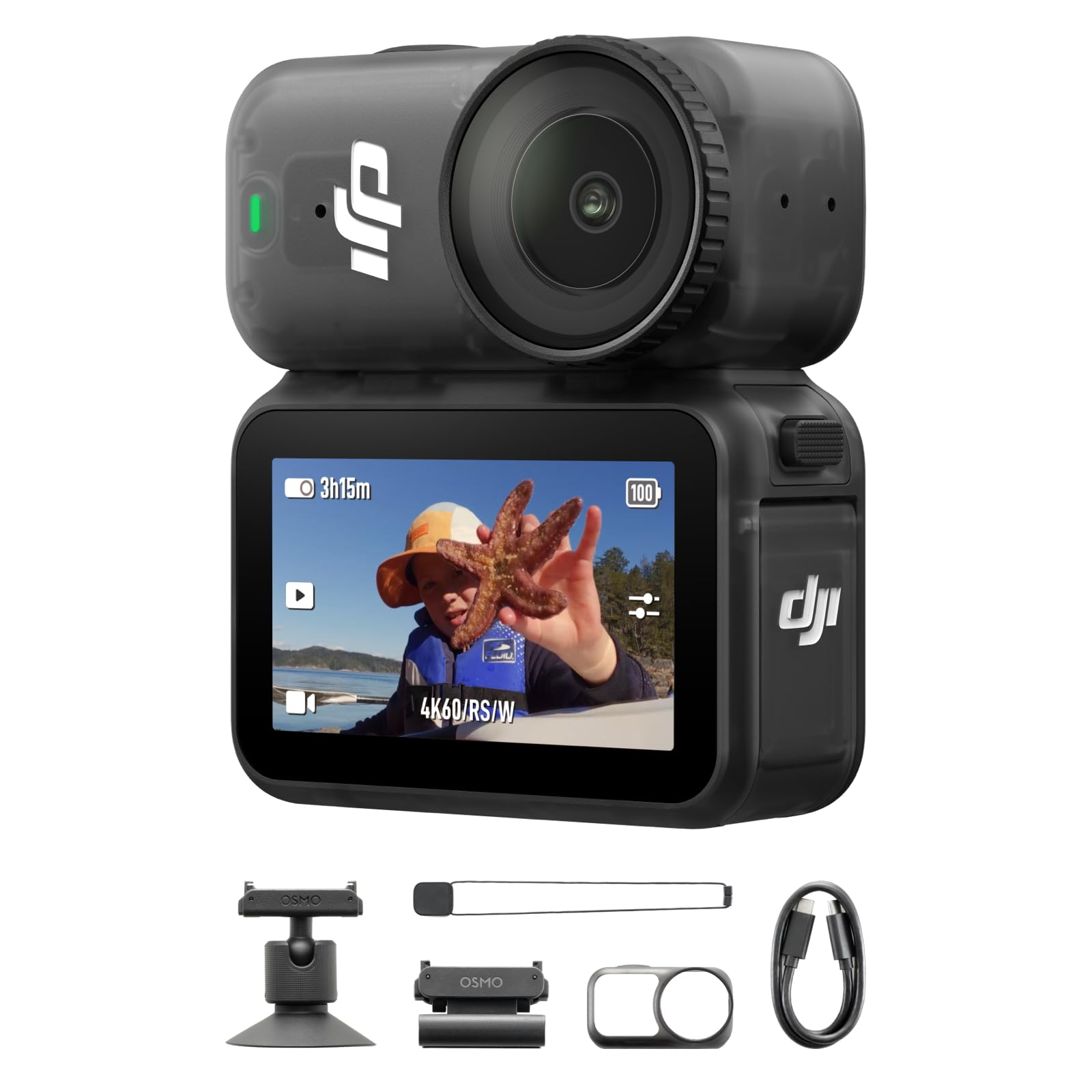
The DJI Osmo Nano shrinks the action cam form factor down to an almost absurdly small 56-gram package without sacrificing footage quality. Its 1/1.3-inch sensor records 4K/60fps video with a 143-degree ultra-wide field of view, making it ideal for immersive POV vlogs, pet adventures, or hands-free chest-mount footage. The magnetic mounting system means you can attach it to a hat clip, lanyard, or ball-joint adapter in seconds—no screwing around with cages or cold shoes.
10-bit D-Log M color profiles capture over a billion colors, giving you real grading latitude that’s unexpected in a camera this tiny. The Vision Dock extends battery life to around 200 minutes total and the built-in 128GB storage means you can start recording immediately. Underwater shooting is supported down to 10 meters without a housing, and the IPX4 splash rating provides peace of mind in light rain.
You trade that tiny size for a learning curve—there’s no viewfinder and minimal buttons, so you navigate menus through the DJI Mimo app or rely on auto mode. The Vision Dock battery drains noticeably even when idle, so you’ll want to detach it between shoots. High-resolution recording triggers internal heat protection that stops recording during long takes unless you enable Endurance Mode.
Why it’s great
- Ultra-compact 56g design with magnetic mounting for versatile POV placement.
- 128GB built-in storage lets you shoot immediately out of the box.
- 10-bit D-Log M color provides grading flexibility beyond typical action cams.
- Waterproof to 10m without external housing.
Good to know
- No built-in screen; relies on app or auto mode for framing.
- Vision Dock battery drains while idle—requires manual disconnection.
- Overheat protection may interrupt long 4K sessions without Endurance Mode.
3. Nikon Z 30 with 16-50mm Zoom Lens

The Nikon Z 30 is purpose-built for the creator who is ready to leave smartphone territory but isn’t ready to memorize a 400-page manual. Its APS-C sensor paired with the 16-50mm retractable zoom lens delivers 4K video with proper depth of field and low-light capability that immediately outpaces any phone. The flip-out touchscreen doubles as a selfie monitor with a red REC tally light, so you always know when you’re rolling.
Autofocus with eye tracking for both people and pets works reliably—especially useful for lifestyle vloggers who include their dogs or cats in content. The built-in stereo microphone includes adjustable sensitivity, and the USB-C connection allows plug-and-play webcam operation in Full HD 60p for live streaming without capture cards. Unlimited recording time means you never hit a 30-minute wall during long sit-down videos or streams.
The lack of a built-in viewfinder is a compromise—you’ll rely entirely on the rear screen, which can be tough in bright sunlight. The 16-50mm kit lens is versatile but maxes out at f/6.3 at the telephoto end, limiting low-light performance compared to a fast prime. For users who want to grow, the Z lens ecosystem is still smaller than Sony or Canon’s third-party options.
Why it’s great
- Excellent entry-level 4K mirrorless with intuitive controls and flip-out screen.
- Unlimited 4K recording time—no 30-minute limit.
- Eye-tracking autofocus works reliably on people and pets.
- USB-C webcam mode for easy streaming without extra hardware.
Good to know
- No built-in electronic viewfinder—screen-only composition.
- Kit lens aperture limits low-light performance at the telephoto end.
- Z lens ecosystem is still smaller than competing mounts.
4. Canon EOS R50 Kit + 18-45mm Lens
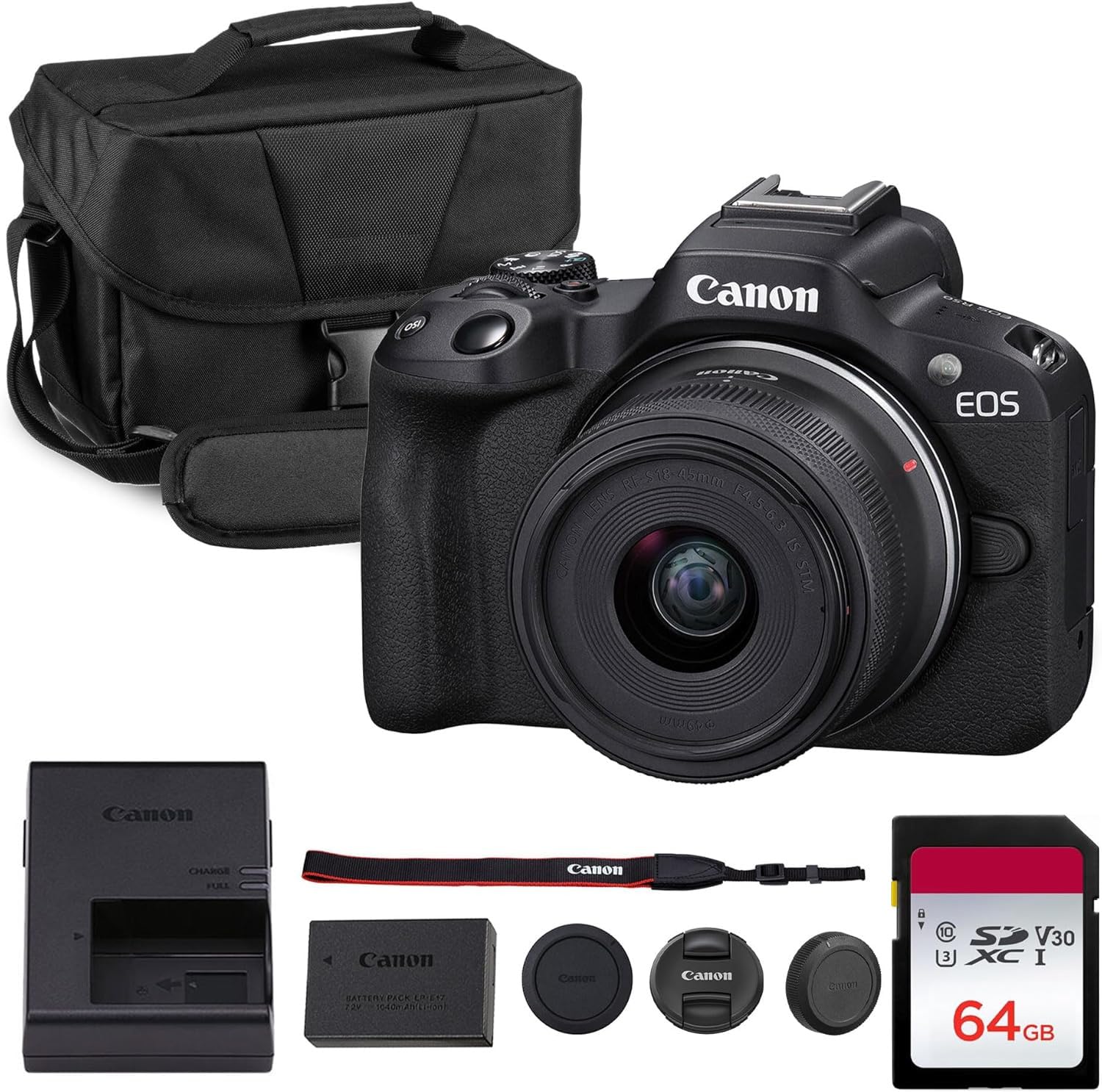
The Canon EOS R50 is the most beginner-friendly YouTube camera in this lineup, and that’s exactly its superpower. Oversampled 4K from a 24.2MP APS-C sensor delivers sharp, artifact-free video that punches well above its tier. Dual Pixel CMOS AF II provides reliable face and eye detection that sticks to subjects even when they turn their head or move closer to the lens—critical for dynamic vlog content where you’re constantly shifting position.
Creative Assist mode adds in-camera guides that help new users understand exposure and color without needing to learn manual mode right away. The vari-angle touchscreen flips out to the side, giving you a clear selfie view even when the camera is mounted on a tripod close to your face. Vertical video capture and social-ready aspect ratios save you a post-processing step when cutting for YouTube Shorts.
The kit lens aperture range (f/4.5-6.3) is the weakest link—it needs good studio lighting to avoid noise. The camera body doesn’t include a built-in flash, which limits fill light options without an external unit. The included shoulder bag and 64GB SD card make it a true start-shooting kit, but serious creators will want a faster prime lens soon.
Why it’s great
- Oversampled 4K video with excellent Dual Pixel AF II tracking.
- Vari-angle touchscreen makes selfie framing easy on a tripod.
- Creative Assist helps beginners understand exposure without manual mode stress.
- Vertical video and social-ready tools streamline Shorts creation.
Good to know
- Kit lens aperture (f/4.5-6.3) requires good lighting for clean footage.
- No built-in flash—relies on hotshoe for external strobes.
- Battery life is average; expect to carry a spare for full-day shoots.
5. Sony Alpha ZV-E10
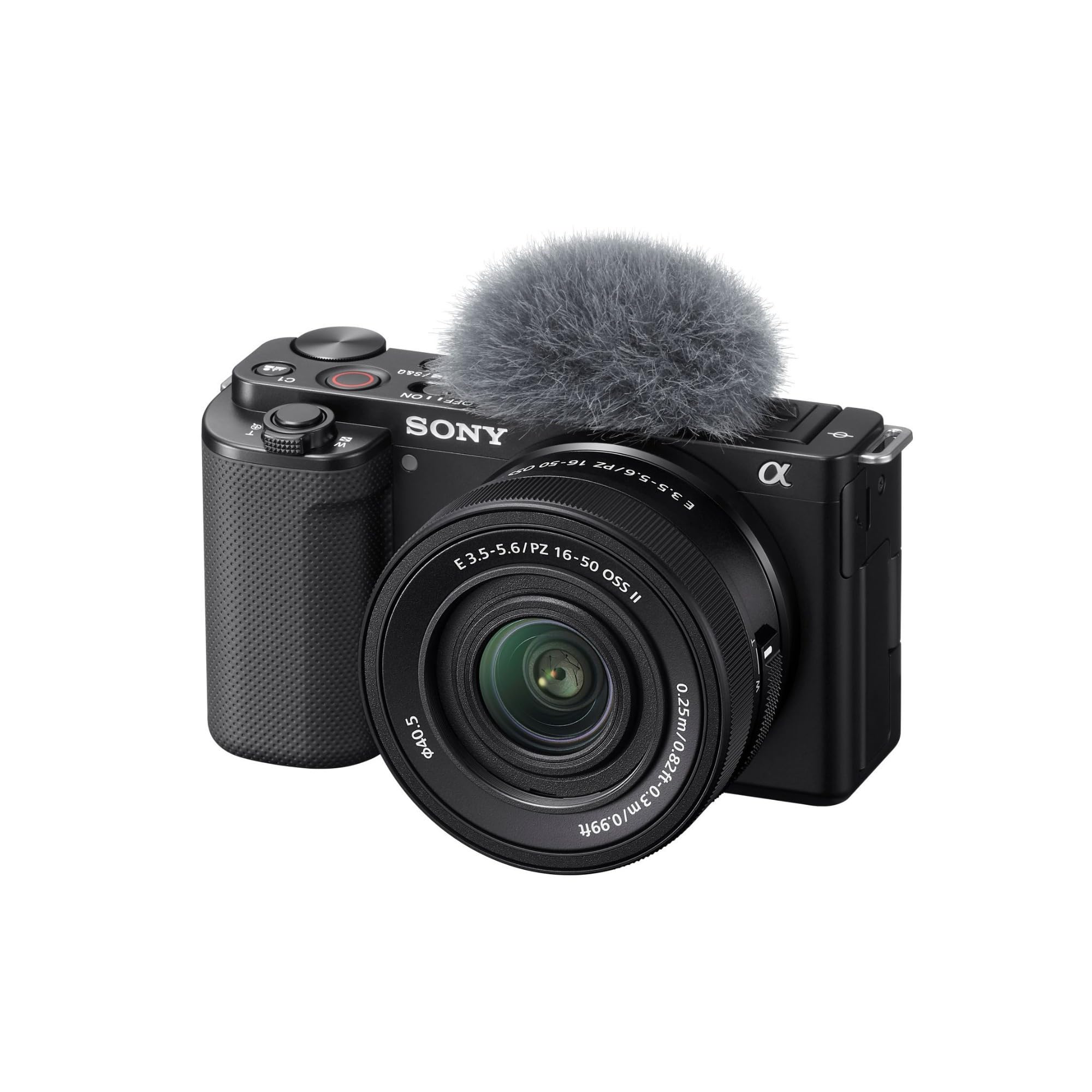
The Sony ZV-E10 has become a de facto standard for vloggers and the updated version carries that torch forward with meaningful refinements. Its 24.2MP APS-C Exmor CMOS sensor shoots 4K oversampled from a 6K readout, delivering exceptional detail and color with no pixel binning artifacts. The Background Defocus button instantly toggles between a blurred bokeh look and a sharp wide-depth scene—one of the most practical quick-switch controls for product review channels.
Product Showcase Setting automatically transitions focus from your face to an object held near the lens, then back to your face when you lower it. That single feature solves the single biggest headache for tech and beauty reviewers who constantly switch between talking head and item close-ups. The E PZ 16-50mm power zoom lens is compact but motorized, allowing smooth zooms during recording.
The microSD card slot is an odd downgrade compared to full-size SD slots found on rivals. The battery life is adequate for short shooting sessions but will need replacement for half-day productions. The lack of in-body stabilization means you’ll rely on electronic stabilization (which crops the frame) or an external gimbal for smooth handheld walking footage.
Why it’s great
- 4K oversampled from 6K readout for superior detail and no aliasing.
- Product Showcase Setting automates face-to-object focus transitions.
- Background Defocus button provides instant bokeh toggle without menu diving.
- Compact and lightweight body with clear vlogger-first ergonomics.
Good to know
- Uses microSD cards instead of standard full-size SD cards.
- No in-body stabilization—relies on electronic crop or external gimbal.
- Battery life is modest; a spare is recommended for longer shoots.
6. Canon EOS RP + RF24-105mm Lens

The Canon EOS RP is the most affordable entry point into full-frame mirrorless photography and video, and for YouTube creators who prize sensor performance, that matters. The 26.2MP full-frame sensor delivers markedly better low-light performance and shallower depth of field than any APS-C camera at this price tier. The RF 24-105mm f/4-7.1 IS STM kit lens includes optical stabilization rated at up to 5 stops of shake correction, making handheld shots genuinely usable without a gimbal.
Face-detecting autofocus in 1080p mode is snappy and reliable, perfect for sit-down talking head content where you stay roughly in one spot. The 1080p footage itself is clean and detailed—enough for most YouTube formats. The compact and lightweight construction (for a full-frame) makes it a strong travel companion, and compatibility with Canon’s entire RF and EF lens lineup via adapter means near-infinite upgrade potential.
The 4K mode has limitations: it introduces a significant crop factor, lacks Dual Pixel AF, and includes a 30-minute recording limit. Full-frame sensors also benefit from fast, expensive glass to realize their full potential. The kit lens at f/7.1 on the telephoto end is slow, so you’ll want a faster prime for interior shooting without cranking ISO.
Why it’s great
- Full-frame sensor delivers superior low-light and depth-of-field at entry-level pricing.
- RF 24-105mm kit lens includes 5-stop optical stabilization.
- Extensive lens compatibility via RF and EF mount with adapter.
- Compact and lightweight body for a full-frame mirrorless.
Good to know
- 4K mode has a crop factor and no Dual Pixel AF—use 1080p instead.
- 30-minute recording limit in 4K; unlimited in 1080p.
- Kit lens is slow at the telephoto end; faster primes recommended for interiors.
7. Nikon Z50 II Two-Lens Kit

The Nikon Z50 II starts with a 20.9MP APS-C sensor that’s physically larger than typical smartphone sensors, and the two-lens kit covers nearly every focal length a YouTube creator needs. The 16-50mm f/3.5-6.3 VR handles wide-angle vlogging and general walkaround footage, while the 50-250mm f/4.5-6.3 VR gives you telephoto reach for detail shots, compressed backgrounds in interviews, or wildlife content. Both lenses include vibration reduction for handheld use.
The 31 built-in Picture Control presets let you dial in a specific look—cinematic, muted, high-contrast—without any post-grading. Real-time preview as you shoot means what you see is what the final video looks like, speeding up delivery for creators who don’t want to color grade. Autofocus automatically detects nine subject types including people, dogs, cats, birds, and vehicles, with dedicated bird and airplane modes for greater accuracy.
You get 4K UHD at 60p and in-camera Full HD slow motion at 120p, which is solid for this price tier. The electronic VR stabilization works for casual handheld use but introduces a crop—walking shots are smoother with a gimbal. The flip-out LED screen is bright but drains battery noticeably. Only one battery is included in the box, so budget for extras if you shoot all day.
Why it’s great
- Two-lens kit covers 16-250mm equivalent for versatile framing options.
- 31 built-in Picture Control presets for instant in-camera looks without grading.
- Subject detection autofocus for people, pets, birds, and vehicles.
- 4K/60p and 1080p/120p slow motion support.
Good to know
- Electronic VR crops the frame; best results still come from a gimbal.
- Flip-out screen drains battery noticeably during extended use.
- Only one battery included; spares are recommended for full-day shoots.
8. Canon EOS R7 Body

The Canon EOS R7 is an APS-C powerhouse that brings professional-grade speed and stabilization to the semi-pro creator. Its 32.5MP sensor captures 4K video oversampled from the full sensor width, and the 5-axis in-body image stabilization (IBIS) allows smooth handheld walking footage without a gimbal. The coordinated control IS combines IBIS with lens-based stabilization for even more effective shake cancellation in darker environments.
Dual Pixel CMOS AF II covers approximately 100% of the frame width and height with up to 651 AF zones, so autofocus performance is sticky and confident even with fast-moving subjects. The mechanical shutter fires at 15 fps and the electronic shutter hits 30 fps, making it ideal for creators who film action sports, product launches, or quick-moving demonstrations. The RAW Burst Mode with pre-shooting captures the half-second before you fully press the shutter, ensuring you never miss a moment.
The body-only configuration means you need to budget for a lens separately—the RF-S lens lineup is still growing, though an EF-to-RF adapter opens up thousands of older Canon lenses. The battery life is excellent for a mirrorless, and the dual card slots (SD UHS-II) provide backup or overflow recording. There is no built-in flash, and the R7’s higher-resolution sensor demands high-quality glass to resolve its full potential.
Why it’s great
- 5-axis IBIS delivers gimbal-smooth handheld footage without external gear.
- 30fps electronic shutter and RAW Burst with pre-shooting for action sequences.
- Dual Pixel CMOS AF II with 651 zones tracks subjects across the entire frame.
- Excellent battery life and dual UHS-II card slots for extended shooting.
Good to know
- Body-only purchase requires a separate lens—RF-S lenses are limited.
- 32.5MP sensor demands high-quality glass to resolve its full detail.
- No built-in flash—relies on the hotshoe for external lighting.
9. Blackmagic Pocket Cinema Camera 4K

The Blackmagic Pocket Cinema Camera 4K is a true cinema camera at a price that undercuts most mirrorless bodies. Its 4/3-inch image sensor with native 4096 x 2160 resolution and 13 stops of dynamic range captures highlight and shadow detail that consumer cameras simply cannot reproduce. Dual native ISO up to 25,600 keeps noise minimal in low-light studio or interview settings. The MFT lens mount gives you access to a huge ecosystem of affordable Micro Four Thirds glass, plus vintage lenses with adapters.
Recording options are professional-grade: Apple ProRes up to 4K and 12-bit Blackmagic RAW, which retain maximum grading flexibility. You can record to SD/UHS-II, CFast 2.0, or external SSD via USB-C—the SSD route offers the cheapest storage per gigabyte. The included DaVinci Resolve Studio activation key gives you a full post-production pipeline without additional software costs. The large 5-inch LCD display eliminates the need for an external monitor in most setups.
There is no continuous autofocus, no in-body stabilization, and no flip-out screen—you are shooting fully manual with manual lenses or relying on single AF with compatible glass. Battery life is roughly 30 minutes per LP-E6 pack, so external power via a V-mount battery or USB-C PD is effectively required for any real production. It is designed for tripod or gimbal use, not casual handheld vlogging.
Why it’s great
- 13 stops of dynamic range and dual native ISO for cinema-quality images.
- ProRes and 12-bit Blackmagic RAW recording with DaVinci Resolve Studio included.
- SSD recording via USB-C for affordable, reliable storage.
- Large 5-inch LCD display works as a built-in monitor.
Good to know
- No continuous autofocus or in-body stabilization—fully manual operation.
- Battery life is very short (~30 min); external power is essential.
- Requires gimbal or tripod for stable footage—not for handheld vlogging.
10. Sony FX30 Cinema Line

The Sony FX30 brings genuine Cinema Line technology to a Super 35 sensor at a price that undercuts full-frame cinema cameras. Its 20.1MP Exmor R APS-C sensor captures 4K video oversampled from a 6K readout, delivering exceptional sharpness and color science inherited from the FX6 and FX3. S-Cinetone color profile provides a cinematic look straight out of the camera without any grading—ideal for creators who prioritize speed of delivery over post-production color work.
Dual Base ISO (800 and 2500) gives you two clean high-sensitivity ranges while maintaining dynamic range and minimizing noise. Cine EI Quick and Cine EI Log shooting modes provide exposure tools typically found only on + cinema cameras. User LUTs can be applied directly to the LCD display, HDMI output, and embedded into clip metadata, allowing you to monitor with your preferred look live. Active cooling via an internal fan prevents overheating during extended 4K recording sessions.
Battery life with the NP-FZ100 is decent but realistically yields 1-2 hours of continuous recording, making a cage with external V-mount a smart investment for long productions. The APS-C sensor introduces a 1.5x crop factor compared to full-frame, which actually benefits telephoto shooting but requires wider lenses for wide-angle B-roll. The autofocus and IBIS are fantastic, carrying over Sony’s best mirrorless tracking technology.
Why it’s great
- Cinema Line features including Cine EI, S-Log3, and LUT embedding.
- 6K oversampled 4K with S-Cinetone for cinematic color out of the box.
- Dual Base ISO (800/2500) provides clean images across lighting conditions.
- Active cooling prevents overheating during long 4K takes.
Good to know
- APS-C sensor means 1.5x crop factor versus full-frame—plan lens selection accordingly.
- Battery life is moderate (1-2 hours); external power recommended for all-day shoots.
- Full body is compact but benefits from a cage for accessory mounting and protection.
11. Blackmagic Pocket Cinema Camera 6K G2

The Blackmagic Pocket Cinema Camera 6K G2 is the most capable dedicated cinema camera in this roundup, designed for creators who demand maximum editing flexibility and image quality. Its Super 35 sensor records native 6144 x 3456 resolution in 12-bit Blackmagic RAW, capturing 13 stops of dynamic range that hold highlight detail and shadow information other cameras clip. The active EF/EF-S lens mount provides direct compatibility with Canon’s massive EF lens ecosystem, giving you access to everything from budget 50mm primes to professional cinema zooms.
Recording options match the 4K model but at higher resolution: Apple ProRes up to 4K DCI and Blackmagic RAW at full 6K, with recording to SD/UHS-II, CFast 2.0, or affordable external SSDs via USB-C. The adjustable tilt 5-inch LCD allows comfortable viewing at different angles—key when the camera is rigged on a shoulder mount or gimbal. The included DaVinci Resolve Studio license provides a full color grading and editing suite out of the box.
The trade-offs are identical to its 4K sibling but amplified: no continuous autofocus, no IBIS, and a battery that lasts roughly 60 minutes per NP-F570 pack. The manual focusing workflow requires practice, and the 6K files demand fast storage and a capable editing machine—a 3600-series CPU with a 3060 Ti GPU handled them fine according to owners, but older hardware will struggle. The G2 is for creators who prioritize image quality over convenience.
Why it’s great
- 6K native resolution with 13 stops of dynamic range for maximum grading flexibility.
- EF lens mount opens up Canon’s massive and affordable lens ecosystem.
- 12-bit Blackmagic RAW and ProRes recording options with DaVinci Resolve Studio included.
- Adjustable tilt 5-inch LCD for comfortable monitoring at various angles.
Good to know
- No continuous autofocus or in-body stabilization—fully manual shooting workflow.
- Battery life is roughly 60 minutes; external V-mount power recommended.
- 6K RAW files require fast storage (CFast or SSD) and a powerful editing workstation.
FAQ
Do I need full-frame or APS-C for YouTube?
What is the minimum bitrate for YouTube 4K?
Can I use a DSLR instead of a mirrorless for YouTube?
Final Thoughts: The Verdict
For most creators, the best cameras for youtube winner is the DJI Osmo Pocket 3 Creator Combo because it packs a full-frame-level gimbal and a 1-inch sensor into a genuinely pocketable form factor with zero setup time. If you want APS-C versatility with interchangeable lenses and beginner-friendly controls, grab the Nikon Z 30. And for pure cinematic image quality with professional codec support, nothing beats the Sony FX30 in this price range.

Mo Maruf
I created WellFizz to bridge the gap between vague wellness advice and actionable solutions. My mission is simple: to decode the research and give you practical tools you can actually use.
Beyond the data, I am a passionate traveler. I believe that stepping away from the screen to explore new environments is essential for mental clarity and physical vitality.