Our readers keep the lights on and my smoothie glass nicely filled. As an Amazon Associate, I earn from qualifying purchases.
The awkward silence after the fourth round of a game designed for twelve-year-olds when the wine is gone and the teenagers are winning — again — is the real reason adult family board games exist. We need games that challenge our vocabulary, test our alliances, and keep everyone engaged past the first ten minutes without requiring a law degree to parse the rulebook.
I’m Mohammad Maruf — the founder and writer behind WellFizz. I’ve spent years analyzing the mechanics, component durability, and replay value of strategy and party games to help families find the one title that actually makes it back to the table.
After evaluating dozens of options across cooperative, competitive, and party genres, this guide breaks down the seven best candidates for your next game night and explains exactly how to pick the best adult family board games for your group’s unique dynamic and age range.
How To Choose The Best Adult Family Board Games
Adult family game night is a fragile ecosystem. The wrong choice means your cousin checks his phone, your mom declares she’s “just watching,” and the expensive box collects dust on the shelf. You need a framework for filtering the contenders.
Player Count and Engagement
The most common mistake is buying a game that maxes out at four players when you regularly host six. Look at the listed player range and assume the upper limit is tight — three to six players is ideal for most families because it accommodates both the core group and the extra guest without forcing teams or eliminating players early. Games with no player elimination keep everyone involved until the final round.
Playtime Realism
Manufacturers often estimate low. A listed sixty-minute game can stretch to ninety when someone is learning. For a weeknight, aim for games that genuinely finish in thirty to forty-five minutes. For longer evenings, a ninety-minute engine builder like Wyrmspan or CATAN works well because the time investment rewards strategic depth rather than dragging out a simple mechanic.
Complexity Ceiling
The game needs to be learnable in under ten minutes but deep enough to reward repeat plays. Watch for games that offer variable setups, multiple victory paths, or expansion modules — these features prevent the “we already solved this” problem. Cooperative games like So Clover! and Sky Team also solve the quarterbacking issue by limiting communication or forcing silent teamwork.
Component and Storage Quality
A box that won’t close after one game night is a demoralizing experience. Check for built-in card trays, bagged tokens, and insert designs that actually organize the pieces. Thick card stock and wooden tokens survive spills, drops, and enthusiastic shuffling better than thin cardboard that delaminates after a few rounds.
Quick Comparison
On smaller screens, swipe sideways to see the full table.
| Model | Category | Best For | Key Spec | Amazon |
|---|---|---|---|---|
| Wyrmspan | Engine Building | Deep strategy marathon | 183 dragon cards, 90-min play | Amazon |
| CATAN 6th Ed. | Resource Trading | Classic negotiation & building | Modular hex board, 60-90 min | Amazon |
| Sky Team | Co-op 2-Player | Couples or duo teamwork | Silent dice placement, 20 min | Amazon |
| Splendor Duel | Gem Drafting | Head-to-head competitive | 25 plastic gem tokens, 30 min | Amazon |
| Harmonies | Tile Placement | Relaxed puzzle-like play | 120 wooden tokens, 30 min | Amazon |
| So Clover! | Word Association | Large groups, mixed ages | 220 password cards, 30 min | Amazon |
| Cards Against Humanity | Party Humor | Adult-only raucous groups | 500 white + 100 black cards | Amazon |
In‑Depth Reviews
1. CATAN Board Game (6th Edition)

CATAN remains the benchmark for a reason: the modular hexagonal board ensures that every game unfolds differently, so no two rounds feel identical even after dozens of plays. The 6th Edition delivers built-in card trays, chunkier player pieces, and a revised rulebook that finally uses clearer terms like “Wood” and “Wheat” instead of the old figurative language — a meaningful upgrade for new families.
The core loop of rolling for resources, trading with opponents, and building roads, settlements, and cities creates constant negotiation that keeps everyone at the table engaged, even when it’s not their turn. There is no player elimination, so no one is knocked out early and forced to watch. The twenty-two-page rulebook looks dense but the game clicks after one practice round.
At sixty to ninety minutes, CATAN fits a dedicated game night rather than a quick weeknight round. The only real friction is that the robber mechanic can feel punitive to a player who is already behind — but that tension also drives the deal-making that makes CATAN memorable. It also supports four players natively and works beautifully with the 5-6 Player Expansion when your group grows.
Why it’s great
- Infinite replayability from the modular board setup, no two games are the same
- Trading and negotiation keep every player involved even when they are not rolling the dice
- 6th Edition upgrades include better component trays and a much cleaner beginner rulebook
Good to know
- The robber can feel punishing to a player who is already trailing, which sometimes sours the experience for less competitive family members
- Playtime often runs closer to 90 minutes, especially with four players and first-time learners at the table
2. Stonemaier Games: Wyrmspan

Wyrmspan is what happens when the elegance of Wingspan meets dragon-sized ambition. You excavate a labyrinth of caves and entice dragons to roost there, chaining together abilities by moving your adventurer meeple down the cave — a tactile, spatial mechanic that feels genuinely different from other engine-building games. The 183 dragon cards are illustrated in a beautiful watercolor style, and the included dragon fact book adds surprising educational depth.
Rules take about ten minutes to teach, but the depth unfolds across multiple scoring paths: you can focus on dragon guild favor, objective tiles, or maximizing cave excavation bonuses. The Automa solo mode is well-designed and lets a single player enjoy the full experience without feeling like they are just practicing. Component quality is exceptional — thick card stock, wooden eggs, and metal-looking cardboard coins that feel premium in hand.
The ninety-minute runtime makes this a commitment. It is best for families with older teens (14+) who enjoy strategy games and have the patience for a longer arc. The player interaction is indirect — you are mostly building your own sanctuary — so it works well for groups who prefer parallel play over confrontational trading.
Why it’s great
- Stunning watercolor artwork and high-quality wooden and cardboard components elevate the tactile experience
- Multiple victory paths and 183 dragon cards create high replayability that rewards repeated plays
- Excellent solo Automa mode makes it a viable purchase for a single player who also hosts game nights
Good to know
- Playtime stretches to 90 minutes, making it a dedicated evening game rather than a quick round
- Low direct player interaction; it is essentially a multiplayer solitaire experience, which may disappoint groups who love negotiation and trading
3. Scorpion Masqué Sky Team

Sky Team won the Spiel des Jahres for good reason: it solves the two-player cooperative game problem better than almost anything on the market. You and your co-pilot land a plane by rolling dice and then placing them silently on your shared cockpit dashboard — no talking allowed during the placement phase. This constraint eliminates the “alpha player” problem where one person dictates strategy, because you cannot discuss your moves until after the dice are committed.
The core mechanic is wonderfully tense. You have limited coffee tokens to reroll bad dice, and you must balance speed, altitude, and heading while clearing air traffic. Twenty different scenarios introduce new modules like kerosene leaks and icy tarmac, so the challenge escalates naturally without feeling arbitrary. A full game takes about twenty minutes, making it perfect for a weeknight or for couples who want to play two or three rounds back to back.
Component design is thoughtful — the cockpit board is compact, the dice are easy to read, and the player aid screens hide your dice from your partner’s view. The only catch is that it is strictly a two-player game, so larger groups will need a different main event. For date night or a quiet evening with a partner, Sky Team is the best pure cooperative experience in this list.
Why it’s great
- Silent dice placement mechanic completely eliminates the alpha player problem that plagues many co-op games
- Twenty escalating scenarios provide a campaign-like progression that keeps the game fresh for dozens of sessions
- Twenty-minute playtime makes it easy to squeeze in multiple rounds on a weeknight or before bed
Good to know
- Strictly two players — it offers nothing for groups of three or more, so it works best as a supplement to a larger game collection
- Lucky dice rolls can sometimes trivialize a scenario, though coffee tokens and the intern module help mitigate that variance
4. Splendor Duel
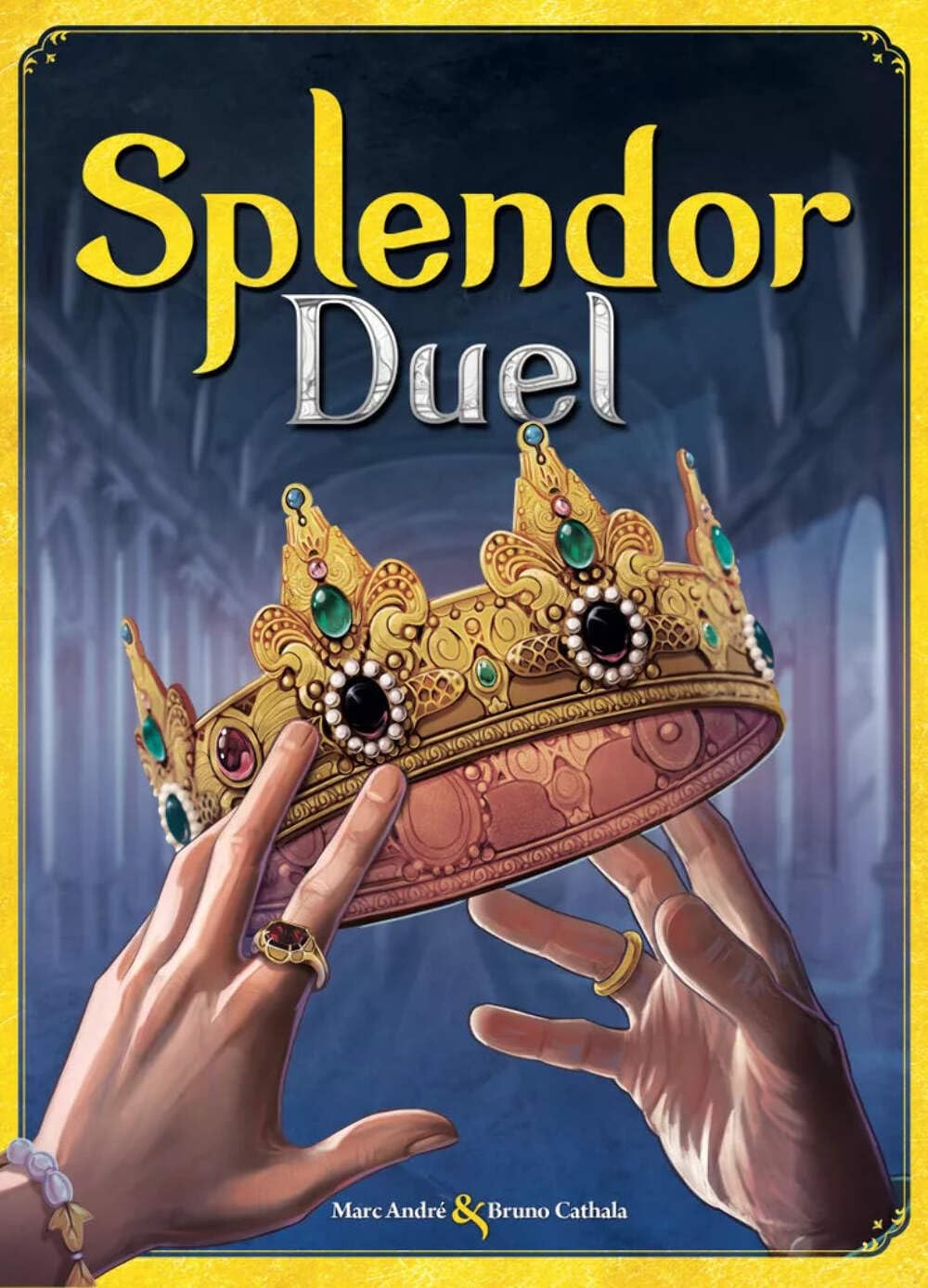
Splendor Duel takes the elegant gem-drafting engine of the original Splendor and retools it specifically for two players. The shared board is smaller and more confrontational — you are directly competing for the same gem tokens, and the addition of privilege tokens and alternate win conditions (ten prestige points, six crowns, or three royals) adds strategic layers that the original game lacks. The chips are thick and satisfying to handle, and the cards are printed on sturdy stock.
What makes this version superior for two players is the tension. Every move you make denies your opponent a resource, and the special powers on certain cards create meaningful decisions about whether to pursue immediate gem income or long-term prestige. Games run about thirty minutes and are tight enough that the outcome is often decided in the final two rounds. The compact box also travels well.
It is not a game for larger groups — strictly two players only. And if your family already owns and loves the original Splendor, the Duel version feels familiar enough that you might prefer it for the sharper head-to-head dynamic. For couples who enjoy competitive but quick strategy games, Splendor Duel is a clean, relentless experience.
Why it’s great
- Alternate win conditions (prestige, crowns, royals) create three parallel tracks that keep each game unpredictable
- High-quality components — thick gem tokens, durable cards, and a compact insert that actually organizes everything
- Every move carries a denial element that keeps the tension high and eliminates the “multiplayer solitaire” feel
Good to know
- Strictly a two-player game; it cannot accommodate larger family groups without buying the original Splendor separately
- If your family already owns the original Splendor, the core mechanism is similar enough that some players may not feel the need for both
5. Asmodee Harmonies

Harmonies is the tile-laying game you pull out when the group wants something beautiful, thoughtful, and non-confrontational. You build a three-dimensional landscape by stacking wooden tokens to create mountains, forests, and water, then place animal groups that score based on their preferred terrain patterns. The production is stunning — the wooden pieces have a textured, natural feel, and the 42 illustrated animal cards are genuinely lovely to look at.
The rulebook is simple enough to teach in five minutes, but the scoring system has real depth. Each animal card has a unique placement requirement, and you are balancing terrain expansion against animal scoring in a tight puzzle. The game offers three difficulty levels, which extends its lifespan considerably. It also includes a solo mode that works well for quiet evenings.
Player interaction is minimal — you are mostly solving your own puzzle on your personal board — so it is best for groups who enjoy parallel play rather than direct competition. At thirty minutes, it is also one of the faster options on this list, making it a good warm-up or closer for a longer game night. The only downside is that the box is slightly oversized for what it contains, but the insert keeps everything organized.
Why it’s great
- Gorgeous tactile components — textured wooden tokens and beautifully illustrated cards create a relaxing, sensory experience
- Three difficulty levels and multiple animal card combinations provide genuine replay value beyond the first few sessions
- Quick to teach and plays in thirty minutes, making it an excellent opener or filler for a longer game night
Good to know
- Very low player interaction — it is essentially a multiplayer solitaire puzzle that may leave competitive groups wanting more engagement with each other
- The game can end abruptly once the terrain token stack runs out, occasionally leaving players feeling one turn short of a satisfying finish
6. Asmodee So Clover!

So Clover! flips the party game formula by making everyone cooperative. Each player draws a clover board with four keyword pairs and writes one clue per pair that connects the two words. Teammates then try to guess which keywords each clue refers to — and the whole team scores together. This eliminates the “one winner, everyone else loses” dynamic that often kills the mood at adult family gatherings.
The brilliance is in the clue writing. You want to be specific enough that your teammates connect the dots but creative enough that the round stays interesting. A clue like “dusty basement” might link “attic” and “cobweb,” but “dusty basement vault” might link “vault” and “safe.” The game rewards lateral thinking and inside jokes without requiring deep pop culture knowledge. The 220 password cards provide plenty of material for repeated play.
Setup takes under a minute. The clover boards and dry-erase markers are easy to handle, and the game works with any group size from three to six (and more if people pair up). Playtime is a brisk thirty minutes or less. The only drawback is that the cooperative scoring can feel anticlimactic for groups who thrive on cutthroat competition — but for inclusive, laughter-filled rounds, So Clover! is hard to beat.
Why it’s great
- Fully cooperative design keeps everyone engaged and avoids the “one winner, everyone else loses” problem of most party games
- Clue writing is deeply creative and rewards lateral thinking, making each round feel unique and personal to your group
- Extremely fast setup and thirty-minute playtime make it ideal for large gatherings where attention spans vary
Good to know
- Cooperative scoring removes the competitive edge that some groups crave, which may make it feel anticlimactic for highly competitive families
- Replay value depends on your group’s creativity — if players tend to write similar clues, the game can start to feel repetitive after several sessions
7. Cards Against Humanity

Cards Against Humanity is the short-fuse nuclear option of adult family game night. The formula is simple: one player draws a black card with a fill-in-the-blank prompt, and everyone else plays a white card from their hand to create the funniest (or most horrifying) combination possible. Version 2.0 includes over 150 new cards, bringing the total to 500 white cards and 100 black cards, which dramatically improves replayability over earlier editions.
The humor is deliberately offensive and scatological. If your family includes conservative grandparents, young teens, or anyone who is easily offended, this game will create an awkward silence rather than laughter. It works best with groups of four to eight adults who share a dark sense of humor and are already comfortable with each other. The iconic black box and the absurd card quality (thick, durable, US-made) mean the physical product will survive many trips to the table.
Setup is instant — deal white cards, flip a black card, and go. The round structure means no one is eliminated, and the judge role rotates quickly. The biggest criticism is that replayability with the same group diminishes as you learn the white card pool, but the Version 2.0 refresh and available expansion packs mitigate this. For the right crowd, Cards Against Humanity is the most reliable laugh generator on this list.
Why it’s great
- Version 2.0 includes 150 new cards that improve replayability and update the humor for a modern audience
- Durable US-made card stock can survive enthusiastic shuffling, spills, and years of game nights
- Instant setup and no complex rules — you can go from box to laughing in under two minutes
Good to know
- Explicitly not suitable for children, conservative family members, or anyone uncomfortable with dark, offensive, or scatological humor
- Replay value drops noticeably once your regular group has seen most of the white cards, requiring expansion packs to stay fresh
FAQ
What is the ideal player count for a family game night with teenagers and grandparents?
How do I know if a board game is too complex for my family?
Are cooperative games better for families than competitive ones?
Final Thoughts: The Verdict
For most families, the best adult family board games winner is the CATAN Board Game (6th Edition) because its modular board and negotiation mechanics create infinite replayability and keep everyone at the table talking, trading, and building together. If you want a quiet, meditative puzzle that works for solo and group play, grab the Harmonies. And for an intense two-player cooperative experience that couples will return to nightly, nothing beats the Sky Team.

Mo Maruf
I created WellFizz to bridge the gap between vague wellness advice and actionable solutions. My mission is simple: to decode the research and give you practical tools you can actually use.
Beyond the data, I am a passionate traveler. I believe that stepping away from the screen to explore new environments is essential for mental clarity and physical vitality.