Our readers keep the lights on and my smoothie glass nicely filled. As an Amazon Associate, I earn from qualifying purchases.
Choosing a home projector means balancing brightness, resolution, native color performance, and ease of setup in a single device. The wrong pick leaves you with washed-out daytime images or a tangled mess of external streaming sticks.
I’m Mohammad Maruf — the founder and writer behind WellFizz. I’ve spent years analyzing optical engines, contrast ratios, and smart TV integration to separate real performance from inflated lumen claims.
Whether you want a laser system for permanent living room installation or a portable LCD for backyard movies, this guide covers the best beamer for home across every serious use case and budget tier.
How To Choose The Best Beamer For Home
The home projector market is flooded with contradictory brightness numbers, misleading resolution labels, and confusing OS ecosystems. A systematic approach to three core specs will cut through the noise and land you on the right model for your specific room and usage pattern.
Brightness: Real Lumens vs. Marketing Lumens
Look for ANSI or ISO lumen ratings from reputable brands. Many budget projectors claim 10,000+ lumens but deliver only 200–300 real ANSI lumens, making them unwatchable with any ambient light. A true 1,500–2,000 ANSI lumens is the minimum for living room use with curtains drawn; 3,000+ allows daytime viewing without blackout shades. Premium laser models from BenQ, JMGO, and Hisense provide verified, repeatable brightness figures that match their lab testing.
Resolution: Native vs. Decoding
Native 1080p is the baseline for any worthwhile home theater projector. Many sub- units advertise “4K support” meaning they decode a 4K signal but display it at native 1080p. True 4K projectors from BenQ, Dangbei, and AWOL VISION use pixel-shifting or native 4K DMD chips to deliver full UHD clarity. If you sit close to a 120-inch screen, native 4K makes a visible difference in fine text and skin detail.
Light Source: LED vs. Laser vs. Lamp
LED projectors are cheap and portable but lack the brightness for daytime use. Traditional lamp projectors (like the BenQ TH575) offer high brightness at a low entry cost but require bulb replacement every 3,000–6,000 hours. Triple-laser systems from Hisense, JMGO, and AWOL achieve 25,000–30,000 hours with consistent color output, instant on/off, and no rainbow artifact. Single-laser DLP projectors are a middle ground but may still produce some color separation on high-contrast edges.
Quick Comparison
On smaller screens, swipe sideways to see the full table.
| Model | Category | Best For | Key Spec | Amazon |
|---|---|---|---|---|
| WiMiUS G2 | Google TV | Live sports & action movies | 1100 ANSI, MEMC, 30W Dolby | Amazon |
| Lisowod L61Pro | Portable Smart | Outdoor movie nights | 2.4 lb, 50W Dolby, WiFi 6 | Amazon |
| Epson CO-W01 | 3LCD Budget | Bright rooms on a budget | 3000 lumens, 3-chip 3LCD | Amazon |
| HAPPRUN 4K | Value LCD | First-time buyers | 2000 ANSI, 4K decode, WiFi 6 | Amazon |
| TOPTRO A2 | Short Throw | Small rooms & apartments | 1.0:1 throw, 36W Dolby, VIDAA | Amazon |
| BenQ TH575 | Gaming Lamp | Competitive console gaming | 3800 lumens, 16ms lag | Amazon |
| Dangbei DBOX02 | Laser 4K | Cinema-grade day/night use | 2450 ISO, ALPD laser, Netflix | Amazon |
| JMGO N1S Ultimate | Triple Laser | Reference home theater | 3300 ISO, 360° gimbal | Amazon |
| BenQ TK710 | Laser Gaming | 240Hz esports on 120″ screen | 3200 ANSI, 4ms, HDR10 | Amazon |
| Hisense C2 | Gimbal Laser | Flexible placement & Dolby Vision | 2000 ANSI, 240Hz, JBL audio | Amazon |
| AWOL LTV-3000 Pro | UST Laser TV | Wall-hugging living room setup | 0.25:1 throw, Dolby Vision | Amazon |
In‑Depth Reviews
1. WiMiUS G2
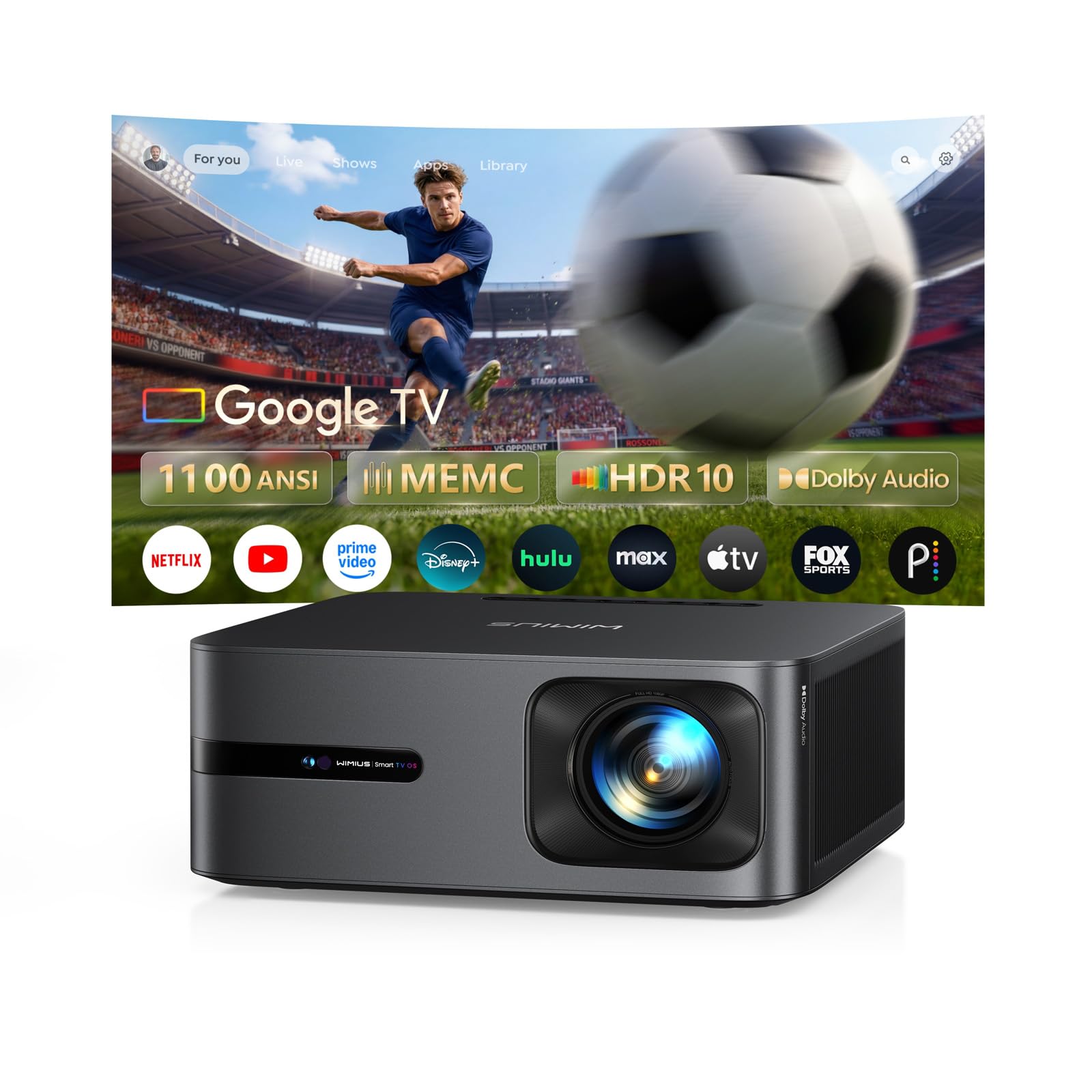
The WiMiUS G2 delivers a rare combination for the mid-range: verified 1100 ANSI lumens that actually outperform many budget models claiming triple that number. Its native 1080p with 4K decoding ensures sharp text and detailed skin tones up to a 120-inch diagonal, while MEMC motion smoothing eliminates blur during fast sports or action sequences. The included Google TV 14.0 interface with 2GB RAM and 32GB storage runs Netflix, Prime Video, and 800+ live channels without requiring an external streaming stick.
Setup is genuinely hands-free thanks to auto focus, auto keystone, obstacle avoidance, and screen alignment that completes within seconds of powering on. The 30W Dolby Audio speakers fill a medium living room without distortion, and the two-way Bluetooth 5.2 lets you use the projector as a standalone speaker when the screen is off. HDMI 2.1 eARC support simplifies connection to a soundbar for those who want more bass extension.
Battery life is not applicable since this is a mains-powered unit, but the one-click dust removal system extends optical clarity over years of use without opening the chassis. Customers consistently praise its bright, vibrant image even with ambient light and the stability of its Google TV operating system. The 3-year warranty and lifetime technical support from WiMiUS add significant long-term value.
Why it’s great
- True 1100 ANSI brightness holds up with curtains open
- MEMC smooths fast sports without visible artifacts
- Integrated Google TV negates the need for a second remote
Good to know
- Native 1080p, not true 4K resolution
- Auto keystone can drift on angled surfaces exceeding 15 degrees
2. Lisowod L61Pro
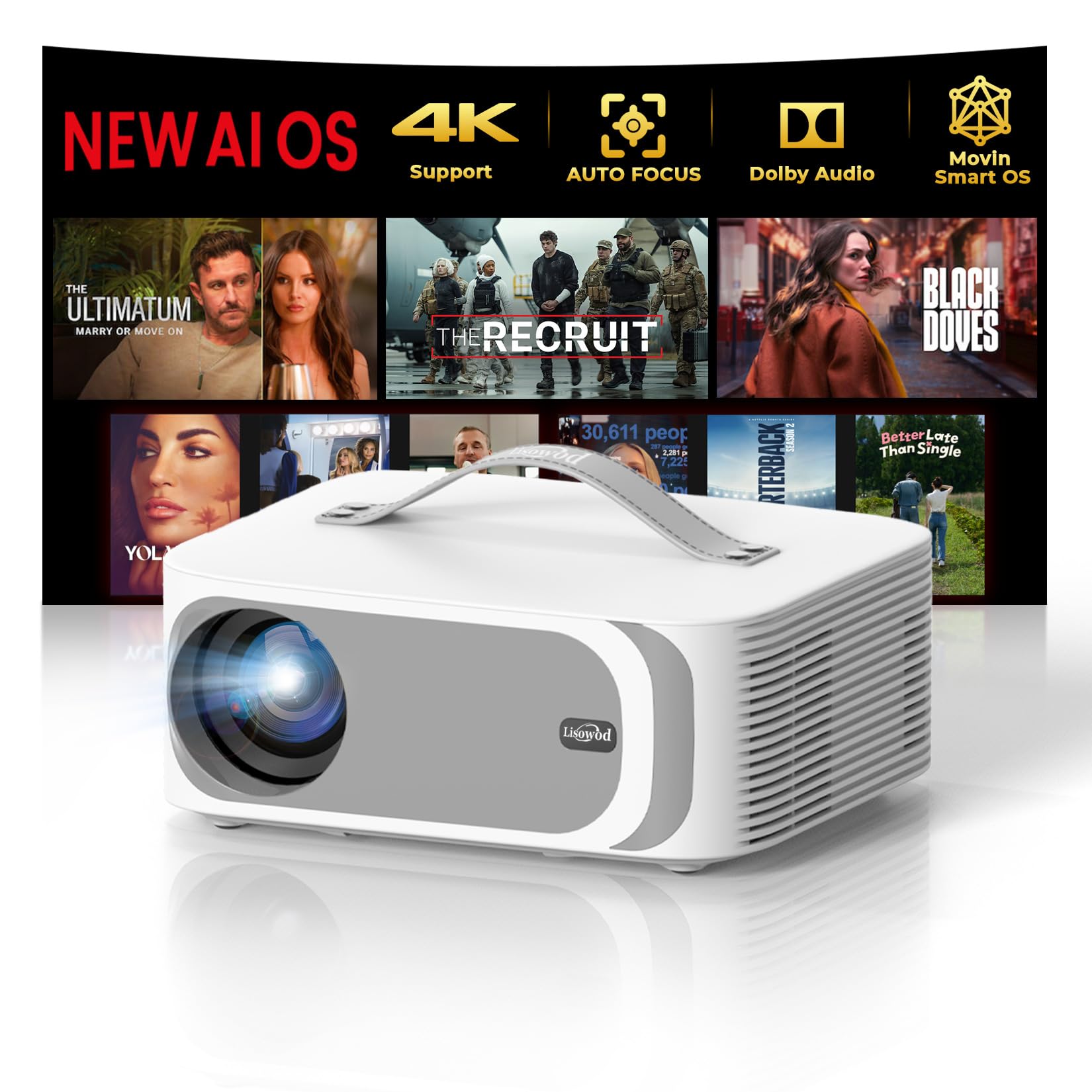
At just 2.4 pounds with a built-in carry handle, the Lisowod L61Pro redefines portable home cinema without sacrificing audio quality. Its Movin 2.0 OS provides a smart TV interface with pre-installed Netflix, Prime Video, Disney+, and YouTube out of the box — no extra dongle required. The AI Movin 2.0 OS and quad-core A55 processor deliver 75% faster app launches than typical 1080P Android projectors, making it responsive enough for casual browsing between movies.
Audio is the standout feature here: dual 50W Dolby speakers produce deep bass and clear dialogue that easily fills a backyard or living room. The 2026-gen AI auto calibration handles focus, keystone, obstacle avoidance, and screen alignment within three seconds, and WiFi 6 ensures buffer-free 4K streaming from popular apps. Users report crisp 1080p images with true 25000:1 contrast and reliable HDR10+ decoding for vibrant colors in dim environments.
The biggest trade-off is brightness — at a real-world 2500 lumens (peak), it performs best after sunset or in a controlled dark room. Some customers note the auto-focus occasionally needs manual fine-tuning when projecting onto uneven surfaces like textured walls. For those who prioritize portability and built-in sound over brute-force daytime brightness, this is the most complete grab-and-go option in its price tier.
Why it’s great
- Ultra-light 2.4 lb design with ergonomic handle for true portability
- 50W built-in Dolby audio eliminates need for external speakers in most rooms
- Pre-installed official streaming apps with zero setup
Good to know
- Not bright enough for daytime living room use without blackout curtains
- Auto-focus may struggle on highly textured or non-white surfaces
3. Epson EpiqVision Flex CO-W01

Epson’s 3-chip 3LCD technology gives the CO-W01 a significant advantage over single-chip DLP rivals in the same price bracket: zero rainbow effect and 100% of the RGB color signal per frame. With 3,000 lumens of both color and white brightness, it remains watchable with ambient light from windows, making it a solid choice for living rooms where total blackout isn’t practical. Its native WXGA (1280×800) resolution is lower than 1080p but still fine for casual movie nights and presentations up to 120 inches.
The compact chassis fits easily into a backpack, and the single HDMI port accepts streaming sticks like Fire TV or Roku for smart functionality. Customers highlight the image sharpness adjustment knob, which allows fine-tuning focus manually, and the keystone correction that works reliably for tabletop placement. The built-in 5W speaker is mediocre and quiet — almost every user recommends an external audio solution.
Fan noise is noticeable in high-brightness mode but disappears in eco mode with minimal brightness penalty. The lack of built-in smart OS means you must supply your own streaming device, but for someone who already owns a Fire Stick, this is a cost-effective path to a bright, rainbow-free image. It’s the best entry-level option for community events, classrooms, or family rooms where a 75-inch TV feels too small.
Why it’s great
- 3LCD technology eliminates rainbow artifact completely
- 3000 lumens maintain usable image in moderate ambient light
- Compact and lightweight for easy transport between rooms
Good to know
- Only WXGA resolution — not full 1080p
- Built-in 5W speaker is weak; external audio is almost mandatory
4. HAPPRUN 4K Decoding Projector

The HAPPRUN 4K decoding projector brings AI-driven auto setup to the sub- segment with a feature set that was once reserved for models costing twice as much. It packs auto focus, 6D auto keystone, obstacle avoidance, and screen alignment that deliver a sharp rectangular image within five seconds of startup. The 2000 ANSI lumen rating is high enough for evening viewing with some ambient light, and the 20000:1 contrast ratio helps dark scenes retain shadow detail without crushing blacks.
WiFi 6 ensures stable wireless casting from both iOS and Android devices, and the bidirectional Bluetooth 5.2 lets it double as a standalone speaker when not projecting. Dual HDMI ports (2.0) accommodate a TV stick for Disney+ or Hulu, since the onboard operating system does not include those apps natively. Customers routinely call it a top-tier value, with several noting the picture stays crisp even when the projector is not perfectly centered thanks to the 50% zoom and auto alignment.
The 8W built-in speaker is adequate for a bedroom but lacks the low-end presence for a living room — plan to connect an external speaker via Bluetooth or the 3.5mm jack. Some users report the auto keystone occasionally misses the mark on highly angled placements, requiring a manual tweak through the remote. For a first-time projector buyer on a strict budget, this strikes an impressive balance between automated convenience and image quality.
Why it’s great
- AI auto setup completes in 5 seconds for hassle-free placement
- 2000 ANSI lumens provide solid evening performance
- Dual HDMI inputs for flexible source switching
Good to know
- Built-in speaker lacks bass for immersive audio
- Auto keystone can misalign on steep angles above 15 degrees
5. TOPTRO A2 VIDAA 4K
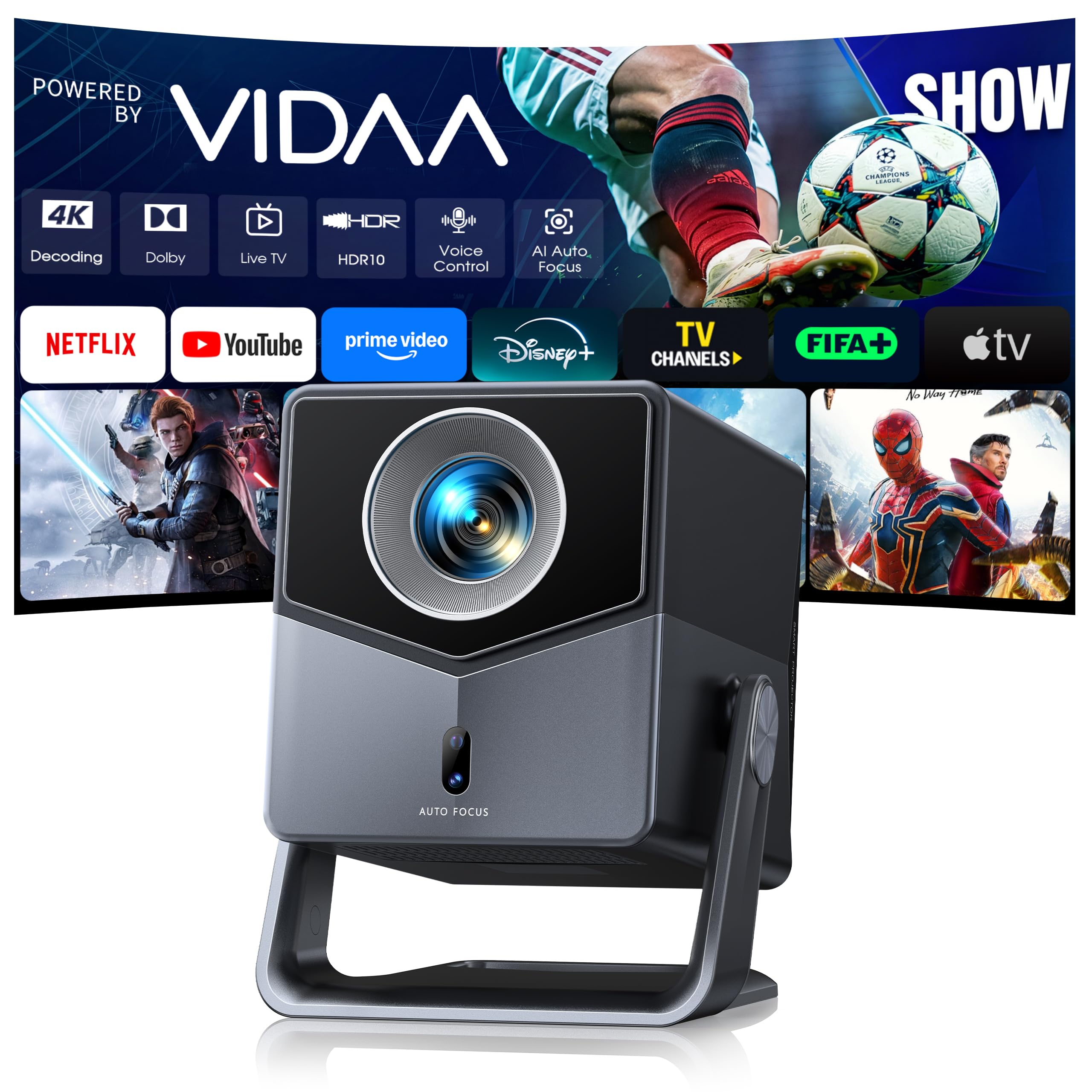
The TOPTRO A2 solves a specific pain point for apartment dwellers and small-room users: its 1.0:1 short throw ratio produces a 100-inch image from just 2.2 meters away, versus the 3+ meters required by standard LCD projectors. The built-in VIDAA Smart OS provides 1,000+ live TV channels plus access to Netflix, Prime Video, and Disney+ without any external device. Its 650 ISO ANSI brightness is honest and consistent — unlike many budget projectors that exaggerate by 5x — and the HDR10 decoding adds visible contrast in shadow-heavy scenes.
The 200° rotatable stand doubles as a carrying handle and supports tabletop, wall, or ceiling projection, making it easy to reposition between rooms. Audio performance punches above its size class: dual 18W speakers with Dolby Audio deliver room-filling sound with clear dialogue and respectable bass. Two-way Bluetooth 5.2 allows connecting wireless headphones for late-night viewing or using the projector as a standalone Bluetooth speaker.
Customers consistently praise the fast, responsive VIDAA interface and the hassle-free auto focus and keystone correction. The main limitation is the 650 ANSI brightness — this is strictly a dim-room or nighttime performer. A few users report that the auto obstacle avoidance occasionally over-crops the image when placed near wall art. For anyone with tight projection distance or who wants a truly self-contained streaming projector without extra dongles, this is a uniquely capable choice.
Why it’s great
- 1.0:1 short throw fits 100-inch screen in small rooms
- Integrated VIDAA OS with live TV and all major streaming apps
- 36W Dolby audio with 200° rotating stand
Good to know
- 650 ANSI lumens require a dark room for best results
- Auto obstacle avoidance can slightly crop the displayed image
6. BenQ TH575

BenQ’s TH575 is purpose-built for console gamers who refuse to compromise on responsiveness. With 3800 ANSI lumens and a native 1080p DLP chip, it produces a bright, sharp image even in a room with overhead lights on. The 16.7ms input lag at 1080p/60Hz is imperceptible for most players, and the enhanced Game Mode optimizes contrast and color for fast-moving titles like Call of Duty or FIFA. Its 15000:1 contrast ratio (FOFO) ensures deep blacks in dark scenes without the washed-out look of lower-end DLP units.
The standard throw lens requires roughly 10.8 feet for a 100-inch image, which fits most living rooms or dedicated game rooms. Dual HDMI inputs allow simultaneous connection to a console and a streaming device, while the 3D support (via optional active shutter glasses) adds an extra layer of immersion for compatible Blu-ray titles. Customers consistently mention zero noticeable input lag with Nintendo Switch and PS5, and the quiet cooling system keeps fan noise to a minimum during extended sessions.
There is no built-in smart TV platform here — you must supply a Fire Stick, Roku, or game console for streaming. The 5W mono speaker is basic and best replaced with an external audio system. One year of consistent use has shown no drop in brightness or color accuracy, and the lamp is rated for 6,000 hours in normal mode. This is the benchmark for budget-friendly, low-latency gaming projection.
Why it’s great
- 3800 lumens deliver playable image with room lights on
- 16ms input lag is imperceptible for console gaming
- 15000:1 contrast ratio produces deep, satisfying blacks
Good to know
- No built-in smart OS; external streamer required
- Built-in mono speaker is too weak for immersive audio
7. Dangbei DBOX02

The Dangbei DBOX02 uses ALPD (Advanced Laser Phosphor Display) technology to deliver true 4K UHD resolution at 2450 ISO lumens, producing a bright, speckle-free image that rivals entry-level home theater projectors. Its Google TV interface with official Netflix licensing means you can access the full streaming library directly without a workaround — a rarity among laser projectors. The 5000:1 contrast ratio and HDR10+ support give HDR content the punch and dynamic range expected from a premium cinema display.
InstanPro AI Image Setup handles auto focus, keystone, screen fit, and obstacle avoidance in seconds, making ceiling or tabletop installation painless. Dual 12W speakers with DTS:X and Dolby Audio output surprisingly rich sound for a compact chassis, though purists will still want an external soundbar connected via HDMI eARC. Customers report outstanding brightness even in daylight conditions, and the quiet fan operation in eco mode makes it suitable for bedroom installations.
The main critique involves the default out-of-box picture settings, which some users describe as oversaturated until switching to Movie mode. The non-adjustable legs require a small swivel stand to achieve the perfect projection angle, and the light leak around the image edges is noticeable in fully dark rooms. For anyone seeking a true 4K laser projector under that works natively with Netflix and delivers genuinely bright HDR, this is the strongest contender.
Why it’s great
- ALPD laser eliminates the speckle common in single-laser DLP projectors
- Officially licensed Netflix with Google TV built-in
- 2450 ISO lumens produce bright HDR in living rooms
Good to know
- Out-of-box color settings require calibration for accurate image
- Minor light leak visible around image edge in dark theater rooms
8. JMGO N1S Ultimate

The JMGO N1S Ultimate sets a new reference standard for home projection with its triple-laser RGB engine hitting 3300 ISO lumens and covering 110% of the Rec.2020 color gamut. This means colors are purer, brighter, and more saturated than any single-laser or LED projector in its class — reds appear rich without clipping, and skin tones remain natural even in brightly lit scenes. The 1600:1 native contrast ratio, combined with 10-bit color depth, produces smooth gradients and deep black levels that rival OLED TVs in a dim room.
The FlexiSmart 2.0 system uses a 3D-TOF sensor and CMOS camera to maintain real-time auto focus and keystone correction, even as the projector is moved during use. The 360° horizontal and 135° vertical gimbal allows projection onto walls, ceilings, or angled surfaces without requiring a separate mount. Google TV with official Netflix certification provides seamless access to 10,000+ apps, and the 20W subwoofer with Dolby Digital Plus delivers room-shaking bass that eliminates the need for a dedicated soundbar in most rooms.
Customer reviews highlight the astonishing clarity and brightness relative to the unit’s size, with several users upgrading from much more expensive Epson and BenQ models. The built-in carrying case is brilliant for transport, though the external power brick reduces portability slightly. The UI can feel sluggish occasionally, and the digital zoom (rather than optical) is a minor compromise. For anyone building a dedicated home theater who wants reference-level color without spending +, this is the definitive choice.
Why it’s great
- Triple laser covers 110% Rec.2020 for unmatched color purity
- 3300 ISO lumens deliver daylight-ready brightness
- Gimbal mount enables projection on walls and ceilings without a mount
Good to know
- User interface can feel slow compared to dedicated streaming boxes
- Digital zoom instead of optical zoom limits placement flexibility
9. BenQ TK710

BenQ’s TK710 pushes gaming projection performance to new heights with a 240Hz refresh rate at 1080p and a 4ms response time — numbers that directly compete with high-end gaming monitors. The 3200 ANSI lumen laser light source maintains consistent brightness through its entire 20,000+ hour lifespan, eliminating lamp replacement costs entirely. True 4K UHD resolution with HDR10 and HLG support ensures that non-gaming content looks equally impressive, with a 600,000:1 dynamic contrast ratio that handles bright sunlight and dark shadows with equal precision.
Vertical lens shift and 3D keystone correction offer far more installation flexibility than the vast majority of gaming-focused projectors, allowing ceiling-mount placement without image distortion. The 1.3x optical zoom is a genuine advantage over digital zoom rivals, preserving pixel integrity when scaling down the image. Customers upgrading from decade-old 1080p BenQ models report a dramatic improvement in sharpness, color saturation, and ambient light resistance.
The biggest caveat is that the 240Hz mode operates at 1080p, with 4K/60Hz hitting a still-respectable 16ms input lag. The built-in 5W speaker is merely functional, and the lack of a smart TV platform means you’ll need an external source. A few users note the short throw distance is a benefit but requires recalculation if upgrading from a standard-throw model. For the competitive gamer who also wants a brilliant 4K home theater for movies and sports, this is the ultimate hybrid.
Why it’s great
- 240Hz refresh rate with 4ms response for lag-free esports
- Laser light source eliminates bulb replacements for 20,000+ hours
- Vertical lens shift and optical zoom offer flexible installation
Good to know
- No built-in smart TV platform; external streamer required
- 240Hz mode limited to 1080p resolution
10. Hisense C2

The Hisense C2 packs a pure triple-color laser engine with 18 independent laser chips into a compact chassis with a 360° horizontal and 135° vertical gimbal, allowing instant projection onto any wall or ceiling without a mount. Its 2000 ANSI lumens deliver vivid, watchable images even in moderately lit rooms, and the native 4K resolution with AI upscaling brings HD content to near-4K clarity. Dolby Vision support ensures HDR content from supported streaming services looks exactly as the director intended, with nuanced highlights and deep, controlled blacks.
Sound by JBL with DTS Virtual:X provides cinematic audio from the built-in speakers, with clear dialogue and genuinely impactful bass for its size. The 240Hz refresh rate at 1080p with 12ms input lag makes it a low-latency gaming option as well. Customers consistently praise the image quality as rivaling projectors costing twice as much, with one reviewer calling the C2 90% of a reference projector at half the price. The auto keystone and focus are fast and accurate thanks to the TOF and gyroscope sensor array.
Some users note that the required throw distance is longer than previous Hisense models, meaning a 100-inch screen may not fit in very compact rooms. The VIDAA OS includes some ad content on the home screen, though it does not appear during actual content playback. For anyone seeking a truly premium portable laser projector with Dolby Vision, excellent out-of-box color, and flexible placement, the C2 is a near-perfect package.
Why it’s great
- Triple laser with 110% BT.2020 color gamut for reference-level color
- Dolby Vision support improves HDR performance significantly
- Gimbal design enables ceiling projection without a mount
Good to know
- Requires more throw distance than previous Hisense C1 model
- VIDAA OS home screen includes minor ad content
11. AWOL VISION LTV-3000 Pro

The AWOL VISION LTV-3000 Pro is the world’s first ultra-short-throw (UST) projector with a built-in center channel speaker, mapping dialogue directly to the screen for crystal-clear vocals without an external soundbar. Its triple laser engine delivers true 4K UHD at 2000 lumens with Dolby Vision, HDR10+, and support for Blu-ray 3D, creating a cinema-grade image that pairs perfectly with an ALR screen for daytime viewing. The 0.25:1 throw ratio means the projector sits just 8.5 inches from the wall to produce a 100-inch image, making it ideal for living rooms where a long-throw projector is impractical.
PJ Link IP control allows seamless integration with Control4 and other home automation systems, a feature rarely found in consumer UST projectors. The 107% BT.2020 and 147% DCI-P3 color coverage rivals commercial digital cinema standards, and users report deep blacks and vibrant colors right out of the box. The laser light source consumes roughly one-tenth the energy of a similarly sized LED TV, providing ongoing energy savings for heavy daily use.
Some customers report a minor red tint in the color balance that requires user adjustment, and the lack of auto 3D detection means you must manually switch modes in the menu for 3D content. The built-in speakers are loud enough for a medium room but benefit from the optional AWOL ThunderBeat surround system for a full 5.2.2 setup. For anyone wanting a zero-footprint, wall-hugging home theater with Dolby Vision and native 3D playback, the LTV-3000 Pro is the ultimate UST solution.
Why it’s great
- 0.25:1 ultra-short throw enables 100-inch image from 8.5 inches away
- Built-in center channel speaker delivers clear on-screen dialogue
- Dolby Vision, HDR10+, and Blu-ray 3D support in one unit
Good to know
- Minor red tint in default color balance may need adjustment
- No auto 3D detection; manual mode switching required
FAQ
Will a 1080p projector look blurry on a 120-inch screen?
How much brightness do I need for a living room with windows?
What is the difference between LED and laser projectors for home use?
Can I use a short throw projector on a regular TV stand?
Final Thoughts: The Verdict
For most users, the beamer for home winner is the WiMiUS G2 because it combines verified 1100 ANSI brightness, MEMC motion smoothing, and a full Google TV interface with auto setup at a mid-range price that outperforms every competitor in its bracket. If you want triple-laser color accuracy with a flexible gimbal, grab the Hisense C2. And for zero-footprint installation with Dolby Vision and built-in 3D, nothing beats the AWOL VISION LTV-3000 Pro.

Mo Maruf
I created WellFizz to bridge the gap between vague wellness advice and actionable solutions. My mission is simple: to decode the research and give you practical tools you can actually use.
Beyond the data, I am a passionate traveler. I believe that stepping away from the screen to explore new environments is essential for mental clarity and physical vitality.