Our readers keep the lights on and my smoothie glass nicely filled. As an Amazon Associate, I earn from qualifying purchases.
When cognitive decline begins creeping in, the frustration isn’t just about forgotten names—it’s about losing the quiet joy of finishing something. Puzzles that feel too childish offend dignity, while standard jigsaws overwhelm shaky hands and fading vision. The right game bridges that gap: it must be physically manageable, visually clear, and mentally stimulating without tipping into frustration. A low piece count doesn’t mean low value—it means the challenge is precisely calibrated for a brain that still wants to succeed.
I’m Mohammad Maruf — the founder and writer behind WellFizz. I’ve spent years analyzing therapeutic product categories, studying cognitive stimulation tools and their measurable impact on senior mental acuity and fine-motor coordination.
Because the wrong choice collects dust while the right one becomes a daily ritual, we’ve tested dozens of options to find the best brain games for seniors that respect their abilities and encourage consistent engagement.
How To Choose The Best Brain Games For Seniors
Not every puzzle or card deck is appropriate for an aging mind. The key is matching the physical design and cognitive demand to the senior’s current stage. Here are the three critical factors that separate a meaningful activity from a frustrating one.
Piece Size & Grip Accessibility
Standard jigsaw pieces are roughly 1 inch across—far too small for unsteady hands or arthritic fingers. Seniors with reduced fine motor control need pieces that measure at least 4 to 5 inches in length. Look for embossed surfaces or textured grips that help pieces stay in place. Glossy, slippery cardboard is the enemy of independent assembly.
Imagery & Cognitive Load
The artwork must walk a narrow line: engaging without being overstimulating, age-appropriate without being childish. High-contrast, vivid colors help visual-spatial processing. Real-world photographs (animals, gardens, familiar scenes) tend to spark more memory recall and conversation than abstract patterns. Avoid puzzles with large single-color sections—those frustrate short attention spans and reduce completion rates.
Built-In Workspace & Portability
Losing pieces is the fastest way to kill a senior’s interest. Games that include a dedicated workspace—a box lid that doubles as a build tray, storage bags, or laminated mats—prevent pieces from scattering. A slim, portable format means they can use the activity at a table, on a lap tray, or at a nursing home common area without needing a dedicated puzzle table.
Quick Comparison
On smaller screens, swipe sideways to see the full table.
| Model | Category | Best For | Key Spec | Amazon |
|---|---|---|---|---|
| GoodDay Puzzles 48-Piece | Jigsaw Puzzle | Build-in-box, portable design | 48 pieces, build-in-box workspace | Amazon |
| Keeping Busy 3-in-1 | Matching Puzzle | Multi-level cognitive matching | 6 large pieces + 18 matching pieces | Amazon |
| WSCXSC 6-Pack 16-Piece | Large Piece Jigsaw | Multiple puzzles, group use | 16 pieces each, embossed grip | Amazon |
| CreateFun Go Together Cards | Flash Cards | Speech therapy & matching | 50 cards, 25 matching pairs | Amazon |
| NYT Puzzle Mania! Book | Puzzle Book | Word & logic puzzles, advanced | 224 pages, multiple puzzle types | Amazon |
In‑Depth Reviews
1. GoodDay Puzzles 48-Piece — Summer Bloom

The defining feature of this puzzle is its build-in-box system: the box bottom has an outline of where each piece belongs, acting as a template that guides placement without relying on memory alone. Pieces are 2–3 times larger than standard jigsaw pieces, which significantly reduces grip strain and visual fatigue. The 48-piece count is enough to feel like an accomplishment without overwhelming someone whose attention span has shortened.
The “Summer Bloom” imagery uses bold, high-contrast floral colors that are age-appropriate without looking childish. Several reviewers noted that seniors who normally resist puzzles engaged with this one because the artwork felt dignified. The slim profile of the box fits easily on a lap tray or small table, making it ideal for nursing home environments where space is tight.
Compared to standard 500- or 1000-piece puzzles, this deliberately caps difficulty at a level where success is almost guaranteed. The only minor drawback is that the reference image is printed on the underside of the lid, which requires flipping the box to check—a small ergonomic trade-off for the built-in template system. For a senior who needs a confidence-building introduction to puzzles, this is the first choice.
Why it’s great
- Box bottom doubles as placement template, preventing lost pieces
- Extra-large ergonomic pieces reduce hand fatigue and improve grip
- Dignified, vibrant artwork sparks conversation and memory recall
Good to know
- Reference image only on lid underside, requires flipping to check
- 48-piece count may feel too easy for advanced seniors still at full cognitive capacity
2. Keeping Busy 3-in-1 Numbered Dementia Puzzles
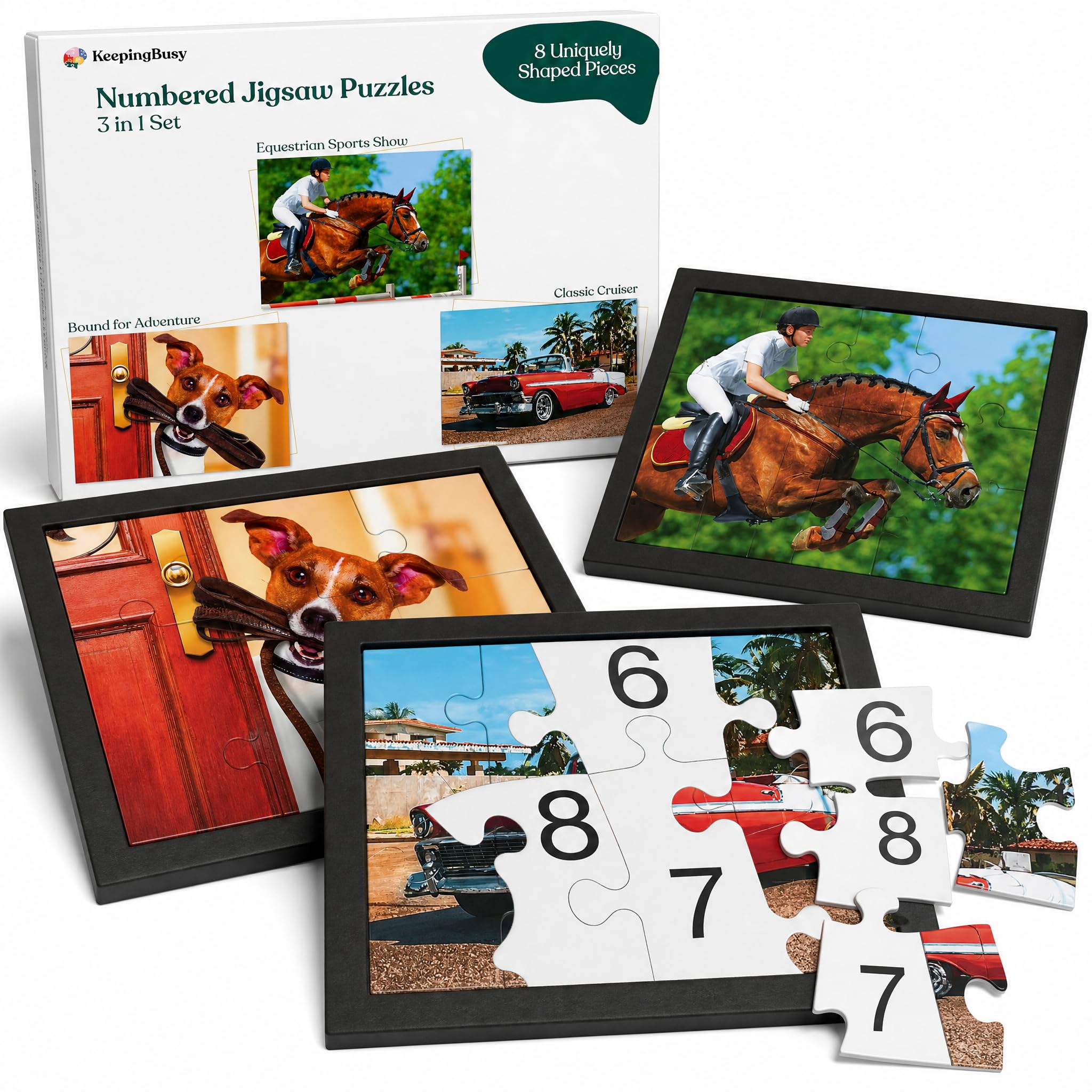
This set uses a clever 3-in-1 format: first you assemble two giant base pieces to form a board, then you match six large puzzle pieces, each with a numbered counterpart that reinforces sequencing logic. The result is a multi-layered cognitive challenge that progresses from simple assembly to matching and ordering—all without requiring reading skills. The pieces are thick, laminated, and large enough for severely reduced dexterity.
A standout addition is the included discussion guide for caregivers, which prompts meaningful conversation about the objects, animals, or scenes depicted in the puzzle. This transforms a simple matching activity into a verbal engagement tool that can spark memory recall and social interaction. The set comes in a portable format that is easy to carry between rooms or facilities.
One reviewer noted a design issue with a large brown section in the background of one puzzle, which caused confusion for a dementia patient with short attention span. However, most feedback emphasizes the durability of the laminated mats and the ability to adjust difficulty as cognitive decline progresses. For a caregiver who wants one product that grows with the user’s changing needs, this is the strongest option.
Why it’s great
- Three difficulty tiers in one set: assembly, matching, sequencing
- Laminated mats and thick pieces hold up to repeated daily use
- Caregiver discussion guide promotes conversation and memory recall
Good to know
- One puzzle has large single-color section that may confuse some users
- Higher price reflects the multi-component format and durable materials
3. WSCXSC 6-Pack 16 Large Piece Puzzles
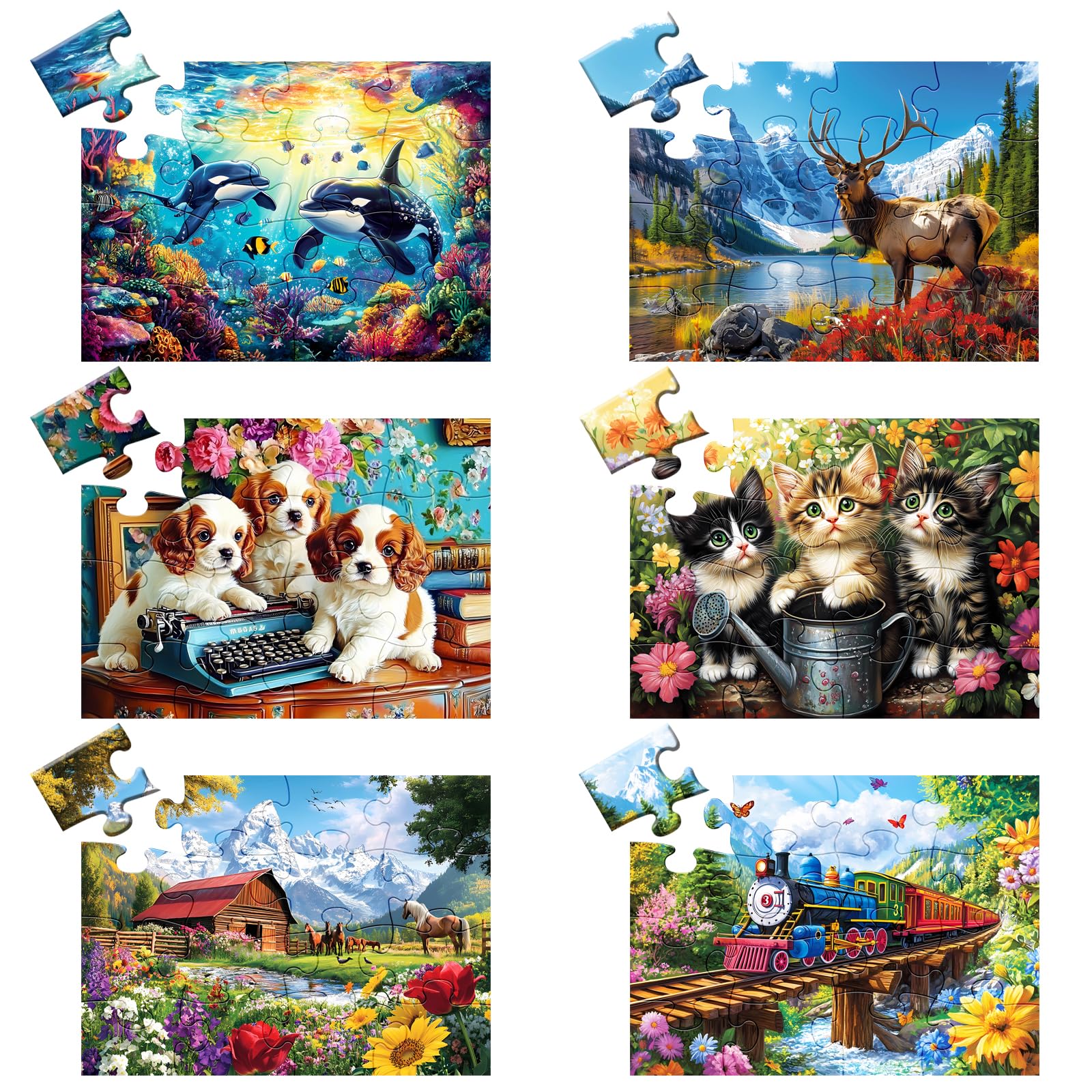
What makes this set exceptional for its tier is the embossed grip on each piece—a subtle texture that prevents fingers from slipping during assembly. Each of the six puzzles contains 16 pieces, each measuring 5 inches long and 0.1 inches thick, making them among the largest and easiest to handle in this category. The set includes six storage bags and six 1:1 reference posters, which eliminate the frustration of hunting for a tiny picture on a box lid.
The imagery covers a range of calming themes: horses, forests, and floral scenes that are appropriate for both men and women. Several reviews from nursing home staff note that residents who resist group activities will sit and complete these puzzles independently. The 16-piece count is low enough that even a user with late-stage decline can finish within a single sitting, providing a consistent sense of accomplishment.
The cardboard material is recyclable and durable enough for repeated use, though it is not laminated like the Keeping Busy set. The packaging discreetly avoids mentioning dementia or Alzheimer’s on the exterior, which is a thoughtful touch for gift-givers. For family members who want multiple puzzles to rotate through without a large investment, this pack delivers exceptional value.
Why it’s great
- Embossed grip texture prevents piece slippage for unsteady hands
- Six puzzles with storage bags allow variety and easy cleanup
- Discreet packaging avoids stigmatizing dementia or Alzheimer’s
Good to know
- Cardboard material less durable than laminated alternatives
- 16 pieces per puzzle may be too simple for mid-stage users
4. CreateFun Go Together Flash Cards
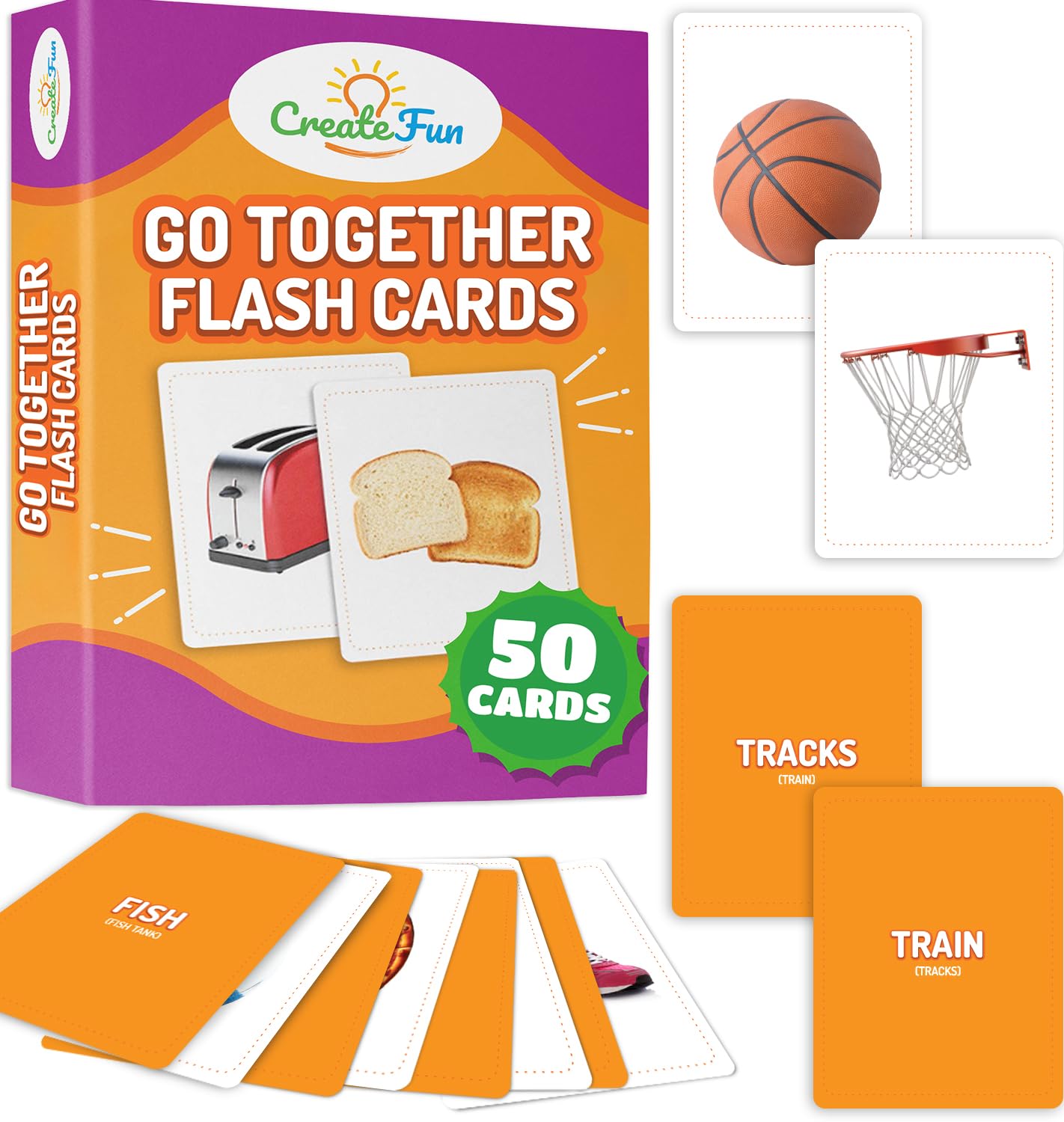
Unlike jigsaw puzzles, these flashcards focus on object association and verbal reasoning. The set contains 50 cards forming 25 matching pairs—such as “sock” with “shoe”—printed with real photographs rather than cartoons. The realistic imagery is critical for seniors with dementia, who often respond better to recognizable real-world objects than stylized illustrations. The cards are coated with a smudge-proof, water-resistant layer that survives frequent handling and accidental spills.
This format is particularly effective for speech therapy and aphasia recovery. Multiple reviewers report using these cards with elderly parents post-stroke or after brain surgery, where verbal recall is the primary deficit. The ability to start with just 6 pairs and gradually increase the set size allows the caregiver to calibrate difficulty session by session. The cards are small—3.55 by 4.55 inches—which means they are easy to store but require some manual dexterity to handle.
One limitation is that the cards are not designed for independent play; they require a partner to facilitate the matching activity. For a senior who can still engage verbally but struggles with fine motor tasks, this is a better choice than a jigsaw. For those who want solitary engagement, a puzzle format remains more appropriate. This is the best pick for targeted language and memory recall work.
Why it’s great
- Real photographs improve object recognition and memory recall
- Water-resistant coating withstands frequent handling and spills
- Graduated difficulty: start with few pairs, increase over time
Good to know
- Requires a partner to facilitate; not suitable for solo play
- Small card size may be difficult for severely arthritic hands
5. NYT Puzzle Mania! — Wordle, Connections, Spelling Bee

This is the only non-puzzle, non-card entry on this list—a 224-page book collecting the most popular New York Times game formats: Wordle, Connections, Spelling Bee, and the mini-crossword. For seniors who still have strong verbal fluency and reading comprehension but need a mental workout that doesn’t involve physical dexterity, this book delivers pure cognitive exercise. The layout mimics the experience of the mobile app versions, offering familiarity without the screen.
The print quality is high—bright colors and a clean typeface that respects aging eyes. The answers are included in the back of the book, which removes the frustration of being stuck. Several reviewers note that this makes an excellent coffee table book, sparking conversation when visitors see it. It is a departure from the large-piece jigsaw format, but for seniors who never enjoyed puzzles and prefer word challenges, this fills that specific gap.
The physical weight of the book—1.52 pounds—makes it less portable than a slim puzzle box. Additionally, the content assumes a certain baseline literacy and cognitive function, so it is not appropriate for late-stage dementia patients. For active seniors who want to keep their word recall sharp, especially those who already play Wordle on their phone, this is an excellent offline companion.
Why it’s great
- Familiar NYT game formats in an offline, large-print book
- Answers in the back reduce frustration for independent play
- Appeals to seniors who prefer word games over puzzles
Good to know
- Requires strong reading comprehension; not for late-stage dementia
- Heavier than puzzle boxes, less portable for travel
FAQ
Are 16-piece puzzles too simple for a senior who still reads and writes?
Can these puzzles be used by someone with advanced arthritis in their hands?
What is the difference between a cognitive matching puzzle and a standard jigsaw for seniors?
Final Thoughts: The Verdict
For most users, the best brain games for seniors winner is the GoodDay Puzzles 48-Piece Summer Bloom because its build-in-box template system and extra-large pieces deliver the ideal balance of challenge and physical accessibility. If you want multi-level cognitive progression that grows with changing needs, grab the Keeping Busy 3-in-1. And for seniors who prefer word games over puzzles, nothing beats the NYT Puzzle Mania book.

Mo Maruf
I created WellFizz to bridge the gap between vague wellness advice and actionable solutions. My mission is simple: to decode the research and give you practical tools you can actually use.
Beyond the data, I am a passionate traveler. I believe that stepping away from the screen to explore new environments is essential for mental clarity and physical vitality.