Our readers keep the lights on and my smoothie glass nicely filled. As an Amazon Associate, I earn from qualifying purchases.
The lateral collateral ligament (LCL) is the knee’s primary gatekeeper against excessive side-to-side force, and once it’s compromised—whether from a sports tackle, a misstep, or wear over time—every lateral movement becomes a gamble. Finding a brace that genuinely resists varus stress without turning your leg into a rigid pipe is the central engineering challenge in this category.
I’m Mohammad Maruf — the founder and writer behind WellFizz. Over the years I’ve analyzed hundreds of orthopedic support products, focusing on hinge geometry, material breathability, and real-world patient feedback to separate what actually stabilizes the knee from what just squeezes it.
This guide breaks down the five best options on the market, each evaluated for hinge rigidity, strap configuration, and clinical suitability, to help you confidently choose the right brace for lcl injury for your recovery or activity level.
How To Choose The Best Brace For LCL Injury
LCL injuries are distinct from ACL or MCL tears because the damaged ligament sits on the outer knee, controlling lateral opening. A brace that doesn’t specifically resist varus (inward-bending) force is essentially cosmetic. Focus on these three critical factors.
Hinge Design and ROM Control
Fixed or single-axis hinges can bind or drift away from the knee’s natural rotation. Triaxial or polycentric hinges track the femoral-tibial rollback more accurately, reducing skin irritation and hinge-pinching. For post-surgical or grade-2/3 tears, adjustable ROM locking dials—ranging from 0° (full extension block) to 120°—let your clinician gradually increase range as healing progresses.
Stabilizer Length and Strap Anchoring
A short stabilizer that stops mid-thigh provides little lever arm against lateral force. Look for bilateral metal supports that extend at least 6 inches above and below the knee joint. Cross-straps (X-straps) above and below the patella create a counter-tension system that locks the brace in place, preventing the “slide-down” that plagues simple sleeve braces during walking.
Material: Breathability vs. Rigidity Trade-off
Neoprene offers excellent compression and thermal therapy but traps sweat during extended wear. Lycra mesh or CoolPrene fabrics wick moisture while maintaining structural integrity. If you need the brace for daily work or sports, prioritize four-way stretch materials with ventilated panels to avoid skin maceration and odor buildup.
Quick Comparison
On smaller screens, swipe sideways to see the full table.
| Model | Category | Best For | Key Spec | Amazon |
|---|---|---|---|---|
| Shock Doctor 875 | Premium Hinged | High-impact sports & max stability | Full-length bilateral metal hinges | Amazon |
| Mueller Hg80 | Premium Hinged | All-day comfort with triaxial tracking | Triaxial hinge system | Amazon |
| T TIMTAKBO Hinged | Mid-Range Hinged | Custom compression with X-straps | 1/8in thick alloy steel stabilizers | Amazon |
| Tairibousy Hinged | Mid-Range Hinged | Post-surgery ROM restriction | 0°–120° locking dial | Amazon |
| LP 758CA | Budget Sleeve | Mild LCL strain & gym recovery | CoolPrene X moisture-wicking fabric | Amazon |
In‑Depth Reviews
1. Shock Doctor Knee Brace 875

The Shock Doctor 875 is built for athletes and active individuals who need maximum lateral rigidity without sacrificing mobility. Its bilateral full-length metal hinges run from mid-thigh to mid-calf, providing an unusually long lever arm that effectively resists varus stress on the LCL. The four-way stretch Lycra mesh wraps snugly without trapping heat, and the pre-curved anatomical design keeps the brace aligned during dynamic movements like cutting or jumping.
Users report that the initial fit is tight—intentionally so—with a break-in period of roughly three days before the fabric conforms to the leg. The heavy-duty construction has held up through a year of indoor handball and court sports with seams intact and only minor hinge loosening. The open-patella design reduces pressure on the kneecap during deep flexion.
Where it truly differentiates itself is in post-injury confidence: reviewers who previously re-injured their knee with lesser braces found the Shock Doctor secure enough for jumping jacks and lateral shuffling during rehab. The latex-free construction and airflow vented tech keep moisture and odor manageable even during multi-hour wear sessions.
Why it’s great
- Extended thigh/calf coverage creates superior lateral stability
- Four-way stretch fabric breathes better than standard neoprene
- Easy-grip tabs make custom tension adjustment simple
Good to know
- Very tight on day one; requires break-in period
- Straps may dig initially; recommend wearing a cloth liner underneath
- Size selection is critical—err toward the tighter measurement in the chart
2. Mueller Hg80 Hinged Knee Brace
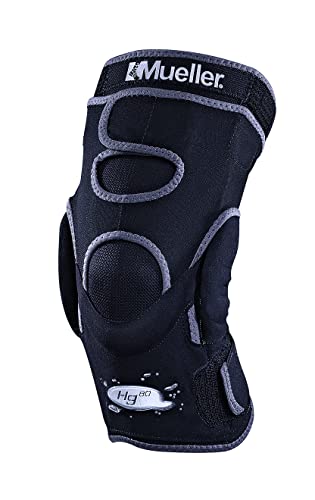
The Mueller Hg80 stands apart with its triaxial hinge system—three interconnected pivot points that more closely mimic the knee’s natural screw-home rotation than standard single-axis hinges. This design reduces hinge binding and skin pinching during walking and stair climbing, making it one of the most comfortable hinged braces for all-day wear. The HydraCinn fabric is soft against the skin and wicks sweat effectively, and at roughly one-third the weight of some clinical-grade rivals, it’s easy to forget you’re wearing it.
Physical therapists have described this brace as the best low-end hinged option they’ve used, noting that it reduced walking pain by roughly 80% in acute meniscus and LCL strain cases. The brace must be slipped over the foot, which creates a sizing barrier for users with large calves—the XL opening is tight for a 17.5-inch calf circumference. Mueller now offers a 2XL, but sizing up may compromise thigh fit.
After two years of daily use, the fabric stretches slightly, but a wash cycle restores most of the original snugness. The hinges can develop a squeak over time, and they are removable—though reinserting them is fiddly. This brace prioritizes mediolateral support and hyperextension prevention over full ROM restriction, so it’s best suited for grade-1 LCL sprains or as a prophylactic brace during sport.
Why it’s great
- Triaxial hinge tracks the knee’s natural rotation
- Lightweight, breathable, and concealable under pants
- Proven track record for reducing pain during walking
Good to know
- Must slip over the foot; not suitable for large calves (over 17.5″)
- Hinges can develop audible squeaks over time
- No patella pressure pad; pair with a compression sleeve for additional support
3. T TIMTAKBO Hinged Knee Brace
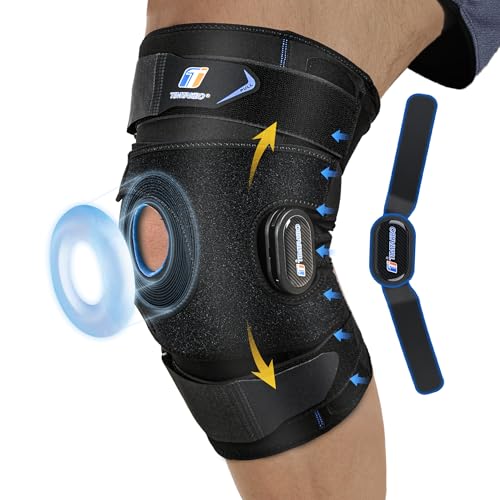
T TIMTAKBO positions itself as a versatile mid-range option by combining a pull-on compression sleeve with six adjustable Velcro straps for customized tension. The 1/8-inch thick alloy steel side stabilizers are hefty enough to resist lateral opening, and the open-patella design prevents pressure on the kneecap during bending. The fabric blend—polyester, nylon, and spandex with a 3D air-spacer layer—prioritizes breathability, and the silicone strips inside the sleeve grip the skin to reduce slippage.
Users with larger thighs and calves found the sizing accurate, and the initial compression is supportive without being restrictive. However, durability is a mixed report: several reviewers noted that the Velcro circle patches began unstitching after a few weeks, and the brace was unable to prevent knee buckling during walking in more severe instability cases. It works best for mild-to-moderate LCL strains where the primary need is compression and some lateral reassurance rather than rigid immobilization.
For price-conscious buyers who want hinged support without committing to a premium brace, this model offers good feature density. The slip-on design makes it easier to self-apply than wraparound braces, and the ability to remove the metal stabilizers lets you convert it into a lighter sports sleeve once the ligament has healed enough for activity without full protection.
Why it’s great
- 6 adjustable straps allow fine-tuned compression
- Breathable 3D air-spacer fabric reduces sweat buildup
- Removable stabilizers make it usable across recovery phases
Good to know
- Velcro patches may unstitch with regular use
- Not rigid enough to prevent knee buckling in grade-2/3 injuries
- Sizing chart requires careful thigh measurement 6 inches above knee center
4. Tairibousy Hinged Knee Brace with ROM Lock

The Tairibousy brace is engineered specifically for the post-surgery and structured rehab phase, where protecting the healing ligament from excessive motion is the top priority. The locking dials on both side stabilizers allow you to set the range of motion anywhere from full extension block (0°) up to 120° of flexion, giving clinicians and patients precise control over how much the knee can bend during early recovery. When set to around 30°, the brace effectively immobilizes the joint, eliminating the painful lateral opening that aggravates an LCL repair.
The Lycra fabric provides good elasticity and compression, and the open-patella and open-back design reduces heat buildup and patellar pressure. Users reported an accurate fit for a 23-inch thigh and 17-inch calf at size XL, though the brace requires a wraparound approach rather than slip-on—you place the metal stabilizers inside fabric pockets and fasten with Velcro. A few reviewers noted that the angle locking dial can slip if bumped against a hard surface, though the other side usually holds position.
For those who need a rigid immobilizer that can later transition into a less restrictive brace as healing progresses, the removable stabilizers provide a pathway. However, the wraparound assembly is more fiddly than pull-on designs, and some users with limited hand dexterity found it difficult to align the hinge pockets correctly on the first few tries.
Why it’s great
- Adjustable ROM dials from 0° to 120° for phased rehab
- Open patella and open back design reduces heat and pressure
- Lycra fabric provides 360° compression without slippage
Good to know
- Angle dial can slip if bumped during activity
- Wraparound hinge-pocket assembly is fiddly to set up
- Not designed for high-impact sports or dynamic movement
5. LP 758CA Knee Brace
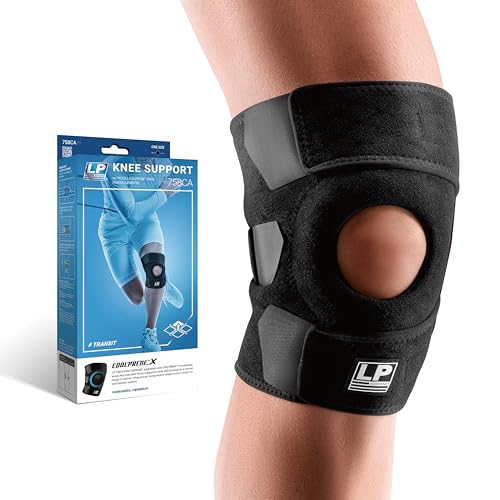
The LP 758CA is a compression sleeve with a patella pad and tendon strap, not a hinged brace. It lacks the bilateral metal stabilizers essential for resisting varus stress in true LCL injuries, but its elongated design reaches well up the thigh to provide muscle support and proprioceptive feedback. The CoolPrene X fabric features dynamic diamond grooves that create a massaging effect during movement while wicking moisture and heat, making it comfortable for gym use and mild ligament strain.
Users who wore this after badminton sessions reported that it eliminated next-day knee pain, though this effect is likely due to the compression and warmth encouraging blood flow rather than true mechanical stabilization. The one-size-fits-all approach is the weakest point—several customers found it too small for average jeans, with the middle strap barely reaching and the bottom strap sitting at an awkward angle. The absence of side stabilizers means it provides no protection against lateral opening.
For grade-1 LCL strains where the primary goal is proprioceptive awareness and mild compression, this is an affordable entry-level option. But for anyone with clinical LCL laxity or a desire to return to cutting sports, it lacks the fundamental structural feature (a rigid lateral hinge) that defines an effective brace for this specific injury pattern.
Why it’s great
- CoolPrene X fabric wicks moisture and stays cool
- Elongated thigh coverage supports surrounding muscles
- Lightweight and easy to pull on for the gym
Good to know
- No side stabilizers—insufficient for true LCL instability
- One-size-fits-all is too small for larger legs
- Not suitable for post-surgery or moderate-to-severe tears
FAQ
Can a sleeve-style brace provide enough support for an LCL injury?
What is the difference between LCL, MCL, and ACL braces?
How tight should an LCL brace feel during recovery?
Final Thoughts: The Verdict
For most users, the brace for lcl injury winner is the Shock Doctor 875 because its full-length bilateral hinges provide the lateral stability needed for active recovery, and the breathable four-way stretch fabric makes it tolerable for long wear. If you want all-day comfort with exceptional hinge tracking, grab the Mueller Hg80 for its triaxial pivot system that feels natural during walking. And for structured post-surgery rehab, nothing beats the Tairibousy Hinged Brace with its 0°–120° ROM locking dials that give you precise control over healing progression.

Mo Maruf
I created WellFizz to bridge the gap between vague wellness advice and actionable solutions. My mission is simple: to decode the research and give you practical tools you can actually use.
Beyond the data, I am a passionate traveler. I believe that stepping away from the screen to explore new environments is essential for mental clarity and physical vitality.